Are employees partly-owned brands?

Chris Brogan, whom I regard as a lead evangelist of social media, raises a great question: Are employees quietly becoming a “half-owned brands” of the company they work for?

Indeed, he’s referring to people like Robert (Fast Company) Scoble, and Charlene (Forrester) Li etc, who are known not for the company they work for (or leave) but for the ideas they represent.

His point needs to be looked at in the context of how organizations ought to hire, empower and work. They need not be looking for super novas but for those with star potential. Why? Because ultimately an organization’s ‘about us’ pages will be irrelevant. What matters will be not its ‘core competencies,’ ‘heritage’ or strategic business units, but its DNA made up of strands of these partly-owned brands.

I found some interesting examples.

  • Rahul Sood, is a brand that happens to work for HP. He is the Chief Technology Officer of HP’s gaming business, and his blog is linked from HP but exists outside of the enterprise. He doesn’t write mainly about his employer, but about his passion in the IT world of gaming and business, about Nintendo’s Wii and batteries.
  • Sun Microsystem’s bloggers may write about the products they represent, but three of them have more hits than the CEO Jonathan Schwatz’s well-known, well written blog.
  • Rohit Bhargava may ‘belong’ to WPP, being senior VP of Ogilvy 360 Digital Influence, but as a marketer, speaker and author he is a brand in his own right, a satellite that casts a nice glow on the mothership without needing to hype the WPP or Ogilvy brand.

I don’t know about you, but these partly-owned brands come across as a lot more authentic. I would rather do business with a Raul Sood, than some anonymous corporate voice at the other end of a toll free number.

Widgets used to attack Obama.

It’s getting a bit testy, and confusing with McCain and Obama both being accused of flip-flopping. One’s a ‘maverick’, the other an agent of ‘change,’ which gives them some leeway to operate within these positions.

But instead of McCain’s campaign attacking Obama on this alone, it is going after Obama on Iraq, and why he has not visited the country in years. So what more horrific way to sharpen the point of the arrow than attach a widget to it. The widget being a clock that keeps track of the days, hours, minutes, seconds. Ouch!

Clock counting days since Barack Obama\'s last visit to Iraq It’s not unlike the typical countdown clock you’ve seen before New Year’s eve. But by putting it on the web site –and encouraging others to copy and paste the code on their blogs etc. — it is raising the noise level of the ‘time’ aspect, forcing it into the debate and forcing Obama to respond. At the time of writing, the time is 909 days.

There is a second widget –counting days since McCain invited Obama to town hall meetings (the one he did not rsvp.)

Using widgets is not new to politics.

  • There are widgets like this one (left) that track contributions to congressional leaders.
  • Another one keeps tab of their fund raising.

Oh, there are pro-Obama widgets like this one, and one created by CBC News, for instance. But the use of an attack widget strikes me as a bold new move in politics. Speeches can be transcribed, but they lose their bite a few days later. A widget with a time component makes it very compelling, even if it highlights a point of difference that’s not quite relevant to the choice we have to make at the election.

Quotes for the week ending 5th July, 2008

“”We are all Hussein.”

New York Times, reporting on how people are adopting Barack Obama’s middle name to counter those who are using it in a negative way.

“Twitter is the public square. Lots of noise, little signal. Blogs are like a speech. Signal, but little noise.”

Fast Company article on the power of Twitter, highlighting Tweets from Robert Scoble’s Tweetstream.

“Google is the perfect example showing reputation does not correlate with ad spending,”

Robert Fronk, senior VP-senior consultant, reputation strategy, at Harris Interactive.

“In this election the internet is for the Democratic Party what talk radio was for the Republican Party in the last 15 years”

Derek LaVallee, VP-U.S. public affairs practice at Waggener Edstrom, on research showing digital media preference of 18-35 year olds.

“I’m not retiring until every American agrees with me.”

Rush Limbaugh, quoted in the New York Times, in a story on his $400 million contract with ClearChannel.

“Twebinar”

A mashup of a name for a webinar (which itself is a mashup) and conversations talking place via Twitter before, during and after a webinar, attributed to Chris Brogan.

“Police wnt u to fight crime w/txt msgs.”

Headline for a story in USA Today, about Louiville, Florida police opening a text messaging tip line for teens to report crime.

“Your Personal Brand may be doing much more harm than good… to others.”

Mitch Joel, on a cautionary note about how people in an organization embracing social media should not expect others to have the same passion for it.

Snail mail experiment, cute with a lesson

Three snails, traveling at a blazing speed of 0.03 miles per hour, deliver 14 electronic messages.

Yes, this is snail mail in the digital age. Oh, the irony. We take for granted that we could use the web to deliver snail mail to far corners of the earth that have no internet access. But this experiment delivers web-mail on the back of snails! Meaning, you could log onto the RealSnailProject website, and type in an email to someone, and the web server delivers your email to the snail fitted with a RFID chip. The ‘mail forwarding’ then takes place as the snail moves around and comes into contact with an RFID reader, which picks up your email and send it onward.

For the rest of us who suffer near-death experiences when there’s a Blackberry blackout, there’s a sobering takeaway about this slowed down delivery. It is part of ‘slow art’.

The three snails, in keeping with a MySpace era, have ‘profiles.’ What’s next, a snailcast?

Quotes for the week ending 28 June, 2008

Seth - Meatball Sundae - Godin at the IABC conference, NY, 2008

“We are entering an era of tribes. Every tribe needs a leader.”

Seth Godin, final keynote, at the IABC Conference, New York

“Most intranets look like two tin cans and a piece of string.”

Steve Crescenzo on Corporate Blogging, at the IABC Conference, New York

“I dream of 150,000 members”

Barbara Gibson, Incoming chair of IABC, at the IABC Conference, New York

“Journalists’ sensors are tingling.”

Doug Wotherspoon, on the dangers of ‘greenwashing,’ at the IABC Conference, New York

“We want transparency in business, but wonder why students are baring their whole lives on MySpace.”

John Deveney, on Building Credibility, at the IABC Conference, New York

“You have to be careful in your belief that you can have an influence.”

Carol Sapriel, on Crisis Management, at the IABC Conference, New York

These information panels tell a story

How do you organize information? Once you do that, what kind of story does it tell your audience?

I visited The New York Times‘ building yesterday to check out what’s they call the ‘Movable Type‘ display in the lobby. Couldn’t help noticing the new building since my hotel was just a few blocks from this modern steely landmark. (The stunt a few weeks ago gave me even more reason to visit, although the panels were the real draw.) It takes the old idea of lead-based movable type and interprets it for the digital world where type is on the move, in and out of people’s lives.

The fluorescent panels at the Times building are stunning in their simplicity, considering the complex technology behind them. They are constantly being updated with bits of information coursing through the veins of the news organization -snippets of letters to the editor, comments on blogs, obituaries, headlines, search queries, sports results, politics…

For the past few weeks I have been photographing information panels -the analog, the dynamic, the sombre, and the marketing kind. Below are some of them:

Penn Station, New York

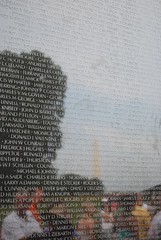
The first is at Penn Station, NY, the second is from the Apple store on 5th Avenue, and the third is a section of the panels at The New York Times. Or take this fourth panel, made of granite. It is one section of the highly charged 246-foot Vietnam Memorial in Washington, DC.

It is not just a list of fallen soldiers. The names are organized according to the day they lost their lives, with a legend next to each name so that a family member, or someone who served at that time could get a broader story.

The design of the wall itself is rich in meaning. It’s impossible to not be moved when you look at each name and read into it your own version of the story. If you look close, you’ll notice the panel reflects the Washington Memorial.

Quotes for the week ending 21 June, 2008

“It’s a push back from the sound-bite culture.”

Lee Rainie, director of the Pew group, on recent findings that 30% of Americans use the web to get more of the story that the media slice up.

“We have a steady, relentless snack-food diet of facts and ‘news briefs’ driven by the mistaken perception that fast is best and better in an RSS alert-enabled world. Unfortunately, with news happenings in constant motion, we never “have time” to “go back” and provide a deeper look for our news consumers.”

Linda Zimmer, on the blog Business Communicators in Second Life.

“A radical suggestion for the Social Media Release: don’t put any Social Media Releases out over the wires.”

Todd Defren, recommending people publish a regular press release on the wires, with a link in it to the Social Media version.

“They’ll get half of it right. We’ll push them to getting all of it right.”

Michael Tippett, co-founder of Now Public, on how bloggers are being trained in Journalism by the Society of Professional Journalists.

“The reality is that they’re tiptoeing in the gray zone between open and traditional media.”

Andrew Keen, commenting on Encyclopedia’s move to expand it’s ‘community of experts.’

“Nope. No fine print here my dear sirs and madams. HONEST. Everything that’s currently free is still free.”

Mike Curtis, on Jing’s blog, about the relationship -and business model– of Screencast and Jing by parent company Techsmith

“it’s a big red flag that the AP is now waving in the blogosphere.”

Neville Hobson, on the Associate Press’ pay-as-you-quote system

Taking risks with popcorn popping cellphone video

“Why would the internet lie?” says someone at the end of a failed attempt to ‘test’ if cellphones could produce enough energy to pop corn kernels.

They were responding to the hilarious video on YouTube that has all the hallmarks of being authentic –poor resolution, shaky camera. The unspoken hypothesis: cell phones could have the same effect as a microwave. And you hold it close to your head?

Not just hilarious, but a wicked -un-marketing speak for strategic- way to send a message without actually issuing a press release that cell phones may fry your brain. Not just wicked, but viral.

Some feel cheated. Some suggest it is sneaky “murketing.” Whaddya expect? This was on YouTube, not the Discovery Channel! “We knew they were fake, the only mysteries were the “how?” and the “why?”” said WIRED’s Charlie Sorrell -who later confirmed that the folks behind the fake popcorn were from By Cardo Systems, maker of bluetooth headsets for motorcycle riders.

So what does this tell us about marketing?

1. Viral marketing doesn’t follow the rules. Does the fact that it is a hoax (disproving the preposterous idea that cell phones are lethal microwaves) take away from the need for Cardo’s products? In the old brand world, the answer would have been yes, so please kill the idea. In a few days, by ignoring these rules Cardo will have the kind of word of mouth advertising many brands would die for.

2. Viral marketing takes risks. Cardo probably knew enough about comparisons that have been made between a bluetooth frequency and cell phones frequency -both operate on the same range as microwave ovens. Bluetooth is just a weaker transmitter.

3. Viral marketing energizes others. People were very anxious to debunk it, but had to upload their videos about it! To borrow a point Charlene Li and Josh Bernoff advocate in their book, Groundswell, the new rules mean you need to ‘energize the groundswell.’

Quotes for the week ending 14 June, 2008

“Today, it has become an economic, environmental and brand liability for the company.”

Advertising Age’s jean Halliday, commenting on Hummer, and GM’s CEO Rick Wagoner suggesting the company may dump the brand.

“Scott McClellan is having a ‘Matrix’ moment.”

Mark Dery, who teaches journalism at NYU, on former White House press secretary’s book, and waking up for the dream made up of a media fiction.

“Prime time is still the right time.”

WIRED article on why broadcast ad sales are strong, in spite of the economic slump and other woes.

“Hi. My name is Steve and I suffer from Shiny Object Syndrome (SOS for short).”

Steve Rubel, on how to sift through shiny objects in social media sites such as FriendFeed, that he is bullish about.

This is more than a facelift.”

Facebook spokesperson, about the new, improved Facebook with added vitamins 🙂

“Britannica goes wiki without actually admitting it.”

One of the many (in my opinion mistaken) responses to the news of Encyclopedia Britannica shifting gears into a more collaborative model.

“One of the premier political journalists and analysts of his time.”

Tom Brokaw on NBC’s Tim Russert who died of a heart attack.

Britannica could reposition Wikipedia

The gap between the dusty reference book on your desk and the wiki you could pull up on your smart phone is being bridged as Encyclopedia Britannica appears poised to change the game.

I have been tracking wiki development for years, using wikis, and writing about them (here and more recently here), and always wondered why a third player hasn’t emerged. Wikipedia rules the roost, warts and all. It has lodged itself into the lexicon of knowledge. To “Wikipedia” something is to poke around and be somewhat informed. Other encyclopedias have not engaged us as much.

If a third player IS emerging, it’s from within the bowels of Encyclopedia Britannica. Many have been quick to suggest that Britannica is biting the bullet and going all wiki. I think this is too simplistic. Maybe Britannica is responding to pressure and facing up to the reality that on-demand knowledge has to be more collaborative and accessible. But they seem to be moving in new directions, too.

Let’s take Collaboration. Britannica is making a very interesting point of differentiation, because it forces people to look at the back room edit wars that go on in Wikipedia (that Wikipedia calls a ‘breach of wikiquette’) as confrontation, not collaboration. Britannica plans to put contributors in touch with its ‘community of scholars’ and still allow individuals to retain control of their work.

Access. As far as following Wikipedia’s open source model, access isn’t the only value up for grabs–it’s accuracy. Britannica puts it this way:

Encyclopaedia Britannica itself will continue to be edited according to the most rigorous standards and will bear the imprimatur “Britannica Checked” to distinguish it from material on the site for which Britannica editors are not responsible.

Trust. This week I interviewed Tom Panelas, Encyclopedia Britannica’s director of corporate communications for an upcoming article, and he stresses the value of “editorial stewardship.” While reaching out to a wider audience it will not compromise on trust.

The battle over knowledge platforms has always been bitter and not so easy to predict. Think of how Google dethroned Yahoo, and Intranets are being made obsolete by internal blogs. How we access these knowledge repositories could determine how much we value accuracy and trust. Done right and delivered right Britannica could quickly reposition Wikipedia.