“Rumor” about Jobs, a symptom of things to come

Steve Jobs brushed it off with a slide. He used the Mark Twain line to note that the rumor of his death had been greatly exaggerated.

The rumor, was not a rumor but a publishing mistake –going live with a story that should have been behind a firewall. Bloomberg is not the first to make this new-media error.

The copy had the usual safeguards: “HOLD FOR RELEASE – DO NOT USE – HOLD FOR RELEASE – DO NOT USE.” There were placeholders such as “IF STOCK DROPS” leading into a sentence “…The decline is no surprise to investors…” All good intentioned.

But in the rush to do things to meet unforgiving deadlines, to hit the newsstands, and sate the digital newsfeeds, publishing must take these risks. Are we moving too fast, where we might accidentally push the button that could affect the stock price of a company?

Rumors –especially the online kind– are nothing new. United Airlines’ stock was a victim of a rumor just this week, while Yahoo! (temporarily) benefitted from the Microsoft takeover rumor that turned out to be more than a rumor.

Rumor is being slipped into the PR toolbox because it goes well with viral. Recently, there was one about the –ready for this?- Apple Nano iPhone. If you replace “rumor” with “forecast” a lot of this might make sense. The Nano iPhone story was based on a “forecast” using “unnamed sources in the supply channel.”

As we accelerate our marketing, our PR and how we generate news about organizations we represent, news, forecasting and speculating could begin to blur.

Dan Lyons, who once created the now-retired Fake Steve blog, didn’t mince his words describing Gawker, which republished the Bloomberg gaffe as “filthy hacks,” ending also with “Great work, Bloomberg. You dopes.”

Quotes for the week ending 6 September, 2008

“Most people know the staff at the local Starbucks better than McCain knows Palin”

David Mark and Fred Barbash, of Politico, about John McCain’s Vice Presidential pick.

“It won’t work. This is a nation that elected men with such middle names as Gamaliel, Milhous and Rudolph. This also is the home of Elvis, Madonna, Oprah and Rush. We love unusual names.”

David Walters, at the Washington Post, commenting on Ann Coulter’s attempt to make Barack Obama look dangerous by calling him B. Husein Obama.

“Apparently tweeting, friending and linking have not infiltrated popular culture as much as one might think.”

Tanya Irwin, of Online Media Daily, commenting on a global study by Synovate that found that 58% of people aren’t familiar with social networking.

“You actually spend more time in your browser than you do in your car.”

Brian Rakowski, a Google group product manager, commenting on its new browser, Chrome.

“fashion is no longer a rich man’s privilege”.

Priya Tanna, editor of Vogue India, who draped flashy fashion accessories on ordinary Indians for a photo shoot for the August issue, responding to New York Times, which criticized the effort.

“Standing on that stage, I saw past the balloons, confetti and cheers. I was left with a singular image. One of a man who will take his improbable journey and draw from it at every turn to change our country and our world for the better.”

Meghan McCain, daughter of John McCain, on her blog that chronicles the presidential campaign from the inside.


Community uses social media to prepare for Gustav

As the hurricane heads toward New Orleans and mandatory evacuation orders were made, there’s plenty of emergency news and help coming through on social media channels.

Craig Newmark posed a question as to how his site, Cragslist, might help, noting now users are taking over and  ‘repurposing’ the New Orleans portion of the Craigslist site.

“Is something happening now I’m missing?” he asked?

The site looks like it is shaping up to be a bulletin board and clearing house of helpful information. One person posted this offer for accommodation for the displaced, today, even adding a phone number:

“WANT TO HELP A FAMILY or persons needing a SAFE PLACE DURING GUSTAV. WILMINGTON, NC been through hurricane andrew – Have spare bedroom / bath king size bed. Pet ok too. call my toll free # 1-877-269-2784.”

Another offered shelter in New Hampsire.

On Twitter, there’s a feed called NOLANews those in the area can subscribe to., with lots of tips and links for truckers, and others fleeing the city. CNN’s Twitter posts also carry good breaking news

Quotes for the week ending 23 August, 2008

“I don’t need to answer that. You guys know that answer. I am the best.”

Usain Bolt, on being asked who was the greatest sprinter in history, after winning his second gold at the Beijing Games.

“You Facebook / Twitter people are a bunch of losers. Who cares how many “friends” anyone has on Facebook”

Someone going by the name Fred, commenting on the Sports Illustrated story about Michael Phelps having one million Facebook “Friends.”

“The teeny bikinis that pass for uniforms tend to overshadow the nature and soul of the athletes inside. Without those uniforms, though, will would anyone be paying attention?”

Dan Bickley, on beach volleyball at the Beijing Games, filing one of his brilliant reports for The Arizona Republic.

“Wikis are troughing”

Tech Crunch, commenting on the Gartner chart that shows the peaks and troughs technologies go through in a hype-cycle.

“This is not a copy of a PC on TV.”

Intel’s Eric Kim, on the ‘Widget Channel’ that will allow TV users check more information on TV and share it with others from the TV set.

Will crowdsourcing take off with Photosynth?

As an amateur photographer I have been watching this Microsoft ‘lab’ project, talking it up since last year in fact, as an example of where crowdsourcing and visual communication could be headed.

Glad to note that it’s now open to us, the hoi polloi. You will need two small plug-ins for the site to work, and adhere to a code of conduct that includes abiding by intellectual property and privacy laws.

I can see how global and local events could be seen and reported.

OlympicSynth: Imagine if Photsynth pulled all the tens of thousands of images from amateurs and Pro-Ams at the 2008 Beijing Games via Flickr and Picasa. We would get a whole new perspective and in-depth look at events such as the disqualification of an athlete for stepping over the line, the tie breaker at a gymnastics final, the Free Tibet protests, the opening ceremony etc.

ReuterSynth: Could news organizations such as local TV stations and newspapers, even global ones such as the AP and the BBC create their own synths and let communities contribute to stories? Not a stretch since some of them are taking contributions from citizen journalists.

Internal CommsSynth: Organizations could let employees feed their intranets through Photosynth widgets to participate in company events.

iPhoneSynth: The widget for an iPhone plugin is just begging to happen, considering how iPhone / iPod users are sharing pictures anyway. Camera phones and digital cameras are waiting to be knitted together.

SecuritySynths. The FBI and SIS could easily pull together real-time synths of cities and buildings, subway systems etc when something on the scale of the London bombings occurs. If you the detail of people and architectural features possible on Photosynth demos (it can capture anything from a logo on a T-shirt to a pack of cigarettes in a piazza) it makes the controversial Google Street View maps quite tame.

Dell’s Nomads grab rich marketing space

There’s a Digital Nomad in all of us.

The term came into currency with the book, and soon independent consultants were ditching their desks and cubes finding it convenient to work from “wherever.” Gas prices have been accelerating this trend too, with nomadic workers telecommuting a few days of the week or using Starbucks as their home office.

So Dell‘s move to own the term, albeit a bit late, is extremely smart. I see DigitalNomads.com as a business strategy to capture the mobile space that will ultimately be crowded by not just laptops, Blackberries, and iPhones, but by all the hybrid forms of connectivity we will adopt. Especially when ubiquitous computing gives way to invisible computing.

Not only does the web site connect people with a nomadic lifestyle, but it promotes a slew of connectivity tools and social groups. From Jott (one of my huge favorites) and Adobe Air to LinkedIn and Skype. It’s turning out to be a good place for discussion of the trend.

  • Shel Holtz, the archetypal digital nomad had added a lot more tools to the list.
  • Clint O’Connor considers the need for clear policies of freedom and security when an organization embraces ‘digital nomadity.’
  • Matt Jenson suggests that the term –and the role– of ‘Boss’ will give way to the role of the semi-authority figure, the ‘Mentor.’

Image is everything. Beijing we don’t have a problem

So easy to criticize lip-syncing, now that the news is out that Lin Miaoke (the girl on the right) who ‘sang’ at the opening ceremony, didn’t. She was simply mouthing the words from Yang Peiyi (left).

“The reason why little Yang was not chosen to appear was because we wanted to project the right image, we were thinking about what was best for the nation,” the music designer Chen Qigang has observed.

I understand the transparency/ethics brouhaha. But when we get to this level of production, since this is ‘theater’ after all, what’s real and what’s fake? Wasn’t most of what happened on the massive stage an analog-to-digital suspension of disbelief?

Before you rant about the fakeness of it all (al la Milli Vanilli) consider too that the pyrotechnic creation of  29 footsteps leading up to the opening event was –for want of a better word, and I don’t mean this badly– fabricated using CGI for the billions of TV viewers. It was part real, part fake.  No different from how special effects around major events are staged, pre-made, and whatever Thesaurus word you can find to fit.

It’s all about the right image, whether we call it advertising, marketing or an opening ceremony. So give Beijing a break.

Mojave Experiment: marketing not science

I don’t use Vista, the Microsoft operating system. But I have heard mixed feelings about it: It’s classy, or it’s like adding a piranha to your gold fish bowl. Vista has a huge perception problem; maybe we humans are just fickle; maybe there’s a marketing or PR fix to tell the Vista story better.

Maybe.

But if the Mojave Experiment is part of that attempt, you wonder what kind of mad science teacher is sitting next to the PR wizard in the perception adjustment department.

The set up: 22 Hidden cameras; ordinary people who have heard bad things about Microsoft Vista, and would never ever try it.

The experiment: This happens off camera, so we see no more than a before and after series of short video clips

The outcome: People who thought they were using a “new” operating system called “Mojave” having seen the software box and tried it in the ‘lab’ loved it, loved it, loved it, loved it.

The microsite looks like a fun experiment from a marketing angle. A panel of clickable videos that give you a feeling you are watching the participants as you would from behind the one-sided glass in a focus group.

But it’s easy to see that these are edited clips. We don’t see the whole reaction. This is not a lab experiment but a video shoot in search of footage that could be used for other purposes. I would have liked to see the guinea pigs use the OS, watch them struggle with the set up, and (assuming these are not all IT folk) do things like install print drivers, set up a wireless network, download web apps etc to suggest they/we do in real life.

If the Mojave Experiment is an exercise in attitude adjustment, we need to see less of the (reality) TV and more of the transparency. I like to know:

  • Who are these people in the experiment?
  • What do they say now –outside the lab?
  • Are some of them blogging about it? Could they be quizzed by us?
  • What percent of them are upgrading from Microsoft XP to Vista in their homes?

Finally, what is the outcome? I guess there will be more Mojave experiments. Give me some Mojave results.

Pandemic flu hits blogosphere

I’ve been tracking how the pandemic flu is being covered over the past few months, and notice a spike in interest across many cities, scary media stories, a military-styled exercise. The blogosphere has suddenly become engaged in this.

Blogging a pandemic I. SDHD PanFlu BlogEx, a blog by the Southeastern District Health Department in Pocatello, Idaho is nothing to sneeze at. It is using a blog format to ‘report’ an outbreak within a two-week period using news-like headlines, fact-filled blog posts, videos and and links to external agencies. I like the fact that comments are open to the public. Every carries this disclaimer in red: “This is an exercise. It is not real.”

Unlike most What-If exercises (considered table-top exercises by the Dept. of Homeland Security) a global event like this cannot be contained by governments and medical professionals. There is a huge public component, not to mention a media component. Information will spread fast through whatever channels are available and it is not a stretch to assume that the blogosphere will upstage the traditional media in the same way it did during recent crises, such as the London bombings and the Asian tsunami. People will upload videos from their phones. Paramedics will provide advice via home made videos published on Youtube. Citizen journalists will break stories from far flung places before Newsweek or Catie Couric even get there –if flights to affected areas will even be possible. This format with potential for greater collaboration and dissemination is truly worth exploring.

Blogging a pandemic II: One Michael Coston, a paramedic, maintains a blog called Avian-Flu diary. He’s onto something, being a sort of a paramedic-meets CitJo.

On similar lines, the Kaiser Network is hosting a web conference called “The Health Blogosphere: What It Means for Policy Debates and Journalism” today at 1 p.m. Eastern time.

ASU fired the first shot? I like to think we had a head start on some of these. Our ‘hybrid’ Pandemic Flu exercise at ASU’s Decision Theater in April this year took the table-top model in a new direction, using the collaboration tools of the Theater with rich media inputs, and scenarios.

What a magazine’s colophon tells you

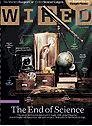
WIRED

If you are in any way involved in writing –and who isn’t?– and you have not thumbed through a copy of Wired, stop reading blogs, and get thee to a book store. The online version of the magazine will not suffice, either.

Why? The very act of turning the page, absorbing the impact of the typography, and juxtaposition of content will teach you something. The contents page looks different every time, the photo-illustrations are quirky, risque, challenging; the sections (like Artifacts from the future) and color really push the boundaries of print. And as for audience engagement, try putting it down after two minutes. I dare you!

Wired also does a few neat things you won’t see in many other publications:

  • Place cryptic words or phrases next to the publication date on the cover that relate to the cover story. July 2006 featured the letters ‘TMI’ because the story was about data. March ’08 was ‘Nothing is sacred.’ For the April ’08 cover story, Evil Genius, it was “original Sin.’ The story was about Apple.
  • Use photo illustrations that are basically articles condensed into illustrated stories and maps –a different way to tell a story.
  • Use a colophon. A what? Somewhere at the back of the book is a column set in all caps titled ‘Colophon.’ It’s one of those obscure words that derive from a much earlier print industry -tablets and manuscripts. It describes odd little details about the making of that issue including the blood sweat and bloody mary’s involved.

I’ve been reading Wired for about ten years now. It’s one of those pubs you know will not go away no matter where digital content is moving into, despite the dire predictions of the ‘Print is toast‘ crowd. Why? Because they pay attention to excruciating details.