True story: Recently I took a small group of students to visit a lab, and while breaking for lunch on some garden benches, they began climbing the trees nearby. They were getting a bit noisy when a lady walking by stopped and looked up into the branches. I thought I would get asked to get them to ‘behave’. But the lady smiled and said loudly to others passing by, “Look! look! children are playing on trees again!”
It took me a few seconds to figure out what she was really saying – that having seen so many kids today plugged into screens, it’s thrilling to see them having fun scampering up trees. (Side note: this was outside a Mars Space lab in Tempe, Arizona, and we were on a field trip to see a whole lot of technology!)

Drawing from : 7th period: Feed a Fish Wikispaces page Click on image to visit this class project page
I keep this in mind when I introduce students to new technologies. Last week, I began a lesson on animation, and as subject matter, I returned to the ‘Rube Goldberg Machine.’ We don’t always need screens for this. (Unless we need to check out the many Rube Goldberg contests like this.). How could we turn students into makers, and innovators, problem-solvers and scientific thinkers?
A Rube Goldberg Machine (or ‘contraption‘) teaches us a lot about levers, gravity, kinetic energy, and chain reactions among other things – such as precision, iterative design, and learning from failure. All it takes is some lengths of wood, string, paper cups, shoe boxes, old clothes hangers, marbles and/or ping-pong balls, rubber bands and cardboard tubes.
I like to get them to ‘design’ their machine first, and see what they come up with – then set them on a building mission! We could use a drawing app, but paper and pencil work just fine!
Image on right – One of the manyprojects from a 7th grade class – found here
 A few weeks back I applied to have them come out and run VR sessions, so –fingers crossed — I’m hoping my school gets picked.




 I tried to help a friend the other day transfer a video to an external drive, and oh the run-around his iPad gave us. No simple drag-and-drop worked – this from a company that practically invented drag-and-drop. We finally exported the file to Dropbox, logged into another PC (a Windows model), and downloaded the video to a thumb drive that was instantly recognizable on the computer.



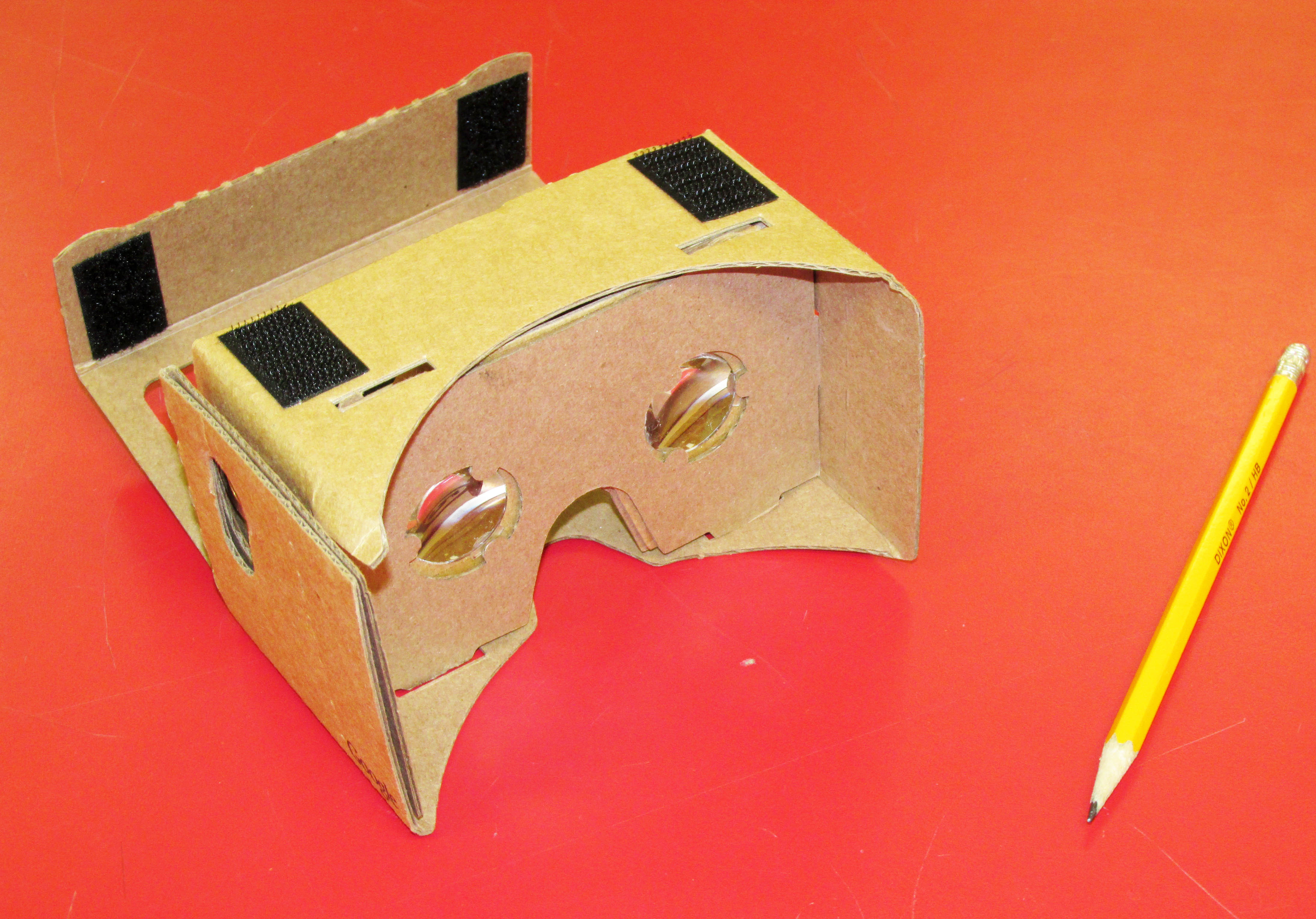
 As Derrick explained, this is another way to use Apps in education. Not just to stare at a screen but to ignore the screen (which disappears, the moment you put these goggles on) and engage and explore new worlds. We are not talking about fictitious virtual worlds, but uncharted territories whether it is at the bottom of the Grand Canyon, or to observe an eco-system in a rain forest.
 Hoipolloireport