Curtail pre-teen cellphone use. Please!

“It sucks to be Asian,” was one of the many comments teenagers left on the comments section of an article in Common Sense Media. Well?

Let me respond to this as an Asian person. It’s true that we fit the tough-love stereotype. It has worked in our family. We look at cellphones as a privilege –a luxury even. Certainly not a necessity.* I find it amusing that Common Sense Media, also features an article for parents titled, “What’s the best cell phone for kids?” and it begins to answer it by saying “Honestly, the best cell phone for kids is one they use responsibly and respectfully…” Which is a safe but highly irresponsible answer. The best cell phone for ‘kids’ is no phone at all, if by kids you mean children who can barely feed themselves, or do still use a booster seat.

To put it another way, pretending that very young children need a device to initiate phone calls “for emergency purposes” is a lie many parents tell themselves. We told our two children, right up to 7th grade that if they urgently needed to make a phone call to us, they should go to the school office. Or a teacher.

In my school, students cannot use a cell phone during school hours. No ifs, no buts. Many of my students ask me if they could call a parent from my desk phone when they forget their lunch, or sports clothes. Or need to stay late for a make-up assignment. I happily oblige.

We did not ‘invest’ in a phone just to be our children’s pacifier, or a way to spend idle time. We recognized early enough –long before the cellphones-and-mental health uproar– that giving a child a multi-media device was like force feeding a child with weed. Here, take this and stop throwing a tantrum!

We often hear of many parents making excuses for giving a child a phone (for ‘research’ purposes!) only to hear that the child is suddenly turned sullen, finds hard to make friends etc.

I get the ‘correlation’ vs ‘causation’ argument. This is another dodge. Society didn’t have to wait for the ‘data’ to prove that the correlation between nicotine and cancer had turned to causation, did we? Adults are afraid to admit that smart phones are harmful for fear they may be cast as Luddites, laggards or simply out of sync with the times. If you watch the Netflix documentary, The Social Dilemma, you will hear how the architects of the features that get young people hooked to smart phones, do not give their own children these devices. Here’s that trailer.

The Social Dilemma. Around 1 minute, you will hear from Sri Lankan born former Facebook exec, Chamath Palihapitiya whom I have featured on this blog before.

Knowing what we know that ‘dopamine feedback loops‘ are built into the apps children get addicted, the radicalization potential of many sites, the exposure to porn, and the effect of social media on social discourse, the smart phone is a loaded weapon.

Kids do not need a cell phone. Curtail their use of your device. Do not buy them a phone. Please!

*The cost of a phone is now approaching $1,500.

“One Nation Under CCTV,” waiting for the lame ducks to get back to work

Bansky, in 2008, made this simple provocative four-word statement at Westminster, London. The words, “One nation under CCTV” were painted on the side of a building. But what’s most interesting are the details.

By Banksy – One Nation Under CCTV, CC BY-SA 2.0, https://commons.wikimedia.org/w/index.php?curid=3890275

Take a closer look at this picture. The two people are painted in as part of the graffiti. (Including the dog next to the policeman.)

Odd question: Why is the cop photographing this act of ‘vandalism’? He looks as if he’s carefully framing it to to post it on social media.

Another odd question: Isn’t it funny that the policeman is also being ‘watched’ by the closed circuit camera on the wall of the building?

Cameras are so ubiquitous now we seldom notice they are there. We almost expect them to be there. Have we become desensitized to being watched? Recently the Los Angeles Police Department banned the use of facial recognition using an AI platform known as Clearview. The US Congress has been slow in enacting a law that puts some guardrails around facial recognition. It’s called the “National Biometric & Information Privacy Act of 2020’’ It stipulates that “A private entity may not collect, capture, purchase, receive through trade, or otherwise obtain a person’s or a customer’s biometric identifier” unless some conditions are met. Introduced on 3rd August this year, there seems to be no traction on this.*

Clearview AI has been investigated by the media, and lawmakers and found to be engaging into some dark data mining practices connected to facial recognition. The company declares on its website that it is “not a surveillance system.” Commissions in the Australia and the UK opened investigations into this in July.

Bansky, have you been asleep recently?

______________________________________________________________________________________________

* Interesting sidebar: The way to see progress of a bill in Congress is through a website, www.govtrack.us. (Yes it sounds like ‘government track us’!) In reality we can track them – so that, in this instance, they pass a law that doesn’t track us.

In the Internet graveyard: RSS, USENET, CompuServe and GeoCities

You have to be of a certain age to remember that geeky feature known as ‘RSS” and why it was supposed to change everything.* Or to have been on a USENET group or a BBS to know that there were ‘discussion boards’ before Twitter and Discord. I still remember creating a ‘homestead’ in GeoCities, which was a precursor to, Second Life. Second what? This was a ‘massively multiplayer’ virtual hangout in which businesses spent millions of dollars creating virtual storefronts, hosting virtual conferences etc. This was all part of a frenzy to colonize cyberspace, as if real estate was about to run out. This was when we breathlessly talked about the clash between the bricks and clicks.

IBM’s meeting room in SecondLife

I have to admit I too went in for a land grab with a domain I registered called Brand Buzz. I was nearly sued by a big name ad agency that claimed I was trespassing on their ‘land’ and for awhile stood my ground. (Long story; I featured this in my book Chat Republic.) As a tech columnist for Communication World magazine I remember attending virtual conferences in Second Life, and wondering where this bizarre game-like experience was taking us. Could we be chatting with each other as (through) pixelated avatars in the future? Thankfully not.

There was also a time when we had 56K modems, and needed a CD-ROM from American Online (Who remembers ‘ROM’s and AOL?). I bring these up because we are now being submerged in new terms and new technologies claiming to be defining the future of the Internet. I occasionally broach the subject in my class to give my students some context to the tech hype they are being exposed to, as we were then. Like 5G. Here’s what the Electronic Frontier Foundation, (a thinking person’s guide to anything with or without wires and apps) had to say of 5G:

Without a comprehensive plan for fiber infrastructure, 5G will not revolutionize Internet access or speeds for rural customers. So anytime the industry is asserting that 5G will revolutionize rural broadband access, they are more than just hyping it, they are just plainly misleading people. (“Enough of the 5G Hype 2019)

We’re still drowning in hype, aren’t we?

* RSS is dead. But the protocol that it was based on to provide ‘feeds’ lives on. Second Life is still on life support.

Drone surveillance in Sri Lanka raises deep ethical questions

Worth listening to Prof. Rohan Samarajiva break down the pros and the cons of drone use – and related sticky issues around big data, anonymization and machine learning this brings up.

This month, Sri Lanka’s army set up a drone regiment. Terms such as ‘organic aerial reconnaissance’ and disaster response are being used. But are we know with any technology, they come ‘locked’ with ethical and social dilemmas which go unnoticed.

This kind of deep discussion that professor Samarajiva brings, around whether citizens approve or recognize the privacy they forfeit for convenience, should be asked all the time. Otherwise, just as how the data mining companies are allowed to exploit us, a new technology could do the same until it’s way too late.

We love our machines – until we begin to see how they conspire against us.

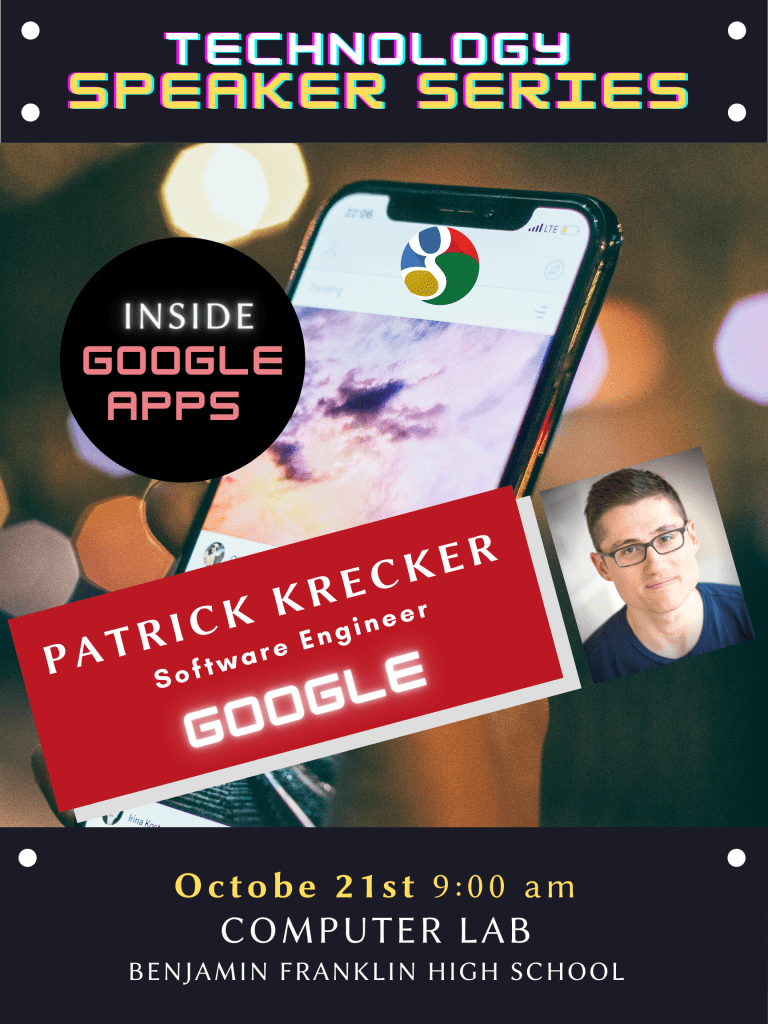
Googler speaks to my students

Patrick Krecker, a software engineer at Google spoke to my students last week. This was the start of a series of Technology Speakers this semester at Benjamin Franklin High School.

The goal is to give students a different way of seeing the relevance of a computer class. My hope is that speaking to someone in the real world, at a company they are acutely familiar with, could put many things in context. The previous week, we discussed search engines, and Sergey Brin and Larry Page’s early engine, curiously called Backrub! They also took a deep dive into Google’s Moonshot projects at GoogleX.

Hearing about the Google culture, its pioneering spirit, and the way a Google engineer approaches apps was really enlightening. Even for me. I used to work with Patrick at ASU. I was so impressed to see what he’s doing at one of the most powerful, omnipresent companies today.

Thanks, Patrick! I would certainly want to have to back on Google Meet (what else?) in the future!

Hacks that make you long for un-smart devices again!

Have you heard of the hack that could make your smart watch expose your ATM PIN? Of how a guy with a laptop could hack into a vehicle and turn off the engine on the highway?

This demo of a Jeep’s system being hacked was in 2015. Imagine what’s possible today!

There’s a reason I will never wear a smart watch. Or install a Nest thermostat. Or a Ring smart doorbell.

Indeed 2FA, or two-factor authentication can protect us. But this could mean cyber-security manager would be yet another task we take on in managing and maintaining our appliances, our wearable devices and our vehicles. You probably know that your TV is watching you, right?

Next week, my students are going to talk to a someone who works in cyber-security compliance at Microsoft. I showed them this Jeep-hack video to get them thinking. They got quite spooked! I don’t think they’re going to sleep well. It’s Halloween, too!

Why isn’t encryption used in voting?

One of the long, ridiculous exchanges in the presidential debates last night was on voter fraud, a perpetual conspiracy theory of president Trump. “This is going to be a fraud like you’ve never seen,” he said.

Courtesy, Noah Pederson -Unsplash.com

Whenever I see the word ‘fraud‘ in the same sentence as ‘ballots‘ I wonder why software companies haven’t stepped in to fix this.  With some of the best software companies addressing all kinds of threats, whether it’s banking or homeland security, why has ballot encryption been on the back burner?

It appears that the software solution has been in the make-up room, but has never made a grand appearance on stage. About a decade ago, there was a suggestion that we might have ballots that use invisible ink that ‘code’ a ballot as well.

 “…instead of filling in a bubble next to a candidate’s name, the voter uses a special pen that exposes a code printed inside the bubble in invisible ink. A voter can write down that code, along with the serial number of her ballot, to later verify the results online.” 

Larry Hardesty, MIT News Office

Encryption is all grown up now. There is a product, according to a recent WIRED article, called ‘STAR‘ developed out of an initiative in Travis County, Texas.  Benjamin Wofford’s article traces the path of the development, the ‘secure, transparent, auditable, and reliable encryption solution (hence the STAR acronym) of the software.

To summarize it, STAR converts a person’s vote at the voting machine into a ‘hash code‘ that could be printed out and taken, similar to how we leave a grocery store with a receipt of our transaction.  Voter impersonation with this system is very easily detected. The best part is, votes can go back and check or track if their vote has been cast and counted.

It’s about time. We have turned to encryption for everything from text messages and financial transactions. It’s time we encrypt the vote.


Planning a school podcast, 11 years later

I have been working on material for a podcast at school in the past few weeks. It’s an opportune time to do it, with so much to discuss in education, especially with millions of students rethinking ‘school’ in the middle of a pandemic.

Ever since I re-discovered my 2009 podcasts, I’ve felt pull to get out that microphone and fire up the recording app! The tools make it so much easier. Here are some ideas to start up:

Recording:

  • Audacity, open-source software is free to download. It’s also super intuitive –easy to use.
  • Hindenburg This is professional-grade software. More complex, but serious features!

Now for mics.

  • I have a trusty old mic that does look like it was from the nineties, and it is. Quality is great but not too much base.
  • I am experimenting with a lavelier (clip-on) mic we were  given for our distance learning video recordings. I found an adapter on Amazon, which plugs directly into a PC.
  • Zoom. I consider the ZoomH4N the best. I used to own one. It has a curious shape, but voice quality is terrific with 2 uni-directional mics

Intros/Outros

Unlike in 2009, there is plenty of podsafe –Copyright free–music available. But it is highly recommended you support the artists with a small contribution. Nothing should be free, in this economy!

Sal Khan’s take on tutoring, timely

Sal Khan’s latest project is called Schoolhouse World – basically a platform for tutoring.  This guy never rests, does he? The ideas is so much in tune with the times – to avert what he thinks is a catastrophe in the making, with distance learning models. With students wrestling with screen time, and feeling disengaged though they’ve never been so ‘connected.’

We’ve seen the rise of tutoring needs, the private kind as well as the need for one-to-one sessions. During my ‘Office Hours’ each week I get so many requests from parents about this. It’s really unfortunate. Many distance learning platforms are not designed for parents, but Mom and Dad have become the de facto tech support team in the home, while balancing a noisy, work-from-home lifestyle.

Into this mess of pottage comes Sal Khan’s idea.  Every parent of a child struggling with assignments would love it! Listen to this interview he gave Bloomberg’s by Emily Chang.

Or listen to Sal himself:

In 2009 we planned for an influenza pandemic. I was in the room. I recorded it in a podcast

I have heard the ridiculous ‘plandemic‘ theory,  including one about a virus outbreak appearing in an election year. Or, that the US didn’t see this coming.


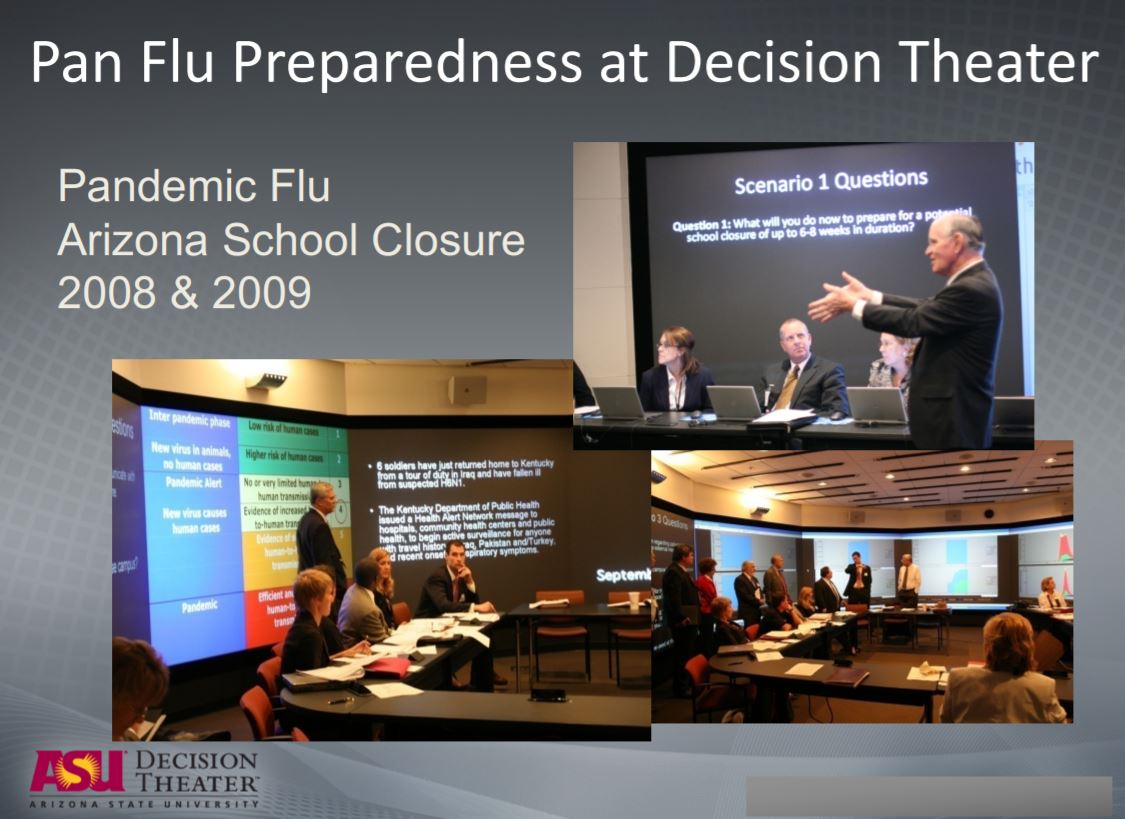
Well, in 2009, at ASU, I worked for an outfit that ran a 2-day pandemic planning exercise, with realistic scenarios. Elections were over. The participants were county health officials, school superintendents, infectious disease specialists.  People who would be called upon to make the tough calls, to safeguard populations, and schools.  Arizona State University’s WP Carey school of business was involved, as was the School of Health Policy and Management. But this was not what researchers typically call a ‘table-top exercise.’ This was a bit more realistic.

The location of this exercise was the Decision Theater – a visualization space that has a war room ambiance. (Fun fact: Decision Theater was used to movie as exactly that , where scientists wrestle with how to avert a catastrophe when an asteroid was heading to earth.)

Participants were presented with news reports, and data sets of unexpected scenarios: a virus entering the country through returning soldiers, outbreaks spreading to cities, and small towns, children infected etc. On the large screens in the Theater (also known as the ‘Drum’) our team created simulated news reports for each potential crisis point. The 2009 exercise, a follow up to the one in 2008,  was to be a test of how decisions would be made in an unfolding crisis.

Weeks before, our videographer, Dustin Hampton and I set up and recorded ‘news’ reporters, and edited story-lines that would track with the mathematical models that would be presented to the participants.  In one sense it was a fun exercise, even though the H1N1 Flu was a concern in some parts of the world.

I was in the room, and we were behind the scenes making the event look realistic. Cameras rolled, make-shift media were putting pressure on people to quarantine people, students, and shut down schools. I had not realized this but I had created two podcasts of the event, interviewing attendees.  They are a peek into the situation I describe.

This is not the only exercise of its kind that preempted the current pandemic. In May 2018 Johns Hopkins University ran a similar table-top exercise, that put people in a room to respond to realistic reports of a viral outbreak Watch the video below. It’s eerily similar. Even the date of the fictitious outbreak is so close, it shocked me when I watched it.

If you want more research into this, there’s a paper here: https://www.sciencedirect.com/science/article/abs/pii/S0167923612002680#!

Below, is another interview we did with Dr. Robert Pahle who worked on another piece of software for pandemic preparedness.

POD Throughput Model from Decision Theater Network on Vimeo.