Is surge of Signal, triggered by paranoia or cynicism?

Chat apps with encryption sound like an idea whose time has come. Or rather, an idea whose time came, did a quiet exit, and after some tangle with Twitter, did an U-turn and returned as ‘Signal’.

signalSignal has powerful encryption, and has supposedly grown by 400 percent since the US election. Indeed, most people are passionate about keeping their communication away from prying eyes of governments. Or is this paranoia, knowing what we know about email being easily hacked or compromised? Even Signal has been subpoenaed by the govt! No coincidence that journalists now use encrypted chat apps more than ever.

Which explains why Chat apps like WhatsApp, Line, SnapChat and FB Messenger have quietly changed how we communicate. Hike, the SnapChat clone in India lets users chat in eight languages!

To be sure, as I said (in the last chapter of my book, Chat Republic) ordinary citizens, not just journalists, who become wary of the status quo, would refine these modes of chat in ways that we never imagined. That was in 2013.

And we the ____________ people (insertcynical,’ ‘paranoid,’ etc) are probably taking that path too.
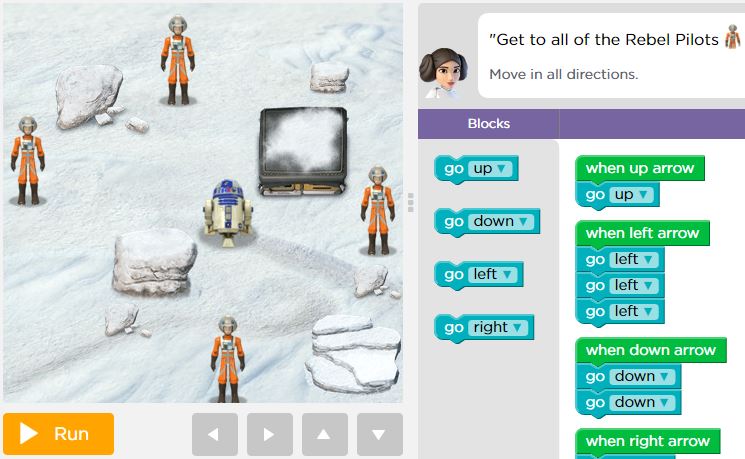
Planning for Star Wars class for ‘Hour of Code’ next week

I wish I had had the opportunity to learn JavaScript. But it’s never too late, since I can learn it while teaching some programming next week. You know, ‘He who teaches, learns twice‘ and all that!

hour-of-code-star-wars

I’m doing this because it is Computer Science Education Week from Dec 5 – 11 with a focus on the ‘Hour of Code‘. (It is also the week when I have to take my ‘Lab’ to the classrooms, while the computer lab is being used for NWEA evaluations.)

The ‘Hour of Code’ folk have added new tutorials featuring, Star Wars. Something my students are focusing on for an Image Manipulation class this week. It helps to have Kathleen Kennedy (seen in the video below), producer of The Force Awakens explain how programming is very much a part of movie production today.

Students will specifically learn to program a game in which BB8 must be sent on missions to recover objects and deliver messages.

In case you are interested, Hour of Code has several social media outlets, including

Twitter https://twitter.com/codeorg
Facebook https://www.facebook.com/Code.org
Instagram https://instagram.com/codeorg
Tumblr https://blog.code.org

Snowden movie’s ‘Whole kingdom, Snow White” line becomes real in UK

It’s hard to separate fact from drama in ‘Snowden.’

It’s not the typical Oliver Stone version of history (meaning ridden with conspiracy theories) for one reason: It deals with groups working in the shadows, conspiring if you will, to tap into networks.

I found the line by  interesting. When Edward Snowden (Joseph Gordon-Levitt) asks who is being surveilled, his friend (played by Zachary Quintino) tells him that the NSA tracks everyone and everything in “the whole kingdom, Snow White!”
While it is true that the whole planet is now under surveillance, it’s more true of the ‘Kingdom’ across the Atlantic. BBC reports that bulk data collections had been going on for the past 10 years. The new bill passed yesterday legalizes the UK’s global and domestic surveillance program, including collecting web and phone data of people for the past 12 months.

Oliver Stone’s screen writer must be laughing.


Please don’t ‘Like’ this post – read it

Look, you are free to not read this. I’m mainly concerned about people clicking on links or forwarding them, while not reading beyond the first two sentences.

If you got this far, Thanks!

I run into issues of young people not ‘seeing’ information in front of them, because their brains have become trained bypass information on a screen and look for images and videos. They are good ‘readers’ as the data shows. They borrow a lot of books, for sure. However they seem inattentive to information, even on beautifully laid out web pages.

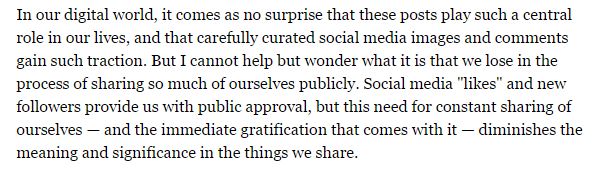
Does it have something to do with our newfound desire to share, reducing our appetite to absorb, and for conversations, as Emerson Csorba says. [“Online sharing and selfies erode the value of our private lives“]

nyt-quote_1


The article for the above quote is here at the New York Times article on Digital Connectedness. Worth a read.

If you got this far, I’m flattered. Thanks!

So how do students read in the digital era? Or rather, how is reading taught today to digital natives? Sadly, in many places, no differently from the pre-digital era. I read a long (warning: long!) article in Education Week, where reporter  says that “practitioners have few guidelines, and many are simply adapting their lessons as they see fit.” Those in literacy studies recommend that we adopt a simultaneous approach, teaching traditional and digital reading skills.

My gut feeling is we assume too much that seeing young people click on topics and pages. It makes us believe that they click, therefore the must be reading. The linear experience is being remodeled by a hyperlinked, non-linear experience even while we watch. Given the powerful desire to share instead of absorb, the non-linear experience may be not as great as advertised.

If you got THIS far, I would like to talk to you! 

(There is, intentionally, no picture in this post. What made you read on?)

Filtering the news for our kids

It gushes out of multiple channels, often without any context.

For young people, especially those under 10 years, what passes for news is almost toxic. Our challenge is to find ways to keep them ‘well informed’ and yet not overwhelmed.

And of course, there’s no wonder app for that. Even the ones that promise to filter the crud (so-called ‘news aggregators‘ like FlowReader, Flipboard etc) are often accomplices when it comes to ‘TMI,’ or To Much Information.

But wait, there was once an filter for this which we have put to pasture. We called it ‘conversations.’ The human 1.0 app that helped us sift through day-to-day details, layering over the minutia with ‘big picture’ ideas, and cross-referencing them with stories.

We re-framed topics too ugly to ponder and yet too important to ignore. Children posed questions, and found answers to them at the dinner table. We didn’t need to fact-check everything on the spot because…. yes, you guessed it: Our conversations were not hijacked by a smart device sitting next to the casserole dish.

So I like to pose the question to you readers: ‘How do you filter the news for your kids? Common Sense Media has a useful guide for different age groups of children.

Whether you’re a teacher of a parent, I like to know. How do you filter the fire hose?


Good riddance to election noise pollution!

When the party next door becomes too noisy, people sometimes call the cops. But there was very little we could do about the ‘Party’ noise machines we’ve been enduring for the past year or more.

Finally we can reclaim some peace, as the two-party cacophony comes to an end today. (I know what you’re thinking: Yeah right!)
If it was true that Trump’s Twitter account had been wrestled away from him, it won’t be long when he gets back on the air. But at least the media might have other matters to report on. Here’s what I’m dying not to hear about:

  • The word ‘surrogates‘ and any reference to people who echo the party line.
  • Pundits. Those folks to ‘weigh in’ on every gesture or turn of phrase.
  • The phrase ‘social media lit up with…” as a preamble to a political story with no substance.
  • Sloppy, Madison Avenue-like phrases such as ‘Draining the Swamp’ and slogans such as ‘Feeling the Bern.’

Not that vacuous campaign slogans are anything new. In 1944, Thomas Dewey’s slogan was (get ready for this) “Dewey or Die.” And there was the 1980’s slogan “Let’s Make America Great Again” which was recycled (or was it ‘plagiarized’?) this season.

How the Internet is working against us, but no-one seems to care

Plenty of studies, and many critical thinkers have weighed in on how the Internet, once heralded as a gift to society, is not exactly working in our broader interests.

It’s settled then: There won’t be an oxymoron in the White House

For all the debate prep, no one could have contained Donald Trump as he hurtled toward the precipice, sliding on the rocks of loose talk. In the end, despite fancy slogans, websites, and stage props, something as basic as good communication skills makes or breaks a leader.

A free, seemingly easy-to-master, tool should be handed to someone of Donald Trump’s personality with a warning: “May cause user to implode.” Just like Twitter, a microphone could also be a dangerous tool. Indeed, many before him have been dispensed into the heap of disgraced leaders and also-rans because of a hot mic, or a video capture, or even a spool of tape.

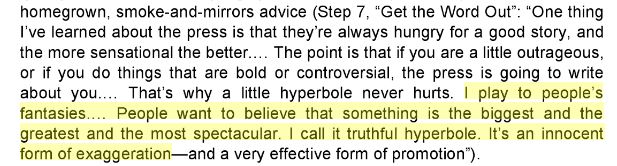
Another interesting thing about Trump was his penchant for ‘truthful hyperbole’ – a term he used in his book, The Art of the Deal, which, to be fair was ghost-written.

quote

But as is evident now, truthful hyperbole, a classic oxymoron, is the long fuse that led him to where he is, an outcast of the party he represents.

Citizens vote for leaders who articulate their hopes and needs. Thankfully voting for an oxymoron was not an option.

Footnote worth listening to: Nixon’s tape archive recording where he and his staff discuss ”lying to a base.’

Multi-tasking could reduce performance. But how to turn back the clock?

What would you say about findings that say multi-tasking affects ‘memory creation?’

After all, we email and text while writing reports or watching a movie, don’t we? I just read a 2016 report by Common Sense Media that looked at recent literature of Technology Addiction. here are some alarming findings. Some are red flags, needing more research.

Here are just a few:

  • Media Multi-tasking creates cognitive fatigue, and makes it more difficult for someone to create memories that can be accurately retrieved.
  • Heavy multi-taskers have a harder time filtering out irrelevant information (2009 study of college students)
  • Students who multi-tasked using a laptop during a lecture performed worse on a test, compared to students who were not using a laptop. (2013 study of college students)
  • US ‘Tweens’ (8- to 12-year-olds) spend 5:55 hours outside of school and homework using media. Teens spend 8:56 hours (2015 survey)

The reference to media in media multi-tasking, refers to both digital and non-digital media: TV, video games,social media, using the Internet, reading, and listening to music.

What do we do about these findings? Many parents do not need research to tell them that they (and their kids) must cut back. I have met parents who have taken steps such as not have more than one device in the home, and those who have a ‘digital curfew’ after, say 8:00 pm. There are even those who do not allow mobile devices and tablets in children’s bedrooms – similar to the earlier trend of not having a TV in bedroom.

I teach computers and technology, making it a curious place to discuss this. I often require students to use paper and pencil, even though they come to my Lab to learn about such things as audio recordings (on a cloud-based digital console), QR codes, and search strategies. I often get asked if listening to music while working is OK (they know the answer but think it’s worth a shot!).

Could we turn back the clock, and get back to mono-tasking?

Online textbooks could be fun (or completely annoying)

You’d think I would applaud the trend to digitize textbooks. After all, I’ve winced at the sticker shock of trying to busy a book for a college level class.

But the other day my daughter explained how ‘lame’ it was to have to jump through multiple hoops online just to get to a few pages she had to read for a class. The time spent would have been better spent elsewhere, she said. I had to agree. Sometimes to make things more ‘convenient’ and deliver them in a digital skin, we hide them in confounding folders, hidden behind firewalls that even the Russians my have trouble getting to.

The goal of reading is help students discover ideas and find meaning. Not to be able to check a box on a progress report. Books made from pulp have been a ‘technology’ many want to disrupt. The Nook and the Kindle made a few inroads, but could go only so far. We humans still crave the feel of paper, the tactile experience derived from objects that convey meaning.

I just ordered a book on Amazon. Indeed I read the reviews in the digital realm, but did not buy the Kindle version. Don’t get me wrong. I love reading material on the Kindle app. Just not books anymore.

If you like to read more about The Reading Brain, there’s an excellent Scientific American article which explains how paper sometimes triggers brain circuitry in a way that screens cannot.