“Get clicking, pointing, editing and mixing”

At the risk of creating promoting a stereotype, I have to say this. A monarch is not someone we associate with being an advocate and user of social media. Queen Rania of Jordan, the wife of King Abdullah, loves smashing that stereotype, among others. (It runs in the family. Her husband has appeared on Star Trek).

Her web site begins with the line “A journey of a thousand miles can begin with a single click” and contains phrases like “join the conversation” so you you know where she stands on new media.

It therefore comes as no surprise that Queen Rania has her YouTube channel, where she tackles issues such as … breaking stereotypes. In this video, she not only speaks out about stereotypes (I like the way she takes on the stupid Michele Malkin comment about the scarf, in passing) but urges people to “get clicking, pointing, editing and mixing” to join her in this mission.

Just for the record, Queen Elizabeth does have a YouTube channnel, but doesn’t use it the same way.

Farewell, Randy Pausch

Randy Pausch never met a brick wall he didn’t like. The Carnegie Mellon professor of computer science who inspired his audience -and in this digital age, millions of those who listened to him and watched him and followed his blog — died yesterday.

Pausch came to be known as a fearless fighter against pancreatic cancer. His ‘Last Lecture‘ delivered 10 months ago is now in the public domain. It became a best seller, and is being translated into Chinese. He once said the lecture was never meant for the public.

Pausch however went ‘public’ with his blog about his fight with what he knew was a terminal illness, and was constantly upbeat (“I’ve still got gas in the tank”) about his condition:

“I’m recovering much faster this time from the congestive heart failure (practice makes perfect, I guess). I’m still hideously fatigued, but today I was out of bed most of the day.”

He used it to communicate his ongoing story with his wider audience, commenting on things like a great design of a prescription medicine bottle, the death of Dith Pran (who also succomed to pancreatic cancer) and the media frenzy around his book.

Diane Sawyer is running a special tomorrow (Wednesday) night at 10pm on ABC. People who know what I’m really like will doubtless be throwing tomatoes at the screen ; -)

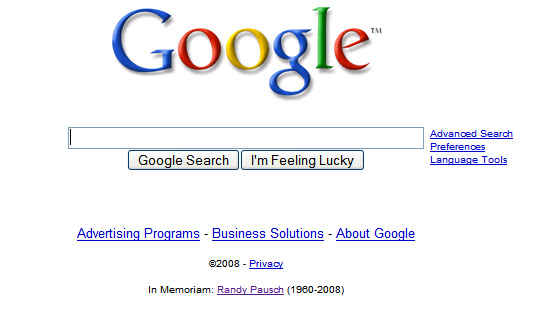
Yesterday, when the sad news came, Google did something it probably has not done for anyone before. It ran a small line under its usually clean search page with In Memoriam: Randy Pausch [1960 -2008], linking to the YouTube video of Last Lecture that’s been viewed over 3.9 million times.

The brick wall reference is from a metaphor he often used about the importance of facing an unsurmountable problem, and what it teaches us.

Quotes for the week ending 26 July, 2008

“Randy died this morning of complications from pancreatic cancer.”

Posting on Randy Pausch’s web site, on Friday 25 July announcing the sad news of the American professor of computer science known for his “The Last Lecture,” that became a New York Times best seller.

“I get that many consumers of online-transmitted information don’t like print much anymore…What I don’t get is why those Republic readers who haven’t sworn off computers altogether would simply ignore the logical digital complement to their dirt of print-based information.”

Paul Maryniak, General Manager of The Mesa Republic, inviting print readers to make better use of the Arizona Republic web site.

“To the average flier, this isn’t a case of the boy who cried wolf; It’s a case of the wolf who cried wolf.”

Editorial in Advertising Age about the disingenuous attack by the CEOs of 12 airlines asking their passengers to support them in their fight against oil companies to restrict oil speculation.

After 9/11, Mr. Bush had the chance to summon the country to a great nation-building project focused on breaking our addiction to oil. Instead, he told us to go shopping. After gasoline prices hit $4.11 last week, he had the chance to summon the country to a great nation-building project focused on clean energy. Instead, he told us to go drilling.

Thomas Friedman on on the significance of 9/11 and 4/11

“The gnashing of teeth from the left took on the odd cast of intellectuals congratulating each other for recognizing the satire of the image …”

Ann Marie Kerwin, on the New Yorker cover that sparked an uproar by the Obama campaign last week.

“The Web is not stealing audience away from TV, but rather helping them to build it.”

Mitch Joel, commenting on the fact that 45% of the CBS TV audience, watches their shows online.

“A throng of adoring fans awaits Senator Obama in Paris …And that’s just the American press.”

John McCain commenting on Obama’s visit to Europe and being neglected by the local media.

Street-smart PR for job search

It could be filed under “sign of the times,” together with the gas theft from cars.

But this story struck me as a very brave act of job seeking. Gilbert resident Corey Gibisch, a recently laid off employee, took to the streets to get his resume out. No one should ever have to get to this point. But instead of feeling bad for him, I would applaud him for this:

  • He got more attention with 100 resumes than he would have at a job fair
  • He got into the media without pitching his story
  • His sign was all about the place he liked to work in, rather than about himself
  • He snagged thirty business cards –leads, in his case. Do the math. 120 minutes, 100 resumes, 3o leads

Whoever hires Mr. Gibisch will have a lucky find –and a very interesting answer to anyone who asks “where did you find this guy?”

Transparency, good. Posting evidence on Facebook dumb

Someone charged with drunken driving and seriously injuring another posts ‘party’ pictures of himself on Facebook, and gets arrested. Oh, the irony. The pictures were of him in a jailbird costume.

Feeding your data cloud is one thing. But on social networking sites like Facebook, it’s easy to feed it with particulate matter that would later hang over you like a brown cloud.

In the U.K. another Facebook-related case of network identity was settled in court. This was about libel, but about another stupid move involving a FB profile.

Thanks to Pat Elliot for sending me the first story.

Your Knol. Your Voice. Your ad supported wiki

Google’s joined the race to create the perfect wiki, with Knol.

And just like Wikipedia, and Britannica, it’s introducing a few new ways to create content.

There is ‘moderated collaboration,’ for instance. Which sounds a lot like the concept behind the edit pages of Wikipedia. probably less edit wars, since the author has to approve the changes for them to go live. Brave authors could however permit edits without approval. The really daring ones will be able to link their entries with advertising to earn some income via AdSense. I can see that feature alone quickly tarnish the value of this wiki as marketers rush in.

Maybe this is Google2 — a move to create a parallel search engine that pretends to be a wiki.

Check the wiki-slayer here.

Internet forecast: partly spammy with chances of control freaks

Jeff Herzog of iCrossing is into a new venture that claims to be ‘the future of the internet.’ It’s easy to scoff at a big-hairy-audacious-goal like this but we are talking of Herzog who anticipated the search business.

Zog Media, is taking aim at a personalized internet with “new ways to control, communicate and experience the Web.” I haven’t seen anyone put the words ‘control’ and ‘communicate’ so close to each other in a Web 2.0 business proposition but it appears to subscribe to the attention crash theory I have long believed in.

The theory being, humans are incapable of functioning with so much information bombarding them –not just spam, but through mindless opt-ins — via channels (like Friendfeed,) filters (like AideRSS and Litefeed) and devices like these and these that promise to simplify their lives.

So yes, the future of the internet will mean each of us will turn into some sort of control freak, just to remain sane and productive. But how many emails can you zap? How many filters can you filter? How many lame tweets can you ignore?

If you are really interested in a speculative look into the future of the Net, there’s a book just out called (you guessed it) The future of the internet By Jonathan Zittrain. If you like to download a copy, it’s is available as a free PDF.

Don’t blame me if it contributes to your attention crash –it’s 351 pages long!

Journalists will blog about journalism. Resistance is futile

When you write about your own company, you’ve got to expect some push-back. Blog about your industry and you can expect a downpour.

That’s what happened when one newspaper intern, Jessica DaSilva reported on a company matter at the newspaper she was working at, the Tampa Tribune. Of course, this was not a report in her paper, but it had her byline (on her blog.) This was not about any company matter, it was a post about a layoff, and the editor in chief explaining it to the newsroom.

What made this blog post and the social media newsroom discussion that ensued acrimonious (and relevant to anyone in a job with analog-digital tension) could be summed up with this statement from the editor:

“We can see a better future for journalism right across the bridge on the other side, but the bridge is on fire, and if we just stand here, we are going to burn up with it.”

But the downpour came not from her employer as you probably imagined–for blogging about something as sensitive as a layoff — but from people who were angry that this young inexperienced person supported the ‘innovate or or obliterate’ concept. More than 200 comments later, she was ridiculed for a lot of things including blogging about a newsroom (“If I were your boss, I’d fire you for posting this. Is this your first job?”), her spelling and her misplaced enthusiasm ( “I really do admire your enthusiasm, but your post comes off extremely naive.”)

Many others rallied in support. When someone threatened her saying:

“I’m an editor at a medium-sized paper and I’m sending your name around to everyone I know in the business to make sure that you are never hired anywhere.

another responded:

“Michael: I’m an editor at a gigantic website and before that was in the print business for 20 years up to the largest metros, and believe me, if you had a full name, I would also send it around to everybody I knew to tell them not to hire the idiot who is willing to write off the career of a young woman who truly has a passion for a trouble profession — something we really need right now — because of something she wrote in a single blog entry when she was just starting out.”

The bridge was definitely on fire!

The digital world to many must seem scary and disruptive, but resistance is futile. John Byrne of Businessweek put it this way, describing his recent leap from print into digital journalism:

“I think of the web as not just another medium, but rather a new utility, like electricity. It’s print, radio, and television all in one, except better and much more than all of them together.”

Fake CEO Blogs serve a purpose

There has been a lot of talk about CEO blogs. Not everyone is cut out for it. That’s why there’s a Fake Steve Jobs blog, while the real Steve concentrates on better things. There was as Fake Jonathan Schwartz blog, but it hasn’t been updated for a while. Pity, as the writer does a good job at it dropping names and taking a few swipes.

I don’t know if Richard Branson has the inclination to blog, but his fake Branson blog could very well be his, written in the style of his book, Screw it, just do it.

Fake Steve Ballmer blog headerThe other Steve’s fake blog is more entertaining and revealing. The Steve Ballmer’s fake blog, that is. Consider this post: I’m not Steve Ballmer, not pretending to be me.” How could you resist? The banner (above) ought to win a blog branding award, despite its being a cliche!

So what lesson do you think we could draw from these fake CEO blogs?

Some options:

  • The Chill Out factor: They help the CEO and his/her corporate handlers loosen up in other forms of communication
  • The Holy Guacamole! Test: They give a potential CEO blogger a taste of social media and what lies in store
  • The Fear Factor. It makes the CEO go “That’s it. I ain’t going there!”

But …they could also help this way:

  • Provide valuable feedback because the fake blog is authored by someone who represents a public sentiment. The fake Jeff Skilling blog may be a bit cruel, but it tells you people think about white collar crime.
  • Tell you what the country is thinking –especially if you’re a politician like McCain who plans to be the country’s CEO. Yes, there’s a Fake John McCain blog!

Cult of the Amateur, full of holes, great read!

If you tend to get pulled into discussions about the pros and cons of social media, Andrew Keen’s The cult of the amateur is a good book to get you all fired up. It is full of holes, plenty of hyperbole, and comes across as an angry dissertation by someone who wanted to get things off his chest in a hurry. But that’s precisely why it’s important to check it out.

These are the kind of arguments someone in the room will bring up when debating whether comments ought to be moderated, or the management team should care about comments by the ’stupid public’ in relation to a YouTube video.

Keen is the kind of person who would have dismissed Abraham Zapruder’s film as unreliable and amateurish, just because he was not a real journalist. Keen is very passionate about the morphing or passing away of the old media. Some of what he observes is accurate, about the digital economy, the downside of internet as an economic and communication conduit. The usual suspects are paraded: click fraud, Google bombing, anonymous YouTube videos (like the Penguin attack on Al Gore by a PR firm), online gambling, fake blogs etc.

For every Perez Hilton and Matt Drudge, bottom-up distribution through blogs, podcasts, Flickr and Digg has created discourse about journalism and law, for instance –from the likes of Jeff Jarvis, Lawrence Lessig and Glen Reynolds. He omits mention of how the pajama bloggers he vilifies fact-checked and checkmated Dan Rather. He would be terribly upset that NBC anchor, Brian Williams writes a blog, and that the queen of England released her Christmas day message through the same democratized distribution network that amateurs upload content, YouTube.

But Cult’s true weakness is in mixing up his argument about amateurism, with an argument about all things digital. To suggest that YouTube, Google, iTunes and Craigslist is causing the extinction of newspapers, television and record labels misses the reality about how these older media were structured, and how some of them failed to respond to changing audience behavior and interests. Smart journalists realize that this isn’t the slippery slope, and that they could adapt. A few weeks ago Dan Shearer, senior editor of the Mesa Republic hailed a citizen reporter for being the first responder with information and pictures of a church fire.

“Ignorance meets bad taste meets mob rule” does fit some of the awful content that passes for entertainment and news, but we haven’t said bye bye to the experts and gatekeepers. It’s just that they are different, and operate differently. To me this has nothing to do with the democratization of media; it’s what we have put up for years on (sigh) the six-o-clock news on television, long before the digital tsunami hit.

Just for the record this is the lens through which Keen sees social media:

  • Amazon: “chief slayer of the independent book store”
  • YouTube: “a large commercial break”
  • Google: a “parasite,” and “an electronic mirror of ourselves”
  • Pastors who research sermons online are “plagiarists;” Lessig is “misguided;” the internet is a “moral hazard.”

There is hope. The last chapter, Solutions, does offer some ideas as to what could be done to save the world from going to hell in a hand-basket. But I won’t spoil it for you. It’s a book I still believe everyone, even those mildly involved in media and communications, ought to read, after Wikinomics. When looking up Wikinomics on Amazon, Keen’s book does not come up as “Customers who bought this item also bought,” recommendation. But then the “chief slayer of the independent bookstore” wouldn’t be reliable, would it?