Kill the leave behind for the long tail?

I had a very stimulating conversation with an editor today and we talked about the motivation to take everything that’s ink on paper to an online platform.

So the question I had was, do those who salivate after the long tail value of content (be assured I am a champion of this) really think that the printed product will lose its audience?

After all, as the popular argument goes, why would anyone pick up a magazine or a paper, when they could read the same content on a mobile device or on a laptop? 

My short answer to that: “experience.”

Anyone could duplicate the story, or even enhance it, for an online audience. But it’s no substitute for the print experience. Content that can be folded, torn, highlighted, photo-copied, taped to a wall, or slipped into a folder can never be substituted. Even on a digital reader.

Then there is our appetite for short-form and long-form journalism. Our brains are wired to shuffle between short content and in-depth stories; our eyes are trained to scan headlines, sidebars and  info-graphics; our bodies trigger automatic responses to seeing large bold headlines of shocking news (like this and this).

To those who say, “yes, but newspapers are filled with yesterday’s news,” my response is that sometimes, the story the day after, put together by thoughtful editors, is what we really want. Could we forget the front pages of thistory –on 09/12?

  • When that United Airlines flight splash-landed in the Hudson, were you content having followed the tweets in real time? Or did you crack open the paper the next day to see how the ‘miracle’ unfolded?
  • As of this morning, the wires and other online media updated us on the passing of Ted Kennedy -a story that all ink-on-paper publications missed for obvious reasons. Would you skip the “old news” in tomorrow’s papers, or will you dive into those broad contextual pieces, timelines, photos, eulogies?

As I told my friend, the problem we are facing is people buying into idea (urban legend?) about people’s reading habits , and partly in the fancy notion that the opposite of the (printed) leave-behind is the (digital) long-tail.

I should be the last person to say this, but digital is not a great replacement for all communication. Some times it is a really bad choice; cutting back on newspapers will be a self-fulling prophecy feeding the idea rather than responding to the notion that “no one really reads!”

Are you a Specialist or a Generalist? If not what?

When you introduce yourself and what you do, do you use the word ‘generalist’ or ‘specialist’ to describe yourself?

I use neither, because I’ve always had problems with both terms. I am not saying both are wrong, but they have not been an ideal fit. Here is my problem:

A Generalist made me come across as trying to do a bit of this and a bit of that, and not really have in-depth knowledge of both ends. Maybe I was talking to a wrong audience. Maybe I was cut off by the person asking a question –this was before the concept of a 140-character pitch! – and did not have time to qualify with some details.

A Specialist sounded fancy at that time, but did not resonate with me because it made me feel like I was capable of one thing and one thing only. From my agency life I realized that a writer who doesn’t understand design, and a designer who doesn’t appreciate the nuances of language is not a great asset. Today’s specialists are different. I’ve met writers who are deep into interactive media, and web geeks who are podcasters and closet citizen journalist.

So my question  to you is: What label best fits you –Generalist or Specialist? Or do you have a better one?

I am reminded of what Silvia Cambie, author and communicator told me when I interviewed her earlier this month. “The communicator of the future will need to be an integrator able to aggregate info and understand new cultural settings,” she said.

Connecting the dots with your blog

Not this!

Not this!

I was at the Social Media AZ conference last Thursday, and some of the well-known practitioners (note: everyone’s refraining from the word ‘experts’)  seemed to affirm what I have been talking about. I also learned a lot in six hours.

Here are some great takeaways longer version at ValleyPRBlog.com:

  • “LinkedIn is the new Rolodex” – Al Maag
  • “In social media, do you want to measure the media, or the social?” – Ed Brice
  • “The ultimate metric is trust.” – Jay Baer
  • “Create a content stew” – Pam Slim
  • “Humanize your company” – Jay Baer
  • “Focus on the bottom of the marketing funnel” –  Chris Hewitt
  • “Segment your audience before forming tactics.” – Michael Corak

One of my big lessons, and something I tend to articulate differently to my clients is that blogging and tweeting, in and of themselves, are nothing if they don’t connect the dots between other activities, content buckets, people, and online/offline properties.

A blog or a podcast will not automatically solve every communication issue.  Unless you allow social media to leave ‘breadcrumbs’ between the different tactics, then all you might be doing is creating new silos.

Download or listen to the presentations:

I think of a blog as the second hub that has dotted lines –pointy arrows in, pointy arrows out– between branding, marketing, HR, PR, the people in the organization. Why? because this is what gives the content more depth and wider context.

Quotes for the week, ending 15 August 2009

“We’ve just had a demonstration of democracy.”

Senator Arlen Specter, after a person attending a town hall meeting shouted at him. The man was escorted out of the room, at a Harrisburg Community College.

“The Obama administration has delivered … a message of tough love. We are not sugarcoating the problems. We’re not shying away from them.”

Secretary Hillary Clinton, summing up her trip to Africa

“The Internet disrupts any industry whose core product can be reduced to ones and zeros ..it is the biggest virgin forest out there”

Jose Ferreira, founder and CEO of education startup Knewton

“Doing sustainability is fine, but being sustainable is where we want to wind up.”

Michelle Bernhart, author of “The Rules of the Game” in an upcoming edition of IABC’s Communication World magazine, interviewed by Natasha Nicholson.

“FriendFeed, in my mind, is the new RSS reader.”

Robert Quigley in Old Media New Tricks

“Macaca Day, for those of us who make our living from video on the Internet and elsewhere, is a holy day – the day that marks the birth of YouTube politics, and reminds us that citizens with cellphone cameras and a YouTube account – or at least an election.”

Dan Manatt, at Tech President, on the infamous comment by senator George Allen during the election campaign

“Google Voice “is merely symptomatic of that larger question.”

Ben Scott, public policy director of Free Press, a Washington-based consumer advocacy group in Washington, on the investigation on whether the carrier (AT&T) and handset maker (Apple) had anything to do with banning Google’s voice application from the iPhone.

“This is a decision based upon consumer experiences, child protection and our strategic investment to build up MSN Messenger.”

Geoff Sutton, GM of MSN Europe, on the decision to shut down Microsoft chat rooms in 28 countries.

//

//

//

//

Collaboration is distance agnostic. Of course you knew that!

I get a kick out of seeing how ordinary folk use simple tools of collaboration.

I do a lot of collaborative work here at the Decision Theater. This is often all about web-based tools, putting people in a room full of screens oozing with data, pulling up GIS maps with interactive features…

And then there’s this. Playing For Change. Collaboration on a whole different scale.

Proof that people of different cultures can be knitted together through music, with nothing more than a makeshift ‘recording studio’ powered by golf cart batteries.

You can’t listen to this version of Stand By Me and not be inspired. And it’s not just the words, but the sheer possibility of connecting people irrespective of distance. Enjoy!

Angry mobs or groundswell? Or just paid marketing?

What do you call a flash mob that has been paid for? Think hard before you answer this.

Now let me complicate it a bit for you:

When connected to a PR campaign, we tend to see it as the evil astro-turfing. Plenty of these examples around us. Those the angry mobs showing up with signs to loudly disrupt town hall meetings as a form of protest against healthcare reform, are suspiciously PR-backed astroturfing practices. TechPresident ‘reveals’ that there is a method behind this madness.

When connected to people protesting against a stolen election, we see it as citizen action —as we saw in Iran. streets

Then there’s the third kind. When connected to marketing, the flash mob could be used to bring attention to a product in a public place. Funny how we have no problem with this, even though it also disrupts civilian life, and appears to be a spontaneous expression of the hoi polloi.


This highly choreographed event earlier this year by Saatchi and Saatchi, for T-mobile at London’s busy Liverpool Street station is a good example of how the lines are being blurred as the radius between sender and receiver gets stretched.

Four lessons after United Airlines faced the music

I wanted to follow up on that United Airlines story I wrote about recently, how the neatest form of push back against dumb customer service turned out to be a song.

United Airlines very quickly jumped in and responded, and Dave Carroll, the band leader whose guitar was smashed by incompetent baggage handlers, is coming up with a second song.

In this happy ending (Big Corporation listens to small guy because of YouTube song) there are some sidebars worth noting:

  • Some things you can’t repair. In his video statement, Carroll says that United offered to ‘generously but late” compensate him. Compensation is great, but when it is forced out of the company, it’s not really damage control.
  • Better late than never. Carroll is now unexpectedly very supportive of the Customer Service person –the infamous Miss Irlweg– he ridiculed for obstinately sticking to company policy.
  • Don’t exploit the situation. Taylor guitars  jumped in on the response to say how they ‘see a lot of damaged guitars’ and offer some good pointers to packing guitars, and airline security policy etc. Unfortunately, Bob Taylor used the YouTube video in a way that came across as crass, rather than helpful.
  • Put the handbook aside. Information in a handbook is designed to help employees. As Dave notes in his long statement, he was up against a “system is designed to frustrate customers.”  Company policy makes lousy communication.

Sidebar:

Southwest Airlines, which practically owns the word ‘fun’ pre-empts this kind of negative experience by reversing the process: The employee creates the music, and the passengers sing along!

Losing sleep over keyword ranking?

I recently met Chase Granberry, the founder of Authority Labs. His company is competing in the SEO space — in a business category known as ‘rank monitoring.’

What’s that,” I asked.

It’s all about knowing how your web site ranks relevant to how people use keywords, he said.

“Competitive intelligence” in other words?

It’s also about usability, too, he reminded me. Are people finding what they need on your web site?

Competitive intelligence gathering is not something many of us do on a day-to-day basis. What I found interesting is how this kind of monitoring and optimization could be done by the rest of us –and not just the chaps in IT or a back office in Mumbai.

Granberry told me that his users range from bloggers to agencies PR types, to the web team. Why? Because people are getting more conscious about keywords, and are creating content aware of the way Google, Internet Explorer, Yahoo and Bing are indexing it.  PR and Interactive agencies are using the service to analyze the data and report back to their clients, he says.

“You mean the average PR person can actually understand this stuff?”

I took a peek at some of these reports, expecting to see a lot of geeky stuff. But they were really clean and well coded (up and down arrows to show a change in ranking against the previous day etc).

How do organizations spend on something like this in a downturn, I asked.

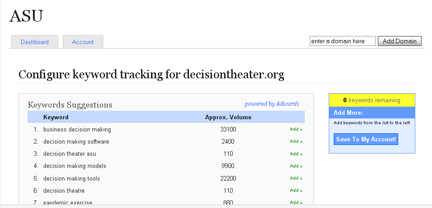
They need to think of search engine optimization as a A_Labs_ASUDTlong-term investment he said. Especially for those who seek ROI in terms of increased traffic and conversions. He mentioned ‘continued insight’ too, and it brought to mind recent cases of how lack of monitoring resulted in PR disasters such as this and this.

We increasingly hear how dangerous it can be when  PR and Comms take its eye off the ball. Competitive intelligence monitoring is like putting matchsticks between your eyelids and staying alert

There’s a free account if you want to give it a try.

Quotes for the week, ending 25 July, 2009

“Combine the ‘show don’t tell’ and ‘report with your senses’ rules to gather details that will paint pictures for your readers.”

Rosland Gammon at BusinessJournalism.org, on reporting details to paint a picture

“When it comes to influencing brand perception and purchase decisions… social networking… has a long way to go.”

Stephanie Molnar, CEO of WorkPlace Media, commenting on a study of social network usage in the workplace.

“When most people say, “prioritize,” I think they really mean to say, force-rank.”

43 Folders, on Mud Rooms, Red Letters and Real Priorities

“They have no friends left.”

US Secretary of State, Hillary Clinton, commenting on North Korea, during her visit to Asia

“Twitter Generates $48 Million of Media Coverage in a Month”

Abbey Klaassen, in Ad Age, in a story that details how Twitter received almost 2.73 billion impressions in the past month. TV contributed to 57% of the PR value; newspapers 37%; magazines 5%.

“Employers hire winners, someone with demonstrated success in previous positions, and someone that inspires confidence from the get-go. Wallowing in self-pity isn’t remotely attractive. Neither is desperation.”

David Mann, former dir. of corporate communications, about maintaining a positive attitude during a job search

“Twitter is not a huge page-view driver, but it does bring in new people.”

Robert Quigley, in Media Bullseye on lessons learned from using Twitter

“He had this bizarre idea that he would ad-lib the newscast without a script … it lasted two days.”

Sanford Socolow, on Walter Cronkite, at the legendary anchor’s funeral.

Twitter interview with Jessica Hansen

Welcome to the fourth ‘Twinterview’ here at HoipolloiReport, and welcome to Jessica Hansen, who’s agreed to participate / be grilled in this compressed, live format.

Others in this series have been:

It’s going on live at 9.00 am today at Twitter.com/heyangelo

AF: @JessicaLHansen Good morning Jess. Thanks for agreeing to do this Twinterview. Did you know you’re the fourth ‘victim’?

JH: @heyangelo I’m honored to be the fourth Twinterview ‘victim’ 🙂

AF: @JessicaLHansenYou’re a very big Twitter user. What do you make of compressed interviews?

JH: @heyangelo I’ve been using Twitter since ’07 & love it! Twinterviews are a great way 2 quickly share concise bits of info w/ a lrg audience

AF: @JessicaLHansen For a moment I thought you said since you were 7 🙂

JH: @heyangelo HAHA! No, the Internet wasn’t even around when I was 7 — Let alone Twitter 🙂

AF: @JessicaLHansen If you were to choose between blogging and micro-blogging, what makes more sense to you and how you work?

JH: @heyangelo I don’t know that u need to choose btwn blogging & micro-blogging…

JH: @heyangelo I’d use a blog to share more in-depth info or maybe info just about one subject (which may only appeal to a smaller audience)…

AF: @JessicaLHansen Some people think Twitter is just mindless ‘brain noise’ http://bit.ly/l Wher and blogging is the new long-form journalism

JH: @heyangelo Use micro-blogging 2 not only share bits of info (& link 2 in-depth blog posts if u want), but also engage more & listen 4 info

JH: @heyangelo I’m going to have to check out The Hobson and Holtz Report – Podcast (http://bit.ly/lWher) for the piece about ‘brain noise’

JH: @heyangelo There are def. still Twitter users who are posting updates about what they are eating (now famous example), and nothing else

JH: @heyangelo Those same people rarely see the value in using Twitter — It should be a two-way form of communication…

JH: Don’t use Twitter to just push ‘mindless’ info…Listen to what else is being shared, & engage w/ others to get the most value

AF: @JessicaLHansen Such as? Name three people you follow who do a good job at it

JH: @heyangelo You’re putting me on the spot–I have a hard time w/ #FollowFriday because there are so many people who are sharing great info

JH: I enjoy following people who tweet useful info (beyond the ‘yum! I’m eating a grilled cheese’) and share common interests of mine

JH: @heyangelo To be general, I enjoy following reporters to get more insight into their personalities & to learn about what they’re working on

AF: @JessicaLHansen Nice dodge, can u be specific? No harm giving a shout out to someone

JH: @heyangelo For a great list of communicators, I turn to the ‘IABC on Twitter’ list (twitter.x.iabc.com)

JH: @heyangelo Most of my #Mindspace colleagues are on Twitter–If I pick 2 who use it regularly & do a great job, follow: @BDiggs @JeffHechtAZ

JH: @heyangelo And of course u do a great job at using Twitter–engaging w/ your followers, & sharing links to interesting artices #FollowFriday

AF: Ah, Flattery! Won’t let you go off lightly, though. Let’s talk about jobs.

AF: @JessicaLHansen Let’s talk about your job. You were immersed in digital media and were laid off. Were you taken by surprise? Why?

JH: @heyangelo Yes, back to your question about jobs, and being laid off while being immersed in digital media…

JH: @heyangelo I think the best thing people can do right now is realize the power of having a strong network, esp. when u don’t think u need it

AF: @JessicaLHansen I want 2 go bck 2 that week. Did you pull out your resume? Log into LinkedIn? Posted a status update on FB? What did u do?

JH: @heyangelo When I was laid off, I had already been actively involved w/ @IABC_Phoenix, was volunteering w/ ADA, & building a Twitter network

JH: @heyangelo First thing I did after being laid off was update all of my online profiles — LinkedIn, Facebook, Twitter…

JH: @heyangelo You always want your online profiles 2 be current, but I was surprised by just how many peopel reached out after hearing the news

JH: @heyangelo I’m connected w/ family & friends on LinkedIn & FB & know I have their support…Was overwhelmed by generosity of Twitter friends

JH: @heyangelo I was already on Twitter sharing info. w/ people–Then, when I needed support, had people offering advice, help w/ my resume, etc

AF: @JessicaLHansen How about networks in the Valley? Did you do a lot of face-to-face meetings or were you all digital?

JH: @heyangelo That’s an important point, Angelo. I connected w/ a lot of people online, but I made a point of having face-to-face mtgs as well

JH: @heyangelo @IABC_Phoenix is a great network, & there are some other chapters organizing support groups 2 help collaborate in tough times

AF: @JessicaLHansen Were there any hiring managers that found you because of your social media footprint?

JH: @heyangelo Yes, I heard from a few hiring mgrs because of my social media footprint–Scheduled in-person interview w/ @cplanchard via DM 🙂

AF: @JessicaLHansen What do you think job seekers do badly?

JH: @heyangelo Job seekers who have a strong network of pros are going to be a step ahead when it comes to finding the next career opp

AF: @JessicaLHansen And from the other side, what do you think companies seeking great employees do badly?

JH: @heyangelo HR depts are getting bombarded by resumes from job seekers right now–It’s important to connect w/ people & build relationships

JH: @heyangelo Hiring mgrs are missing out if they aren’t joining the convo on Twitter–Great way 2 find talent & learn a lot about candidates

AF: @JessicaLHansen Let’s switch to IABC. You’ve taken on the presidency this year for IABC_Phoenix. What are your three big goals?

JH: @heyangelo Yes, I’m honored 2 serve as @IABC_Phoenix President this yr. We are focusing on having our members Be Heard more than ever…

JH: @heyangelo @IABC_Phoenix will be the definitive resource for comm practices & engaging communicators at all stages of their careers

JH: @heyangelo @IABC_Phoenix will enable our members’ success in performing their jobs and advancing their careers

JH: @heyangelo Personally, I’d like 2 connect w/ as many @IABC_Phoenix members as possible this yr–Get 2 know them, hear what they need from us

AF: @JessicaLHansen From recent membership at IABC_Phoenix, attendees at events, what are members seeking most?

JH: @heyangelo From recent @IABC_Pheonix surveys, members want: smart network of comm pros, info on new career opps, & more on social media

JH: @heyangelo @IABC_Phoenix will enable our members’ success in performing their jobs and advancing their career

AF: @JessicaLHansen How do you see Phoenix positioned in terms of Communications opportunities?

JH: @heyangelo I think there are a lot of opps 4 comm pros in #Phx, but it’s also 1 of the hardest hit by this economy–We need to work together

AF: @JessicaLHansen #On that somewhat optimistic note, I’ll let you go. I know you have to run. Thanks for your time!

JH: @heyangelo Thanks so much, Angelo! I enjoyed the Twinterview (thanks for the opp!), and hope I was able to share some helpful information.