Podcasting kicks in at GreenNurture

I’m a big fan of podcasting, as most of you readers probably know.

I’ve talked about it, written about it, been on BlogTalk Radio, and experimented with other similar formats such as iPadio. Along the way I produced some as well, starting with podcasts for ASU’s Decision Theaterfound here, or at iTunes

Trouble is, I have not taken time to put them all in one place –something I will get to shortly. (Yeah right, that’s if the cobbler’s children syndrome doesn’t kick in!)

So I am excited to be able to do it at this venue, for GreenNurture. We call them Nurturecasts, and we just launched the series, starting today.

Armed with a much-recommended ZoomH4N (that tends to look a friendly as a Taser, and upset a few TSA folk in airports), I’ve started on a series of podcasts for Public Radius as well.

Here is where to find them.

Will the Lede, lead?

Once again I’m working on a story about how journalism is getting bolder in its experimentation with new media. Not just looking for new ways to distribute content, but for creative ways to provide us with richer context around stories.

So much has been taking place in blog-like, search-enhanced journalism that’s it’s almost becoming a standard.

The Lede – New York Times

Two great ‘papers’ – published from Twitter Streams:

  • Utah Politics where anyone can sign up to be a ‘Contributing Editor’
  • The Guardian – claiming it is”the first newspaper in the world to be published exclusively via TwitterTwitter Only Jurnalism:

If you have any other great examples, feel free to leave a comment here, or send me a tweet. Thanks!

Plenty of “non-experts” – tons of social media expertise

A funny thing happened in the lobby of MADCAP Theater, Monday.

SMAZ_2010_VPRBIt had nothing to do with these two familiar faces. Most of the 400 + attendees at the Social Media for Business event –a..k.a SMAZ –about all things digital, indulged in one of the oldest communication tools, business cards.

I loved how, despite seeing a Twitter handle on the last statutory slide of every preso, this tiny cardboard rectangle still works. It probably illustrates how social practices like this will not go away despite the attention we give to trackbacks, Tweetdeck or Posterous.

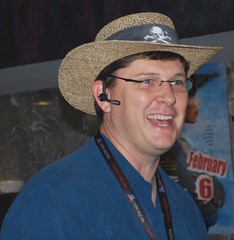
PanelIn between working the floors wearing that funny hat, I sat in on some great sessions. The panel on Building Brand Evangelists with Social Media, moderated by Kevin Gawthrope (@gawthrok), was very enlightening.

Then there was our very own Linda Vandrede moderating Social Media 101 a panel that included Amanda Vega, Chris Hewitt, Scott Andrew and Sheila Kloefkorn. Talk about heavyweights! If you’d been to last year’s SMAZ, you would have notices how the audience had changed, even at a 101 level. One of the sticky topics that came up was about outsourcing content. There were two schools of thought here, but both maintained that content creators have to be transparent and committed. Blogola and astroturfing won’t cut it.

As I mentioned earlier, the tone was set by Sitewire president, Greg (“I am not a social media expert”) Chapman but having said that, there was plenty to glean from. Especially in the hallways!

My takeaways (updated):

  • Be the message, don’t just post the message!
  • Don’t treat Facebook like the Yellow Pages.
  • Listen first, tweet, post later. Use Social Media as a listening post.
  • Be cognizant of the ‘channel agnostic customer.’
  • Google handles hyphens better than underscores, so be watchful when you write headlines, tags.
  • “Social media is free” is a huge misconception. There’s a human resource cost attached to it.
  • Social media is not a strategy – it is what you embed into your Comms strategy, marketing strategy, PR strategy.
  • Google’s new search engine, Caffeine, will knock your socks off.
  • Think less about the platform, more about the content.
  • Content isn’t king. Optimized content is king!
  • Start with small things. If your boss or client wants to start tweeting, facebooking, start with small goals before the big-hairy-audacious ones
  • There’s a difference between a News Feed and a Live Feed on Facebook.
  • Train others freely. Give away secrets. The rising tide lifts all boats.
  • Differentiate between Goals and Tactics. People mix these up.
  • Just like the way they confuse Strategies and Tactics, I suppose.

If you read other takes on SMAZ , you’ll see that there’s a lot of tech stuff to wrap your head around. But for all the talk about ‘matchbacks’ and Seesmic, Tweetie and Flowtown, I came away with three things:

  • “Social Media is an ingredient, not an entre.” – Jason Baer
  • “Hang out where your customers hang out” – Sheila Kloefkorn

And …

  • Bring a lot of business cards, next time, dammit


Cross-posted from ValleyPRBlog

“Stop treating Facebook like the Yellow Pages”

Evo Terra was firing rounds of ‘measurement’.

Jason Baer was his usual self –provocative, helpful, and making some terrific observations of where we are heading.

As with last year’s Social Media for Business Conference, (see post here) now better known as SMAZ, this year’s conference had some outstanding panels.

The event kicked off with Sitewire president, Greg Chapman making  statement that was more of less repeated at every session: “I am not a social media expert.”

Followed by a “however…”

So in the company of these non-experts, I learned some amazing things, and confirmed a lot of the approaches I’ve been taking. Here are the ones that I liked:

  • Don’t treat Facebook like the Yellow Pages.
  • Listen first, tweet, post later. Use Social Media as a listening post.
  • Be cognizant of the ‘channel agnostic customer.’
  • Google handles hyphens better than underscores, so be watchful when you write headlines, tags.
  • “Social media is free” is a huge misconception. There’s a human resource cost attached to it. Social media is not a strategy – it is what you embed into your Comms strategy, marketing strategy, PR strategy.
  • Google’s new search engine, Caffeine, will knock your socks off. Even if you’re in flip-flops 🙂
  • Content isn’t king. Optimized content is king!
  • Start with small things. If your boss or client wants to start tweeting, facebooking, start with small goals before the big-hairy-audacious ones
  • There’s a difference between a News Feed and a Life Feed on Facebook.
  • Train others freely. Give away secrets. The rising tide lifts all boats.
  • Differentiate between Goals and Tactics. people mix these up all the time.
  • Just like the way they confuse Strategies and Tactics, I suppose.

SMAZ also turns out to be a great way to connect with the people we only meet virtually here in the Phoenix area (I met many of our readers from ValleyPRBlog), whether no matter where we are on the analog-to-digital scale.

And lest we forget the person behind the curtain who makes this happen, I want to tip my hat to Fred VonGraf.

SMAZ Conference tomorrow – will you be there?

Big day tomorrow — the second Social Media AZ conference.

It’s at the MADCAP Theater.

I was there this evening helping set up, and according to Fred, they are expecting 400 attendees!

Some great panels, and tracks. I’m planning to check in with the sessions on Augmented Reality, Measurement, and Social Search among others.

Tracks:
Check out the presenters here, and get thee to the MADCAP! (There’s free parking at the 5th and Farmer lot across from Ash.)

Livestream:
If not, you could catch the event online –we are live streaming the Panel Discussions! Check this link at AZWebcasting.

Maping what’s happening in Haiti

Interesting how geomapping is taking off, as  interactive maps (and visualization) becomes a huge asset to crisis communications, journalism. You may recall how mapping was used for the Swine flu.

Now people can help map the relief operation in Haiti – at Ushahidi, a crowd-sourcing site I love to support.

It’s got links to video, news, pictures and ‘Todo’ lists. The site pulls together urgent need requests and status updates.

Like this desparate request:

@MelyMello @WFPlogistics so clos 2 airprt, can u help get help? 18°35’36.24″N, 72°16’40.37″W Othopedic clinic,needs narcotics,IV antibiotics,diesel,gas

Campaign to map Haiti

You can get involved via txt, email, hashtag. Details here: http://ow.ly/YsKP

Quotes for the week ending 16 Jan, 2010

“This isn’t actually an article form a newspaper. It is part of the ad…”

Copy from a fake piece of editorial that’s part of a creative ad buy for Aflac in The Wall Street Journal, linking to the microsite, getquack.com

“They just had a name that was hard for Chinese to pronounce and harder to spell.”

Kaiser Kuo, a Beijing-based consultant and former head of digital strategy at Ogilvy & Mather in China, on Google’s decision to pull out of the country.

“I don’t think it’s wrong to take chances …Sometimes they work.”

Jeff Gaspin, of NBC, on the network’s decision to move Jay Leno back to his original slot –11.35 pm

a “pact with the devil”

The reason, according to televangelist Pat Robertson, why he thinks Haiti is cursed.

“Our alleged “pact with the devil” helped your country a lot.”

Haitian ambassador’s response, to Robertson

“This is citizen journalism at its best, bringing the news of nature’s worst to a global audience.”

John Savageau, on CNNs use of citizen journalism in Haiti

Flickr shows its collaborative power in Haiti disaster

I talk of Collaboration as one of the 4 legs of social media. Usually I use positive examples such as Spot.Us and a host of other experiments.

But as the horrors of the scale of the disaster in Haiti stream in, through citizen journalists, there’s one site to keep watching: Flickr.

Check this Group Pool, where everyone on the ground with a camera of sorts is helping record the event, sharing their resources. Images such as this one will fill our screens and lives in the next few weeks, thanks to them.

A note of caution: Some of these can be disturbing.

Quotes for the week ending 9 Jan, 2010

“…we’re not saying you’re evil, Google–you just sometimes make us want to wear a tin hat.”

Kit Eaton at Fast Company, on Google’s Near Me Now app on its Android phones and the iPhone that he says  will make “a lot of location-based App Makers” furious.

“Yes, I’m serious…there are plenty of companies that still insist on running every single tweet through multiple PR teams to make sure the messaging is spot on.”

Matt Singley, on the 6 things you need to know about social media.

“your diaphragm changes — your voice comes across very differently.”

Nancy Duarte, CEO of Duarte Design and author of slide:ology, on presenting to remote audiences.

“Jay Leno is one of the most compelling entertainers in the world today … It has, however, presented some issues for our affiliates.”

NBC statement on its decision to move the time slot of Leno’s show.

“Seamless connectivity and rich social experience offered by web 2.0 companies are the very antithesis of human freedom.”

Web 2.0 Suicide Machine, a web site that claims it can erase a person’s presence from Facebook, Twitter, LinkedIn and MySpace.

Context will save journalism

It often takes a good journalist to put things in context.

Forget the inverted pyramid. Forget the fair-and-balanced dance of pretending to give equal time. Sometimes it’s the power of good storytelling, that puts things in rich perspective.

I am a big fan of Arizona Republic’s E. E. Montini. In his column today (Putting Janet, John and Jon in context) he puts the whole brouhaha of Homeland Security chief, Janet Napolitano in context. Why? Because politicians tend to mangle context just to score points with their electorate. The ground rule: “Every single thing said by every single politician is taken out of context. Usually by other politicians.”

And so it is left to journalists to dig out the nuggets from the past. Nuggets that readers tend to forget, that supporters hope was buried in the archives. Most of us think of Google as the great equalizer, the amazing memory machine. But there’s nothing like seeing context pop up on the front page of a dead tree. Thanks to the other machine, the journalist.