Social media driving you to distraction?

The jury is still out whether social media is making us more distracted or not. I’ve met many people who claim that the best way to ‘work’ (and it’s within quotes for a reason) is to turn off the wi-fi and stop mult-tasking.

Like that’s easy!

But forget external communication for a moment. Could socially interactive apps make us more productive when we collaborate? I could give you five reasons why (and a few good books to read on the subject). But for now, here’s a presentation my colleagues at GreenNurture just posted to SlideShare.

I would use it for any ice-breaker, or at the start of a discussion in an organization!

Is Social Media Distracting Your Employees?

Podcast on Green Teams

We had a jam-packed radio show on Green Teams this Wednesday.

If last week was all about the external aspects of greening an organizations -buildings and facilities management– this week was all about how health care organizations build green teams. The best practices, and the learning moments.

  • Colleen Cusick of Johns Hopkins Health System talked about the sub-groups in the team that take leadership in many sectors of a health care system.
  • Joan Plisko talked about the corporate culture that drives behavior, and the need to have everybody on the same page.

Here is a link to the podcast: http://bit.ly/your3BL13

Barrier for social collaboration: integration not motivation

I’m attending a webinar right now on ‘Leveraging Social Software for Increased Employee Engagement and Performance’ with Michael Fausette and Steve Paul.

Interesting slide here, earlier on, based on attendee poll.

The biggest barrier to collaboration appears to be:

NOT lack of collaborative tools

BUT: lack of integration with other systems, and that some in the organization won’t use the tools provided

The product being featured is Spaces, an enterprise platform for collaboration from Moxie.

Perfect timing for a discussion today on our radio show, at www.your3bl.com, where we are taking about Green Teams –Part II of our series. The typical tools teams have always been comfortable with are IM and email, while the more social tools such as Wikis and Twitter or even Sharepoint, pose too steep a learning curve to team members.

I’m going to ask our listeners to take a quick poll during the show to tell us what type of tools they are using today, and what they might consider for their team.

If you care to listen in, here is a link to the live stream: http://bit.ly/Your3BL
The show is at 7.00 pm (Pacific)

  • Ping us at @your3bl
  • Email us at contact@your3bl.com
  • Call us, toll free at 1866.536.1100

Crowd-sourcing is fine, until you bump into control freaks


I ran into a great post on Crowd-sourcing,by Sid Roy, at an ad agency blog, PO Box. I was very impressed because this is the kind of topic that agency types who –at least the traditional ones — used to be very suspicious of: outsiders invading their turf.

The gist of the post is that is that co-creation, collaboration and open sourcing are here. And that marketing models that worked fabulously well in a world of scarcity would be ‘severely challenged to work in a world of abundance.’

Challenged is an understatement, isn’t it, Sid?

(You probably wanted to say ‘crushed!’)

I pointed out that while it’s taken awhile for crowd sourcing to catch on (Surowiecki’s book on The Wisdom of The Crowds, notwithstanding). There might be three reasons for this:

1. The ‘NIH’ syndrome. The team or department is often threatened by ideas that are ‘Not Invented Here’

2. Intellectual Property lawyers. Very recently Boeing and Apple rejected ideas from outsiders because they have been advised to not solicit or welcome ideas form people who might later sue them if the idea (or some flavour of it) is used.

3. Crowd-sourcing is somewhat anarchic. It’s not easy to manage the crowd in the traditional sense, since they don’t have roles, titles, proper compensation structures etc.

I can see why an ad/marcom agency might be reluctant to solicit and execute a campaign that came from a ‘bazaar’

Or why a school might not want to publish a text book based on knowledge sourced via Wiki platform

Those who control the distribution, creative and knowledge portals, and wear these hats aren’t ready to let the crowds run the show.

Full Disclosure: I used to work for Phoenix Ogilvy and Mather, publishers of the blog

A formula for going viral? Picking Everett’s and Brown’s brain

I had a great conversation with Brown Russell, former Chairman of Gum Tech (GUMM:NASDAQ), last evening on our radio show.

Brown was behind (and by this I mean he led) the launch of Zicam –the cold remedy, medicine. I didn’t know this but Zicam was one of the fastest growing new cold treatments in recent history.

The reason I thought he would be a great guest was because of a book I noticed on his desk one day. It was one of those thick books on communication that communicators who have just graduated may have not even heard about: The Diffusion of Innovations by Everett Rogers, first published in 1962. (By the way Rogers published 30 books in 15 languages.)

To put this in perspective this was before the Internet was ‘discovered.’ And some of the concepts Rogers analyzed presaged  viral marketing by what, 40 years, maybe?

How do ideas spread and products take off, I asked? Is the diffusion of innovations across networks (the unwired kind) dependent on a marketing and PR push? Derrick brought us a good point –that demand, could possibly be influenced by planned scarcity (as in Apple’s play); by game mechanics (as in earning rewards), and filling the need that nobody has quite recognized (as in Facebook).

Here’s the podcast, if you’re interested. http://bit.ly/your3bl11

By the way, if you occasionally use terms such as ‘early adopters,’ ‘late majority’ or ‘laggards’ you’ve been borrowing from Roger’s theory!

Wikipedia appears to beat media in Chilean miner rescue

By chance I checked Wikipedia on the Chilean  miner rescue operation underway now (9.15 PM Pacific), and was pleasantly surprised to see two things going on:

The first was that Wikipedians are updating the site faster that Google results of news of the rescue operation.

San Jose Mercury News, Yahoo and others come up on search for ‘miner rescue’ with news

that one miner has been rescued.

Wikipedians noted that there have been two miners brought to the surface.

It took about another 10 minutes for the rest of the media reports to show up with this detail.

Meanwhile CBS News is streaming video via Ustream! http://ustre.am/2bWW

The second curious phenomenon will probably be discussed at length in the weeks after this. In what is clearly a sign of the times, where everyone is now a reporter,  the video from the mine captures at least two of the trapped miners photographing (or videoing maybe?) the event that they are part of!

Who’s watching what here? Who’s updating whom here? This is breaking news, and the subjects are reporting the story!

Listen to the blogosphere, or else….


My View | Bi-weekly Column in FT


Have you looked out of the window while your flight waited for takeoff and seen a small truck, barely the size of an airplane engine, pushing a huge 767 into position? It looks so ridiculous. But this small vehicle has the capacity to move a massive hunk of metal carrying hundreds of people and thousands of gallons of fuel. Not to mention luggage!

Sometimes it’s a bit like this in our world of communications. Social media humbles us when it demonstrates the power to give a big behemoth a bit of ‘pushback.’ And yes, there’s an airplane involved in this story –the Boeing company.

Continue to PDF of article – FT Online

What’s a novice like me doing shooting videos?

I’m a photographer of sorts. Have been ever since I used a cheap point-and-shoot Kodak on a world leader. I hadn’t a clue about ‘depth of field’ then, and famously (naively, really) held it within a few inches of the face of John Paul II. They didn’t arrest you for getting too close to a Pontiff in those days.

So shooting videos has been a challenge. Instead of worrying about aperture and ISO rating, I’m now wondering about

  • Use a tripod or keep it natural and do hand-held?
  • Only shoot in natural light or work with the unflattering florescent bulbs?
  • Table top or wide angle?

Most of the cameras I have been using  have been built for novices. The ubiquitous Flip video cam, and my trusty Kodak PlaySport. Funny how it’s point-and-shoot all over again!

And so I’ve settled for happily taking the ‘non-pro’ route in video. The kind of stories I recently recorded have had colorful settings– on golf courses, in the kitchen, down a Disney-like ‘adventure trail’ for kids…

I was doing a video story of an executive chef, today. He was cooking up a lemon sole dish from scratch. The ‘scratch’ part to the photographer meant there was an array of ingredients to zoom in and out of, while he talked to camera, and moved around the kitchen. In still photography you don’t have to deal with things going in and out of focus.
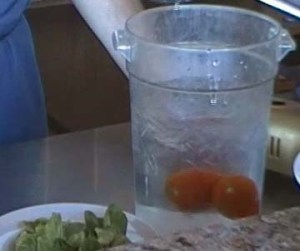
Chef Ryker Brown picked up a gnarled tomato, scored it and submerged in a glass of iced water. It was interesting sidebar to the main dish; the lens whined, decided to stop being confused and locked in to focus.

As I watched it all come together, I realized that stories told in words are a lot like that too. While we hover around our subject, a sudden detail we previously ignored comes into sharp focus. It then plays a starring role in the story.

I’ve always loved tomatoes –the deformed, multi-colored ones that grow in our yard, not the shiny grocery store variety. They puzzle the eye, in the same way they confuse the camera lens. They also bring out a flavor to the otherwise mundane. If there’s a lesson in all this it’s about keeping your subject in focus, but not ignoring the blushing tomato on the side!

As for that early celebrity photo, I got a pretty good shot. I think. A big part of it was his nose, but hey!

What’s a ‘Great Place To Work?’ Podcast of radio show

Employees are either ticked off or raring to go.  That’s the commonly held wisdom, right?

I wanted to find out and conducted a survey before my radio show, Your Triple Bottom Line.  Some pleasant surprises: A large percentage of responders have positive things to say about the workplace. (The survey is still open for a week, so that number could change.)

However, when asked to describe what a terrible place to work was, one respondent cited “Filth, blind micro-management, too many chiefs.”

Hmmm! Too many chiefs is a common refrain whenever I speak to companies about what’s the biggest stumbling block to a more collaborative workplace.

I conducted this snap survey because we were planning on asking our guest, a much-acclaimed author of the book Fired Up Or Burned Out, about what kind of leadership makes workplaces so dreary or at other times, inspiring. The book (it’s received great reviews on Amazon!) takes you into the ‘power of connection’ at work from the American Revolution to… Starbucks!

Show # 8 – with Michael Stallard

Download a PDF of the book free here.

Cross-posting this from the Show blog, Your3bl.com

Forget vanity plates. Your car’s about to get social!

I used to joke about this a few years back: it would be only a matter of time when we were able to get ‘custom’ license plates that connect to your network instead of those static vanity plates. You know, another kind of URL that connects the dots to a social network.

Yikes! It’s here!

BUMP just launched at DEMO, the launchpad conference for tech companies.

Which means those cryptic, ridiculous (and often egoistic) plates could someday be channeled into a way to connect with others on the road. It works through an app on a Blackberry, Android or iPhone.

Here’s how the VentureBeat site describes how BUMP works:

“When Bump users see someone in a car they want to communicate with, they take a picture of the person’s license plate. The Bump iPhone app (pictured right) or a similar BlackBerry app passes along a message, like “Way to use turn signals” or “Would you like to go on a date?”