Lost in translation – when jokes go sour

With so many channels permitting us to share so much chatter, it’s alarming how people forget that what seems private could be very public. Twitter is “a village common” says David Carr, media and culture columnist for the New York Times. He considers what someone says on this channel as very public. (There is a journalistic debate on whether a tweet is actually public content.)

Humor often has a way of going wrong. If you are planning on posting a zinger remember the Aflack guy. The comedian Gilbert Gottfried, who was the voice of the duck in the Aflack commercials, made a few off color tweets soon after the tsunami in 2011. One of them was: “I just split up with my girlfriend, but like the Japanese say, “They’ll be another one floating by any minute now.” He quickly became the ex-Aflack voice.

Even a comedian ought to think before he tweets.

Speaking of humor, this joke gone wrong, involving the Dalai Lama would crack you up. Nothing offensive, but the punch line, lost in translation, just didn’t connect. Karl Stefanovic, the anchor of the Today show in Australia explains.

Storytelling tips from Lone Ranger

When I teach young people about the  elements of a story, I tend to lean on the trusted models of the Who-What-When-Where-Why-How (or the 5WH) structure. Or the one about having a Beginning, Middle and End. (My version of this, for those writing for the web is to make sure they have a Beginning, a Middle and a Hyperlink.)

So this week I revisited  two stories, separated by several centuries. The Lone Ranger, and Beowulf.  (Yes! There’s a delicious irony of being able to listen to a 1930 radio show of The Lone Ranger via a Kindle app!)

The basics of these stories –one from the radio age, and the other from a different culture and era, entirely – is that they revolve around conflict. It makes good drama. Good vs evil material. But beyond that, it is how carefully  the author, or script writer selects his words.

So here are four things we could take away from Lone Ranger:

1. Grab Your Reader/Listener
Cut short the pre-amble, and get to the point fast.  In Lone Ranger, we are all familiar with how the scene is set: “A fiery horse with the speed of light, a cloud of dust and a hearty “Hi-yo Silver!”  (The previous intro was: “In the early days of the western United States, a masked man and an Indian rode the plains, searching for truth and justice. ….Return with us now”)

The ‘search for the truth’ is built around intrigue (masked man) and the promise of action (search for truth, hoofbeats…)

2. Cut to the ‘Chase’
Move quickly to build up the tension. The stereotypical car chase (or horse chase here) can have other variants such as a puzzle that the reader is yearning to solve, the expectation of a confrontation etc.

3.  Build Great Dialogue.
Though the story is told to us by a narrator, it is rich in dialog. Tonto, his foil, despite the author’s use of some clumsy pidgin English, is full of exchanges.

TONTO: “Crooks try rob bank last night”
RANGER: “Have Bogus Brown and his pal Elk been in town?”
TONTO: Umm. “Them the fellers try to rob bank?”

4. Humanize Your Characters
The Lone Ranger, despite his mask, is still human enough for others to be able to relate to him – Sheriff’s, townspeople, crooks.

Too often our modern ‘stories’ –um, press releases, podcasts etc– are full of inside jargon, and layer upon layer of description. It’s almost as if the boss’ requisition stated that the script be stripped of ‘normal’ words, and the sort of everyday, ordinary exchanges. Instead what creeps in a slick, sloganized phrases, put in the mouths of spokespersons who would never talk like that.

Maybe we should make Fran Striker (college dropout, announcer) the little-known writer behind Lone Ranger, essential reading for those writing for an attention-deficit audience.

Wikis to books worth experimenting

I often make the point that we spend too much time clicking on links, rather than spending time on the meaning of what we read.

So I thought of experimenting with PediaPress, a service that lets you convert Wikipedia pages into a book.

The book? On Clark University – for my son’s graduation today.

Knowing fully well that information on the university will change, did not bother me. In fact, that’s precisely why I wanted to do it. After all, Wikipedia content is not exactly writ in stone, could be considered as relevant for a moment in time.

(If you’ve been watching how pages get edited, and the edit wars that ensue over single words or phrases, you’ll know that this ‘moment’ sometimes changes several times an hour as a result of furious edit wars!) I want the book to be a sort of  time capsule that he could one day look back on.

PediaPress is basically offering a print on demand (POD) service, but the beauty of this is how simple they have made the steps. There’s very limited customization (the cover and title, plus a preface), but the layout of pages and sections are very clean.

I would have liked a bit more customization, such as:

  • The ability to move photographs and charts into separate pages
  • Uploading my own photograph for the cover, and a few others for other pages
  • An acknowledgment or title page
  • Adding text to back cover

But as this was an experiment, I was willing to take the risk.

Other risks. For a different project, say trying to compile a short compendium of knowledge on a breaking news event, or a current topic, using Wikipedia as the source of content is more risky. While the Creative Commons license gives anyone permission to use and re-purpose content, one has to me meticulous about accuracy.

I began to wonder of there are other similar services that let you blend knowledge from multiple sources, and let you add chapters to the book. I’ve looked at Blurb, which offers a Blog-to-Book option. Lulu also has a great service. a cookbook/ A book of poetry/ Wikipedia has a rich selection.

Give it a try!

Time magazine’s cover sells, enrages

I’m a great fan of and subscriber to Time magazine. I’ve been used to their shift to become more edgy over the past few years –perhaps in order to stay in business. But this caught me off guard.

Last Friday, when it arrived, I left the magazine on the counter, not thinking too much about the mother and child cover. Another mother’s day angle, I surmised. My wife was shocked, and my daughter probably was even more.

I could see the firestorm emerging. But it’s coming from several interesting sides, especially those enraged by the ‘Mom enough’ question, and also the challenging pose of the breastfeeding mom. The “this creeps me out” reaction from mothers was quite common, and I bet Time wanted This kind of reaction, as the buzz was good for newsstand sales.

Time magazine is not just a news outfit. It’s a marketing machine. I’ve noticed that recently it often makes a big point about how a story gets more web traffic than any other story, or has has more letters to the editor etc. I also get it. Covers need to be provocative, and even stimulate a conversation. But in this instance I think Time went too far. Here’s why:

The headline. Reading the article, it seems to have very little to do with adequacy or inadequacy of mothers, and their feeding methods. Connecting that headline to the stand-up feeding pose, seems like it is posing an unspoken question: “Would you be brave enough to do what I am doing? (with my one hand on my hip, too!)”

The eye contact. They probably took a lot of angles of this mother-and-child. (They had great inspiration, apparently)

Healthcare, now a social, not private affair!

Time was when someone would keep his/her healthcare concerns under the hood, so to speak. A health complication would be kept within the family; the unwritten doctor-patient privacy act was upheld.

Now? We seem to be ready to blab more about it. or, to put it another way, patients are more than ready to take to social media to discuss health-related issues in the open. Some examples

This latest report by PwC recognizes this, and gives you a more granular look at how the private concerns of those seeking healthcare have become closely intertwined with their social media behavior.

For example:

  • Nearly a quarter of people in the US (24%) post something about their healthcare experience.
  • 16 % share health-related videos and images!

It gets more interesting, in the face of concerns about invasion of privacy and health information.

  • Some 30% of people are willing to share their health-elated information with other patients, using social channels.
  • Also, 80% of 18-24 year-olds are likely to share health information through social media. 80 percent! You could find out more here at the PwC site.

This ought to have huge implications for healthcare companies, and even medical practitioners who have been concerned that their connecting with patients could run afoul with health information privacy, or HIPAA, laws. Physicians have been behind the curve. Sermo, their online community, has just 130,000 users, but one study found that while 87% of physicians use at least one social media site at a personal level, only 67% are using at least one site for professional reasons.

Eat More Kale! (Just don’t brag about it)

If someone threatens to sue you for using a common word, whom would you go to for redress?

Well, if you’re a writer, or a mom-and-pop business owner, you may not be able to afford a team of lawyers. You may not think that a common word such as ‘think’, ‘eat,’ or ‘whisperer’ could get you into the cross-hairs of a team of copyright lawyers. But we live in such times.

Last week I spoke to Bo Mueller-Moore, someone who didn’t understand all of this. Bo is a Vermont-based folk artist who became an accidental T-shirt designer.

We grow kale (as you could see here) in our back yard. This story resonated with me. He comes across as a folksy, genial gentleman who might be the least likely chap to threaten a 1,615-restaurant business.

One of his shirts that he sells (he originally made three for farmer John down the street) read ‘Eat More Kale’. But a corporation began claiming the rights to the words ‘Eat’ and ‘More’ and thought that Eat More Kale would confuse its customers.
Bo has been imprinting t-shirts since 2000, and this is not the first time Chick Fil-A has come after him. (It dropped its earlier case after someone from his town sent them a polite letter saying they were going after the wrong kind of person who was no threat to them.).The company’s product? Chicken sandwiches. Sandwiches!

Last year the lawyers sent him the second cease-and-desist letter. This time Bo decided he was going to fight it another way, in another court –the court of public opinion. Which is located …in the realm of social media.

He took to Facebook, and YouTube, and has garnered thousands of fans.

Now I like Chick-Fil-A, and its sandwiches are one of my daughter’s favorites. But I can’t for the life of me imagine why they would think that a small T-shirt business, especially a short slogan promoting kale would ‘confuse’ me as a customer. Bo’s not a lawyer, but he summarizes his defense as plain and uncomplicated as a head of kale: “You can’t eat anything I sell.”

Oddly enough, while you hear of similar cases (Facebook, apparently tried to own the word ‘book,’ and Apple tried to make claims on the word ‘pod’) others who common English words don’t always get into this kind of trouble. Denny’s restaurant is currently using the word ‘whisperer’ to promote its fare.  The series of videos is called ‘Skillet Whisperer.’ (The word whisperer immediately conjures up the movie Horse Whisperer, doesn’t it?) Some folks in Wisconsin have a website called Eat More Cheese. Now they are definitely in the food category, even though a slice of cheese is a far cry from a piece of chicken.

If I were a PR agency advising Chick-Fil-A, I would tell them stop wasting their budget on expensive legal advice and allocate a tiny portion of that to a dude in the office who would listen to the awkward chicken-unfriendly conversations going out there in the blogosphere.

Better still, it could try to repair the relationship and channel the conversations away from anti-chicken talk. How?

How about a seasonal chicken sandwich with Kale instead of lettuce? That would be a nice gesture to the farmer John’s of this world. It may be wise to look back at how United Airlines got the ‘message’ when Dave Carrol took his story to YouTube, and did an admirable job of tuning in, and toning down the voice of an angry customer plus his millions of fans.

Gimme a grilled, spicy chicken-kale sandwich, Chick Fil-A. I’ll eat mo. I promise!

PS: My wife grows eggplant, parsley, and chilli peppers. On her behalf, eat more eggplant! Eat more chillies! Eat more kale, too!

New York Times forcing us through Facebook funnel

Updated: 21 April 2012

I’m Ok with funnels for decanting liquids in the kitchen or garage. Media funnels are another matter entirely.

That’s essentially what The New York Times is trying to do with us readers: entice us down the narrow neck into Facebook territory. No thank you!

We’ll never know what the conversations were at the Times in the past few weeks, but it certainly didn’t involve us.

The folks there probably looked at the evidence of how media is now flowing through networks, how people are jumping platforms and thought it was time to send us to Zuckland. Call it Funnelization-meets monetization.

Were they scared we may be sucked in elsewhere?

I don’t buy the ‘newspapers are dead’ argument any more than I think books are dead. (I love my Kindle, but I don’t plan on not reading real books anytime soon.) I grant that I do get plenty of my news updates via social media, but that has never stopped me from picking up a newspaper, tuning into a radio show or watching a non time-shifted television show now and then. The sheer serendipity of discovery using ‘old media’ could never be replaced.

In short, I get sucked in by great content.

The Times and Facebook relationship is not new. It began in 2010, with a new design of the front page. (Explanation by NYT here.) I liked the idea of enabling readers to be able to follow threaded comments and connect via social channels. It was a tough call, to make trusted commentary a feature that was by invitation only. But hey, reputation is always earned!

Starting this week, however, content on NTY.com is limited to ten articles a month free. Content will still be available via Facebook.

But that’s not the main problem. The Times requires one to link a Facebook account to the Times story to be authorized to comment.  That tantamount ro appointing Facebook as a sort of gatekeeper. An e-verify system for readers. Why Facebook? Why not LinkedIn, amore professional system? Good question. Andrew Rosenthal, the Times’ editorial page editor explains it thus: It’s coming! For now we’re stuck with Facebook.
Maybe it’s not so bad. After all Facebook is now a major authenticator and on ramp to other online properties. But it’s thumbs down for me. I’m not ready to jump into this funnel yet.

Updated: If you have inadvertently linked your Facebook account to the NYT, here’s where you can find the button to uncheck it.

You?

‘TMI’ may stand for Too Many Infographics

For a recent article in  CW magazine I interviewed Alberto Cairo of who teaches at the University of Miami, FL.

One of the questions I asked him was if infographics was being over-used today.  His answer was an unconditional yes! Tons of substandard projects, in fact.

There are “dozens of dubious graphics and “infoposters” that were not designed as tools to aid cognition and understanding,” he said. The problem? People think that by just compressing numbers side by side with ‘cute illustrations’ they could come up with an infographic.

If you like to read more about from Cairo, who’s the director for infographics and multimedia, here’s a link to my article. He’s also got a great blog, a companion to his upcoming book, Functional Art.

He refers to my interview with him in a post, A conversation on marketing, PR and infographics. He makes a great point there. That all this massaging of information is not bringing out the clarity we need. Especially when infographics are being “designed to attract eyeballs with bells-and-whistles.” In my interview he put it another way. “Infographics’ first goal is not to be cool, but to be understandable, readable, useful, and deep.”

I just came across one of these bells-and-whistles infographics. It is on the Kony 2012. I’m not sure what the purpose is and how it really helps us to know how the Kony interest stacks up with other, trivial YouTube videos. Here’s the link to that.

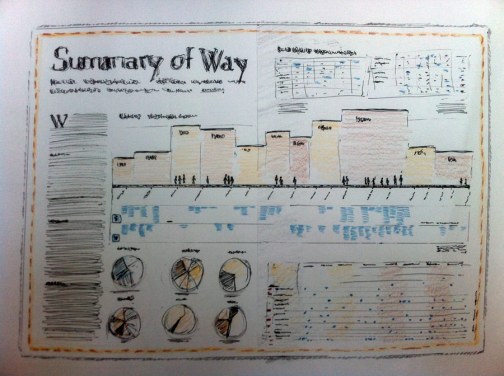
Compare that to this, below, posted by Cairo. It’s a work in progress, by students at a workshop. But you get the drift.

Wikipedia’s ‘truth’ formula needs tweaking. But by whom?

There’s has been a great discussion going on about what it takes for someone to edit an article on Wikipedia. I recently received an invitation to a survey of communicators on my experiences with editing wiki entries. Apparently this is connected to a point raised by Phil Gomes of Edelman Digital, who brought this up, creating a Facebook group to think it through. The group is called CREWE —which stands for Corporate Representatives for Ethical Wikipedia Engagement.

The story of who could edit Wikipedia goes back some two years, when Timothy Messer-Kruse tried to edit an article, and was rebuffed –scolded, really — by Wikipedia’s editors.  Read his article here. Messer-Kruse is an author of several books, including one on race relations. In other words, he’s not someone who just popped by Wikipedia and had an ax to grind.

Prior to that, there were more egregious cases where vandals, and  ‘trolls’ changed biographies of people or created conflict within the editors.

Fast forward to what CREWE is proposing. There’s a task force of communicators from IABC and PRSA looking into Wikipedia’s policies. I was asked to join, and gladly agreed.

If you are interested in following this development, join the Facebook group. I also came across this page  that summarizes what Wikipedia expects of editors.

  • Subjects require significant coverage in independent reliable sources.
  • Your role is to inform and reference, not promote or sell.
  • Write without bias, as if you don’t work for the company or personally know the subject.
  • State facts and statistics, don’t be vague or general.
  • Take time to get sources and policy right and your content will last.
  • Be transparent about your conflict of interest
  • Get neutral, uninvolved editors to review your content
  • Work with the community and we’ll work with you.
  • Communicate, communicate, communicate.

It’s more complicated than this, trust me, but it’s a start. There’s a line on this page that states “Be patient and open to cooperation: no one here is out to get you.” But hearing about some folk’s experiences, it sure feels like a tough space to operate in.

There’s also a page on Wikipedia that states Wikipedia is about verifiability, not truth. But there are other nuances, such as NOR – No Original Research– and Be Bold to master if you want to craft Wikipedia article that adheres to its formula for wiki truth. Worth reading, if your organization expects you to monitor and create content.