My upcoming book – about our ‘Republic of Chatter’

It’s time to break some news. I am at the final stages of a book about the power of conversations.

While it does analyze why audiences are more engaged (the stuff I’ve covered as a technology columnist for six years),  this is an attempt to peel back the layers of hype about social this and social that, and look at the operating system that lies at its core –human chatter.

As so many other ‘republics’ –Facebook and Pinterest, for instance– are being overrun by the masses, I have felt the need to look at why we can’t stop blabbing. The Republic of Chatter (a working title) also addresses another passion of mine, about the power of ordinary people to speak out, to rise above the chatter.

Stay tuned!

“Father of the Internet’ makes case for a freer Net

Vint Cerf, often referred to as one of the ‘fathers of the Internet’ since he helped design a key part of its architecture, made a strong case for a free and open Internet, and why the United Nations should not be in charge of it.

This was in relation to a meeting -apparently a ‘secretive’ meeting– by the International Telecommunications Union (ITU ) at the beginning of December. The idea is to make the ITU the Internet’s traffic cop. Observed Cerf:

“I am concerned, and I am not alone. More than 1,000 organizations from 163 countries have raised concerns about this upcoming closed-door meeting in Dubai. They are joined by hundreds of thousands of Internet users who are standing up for a free and open Internet.”

He has previously castigated the members of the ITU as a “breed of dinosaurs, with their pea-sized brains” who should not make decisions on behalf of the world. They haven’t “figured out that they are dead yet because the signal hasn’t travelled up their long necks,” he said.

The website set up to by Google (where Cerf is a vice president) to garner support for the cause, it says that “Only governments have a voice at the ITU. This includes governments that do not support a free and open Internet. Engineers, companies, and people that build and use the web have no vote. “

Being Obscure, clearly. Why ‘Romnesia’ and ‘Obummer’ distort elections

They are funny, memorable, and provide plenty of water-cooler conversations.

The campaigns know it. They must have gag writers on staff to supplement their communications and marketing people. The unfortunate thing is that they work.

Not the lines, but the distraction. They provide a sidebar to the main event that eventually drowns the real issue.

When Obama, fresh from his speech in New York this week (the annual Alfred E. Smith Memorial dinner, where both Obama and Romney delivered great one-liners, a tradition of that white tie event) fired up a crowd using a coined word ‘Romnesia‘ it supposedly lit up social media. Sure, it gave the president a stick to poke at his challenger, who has been gaining ground.

But in the last few weeks to the election, it is a huge distraction from what Obama and Romney should be doing: telling voters, especially those uneasy about both candidates, what they stand for. It may have pricked the bubble about the self-created entrepreneur, but it also treats an important election as a referendum on who citizens don’t like, as opposed to what they really want. Bumper stickers are all about this. Bumper-sticker campaigning just feeds this mentality that we don’t really need to know  (or read) the candidate’s policies, so long as we keep up with the tweets, and let the one-liner define our choice.

Locally, in Phoenix, we have one of the most intellectually embarrassing senate races, by Jeff Flake and Richard Carmona. Going by their ads, I personally don’t want any of them representing me.

Like both major parties, they spend millions on tarring each other’s reputation instead of telling us why we should pay their salary. Worse, they hide behind shady organizations that pretend to represent us, who pay for these spiteful spats.

Take a guess: who might ‘Americans For Responsible Leadership’ and the ‘Committee for Justice and Fairness’ represent? They are quite opaque –by design. These political action committees (PACs) poison the waters of democracy. Why?

  • They are still stuck in the mass media mindset, imagining that he who shouts the loudest will win our vote.
  • These nattering nabobs of negativism account for 75% of negative advertisements (a tar bucket that’s worth $507,240,744.99 according to the Sunlight Foundation)
  • Their ‘message’ –a mess of pottage, really– is clear. Don’t think, just vote! Their goal is simple, as in E.B. White’s words: “be obscure, clearly”!

To think we as a country spend billions trying to introduce democracy to other parts of the world!

Hungry for zingers? We citizens get what we deserve*

The cynical side of me wanted to skip the presidential debate this Wednesday. But with so much build-up and punditry surrounding this made-for-TV event that pretends to be a way a democracy decides on its leader, I gave in.

Truth be told, I am one of those decidedly ‘undecideds.’ I had decided to not be influenced by this stylized boxing match.

I happen to teach Language Arts, so I wanted to watch it from the perspective of rhetoric. I often I ask young people to pay attention to turns of phrase, juxtaposition, and tone-of-voice. It’s how writers and speakers hold –or lose– an audience. So in this debate I was less concerned with facts and half-truths (we have to expect plenty of the latter, in this setting) and more with how the idea was packaged and delivered.

My three observations:

1. Trickle-Down Twist: Many of you are all familiar with trickle-down economics, a term often associated with president Reagan, but really refers to supply-side economics. I liked how Romney added a twist to it, by introducing the term trickle-down Government.

“The president has a view very similar to the view he had when he ran four years, that a bigger government, spending more, taxing more, regulating more — if you will, trickle-down government — would work.”

Note how he forced Obama into a corner, by starting out the sentence saying his view coupling it with loaded keywords such as big government, regulation, spending

Obama’s come-back?  None. His limp attempt to punch a hole in this branch of macro-economics later, was a painfully professorial argument that was lost in the weeds:

“Now, that’s not my analysis. That’s the analysis of economists who have looked at this. And — and that kind of top — top-down economics, where folks at the top are doing well, so the average person making $3 million is getting a $250,000 tax break, while middle-class families are burdened further, that’s not what I believe is a recipe for economic growth.”

Got that? A 48-word summary of an analysis may have had its place at some dull economic summit, but not here, with a debate divided into tight ‘pods’ by the moderator.

2. Tax Cuts Vs Tax Offset. Obama  tried to clarify his position versus Romney’s as being based on tax cuts.

“And this is where there’s a difference, because Governor Romney’s central economic plan calls for a $5 trillion tax cut — on top of the extension of the Bush tax cuts — that’s another trillion dollars …”

But Romney’s pushed back calling it tax offset, and attacking it thus: “Mr. President, Mr. President, you’re entitled as the president to your own airplane and to your own house, but not to your own facts.” In effect, he was pushing the president into a corner, saying “liar, liar, presidential pants on fire.”

Romney may have been, as numerous fact-checkers very quickly pointed out, tiptoeing with his numbers himself. FactCheck.org called him “a serial exaggerator.”  Romney’s website does state clearly he plans to “Make permanent, across-the-board 20 percent cut in marginal rates” and “Eliminate taxes for taxpayers with AGI below $200,000..”  But who reads campaign websites? It’s too much work; much easier to watch the debate pod!  Romney’s zinger about the airplane +White House +facts was perfect for the Twitterverse.

3. Birdseed For Social Media. Speaking of Twitter, you have to imagine that Romney’s attack on Big Bird was a well planned sidebar. It is a silly piece if information, since PBS accounts for such a minuscule amount of government money (the govt spends $0.223 billion on PBS vs $4 billion subsidizing oil companies). But it adds color to a dull fight between two men in suits on a dark stage.

I believe Big Bird was seeded by those the Romney campaign who knew social media users would love something not-so-boring to tweet about. The yellow bird generated 135,000 tweets per minute while the debate was on! One of the many insta-Twitter accounts that ensued, @FeedTheBird, has tens of thousands of followers.

Will social media, or even the ‘verdict’ of who won, matter in whom the country chooses? My optimistic side believes it will not. But we cannot discount how TV debates have indeed swayed elections. If you are cynical, you will want to believe that we citizens feed this machine that produces a televised horse race. We are ready to scan past the deeper arguments and remember the zingers, and the candidates feed our appetite.

Coir brushes, smart phones – How a small rural community found a market

The human connection, and the grassroots involvement is a preamble to this story which was published this month in LMD Magazine.

A few months ago I interviewed a program manager at a major grass roots organization in Sri Lanka. Isura Silva’s story is fascinating. It’s about a pilot project involving smart phones in a very small village in Kurunegala, about 45 miles from Colombo.

The project, by Sarvodaya Fusion, put 21 Google Nexus phones in the hands of the entrepreneurs, because -despite a very high penetration of mobile phones in Sri Lanka –that village wanted education, and the ability to digitize the information they were generating.

The ‘information’ in this case was details about the coir brushes that they were making on very (very!) small scale. Tweaking the laws of demand and supply effects are not enough for a product to achieve scale. If no one knows you have an awesome product, no one wants to buy, and you could remain a small business forever.

Soon the producers were photographing their coir products and uploading it to a Facebook page, using the smart phones. Within a short time, a major marketing and distribution company, Hayleys Exports (which exports textiles, tea, construction material and coir products) had seen the product and began a conversation. They agreed to buy one million items a month.

Was it the power of a smart phone, or the power of conversations they enabled?

Smart phones are opening up a dialogue with those involved in much more than e-commerce.
In another town, Fusion holds blogging classes, and in another, they show young adults how to use a phone to teach themselves English.

Outside Sri Lanka this model is being tested by grassroots organizations using mobile technologies. UNESCO and Nokia held a Mobile Learning Week in Paris in 2011. Stanford and USAID has a program known as mobile 4 education 4 development.

While all this is going on, Silva is busy trying to find the next big thing for his organization,and how it could further mobilize the grassroots. He accidentally stumbled on Twitter, and has some ideas on that, but that’s a different story.

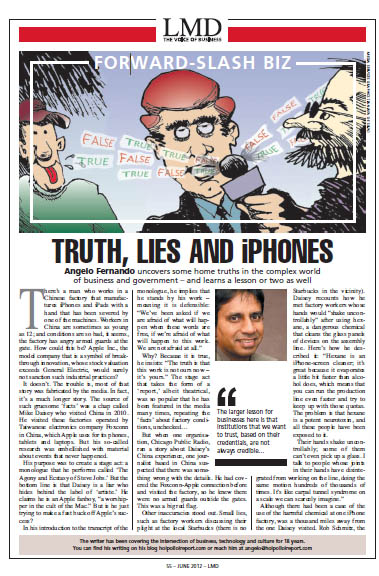
Truth, Lies and iPhones

I had been fascinated about the Mike Daisey story that broke some months back here in the US.

It opened up a can of worms about how truth (or ‘truthiness’ as Stephen Colbert put it) and how we twist and maim words and facts. Politicians do it, as do talk-show hosts, reporters, advertisers, scientists, corporate leaders etc.

As someone who writes for the media, I thought this brouhaha was way too important to dismiss as one man’s folly. Daisey was the everyman in a culture of compromised truths and spin; a culture that sometimes believes the means justifies the end in getting a message across. (Anyone remembers Message Force Multipliers?)  The infamous scientist who lied about climate studies admitted he had has a  “serious lapse” of “professional judgment and ethics.”

The classic statement by Daisey for me was this:

“I’m not going to say that I didn’t take shortcuts in my passion to be heard. But I stand behind my work… It’s not journalism. It’s theatre,”

Is marketing also ‘theater’ then? It could be argued that some aspects of it –product display, packaging etc– is staged, right?  Could some forms of PR (stunts, at least) be also considered theater? Are we sometimes taking Daisey-esque ‘shortcuts’? This is the uncomfortable space many of us operate in.

That’s the background to my recent piece in LMD Magazine, titled “Truth, Lies and iPhones.” Read it here.

Or download a PDF of the article here.

(Incidentally ‘truthiness‘ despite its quirkiness, became the Number 1 Word of the Year in 2006.)

Social Media and innovation surge in Sri Lanka

(This post is being updated)

Today in Colombo the tech and business community attended Social Media Day, a Mashable-coordinated event, worldwide in which 511 cities participated

Two days ago, they held another parallel event known as Refresh Colombo.

One of the organizers noted that the hash-tag #SMDayCMB, which had begun trending regionally (as a ‘tailored trend’) validated the fact that there was a highly engaged community now. Speaking of the community, it’s got the right volatile mix for innovation. One newspaper reported, it was a confluence of “hackers, bloggers, coders, geeks and geek lovers, journalists, techies, entrepreneurs and venture capitalists.” Note: the absence of one group here – politicians. In post-war Sri Lanka, steering clear of politics appears to be a well-honed skill.

One of the highlights was a video-link up with Jehan Ratnatunga in California. Jehan is the person behind the comic YouTube skits. Fittingly (for this social media savvy audience) he explained how he landed a job with YouTube because of his hobby.

Watch this presentation by two of the smartest young entrepreneurs who understand not just technology, but how grass-root change and politics works at a fundamental level.

Watch the whole thing (it’s 25 minutes) because the best discussion is toward the end.

More coverage of event

Augmented reality at point of purchase. Will it change the way brands ‘talk’ to customers?

When I first covered this thing called Augmented Reality’ people gave me a few blank stares. After all, in 2010, smart phones penetration in the US was 25 % of all mobile users, and was just picking up speed.

Today, smart phones account for 50.4 of mobile phones. The comfort level people show with using apps, and engaging with tools such as QR Codes and Augmented Reality is making those who work in Marcom rethink what they do.

  • Should they stop writing ‘copy’ and start writing story ideas that work in these personal, mobile spaces?
  • Is it time to retire headlines and tag lines, and think of ‘swipe lines’ — inspired by the fast growing habits of new touch interfaces
  • Should we stop thinking of ‘chunks’ of brand-laden text, and start thinking instead of scenarios for different moments during the point of purchase?

Take a look at this communication between the label of a bottle of ketchup and someone in the grocery story diving into content that hide behind the label. The content is no longer on the label, but somewhere in the cloud. With a small touch that information (a recipe, ingredients, a promotion etc) could be transmitted to the shopper’s smart phone.

It’s getting better! See how a Dutch magazine, Veronica, uses the same idea to make print come alive.

It blows my mind to think of the possibilities for print advertisers who could turn the reading experience into a point of (online) purchase.

Context is king. Book’s web site has lesson for us

I was looking up author, David Carr, after using a quote from him in my previous post. His is a fascinating story captured in his book, The Night of the Gun.
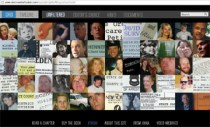
Since every book today has a companion web site, I nearly skipped it, assuming it was another content dump with blurbs and links. I was wrong!  It’s a trove of context, not content.

  • One of the tabs opens a page laid out in a grid of 60-squares. Click on each square and it takes you deeper into Carr’s story by way of candid interviews, photos, scanned documents etc.
  • Another tab has a timeline, which takes you on an online experience you couldn’t even come close to in the pages of a book.

The publisher, Simon and Schuster, notes that it created a database of content because Carr ended up with a large stack of material, recording his thoughts and interviews using many formats – video, audio, notes etc.

With help from the New York Times‘ digital guy, (a ‘User Interface Specialist!) they built a site as a multi-media backdrop, or more precisely, a back-story, to his memoir.

While it makes for a novel way to market a book, we could learn some important lessons in how to surround any other form of communication with rich, contextual information.

In the end The Night of the Gun is more than a book -a living story that cannot be contained within templates, hard covers or style sheets.