WebEx and that ‘ground control’ feeling

I’ve used several Web conference platforms over the past five years, and many of them have had their good, bad and clunky sides. From Skype and WebEx and Adobe, to those with particularly odd names, such as Oovoo and DimDim. I recently used Join.Me when working on my book, Chat Republic, and its screen-share option was stunningly simple.

But today, for a project involving NASA, and my school, we connected 27 classrooms via WebEx, and I have to say it was one of the most relaxes web chats I’ve ever had. I was nervous, because so much was at stake.

Some 425 children were all agog about being able to ‘Talk to an Astronaut’ who happened to be not just any astronaut, but the first Native American in Space, Commander John Herrington.

Students would step up to the phone (we were dialing in on plain-old-telephones to make sure the line was stable; no wireless gizmos!) and ask their questions, and could see Commander Herrington break into a smile and respond. More about that event here.

I was really impressed with the WebEx platform. It may not have the look and feel as, say Adobe, but it does the job by keeping things simple.

Sure, astronauts deal with instrument dashboards that you and I will probably never come into contact with, but for the rest of us –non rocket-scientists– the simple interface works. Especially when all we want to do is chat, just like we were in the same room.

Mars Day –and a chance to talk to an astronaut!

This year I’m expanding Mars Day (an event I started last year) to the whole school, thanks to the Mars Space Flight Facility at ASU, and NASA.

Students can’t get enough of science. I’ve been amazed at the interest from students as early as in Kindergarten. They already know the name and the spacecraft that put the first American into orbit. Some of them have even begun giving me artistic rendering of the spaceship that will one day take a human to Mars.

I love being able to tell them that by the time they are my age, it’s most likely that a human would be walking on Mars. I liberally borrow from Buzz Aldrin’s breathtaking vision of that time (in “Mission To Mars“) where he shows us blueprints for how we would be “a two-planet species”!

Back on planet earth, we are lucky this year to get Commander John Herrington, the first Native American in Space, to speak to my kids via video hook up. It’s a complex set up, making sure we have a stable connection into the library where students will talk to an astronaut, while the rest of the classes watch the event on their smart boards!

If we could chat with astronauts on the space shuttle, or get a live feed from a robot on Mars, this should not be complicated.

Stay tuned!

Review: “Chat Republic: A welcome change from the American-centric view of social media”

Review by Linda VandeVrede

Now that Twitter and Facebook have been around for several years, the ability to communicate with strangers and mobilize crowds seems an accepted form of crowd communication. Younger generations who are extremely good at texting have emerged as so-called “thumb tribes.” Yet as these voices continue to emerge, some corporations are still fearful of these public conversations and their implications.

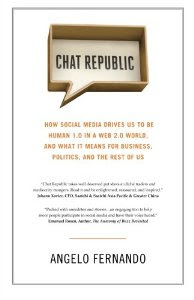
Angelo Fernando’s new book, “Chat Republic,” provides an overview of social media, including how it has evolved and continues to be a work in progress. It acknowledges that social media poses a threat to those who once controlled the conversations that took place within and without an organization. It acknowledges that social media has challenged traditional ingrained ideas about marketing and management, with some taking to it with abandon, some approaching it with a measurement of decorum, and some sniping from the sidelines without partaking. Angelo reminds us to consider communities in terms of what gets shared, not how. He points out that conversations between humans are inherent in our society; even FDR had “fireside chats” that made listeners feel as if they were participating, even through a one-way radio medium.

This citizen journalism scenario is messy but informed. This is not a bad payoff, Angelo observes. The hoi polloi, rather than a filter, decides on which media they will believe. Citizen journalism isn’t merely reactive now. It is becoming more proactive, where people proactively seek stories that interest them and share them with others.

Chat Republic is full of examples of times through world history when people have networked around monolithic authorities in small clusters, from homeless groups decades ago to the Middle East most recently. Still, there is a discrepancy in how people view social media. “There are those who see social media…as a transparency filter to let the sunlight in. There are also those who decry it as a lever that unlocks the floodgates to an unwanted stream of information and/or trouble.” The positives are that it improves trust and reputation. This is the new face of PR, crisis management and advocacy.

One of Angelo’s interviewees observes that people’s habit for deep reading has eroded: “Once I was a scuba diver in the sea of words. Now I zip along the surface like a guy on a jet ski.”

If you ever wanted a view of how social media has changed us for good, this is the book. Best of all, the data presented is multi-cultural, a welcome change from the American-centric view of social media that dominates most books. Angelo’s book is full of tips and case studies about how these concepts have been implemented effectively. I’ve always been impressed with his ability to pull in examples from all walks of life, and analyze the hoi polloi response to social media.

(Disclosure – Angelo was part of the group blog Valley PR Blog, with whom I blogged from 2007-2010, and I am one of the many people interviewed for and quoted in the book).

Picture Copyright: Adam Nollmeyer

Chat Apps don’t just destabilize business models, they ruffle governments

All this chatting is taking us somewhere, right?

Ever since I stumbled on Chat Apps, and discussed it toward the end of my book, I knew that this thing curiously called Over The Top applications (or OTT), could tempt some to see us, chattering masses, as instruments of mass disruption.

I was bemused to hear that the Vietnam government is trying to reign in the OTT business.  Wassup Mr. Nguyen Tan Dung? Worried about the revenue loss of telecoms or worried that the hoi polloi will be talking on their own terms.

Governments famously refuse to engage citizens, while pretending to call their system a participatory democracy. Some have suggested that the Internet disconnects as much as it engages people from public life. I was reminded of my conversation in April with Indi Samarajiva (on ‘Machine Readable Democracy’) when I saw this discussion.

It’s a tantalizing question. Could a participatory democracy be nurtured? Or should it be left to evolve organically?  Or as Jos Zepps puts it, could we build a digitized, engaged democracy from scratch?

Curation of Mixed Media memorializes painful past in Sri Lanka

I never discuss openly the events we went through in July 1983, when an ethnic violence broke out across the country, part-sponsored by sections of the government at that time.

I’ve shared some details with my children, but have tended to focus on the positive — the people who spoke out against the madness, the safe houses I stayed in etc. Perhaps it is one’s way of compartmentalizing the horror; of forgetting…

This week, in Colombo is a series of events around the theme “Thirty Years Ago.” Two days of dialogue, art and memories.

Sanjana Hattotuwa, TED Fellow and new media entrepreneur who has made this happen, puts it this way:

The project is an attempt to remember and probe Sri Lanka’s epochal anti-Tamil pogrom of ’83 through perspectives rarely, if ever, featured before. The producers have used a wide range of media and methods – from a mixed media triptych to info-graphics, from audio podcasts to video, from photography to compelling write-ups.

That’s right, a way of putting this ‘pogrom’ in context, by capturing the “anxiety, fear, violence, courage, love, sacrifice, of opportunities lost as well as well-springs of hope.”

The Web now provides us with new ways of dealing with history, and not just in real-time. We have become accustomed to seeing how shiny new tools and apps can help raise money, provide relief, or report on events. Dealing with the past takes more thoughtfulness. This is a mixed media project that not only informs us of where we have been, but where we might go.

Do visit the site at ThirtyYearsAgo.Asia

In Sri Lanka, these are the upcoming events

Sat 24 August

10am – 11am:    Reflections of ’83: Plus change?

4:00 – 5:00 pm    Art and Memorialising
Looking at how art plays a role in memorialising violent events

Sun 25 August

10 am – 11 am   Frames
How do we see our past, and thereby choose to learn from or repeat that which gave rise to violence? In framing histories, what are the politics of selection and exclusion?

4 pm – 5 pm   Media Matters
How did the media cover 1983, and why is it so difficult to find archival material on Black July?

Will there be a backlash against the Cloud?

There’s this amazing device sold on Amazon: a two-pack outdoor waterproof surveillance camera, for just $19.50 (with free shipping is you use Prime). Menacing looking. But it has one problem.

It’s fake.

Its a deliberate fake –supposedly for people who want to pretend their property is under surveillance.

Don’t you love it? We love to be watched so much we will pay money to pretend we are doing it ourselves. Couple that with the NSA-Snowden scandal, and this story about a Houston, Texas family’s baby monitor being hacked, and it’s enough to make some people long for the pre-digital age.

The Snowden scandal has new embarrassing ramifications, in the UK. The Guardian reporter’s partner was detained in Heathrow, and had his digital devices confiscated.  But it got worse. The British government demanded the newspaper smash its hard drives in the basement, under supervision. The Guardian called it “a pointless piece of symbolism.”

Which makes you wonder if people’s social media habits are going to nose-dive when they realize that we do pay a price for a surveillant society. Do we really need this darn euphemism called the Cloud? For every good story we get about being able to track down the bad guys (the Boston bombers were, after all, tracked down within a few hours because of …cameras) you get a surveillance-off-the-wall story. Incredibly worse than the baby monitor hack.

Presence Orb, is a British company that conducts what it calls “presence analytics” happily reported that hundreds of thousands of pedestrians who walked past recycling bins in London had been ‘stalked’ by the bins, which recorded the unique ‘MAC address’ of their smartphones. A bit of a hue and cry, and the government demanded it stop doing this. It did. Surveillance of people bad, bad, bad.

Smashing hard drives, very, very, good.

There’s a good reason (I now discover) I carry a small, scruffy notebook. My useful stuff is in the Cloud. My important stuff is in my pocket.

How do you prevent employees from reading a story? Use some nice gobbledygook

You can’t make up stories like this.

The Department of Homeland Security has sent a memo to employees that they may be violating their non-disclosure agreement if they click on a link to a Washington Post article.

It’s obviously a tricky legal thing. Employees are being asked not to use their work computers (referred to as “unclassified government workstations”) since doing so will “raise the level of your unclassified workstation to the classification of the slide…” Doing so, they warn, will cause “data spillage.” It’s also sensitive, being connected to the Edward Snowden affair.

That classified slide, featured in the Post, is about the program known as PRISM, that secretly collected downstream data about people from companies such as  Facebook, Skype, Google, Apple, Microsoft etc.

But the question remains: If DHS really fears such “spillage” why did it not block access to the site from work computers, rather than send out that lame memo? It’s as useful as telling 12-year old students “do not turn to page 296 of your reader; by doing so you will be in violation of the school’s policy.”

I find this very topical for another reason. I just interviewed a company called Safetica, about a product it  markets as ‘productivity’ solution – to monitor employees’ online behavior. It will not snoop into people’s content, it says, but collect data about the paces people visit and how much time they spend there. It gets more interesting: this data, can be viewed by both supervisors and employees!

Maybe Safetica ought to send DHS one month free trail of its data leak prevention software!

Google Street View in Sri Lanka, timely -as the ‘walls’ come down

I just wrote a bit of a cynical piece about Google Glass, but, as you may know, there is no shortage of parodies about this new, much-talked about product that will help people ‘augment’ the real world.

But my beef is not with Google, per se. It’s those whom I like to call ‘Shiny New OBject Syndrome’ types. You know, S-N-O-B-S 🙂

The point being, I question if we really need everything reduced to data, or meta data –basically data about data. Do we need an appendage that turns our analog lives that are inherently data-rich in human connections, just to bathe in digital?

In one of my presentations (when asked about Big Data in a Web 2.0 era) I referred to a person who told me how he was befriended on LinkedIn by an old school buddy. Great, he thought, and clicked the button! Then he bumped into the chap a day later, and the ‘friend’ ignored him. In other words, flesh-and-blood alums are so boring, huh? The data-based connection was what the person was after.

Oddly enough, I am planning an upcoming trip, and enjoying the data Google delivers – via Street View. It’s truly amazing how one company can basically index the world as we pass through it. One country at a time. So far Google, which began capturing Street Views in 2007, has 50 countries and counting. Included are Hong Kong, Thailand, Romania, Poland…

Sri Lanka will be soon in this group – reliable sources tell me. I could see why the tourism and leisure industry would want this. For businesses too. Imagine being able to drive through a bridge, walk up the steps of a temple, check out the neighborhood in an area you plan to set up a company etc..

Inviting this kind of visibility, also trains citizens to expect greater transparency in surrounding areas. The new data we will have access to would (and should) inform a nation’s business leaders and public officials to plan for providing data beyond the ‘Street’ level.  We should be able to drive by, virtually, and pick up data, and meta-data: forms, policy papers, constitutional amendments, meeting notes, speeches, parliament bills and voting patterns etc. Will these come? Well, look at it this way. In Colombo, the government has been strident in tearing down the physical walls around public places. Cynics see this is as part of the post-war beautification strategy. But even as we will be able to peer into the windows of an un-walled town hall or government institution, (while Google,simultaneously, begins to provide virtual views) the expectation will be for greater access.

It’s an experiment that many will be watching. (No expensive Glasses required)

Thanks for supporting the ‘Book Launch’ in Colombo

Just got back, after what seems like a whirlwind book launch.

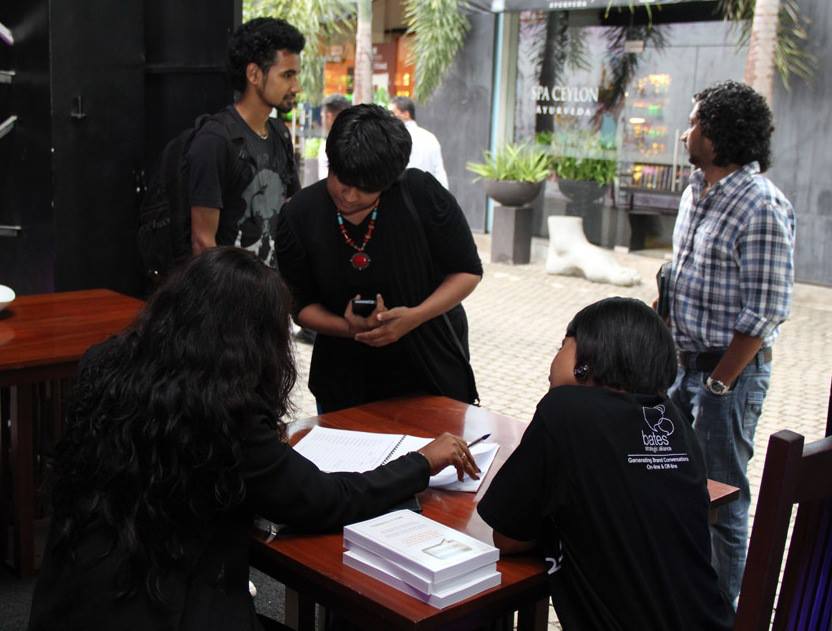
ParkStreetMews_5I’ve had to use the quote marks around ‘book launch’ because it was not originally planned that way. A series of events, coordinated by some of my friends at the last moment was beyond my expectations.

Those who made this happen included:

ParkStreetMews_3

While I got to talk of some of the most timely topics covered in the book — Transparency, for instance– I got to meet some very smart people changing the game of marketing, media and communications.

Social Media, which has been on the back burner for many in Sri Lanka (some say it still is, but that’s a debatable point) is being embedded in so many places it was hard to keep up. More on this in a post, later.

If you are interested, check for video clips at ChatRepublic.net, and #ChatRepublic hashtag on Twitter.

Microphones or Hash Tags?

Last evening, at the Sri Lanka Institute of Marketing event for Chat Republic, we tried to get the audience to chime in.

Some of the areas covered by the panel, which included representatives from a Leading Ad Agency, a Telco, a Research company, a Digital Media company and a Multi-Media publisher were topics that were outside the comfort zone of marketers. We did have some good questions, especially from someone who represented a startup digital shop, and those that came via Twitter.

But it makes me wonder about what compels someone in the audience to not pick up a microphone and ask a question, but instead do it in 140 characters. There is no right answer. It could be that for Gen Y, a hash tag is a more ‘authentic’ way to ask a question, since it is also in a public space. (We requested the use of the hash tag #ChatRepublic). Or are mics, sort of passe? Too much a left over from old media?

I tried to make my keynote less of a lecture and more as a conversation. In fact, on impulse –believe me, it wasn’t planned — I decided to step down from the stage as I tried to make the point of how social media, just like in education today, is all about getting off our soap boxes: Getting the sage off the stage.

In the end, I would have liked more tough questions. I am sure the panel would have liked to hear contrarian view points. The most contrarian one actually came from the least expected source – the moderator, Nimal Gunewardena.