Drone, Baby Drone and other Creative Apps at ISTE 2014

“Creative teachers,” said one presenter –whose name I couldn’t jot down because I didn’t have the appropriate app ready to scan his QR code at a 30-foot distance–“know how to sneak the really good stuff into their classroom.”
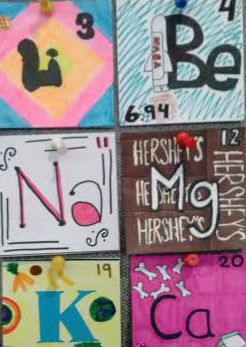
elementsAs this marathon ISTE conference draws to a close, there were so many sidebars, and concurrent darn-I gotta-skip events, it’s hard to pin-point one big thing. I ran into more creatives (the tablet-wielding types) per square foot than at any event I’ve attended. Students, too. More about that in a moment. And I don’t mean creative types in terms of the iPad-toting app-happy folk. There are teachers who have spent insane number of hours disrupting their lesson plans with science-ish, media-ish, technology-ish, math-ish hands-on work that you’d think they were running non-profit enterprises. (sidenote: I just recalled the afore-mentioned speaker – author of the children’s book, “ish” – Peter Reynolds.) Getting students to produce hand-drawn periodic tables because they work better with Augmented Reality. You get the idea.

This enormous body of work ought to be documented (Ok, Evernoted, Dropboxed, Google docked or Wikiid) for the 18,000 weary souls who will drag themselves to the train station and airport today. So that when we return to our students in August, we could pull up some of these big ideas to implement.

Consider some of the discussions and hands-on sessions. Most people outside of education (that’s where I came from) only hear of Arduino, Aurasma, SkitchReflector, and Qrafter at social media shin digs. Drone Baby droneThe rush (crush) to scan QR codes was so great at one point this morning there were lines of people –smart-phones poised– that rivaled Starbucks. I must’ve been the only tech blogger with an analog device –my notebook.

Most people think Maker Spaces are where wanna-be engineers mess around. One teacher at a small booth tucked away in a corner had practically designed a pinball machine kit for students to experiment with simple machines. No fancy app here, but ‘moving parts’ foraged from Home Depot and her garage: door knobs, furniture screws, bolts, rubber bands and ‘springs’ from spines of spiral-bound notebooks. Creative teachers really know how to sneak in the good stuff, on a budget.

In case you read my post yesterday, yes, this kind of creative pedagogical streak is very different from the cameras, cloud-based tools and Google-glas-ish shiny objects I ran into before.

THEN THERE WERE STUDENTS teaching the grown-ups. Lots of them. One group from Mexico brought a mine-rescue bot controlled by Bluetooth, a piezo-electric floor, a cardboard-model levitation train, and a swimming robot embedded in a large plastic bottle that can take water-samples of a polluted lake. Students! Others were showing off how to turn 2D images into 3D movies –ideal for digital time capsules. That palm-sized quadro-copter (above) is not however a student project, but a company who has STEM-ready drones that I just might use, soon.

One more day to go. I plan to skip the last keynote and go talk to more smart people…

And apps to download before I sleep. And apps to download before I sleep.

Ed Tech surge as educators prep for Common Core and more Science

ISTE_crowd1It’s hard to miss the optimism at the premier Education Technology conference here in Atlanta. Think of ISTE as the SXSW for teachers.

Supposedly attended by 18,000 people, it’s a bit like Disney Land, in some respects, with lines stretching hundreds deep. But the technology on show is extremely good, give and take a few shiny new objects.

For instance:

  • I ran into someone from the University of Penn, who’s got a content curation service that uses natural language processing (or nlp) which uses some kind of artificial intelligence and smart filters that a teacher can adjust to grade level. It made complete sense to someone who gets annoyed to hear ‘search’ referred to as ‘Research’. Google isn’t optimized for education, she said. Google is optimized for advertising and monetization. Duh!

PupppetVid_2b

  • There’s a tech coordinator and science instructor out of Colorado, Kristin Donely, who’s found a neat way to let students produce animated videos using a super-cheap green-screen technique.
  • I met someone using, and sat in a class on Augmented Reality (this app Aurasma is amazing) about bringing science to life.
  • I bumped into a team from New Zealand who has a way to let students improve their reading by a teacher adding drag-and-drop sound tracks of music, ambient sound and sound effects. They will let me try Booktrack for free; I could see a different use of it – to amp up my digital storytelling module.
  • Glass3Then there is the iPad economy – with companies developing apps, attachments, learning/tracking systems, engagement tools. The push to create 1:1 classrooms is huge. Steve Jobs must be smiling up there
  • I did see a few people trying to convince us that Google Glass is God’s greatest gift to pedagogy. This lady, Kathy Schrock told me that she believes Glass would be useful in projects that lets a teacher give new perspective to a lab in progress, and also have her hands free.
  • Speaking of Glass, this very cool camera from EXO Labs is more than a shiny new object –it could double up as a microscope for science projects and also stream images wirelessly. And of course, it works with (only) an iPad.

Could we kindly protect educators from buzzword-itis?

There are some words that make people eyes roll. Words like ‘cloud computing’, and ‘gamification.’ I won’t go into my favorite list here. Done it elsewhere.

I remember when I first ran into the term “the Internet of things” and wondered if it was some passing techno-babble. I had heard it from someone deeply involved in working on this, while working on an article. Now suddenly it is everywhere. And no surprise it’s cropping up in my profession –in education.

It is in the latest Horizon Report, a sort of annual, state of the Union piece about emerging technologies in education for the past 12 years.

If you scroll down to page 42, the authors remind us that (besides the fact that hybrid learning models and connectedness will be vital to learning), this Internet of things idea will be soon upon us. Well, in about five years. No wonder companies such as Intel have thrown a lot of brains and money on this. Acronyms too – they refer to it as ‘IoT’.

Speaking of buzzwords, I began swooping up a lot of them this week in prep for the ISTE Conference in Atlanta. I don’t blame my tech colleagues in education. They get swamped by the vendors Which suits me nicely because 70 percent of my other job as a tech columnist, involves ridding sensible business ideas of their buzzwords. This kind of sentence, for instance:

“Cloud Services, an open and massively scalable cloud platform purpose-built for the Internet of Things.”

And where do you think this kind of scalable, cloudy language shows up?

The afore-mentioned Horizon Report, aimed at educators, of course!


What Computers enable in our second ‘Machine Age’

I just ordered “The Second Machine Age” not because authors Erik Brynjolfsson and Andrew McAfee seem optimistic about the ‘digital engines’ that were able to diagnose diseases, talk back, drive cars, and write quality prose. But because they seem to acknowledge the thorny challenges we face as these new machines run our lives.

Think about the recent challenges: We are still surprised by catastrophic weather events, despite the satellites and other climate science tools we have. Our marvelous machines may help us locate a lost phone, but often miss the big things. Just consider what GM’s ‘system’ ignored or considered unimportant in their cars. Then there’s the lost 747. A friend recently commented how, despite all our tools, there’s something humbling about how we don’t have smart enough technology to locate something as big as an airplane.

The book is based on the work at MIT’s Center for Digital Business, at which Brynjolfsson is the prof of management at the Sloan School. I like his description (In a Ted Talk) of what he calls  ‘general purpose technology’ that changes the game.

It’s funny, but this seems to be yet another ‘MIT book’ that has crossed my path that delves deeper into the subject of technology compared to the usual blather about how good things are. Sherry Turkle’s Alone Together was a classic discussion in a narrower field of communication tools and robotics.

Facebook Fatigue builds up

I feel a bit better now that I watched the spoof about Facebook Life Filters.

A few weeks prior, I had submitted my cover story, Time to Exit Facebook and expected to uppset a few FB die hards. The article was published this month in LMD Magazine. I had pointed to some of my favorite annoyances –a few of which are brilliantly covered in the spoof!  These are the most annoying categories of users that drive us away:

The Graffiti Artist – The person who incessantly posts anything and everything he or she sees, thinks or does, because it makes him or her feel like a citizen journalist.

The ‘PDA’ Junkie – Someone who indulges in Public Displays of Affection (known in the pre-Facebook era as a ‘PDA’). This person thanks a sibling, or wishes a spouse in purple prose, an act that can surely be done with more class… in private.

The Random Shooter – Have smart camera-phone, will shoot anything: expensive cars, cumulus clouds from windows of aeroplanes, birthday cakes, children, hotel rooms…

The Poser – Someone who leaves smart comments, regularly updates his or her profile picture and delights in posing in selfies.

You could read the full article here.

Now that selfies are in, can we start ignoring them?

If I see one more selfie on a national awards show, I may gag. It’s getting rather tiresome, seeing grown-ups climb aboard a bandwagon that usually has reserved seating for self-obsessed teenagers.

Sure the made-up word entered the OED last year — but so did jorts and fauxhawk in 2012. It also trumped the word ‘schmeat“, the new word for fake meat. In case you needed to click on the above link, you are probably like me, shaking your head in despair.

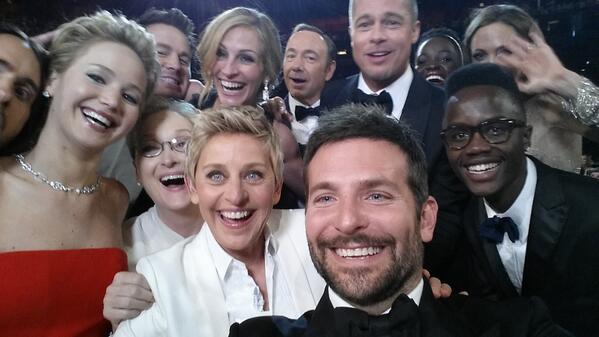
But to get back to selfies, yesterday on the Country Music Awards, there was a selfie moment, and we wondered whatever happened to human ingenuity. Didn’t Ellen make it clear that she owned that brightly lit space that celebs inhabit?

Just to cement the fact that we are in that moment in time when this awful word is rushing to meet us, there’s that annoying song. Obnoxious, albeit a wonderful parody of selfie culture. It’s title: “Let Me Get a Selfie.”

To add to this there’s the pres of the United States fawning over a selfie, as if it was the best thing that happened to image management –with a touch of product placement. I understand the man is desperately going after all the Likes and re-tweets he can get.

It’s time for people over 21 to calmly put away their phones and start real conversations.

Podcast – Blast From the Past –with BitGravity

I came across a podcast by Tracy Swedlow of BitGravity in 2009, when I worked at ASU’s Decision Theater. It made me go back to the early days of podcasting, and how it lit a fire that made me look at social media and self-publishing in a whole new light.

Link here:  Podcast with Bitgravity CEO
New News Podcasts with Tracy Swedlow on BlogTalkRadio with The TV of Tomorrow Show with Tracy Swedlow

Branding theories under scrutiny in “Absolute Value”

To call advertising as the ‘art of relative persuasion‘ is sure to get the major advertising practitioners to put you on their black list.

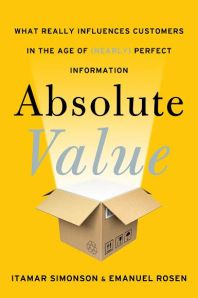
I just completed the book Absolute Value, and found it to be a larger thesis than the title implied. In some ways it’s a systematic take-down of several sacred cows of marketing, branding, the role of persuasion and much more. But what’s impressive is how the authors (Ithamar Simonson and Emanuel Rosen) do it in a calm, intellectual fashion, trying to assure readers they are not really picking a fight.

Book - absolutevalueThey observe how we customers have a hard time assessing the quality of products, so we typically use ‘quality proxies’ such as a brand name, prior satisfaction, country of origin, image of the store at which the purchase could be made etc. Oddly enough, we change these proxies over time. Think about this: There was a time when ‘made in China’ meant superior quality, but not anymore. There was a time our prior experience with a brand determined its replacement. Today? (I recently ditched another carrier for T-Mobile because prior experience wasn’t exactly great.)

Absolute Value gives you a three-part theoretical framework of how to promote brands –the P-O-M Influence Mix. I find it interesting how the authors steer clear of calling it the Marketing Mix. It stands for Prior Preferences (P), Other People (O), and Marketers (M).

Does this mean the death of branding? No! But it does reveal serious cracks in what is typically considered brand management –tied to Positioning theory, Segmentation etc. Today we are nearer to having perfect (or ‘absolute’) information about a brand we are considering because of the abundance of reviews, and websites dedicated to testing, comparing, or even disparaging brands. Bloggers and journalists prod and pry a brand’s claims to see if it is living up to it or the market hype, exposing the slightest flaw, or lesser-discussed breakthrough feature. Social media is a big part of this, obviously.and marketers should understand that their primary role is shifting from persuasion to (and this should not come as a shock!) communication!

In this scenario –this has to be troubling to ‘positionistas’ and those running loyalty programs—customers can evaluate a brand for what it is, rather than how it compares with other “choice-sets” they are allowed to see.

Sidenote: There’s a great story about Jonney Shih, who created a brand following with hardly any brand advertising. I was in the market for a laptop a few weeks back, so having sworn by a Toshiba for many years, guess what brand I bought?

‘Doodles’ push up the audio channels on Google

If you’ve been on the Google search page today you couldn’t have missed the tweak to the traditional Google Doodle. This one is for International Women’s Day.

To call it a tweak is to both understate it (and to state the obvious!) These Google Doodles are always a tweak up on what we have expected.

Notice, too, how these Google doodles now have a neat audio quality? On Valentine’s Day it featured mini stories by Ira Glass –the best ‘radio voice’ today in the U.S. Just like Ira’s show This American Life, Google encapsulated vignettes related to romance in (what else?) little colored hearts. You could read about that project here.

The point of all this is that plain old audio appears to be making a comeback. Big time comeback, if you consider how services such as Sound Cloud, and VoiceThread have become popular.  Is it that we have become jaded by video and pictures –with every mobile phone on the planet generating all this flotsam that wears us down? Or, is it that we may be kicking our habit of glazing over stuff, and now yearn for deeper content?

I didn’t mean ‘plain’ when I said plain old audio. Recording devices now capture a lot more quality than before. We can capture a lot more conversations, and almost make our mini audio documentaries with them. Our own little ‘Audio Doodles’.

And we are richer for this!

Now if only some rich uncle (or Google) would underwrite this idea

One more review of Chat Republic – “Long Live the Republic!”

Amazon review of my book, Chat Republic. The review is by Peggy Bieniek

“American designer, author and artist Edwin Schlossberg said that “the skill of writing is to create context in which other people can think.” Angelo Fernando does just that in his book, Chat Republic. Angelo gives his readers a lot to think about as it relates to our use and obsession with social media. He has included so much content, in fact, that he could have created a collection of books, each with its own conversation and tips about the many subjects that he covers in Chat Republic – podcasting, digital storytelling, communication by citizen-driven grassroots organizations, social listening, “democracy in the digital age” and so much more.” 

Read the rest of her review, here.