Brand Voices vs Brand Conversations

It’s easy to confuse the power of voice, when discussing ‘brand voice.’

(Don’t bother Gogling it, as there are some 441 million results, some of it with the predictable talk about signage etc.)

The Voice of the Brand belongs to two groups, depending on whom you speak to:

(a) The people who define the brand, and “know” what it stands for, and articulate it in their channels. This is really what I would call Brand Talk. Sometimes I cynically call it Bland Talk.

(b) The folks to buy it or use it, and talk it up in their own communities, and sometimes on the brand-owned channels. These are, arguably, more authentic Brand Voices. They tell you why people are using the product or paying attention.

But let’s cut through all this and look at brand conversations, to figure out what are the most valuable conversations? These are what social media helps us unearth: those incomplete, poorly phrased sentences, the angst-ridden, or cult-like exchanges in a forum, or comments section. Those self-appointed ambassadors and know-it-alls…

Sadly, brand managers are not always up to snuff on handling the latter; this sort of anarchy; of data-mining conversations; of engaging with those the bosses instinctively want to block or ban those outside voices from the website.

ONE OF THE FEW AD-MEN who bucks the trend and critiques one-way Brand Talk, calls for true brand conversations.

Nimal Gunewardena, CEO of Bates Strategic Alliance, happens to be moderating a round table discussion I will be part of, when I launch my book, Chat Republic, in Sri Lanka in a few weeks.

His screed about Brand Conversations, called for an abandonment of ‘sales talk’ and the 30-second-commercial mindset. It seemed akin to 1st century monks arguing against using calligraphy.

“It’s time to start thinking beyond that 30 second commercial. It’s time to combine the power of TV with the connectivity and engagement power of digital and social media. It’s time to explore new formats. Two-way conversations, rather than one-way broadcasts. It’s time to talk to communities who have common interests.

To which one person commented:

“oh how our vocabularies have changed recently! We are all part of a social media revolution and it’s simply not possible to have our heads deep in the sand any more.”

It’s so easy to provide knee-jerk responses to the role of conversations: To engage, to discuss, to share etc. I try to pry these apart in Chat Republic, and encourage readers to think of conversations as the ‘operating system’ for their community (OK, maybe the brand) they manage.

We cannot bury our brand-saturated heads in the bland.
Update on my book: “Chat Republic”

It’s official, and I’m now ready to announce the title of my book, which is in its final stages.

It’s called Chat Republic.

Angelo Fernando, Chat RepublicI’ve been covering the intersection of technology and business; technology and culture for more than 18 years. More recently, I’ve focused on digital media and our social media-centric lives, and I wanted to put my ideas into perspective.

Chat Republic is more than a fictional country. It’s about the spaces you inhabit.  Those online and offline communities you move in and out of: conference rooms, Google Circles, IM lists, Facebook, online forums. I think of it as a ‘country’ whose fluid borders take the shape of a giant, invisible speech bubble.

The conversations and opinions pouring in and out of our republic, in real-time, are what make our communities more civil, more vibrant. Our chats are certainly not friction-free! But absent these conversations we would be one dimensional citizens, won’t we?

As of today, I am planning to launch the book in two time zones, in June.

Some specs:

  • 25 Chapters – Divided into 3 sections
  • Case Studies from the U.S. and Asia
  • Interviews with non-profits, tech companies, activists, chief execs, editors, citizen journalists, PR consultants, podcasters, government officials

More information here at ChatRepublic.net

On camera, or on Mic, don’t over-produce your subjects

I am never comfortable whenever someone freezes that smile or his head angle for a picture I am about to take. It’s become the done thing to strike a pose. Not sure where this comes from, but I get the feeling it’s got something to do with a celebrity culture –and perhaps the media uproar when someone is caught looking less photo-ready.

I’ve also worked with PR people and know there is a solid reason to make sure the room is set up well so that the Big Guy (or Gal) acts natural. Controlling clothing, lighting, messing with hands or tapping on a table etc. There’s a good post about this by Paula Lovell, with a related discussion worth following at a LinkedIn group.

Gerard Braud is a pro at this and I’ve even sat in one of his media training workshops some years back at an IABC conference. He knows what he’s talking, so if you do have a client or am planing to put someone on camera, this is a great place to start.

But I have some comments about looking too ‘produced’. It’s not what the pros may say, but think about this:

  • Why should a CEO or thought leader always look like he/she never makes mistakes, and is flawless? Given the big push for transparency in communications in general, business and government in particular, wouldn’t the target audience prefer to see someone who looks slightly more human than studio settings permit?
  • A videographer or photographer could over-prepare a subject. Isaac Pigott makes a good point that the confidence from being who you are trumps all other external factors. That’s why teleprompters are scorned so much, today.

I my new profession, Education, I also teach children to present ideas and ignore the technology as much as they could. Yes I use cameras – video and DSL. I also put them in front of a microphone –corded and a ZoomH4N. It is possible to train them too much; it is also possible to let them come up with the most amazing things, unscripted, warts and all. I know what you may be thinking. They don’t have stakeholders to convince.

It’s a long shot from a CEO interview or podcast that I used to do until recently, but I’ve found some striking similarities in making them come off ‘as they are’ not as we want them to be.

If you are an educator, I write about these education issues at Voices-On.com

Being Obscure, clearly. Why ‘Romnesia’ and ‘Obummer’ distort elections

They are funny, memorable, and provide plenty of water-cooler conversations.

The campaigns know it. They must have gag writers on staff to supplement their communications and marketing people. The unfortunate thing is that they work.

Not the lines, but the distraction. They provide a sidebar to the main event that eventually drowns the real issue.

When Obama, fresh from his speech in New York this week (the annual Alfred E. Smith Memorial dinner, where both Obama and Romney delivered great one-liners, a tradition of that white tie event) fired up a crowd using a coined word ‘Romnesia‘ it supposedly lit up social media. Sure, it gave the president a stick to poke at his challenger, who has been gaining ground.

But in the last few weeks to the election, it is a huge distraction from what Obama and Romney should be doing: telling voters, especially those uneasy about both candidates, what they stand for. It may have pricked the bubble about the self-created entrepreneur, but it also treats an important election as a referendum on who citizens don’t like, as opposed to what they really want. Bumper stickers are all about this. Bumper-sticker campaigning just feeds this mentality that we don’t really need to know  (or read) the candidate’s policies, so long as we keep up with the tweets, and let the one-liner define our choice.

Locally, in Phoenix, we have one of the most intellectually embarrassing senate races, by Jeff Flake and Richard Carmona. Going by their ads, I personally don’t want any of them representing me.

Like both major parties, they spend millions on tarring each other’s reputation instead of telling us why we should pay their salary. Worse, they hide behind shady organizations that pretend to represent us, who pay for these spiteful spats.

Take a guess: who might ‘Americans For Responsible Leadership’ and the ‘Committee for Justice and Fairness’ represent? They are quite opaque –by design. These political action committees (PACs) poison the waters of democracy. Why?

  • They are still stuck in the mass media mindset, imagining that he who shouts the loudest will win our vote.
  • These nattering nabobs of negativism account for 75% of negative advertisements (a tar bucket that’s worth $507,240,744.99 according to the Sunlight Foundation)
  • Their ‘message’ –a mess of pottage, really– is clear. Don’t think, just vote! Their goal is simple, as in E.B. White’s words: “be obscure, clearly”!

To think we as a country spend billions trying to introduce democracy to other parts of the world!

Eat More Kale! (Just don’t brag about it)

If someone threatens to sue you for using a common word, whom would you go to for redress?

Well, if you’re a writer, or a mom-and-pop business owner, you may not be able to afford a team of lawyers. You may not think that a common word such as ‘think’, ‘eat,’ or ‘whisperer’ could get you into the cross-hairs of a team of copyright lawyers. But we live in such times.

Last week I spoke to Bo Mueller-Moore, someone who didn’t understand all of this. Bo is a Vermont-based folk artist who became an accidental T-shirt designer.

We grow kale (as you could see here) in our back yard. This story resonated with me. He comes across as a folksy, genial gentleman who might be the least likely chap to threaten a 1,615-restaurant business.

One of his shirts that he sells (he originally made three for farmer John down the street) read ‘Eat More Kale’. But a corporation began claiming the rights to the words ‘Eat’ and ‘More’ and thought that Eat More Kale would confuse its customers.
Bo has been imprinting t-shirts since 2000, and this is not the first time Chick Fil-A has come after him. (It dropped its earlier case after someone from his town sent them a polite letter saying they were going after the wrong kind of person who was no threat to them.).The company’s product? Chicken sandwiches. Sandwiches!

Last year the lawyers sent him the second cease-and-desist letter. This time Bo decided he was going to fight it another way, in another court –the court of public opinion. Which is located …in the realm of social media.

He took to Facebook, and YouTube, and has garnered thousands of fans.

Now I like Chick-Fil-A, and its sandwiches are one of my daughter’s favorites. But I can’t for the life of me imagine why they would think that a small T-shirt business, especially a short slogan promoting kale would ‘confuse’ me as a customer. Bo’s not a lawyer, but he summarizes his defense as plain and uncomplicated as a head of kale: “You can’t eat anything I sell.”

Oddly enough, while you hear of similar cases (Facebook, apparently tried to own the word ‘book,’ and Apple tried to make claims on the word ‘pod’) others who common English words don’t always get into this kind of trouble. Denny’s restaurant is currently using the word ‘whisperer’ to promote its fare.  The series of videos is called ‘Skillet Whisperer.’ (The word whisperer immediately conjures up the movie Horse Whisperer, doesn’t it?) Some folks in Wisconsin have a website called Eat More Cheese. Now they are definitely in the food category, even though a slice of cheese is a far cry from a piece of chicken.

If I were a PR agency advising Chick-Fil-A, I would tell them stop wasting their budget on expensive legal advice and allocate a tiny portion of that to a dude in the office who would listen to the awkward chicken-unfriendly conversations going out there in the blogosphere.

Better still, it could try to repair the relationship and channel the conversations away from anti-chicken talk. How?

How about a seasonal chicken sandwich with Kale instead of lettuce? That would be a nice gesture to the farmer John’s of this world. It may be wise to look back at how United Airlines got the ‘message’ when Dave Carrol took his story to YouTube, and did an admirable job of tuning in, and toning down the voice of an angry customer plus his millions of fans.

Gimme a grilled, spicy chicken-kale sandwich, Chick Fil-A. I’ll eat mo. I promise!

PS: My wife grows eggplant, parsley, and chilli peppers. On her behalf, eat more eggplant! Eat more chillies! Eat more kale, too!

Why Journalists go for your blog

There are some studies that compare a company’s Twitter profile to a blog.

The 2012 Edelman Trust Barometer study, which I’ve always found to be a fascinating read on where we are in social media practice, had some equally strong indicators as to where traditional and digital media sit on the trust scale.

For instance, trust in company’s web sites are (hold your breath!) up!

So this infographic, which summaries a survey by UK-based Text 100 is a good sidebar to the study. It speaks of engaging journalists using social media.

.

Wikipedia’s ‘truth’ formula needs tweaking. But by whom?

There’s has been a great discussion going on about what it takes for someone to edit an article on Wikipedia. I recently received an invitation to a survey of communicators on my experiences with editing wiki entries. Apparently this is connected to a point raised by Phil Gomes of Edelman Digital, who brought this up, creating a Facebook group to think it through. The group is called CREWE —which stands for Corporate Representatives for Ethical Wikipedia Engagement.

The story of who could edit Wikipedia goes back some two years, when Timothy Messer-Kruse tried to edit an article, and was rebuffed –scolded, really — by Wikipedia’s editors.  Read his article here. Messer-Kruse is an author of several books, including one on race relations. In other words, he’s not someone who just popped by Wikipedia and had an ax to grind.

Prior to that, there were more egregious cases where vandals, and  ‘trolls’ changed biographies of people or created conflict within the editors.

Fast forward to what CREWE is proposing. There’s a task force of communicators from IABC and PRSA looking into Wikipedia’s policies. I was asked to join, and gladly agreed.

If you are interested in following this development, join the Facebook group. I also came across this page  that summarizes what Wikipedia expects of editors.

  • Subjects require significant coverage in independent reliable sources.
  • Your role is to inform and reference, not promote or sell.
  • Write without bias, as if you don’t work for the company or personally know the subject.
  • State facts and statistics, don’t be vague or general.
  • Take time to get sources and policy right and your content will last.
  • Be transparent about your conflict of interest
  • Get neutral, uninvolved editors to review your content
  • Work with the community and we’ll work with you.
  • Communicate, communicate, communicate.

It’s more complicated than this, trust me, but it’s a start. There’s a line on this page that states “Be patient and open to cooperation: no one here is out to get you.” But hearing about some folk’s experiences, it sure feels like a tough space to operate in.

There’s also a page on Wikipedia that states Wikipedia is about verifiability, not truth. But there are other nuances, such as NOR – No Original Research– and Be Bold to master if you want to craft Wikipedia article that adheres to its formula for wiki truth. Worth reading, if your organization expects you to monitor and create content.

Think local, buy local, says Park&Co

You’ve probably seen how some cities (like this and this) have attempted to rein in local dollars and boost their economies with campaigns for buying local. We have our own push here with Local First Arizona, a non-profit group promoting your support of locally owned businesses throughout the state.

But apart from this move to nurture small businesses such as nurseries, nail parlors and ethnic restaurants, there is a lot of money moving out in terms of … advertising. Park & Co have put together a microsite featuring nine agencies (apart from Park&Co), with a push that urges companies to rethink where they s(p)end their dollars.

“You buy local produce, seek out locally owned stores, and drink local wines. So why go to other markets like L.A. for your advertising? Phoenix agencies offer a wealth of talent, from brand strategy and development to internationally award-winning creative, as well as innovative interactive campaigns and Hollywood-caliber film and video production. And you don’t have to look far.”

Park and CoAs Time magazine once put it, the buy-local trend “enhances the ‘velocity’ of money.” But most people only think of products, not services, says Park Howell, who says that it is time to focus on buying local business services, specifically advertising, creative and communications. “We’re promoting our competition because we’re big believers in a rising tide lifts all boats. There’s plenty of business to go around, so keep it local.”

Could PR industry do some crisis PR in post-BP mess?

Now that the BP oil leak has been stopped —or so we hear today — has anyone considered that it may be time to create some good juju for PR, after what BP has successfully done in maiming the industry?

Many of us PR and non PR types have railed against the dark stain that BP’s oil spill is leaving. I have tremendous respect for those who handle corporate PR whether they are consultants or internal PR folk. It’s a tough job getting the organization to say it as it is, and to stop publishing mindless statements just for the sound-byte effect.

So I was hoping to see a coalition of PR agencies coming together, perhaps under the umbrella of PRSA, and the CIPR (British PR association), to bring in some of the largest booms (thought leaders) and heavy equipment (smart technologies) to stop polluting our pristine beaches (er, reputation).

PRSA’s mantra is “Advancing the Profession and the Professional.” Looks like the industry has been mugged by flaks who are effectively planting land mines along this path. Search for BP at PRSA’s web site and you see articles such as “Can the BP brand survive Tony Hayward?” I was hoping to see some folks come out say why “BP’s PR has been toxic for their business.”

Meanwhile BP continues to write about its wonderful response about how it is “Flying higher to get closer to spill response,” and its sea bird rescues.

And nobody in the PR industry seems to mind.

Oil, tweets, and the gushing blogosphere will drown BP

There is no such thing as a ‘top kill’ procedure (the attempt BP made to put a huge concrete dome on the leak in the Gulf of Mexico) to cap off the gushing anger at BP  in the blogosphere.

Each day brings a new wave of voices –comments, creativity, social media channels –to shame the company that has caused the worst environmental disaster here in the US. Like this logo attack.

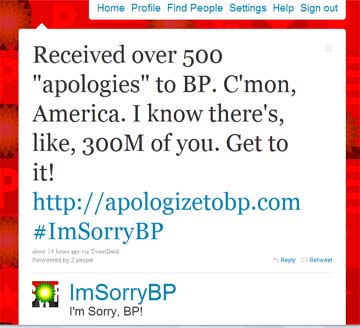
This one, a blog called Apologize To BP taps into the collective wisdom of anyone who has a twitter account, or some time to add some content to the site.

A post contributed by one David Diehl, alongside this picture, is titled ‘Sea Of Contrition.’ He apologizes to the captain of BP this way:

“Thanks again for inviting me to the yachting excursion this last weekend. I’m so very sorry I ate up all of your delicious shrimp during the preliminary revelry on Friday. The staff did indicate it was the last of the Gulf shrimp…”

Apologize, is acerbic and funny, obviously, but content like this (and there are hundreds of tweets being fed into the web site every minute) create a virtual gusher that intentionally or not contaminates anything that BP tries to do by way of PR.
I know, most PR people tend to say that it’s inappropriate to even use ‘ BP’ and ‘PR’  in the same sentence; the company has made so many PR blunders it’s not even funny.

The site urges readers to submit  “videos, photos, quotes, whatever you want, as long as you apologize…”

The feed of tweets into the site is a smart way to keep content flowing through the pages, even while it feeds the tweet-hungry searchers who only see it on the micro-blogging platform. The hashtag #ImSorryBP

At the time of writing, this Twitter account has had just 213 followers. I’s one more way that people will channel their frustration.

There are more. Check these hash tags that are being used to aggregate the comments and conversations:

#BP (of course, usurping the brand initials)

#oilspill

#gulfoilspill

So, despite the news that BP is trying to clean up its online rankings using SEO tactics such as buying keywords, it’s quite apparent that the groundswell is not going to be more powerful.