Quotes for the week, ending 29 Aug 2009

“He took the long view. He never gave up. And though on most issues I very much wished he would give up.”

John McCain, on his friend and Senate adversary, Ted Kennedy who passes away this week.

“IBM is trying to push this debate onto social nets via the most convenient device–the remote you’ve just used to switch channels. “

Fast Company story on the new move to get TV viewers to micro-blog from the couch.

“I would say I’m a different GoDaddy Girl.”

Erin Kalin, a mother and singer who is the latest GoDaddy Girl, who hopes to be a role model for young girls.

“I like to call that person The TMI  Guy.”

A post from CaliberPulse, on how each one of know someone who posts Too Much Information

“a kind of virtual race to get as many people online by the Olympics alongside all the real physical races that will be going on.”

Martha Fox, the British government’s digital champion.

“It’s a balance between the issue and the (one) person …“Pick people who symbolize the issue.”

Kimberly Dozier, on the challenges of being an ’embedded journalist’ in a session (‘Reporting from the frontlines’) at the SPJ Journalism Conference in Indianapolis.

Quotes for the week, ending 15 August 2009

“We’ve just had a demonstration of democracy.”

Senator Arlen Specter, after a person attending a town hall meeting shouted at him. The man was escorted out of the room, at a Harrisburg Community College.

“The Obama administration has delivered … a message of tough love. We are not sugarcoating the problems. We’re not shying away from them.”

Secretary Hillary Clinton, summing up her trip to Africa

“The Internet disrupts any industry whose core product can be reduced to ones and zeros ..it is the biggest virgin forest out there”

Jose Ferreira, founder and CEO of education startup Knewton

“Doing sustainability is fine, but being sustainable is where we want to wind up.”

Michelle Bernhart, author of “The Rules of the Game” in an upcoming edition of IABC’s Communication World magazine, interviewed by Natasha Nicholson.

“FriendFeed, in my mind, is the new RSS reader.”

Robert Quigley in Old Media New Tricks

“Macaca Day, for those of us who make our living from video on the Internet and elsewhere, is a holy day – the day that marks the birth of YouTube politics, and reminds us that citizens with cellphone cameras and a YouTube account – or at least an election.”

Dan Manatt, at Tech President, on the infamous comment by senator George Allen during the election campaign

“Google Voice “is merely symptomatic of that larger question.”

Ben Scott, public policy director of Free Press, a Washington-based consumer advocacy group in Washington, on the investigation on whether the carrier (AT&T) and handset maker (Apple) had anything to do with banning Google’s voice application from the iPhone.

“This is a decision based upon consumer experiences, child protection and our strategic investment to build up MSN Messenger.”

Geoff Sutton, GM of MSN Europe, on the decision to shut down Microsoft chat rooms in 28 countries.

//

//

//

//

Angry mobs or groundswell? Or just paid marketing?

What do you call a flash mob that has been paid for? Think hard before you answer this.

Now let me complicate it a bit for you:

When connected to a PR campaign, we tend to see it as the evil astro-turfing. Plenty of these examples around us. Those the angry mobs showing up with signs to loudly disrupt town hall meetings as a form of protest against healthcare reform, are suspiciously PR-backed astroturfing practices. TechPresident ‘reveals’ that there is a method behind this madness.

When connected to people protesting against a stolen election, we see it as citizen action —as we saw in Iran. streets

Then there’s the third kind. When connected to marketing, the flash mob could be used to bring attention to a product in a public place. Funny how we have no problem with this, even though it also disrupts civilian life, and appears to be a spontaneous expression of the hoi polloi.


This highly choreographed event earlier this year by Saatchi and Saatchi, for T-mobile at London’s busy Liverpool Street station is a good example of how the lines are being blurred as the radius between sender and receiver gets stretched.

Quotes for the week, ending 08 Aug, 2009

“The narrow prism of terrorism”

John Brennan, President Obama’s new counter-terrorism chief, saying the present administration won’t be looking at allies and other nations this way anymore.

FACT: You do own your brand and brand messaging

FACT: You don’t own relationships customers have with your brand

Beth Harte, at SocialMediaToday.com on Brand Vs Brand Relationships

“Washington Post Magazine ceases its XX Files feature in Sept. Probably cause?…the essays tended to focus on negative experiences with men.”

Tweet by InVocus

“But the pleasure of turning the page! I protested. The feel of something organic, not electronic, in your hands. The crispness…”

Jessica Burnette-Lemon, on looking at the Amazon Kindle

“Scare you away yet?”

Job description for AXIS Inc., for entry-level marketing position that requires knowledge in PR, customer service, sales…

“Successful candidate will have: 1) LinkedIn, MySpace, and/or Facebook account; 2) Twitter account with consistent, frequent updates; 3) Personal blog”

Job description for Social Media Director at ADF

“It’s a big surprise to me that my blog has meant that 250m people have not been able to enter Facebook.”

A blogger names Georgy, on the reason for the denial of service attacks on popular networks Facebook and Twitter.

“Military computers off-limits to tweeting GIs.”

Headline of article about the Marine Corps banning soldiers from using military computer networks to access FAcebook, Myspace and Twitter.

Quotes for the week ending 20 June 2009

“Students sell their internet access to their neighbors and they also do the same in public offices …”

A BBC report on blogging in China, Vietnam and Cuba, and how Cubans find creative workarounds to poor internet access.

“I wouldn’t know a twitter from a tweeter but apparently it is very important”

Ann Curry, quoting HClinton re: #iranelection

“”In California we vote on everything including whether we have to keep voting on everything.”

Joel Stein, TIME magazine

“We do a whole lot of tweeting during the Chapter 11 … we’re their ears.”

Chris Barger, Dir. of Communications for GM, in The LA Times

“Why hang out with celebrities when I can spend time with people who make me one?”

President Obama making fun at teh Broadcasters’ annual dinner.

What did Obama’s speech at ASU ‘look’ like?

Think of this as a post about the deeper side of  “just words.”

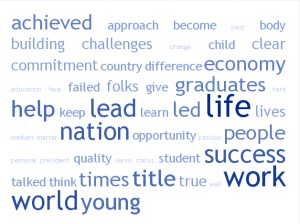
I love tag clouds and word maps. Maybe it is because we deal with visualization quite a bit at the Decision Theater. Last week I ran president Obama’s speech –the one he delivered to Arizona State University graduates– through tagcrowd, and it showed up some interesting emphases. Since we Comms folk at ASU covered the event quite a bit, it threw some new light on the speech.

Check it out here:ObamaSpeech_ASUGrad09_WordCloud

So now, here’s another look at that speech, this time the word cloud is generated through Wordle. The dynamic map is here, too.

ObamaSpeech_ASUGrad09_Wordle

Obama’s ‘Body of work’ speech gags critics

This video is worth watching, if only to see how the president of the United States put an overblown media controversy to rest –giving that phrase a new context, now.

For those not familiar with this flap, ASU had not intended to give the president an honorary degree –an old college custom lavished on commencement speakers. It was a policy that had been in place for years. But a statement by the university raised the ire of some, exacerbated by media chatter. The statement had the phrase “his body of work is yet to come” and attracted headline such as “ASU stiffs Obama.”

ASU didn’t change its policy; it created 2000 ‘Obama Scholarships’ instead.

So it was interesting to see the pres weave in that phrase many times, to take it to a different level. In the vein of any parent, any teacher that tells a young person ‘you never stop learning,’ and ‘don’t sit on your laurels…’ he stressed sacrifice and finding greatness that lies within. “Don’t stop adding to your body of work!”

The entire speech is here.

Quotes for the week ending 2 May, 2009

“If you’re out in the middle of a field and someone sneezes, that’s one thing. If you’re in a closed aircraft or a closed container or closed car or closed classroom, it’s a different thing.”

U.S. Vice President, Joe Biden

“Biden takes train after warning family to beware of confined spaces…”

Headline in ChicagoTribune.com on White House damage control over Joe Biden’s statement.

“The swine influenza outbreak makes Twitter more useful and somewhat useless, at the same time.”

Wayne Kurtzman, Media Bullseye

“Apparently the rate of infection is not as widespread as we might have thought.”

José Ángel Córdova, Mexico’s health minister

“Yes. And NO NO NO. Recently we’ve all been guilty of cheap and dirty!”

Lilamani Dias, CEO of LOwe, Sri Lanka, asked whether advertising standards have inproved over the past five years, on the occasion of the annual creative awards, The Chillies

“Social colonization is when every web experience will be social.”

Jeremiah Owyang, on the news about Facebook opening its walled garden to third-party developers.

Bottom line, Carnival should have been ready sooner with a statement and made it easily accessible on its web site. Surely it has a crisis communications plan?

Len Gutman, Editor of ValleyPRBlog, on the the potential cancellation of a crusie to the Mexican Riviera

Blogs suffer collateral damage in U.K. email scandal

As I was passing through London on Monday I couldn’t help notice the communications storm ripping through Number 10 and the media.

The case of spin doctors being used by Prime Minister Gordon Brown, seems to have consumed everyone from political consultants to the media and communicators on both sides of the political aisle. It was initially a story about slanderous emails, intended to generate content for a web site –one of those attack sites some organizations use. But it soon generated a lot of collateral damage.

As Stephen Pollard, an associate editor of The Jewish Times, in a commentary in The Times observed:

I am no starry-eyed fan of blogging per se. But I am evangelical about the benefits that it can bring – and I accept that the price of being able to print genuine exposés may be the freedom to print rubbish.

As a newspaper man who has turned to blogging he believes crises like these don’t create quite the firestorm unless mainstream media pours on some gasoline. (Note the headline the Times gave his piece: “Don’t be fooled by the power of blogs.”)

Other in-depth analysis included The Independent‘s story on the “Axis of spin” and the raging battle of other newspapers editors’ blogs.

Yes, blogs have become the connective tissue between much of PR, journalism and political communication. We all rejoice in this, but that’s a two-edged sword. In the UK, several cabinet MPs have their own blogs, more or less bypassing the traditional communications teams. Which has another interesting side effect: Not updating one’s blog during a communications crisis, could hereafter be construed as a bad move, too! Almost like offering a “no comment” when a microphone is thrust in one’s face.

Take  Tom Watson, the Labour MP who was one of the earliest to have his own blog. The Independent slammed him for being tardy on his posts saying “The digital expert staying strangely silent on the internet.” Apparently he’s stopped tweeting as well.

Oddly enough few are paying attention to the fact that this was basically an email scandal, since it’s now turned into a political PR issue, with blogs at the center of it.

For crisis communictions experts paying attention to blogs (or not) this will go down as a great case study. Stay tuned!

Quotes for the week ending 28 March, 2009

“This is to voice exception to Leonard Pitts’ use of an entire column on Monday to dis Laura Ingraham’s critique of Meghan McCain’s diatribe about Ann Coulter.”

Rick Melton, of Fountain Hills, Arizona, a reader of The Arizona Republic

“Obama slams CNN dufus…

Tweet after Barack Obama snubbed CNN’s Ed Henry, during a prime time news conference about the budget proposals.

“I got flamed for bitching about how facebook is like twitter, but thank god I have sympathizers.”

Jamie Ell, a student at ASU

“This isn’t something you can jump into without first reading the instructions. Your failure to first listen, empathize, and formulate a genuine strategy that inspires the community to grow the community will unfold publicly and damage the very attributes you wished to promote.”

Brian Solis, writing of the most thoughtful –and very long– posts on Twitter and how it is ushering a new era of relationship marketing that blogs gave birth to.