The “Windows in our Palms” and Digital Practice

There is no shortage of studies about the value or misuse of smart phones. It’s hard to find an adult who does not carry one. (For the record I know three people, and they are doing just fine!)

As a technology teacher in an elementary school, I must take into account the downside of too much tech, and too little ‘think time’ whether my students are involved in writing, weighing in during a discussion, or sometimes, even listening to instructions, undistracted by the screens to which we give them access.

These Digital Natives may rarely find a space that is free of technology, or an object or space urging them to turn to technology. For this reason I kicked off my classes with a unit on Digital Citizenship.

Technology is a tricky beast. Should we ban phones and roll out the cart of tablets? Should we discourage social media, but ask them to become familiar with ‘journaling’ a.k.a. blogging, one of the earliest forms of social media? Hmm!

Here are two pieces worth reading and watching:

“Why I quit Twitter” – Patton Oswalt, TIME Magazine 
Not just a discussion of Twitter, but a wonderful, commentary on how people are “peeping at windows in their palms.”

“Kids with cell phones. How young is too young?
A short video by CBS News about the pros and cons of cell phones for young children, and the need to model good practices, and teach ‘digital hygiene’.

Chromecast Vs Roku case rests (for now)

While many of you are staking bets on whether to back Germany or Portugal, I’ve been wrestling with another tough choice: Extend my content to other screens using Chromecast, or go with a media player such as Roku.

Chromecast is a slick little piece of engineering, with some issues not well explained when you open the delightful little box. One needs to figure out which platforms support Chrome and find a workaround those that don’t. To make matters worse, the Kindle does not support some apps that are available on other Android devices.

Which made me long for something quicker and needs no workaround. Roku has raced ahead and given us about three choices, so this week it was one hearing on my bench: Roku original, Roku 1, or Roku 2. Actually there are four choices: One’s a ‘streaming stick’ (just like Chromecast), and the other three are nifty little media players.

All this about the same week that the Supreme Court ruled against streaming television content via that other little rogue box, known as Aero. In an earlier hearing, some of the judges wondered if this was not what streaming media from the so-called cloud’ was all about.


Podcast – Blast From the Past –with BitGravity

I came across a podcast by Tracy Swedlow of BitGravity in 2009, when I worked at ASU’s Decision Theater. It made me go back to the early days of podcasting, and how it lit a fire that made me look at social media and self-publishing in a whole new light.

Link here:  Podcast with Bitgravity CEO
New News Podcasts with Tracy Swedlow on BlogTalkRadio with The TV of Tomorrow Show with Tracy Swedlow

‘Doodles’ push up the audio channels on Google

If you’ve been on the Google search page today you couldn’t have missed the tweak to the traditional Google Doodle. This one is for International Women’s Day.

To call it a tweak is to both understate it (and to state the obvious!) These Google Doodles are always a tweak up on what we have expected.

Notice, too, how these Google doodles now have a neat audio quality? On Valentine’s Day it featured mini stories by Ira Glass –the best ‘radio voice’ today in the U.S. Just like Ira’s show This American Life, Google encapsulated vignettes related to romance in (what else?) little colored hearts. You could read about that project here.

The point of all this is that plain old audio appears to be making a comeback. Big time comeback, if you consider how services such as Sound Cloud, and VoiceThread have become popular.  Is it that we have become jaded by video and pictures –with every mobile phone on the planet generating all this flotsam that wears us down? Or, is it that we may be kicking our habit of glazing over stuff, and now yearn for deeper content?

I didn’t mean ‘plain’ when I said plain old audio. Recording devices now capture a lot more quality than before. We can capture a lot more conversations, and almost make our mini audio documentaries with them. Our own little ‘Audio Doodles’.

And we are richer for this!

Now if only some rich uncle (or Google) would underwrite this idea

Why SoundCloud rocks

Whenever I get tired of reading the news, I switch to SoundCloud.

I’m currently doing a series of lessons with my students on audio, and having them experiment with the power of voice. (I know: It fits nicely into the theme I’ve been plugging in my book, Chat Republic.) Truth is, young people are enamored by video, and instinctively see audio as its poor-relation.

But ever so often, one of them says something in a microphone that makes them realize how simple and real an audio experience could be.

Here’s one that is part of an NPR experiment itself. An experiment to study why audio seldom goes viral.

It’s almost impossible to listen to this and not (a) feel close to the event (b) wonder how someone managed to record this near-death experience.

Polar Vortex gets media massage – delicious left-wing/right wing debate

Breaking News. Limbaugh’s argument freezes on contact! 

I have to admit the term Polar Vortex at first sounded a bit of verbosity aimed at making a big story out of a weather phenomenon.

But I did look it up, and find that for once, it is not one of those media marquees trotted out by a TV station’s graphics department.
But it turned out to be a delicious controversy, when good old Rush Limbaugh stuck his tongue out at the equivalent of a frigid lamp-post.  I first picked up the detail in the Discussion Pages of Wikipedia. One Charles Edwin, a Wikipedia editor (biting his tongue, no doubt) left this terse note in the Talk Pages:

“a lot about the media frenzy. Rush Limbaugh, like others, say they remember cold winters and walking to school in massive snow, uphill, both ways. 🙂 Rush Limbaugh is a student of global weather and expects there may be a three-day gap in the cold for Superbowl Sunday.”

Limbaugh called the term something invented by the left-wing media. Predictably so, since Limbaugh makes everything sound like a conspiracy, since that is the jet fuel which powers his craft. Here’s what he said on Monday.

“Now, in their attempt, the left, the media, everybody, to come up with a way to make this sound like it’s something new and completely unprecedented, they’ve come up with this phrase called the “polar vortex.”

To which weatherman Al Roker, threw a nice counterpunch, by revealing and reading from a 1959 college text-book that had the term Polar Vortex defined.

Sometimes these silly spats teach us something, especially about speaking out of turn –with poor facts.

Now if you’re wondering why I would be interested in this the Vortex debate it’s this. I just got back to school today, and as is normal, interrupted my lesson plan to get my fifth- and sixth-grade students to do a project on the Polar Vortex. 

As I used to tell people when discussing social media and the oft-contested topic called the ‘wisdom of the crowds,’ poking around the talk pages can take you to down some interesting paths.

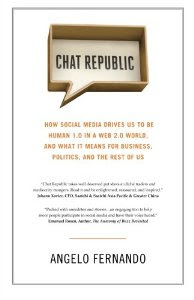
Review: “Chat Republic: A welcome change from the American-centric view of social media”

Review by Linda VandeVrede

Now that Twitter and Facebook have been around for several years, the ability to communicate with strangers and mobilize crowds seems an accepted form of crowd communication. Younger generations who are extremely good at texting have emerged as so-called “thumb tribes.” Yet as these voices continue to emerge, some corporations are still fearful of these public conversations and their implications.

Angelo Fernando’s new book, “Chat Republic,” provides an overview of social media, including how it has evolved and continues to be a work in progress. It acknowledges that social media poses a threat to those who once controlled the conversations that took place within and without an organization. It acknowledges that social media has challenged traditional ingrained ideas about marketing and management, with some taking to it with abandon, some approaching it with a measurement of decorum, and some sniping from the sidelines without partaking. Angelo reminds us to consider communities in terms of what gets shared, not how. He points out that conversations between humans are inherent in our society; even FDR had “fireside chats” that made listeners feel as if they were participating, even through a one-way radio medium.

This citizen journalism scenario is messy but informed. This is not a bad payoff, Angelo observes. The hoi polloi, rather than a filter, decides on which media they will believe. Citizen journalism isn’t merely reactive now. It is becoming more proactive, where people proactively seek stories that interest them and share them with others.

Chat Republic is full of examples of times through world history when people have networked around monolithic authorities in small clusters, from homeless groups decades ago to the Middle East most recently. Still, there is a discrepancy in how people view social media. “There are those who see social media…as a transparency filter to let the sunlight in. There are also those who decry it as a lever that unlocks the floodgates to an unwanted stream of information and/or trouble.” The positives are that it improves trust and reputation. This is the new face of PR, crisis management and advocacy.

One of Angelo’s interviewees observes that people’s habit for deep reading has eroded: “Once I was a scuba diver in the sea of words. Now I zip along the surface like a guy on a jet ski.”

If you ever wanted a view of how social media has changed us for good, this is the book. Best of all, the data presented is multi-cultural, a welcome change from the American-centric view of social media that dominates most books. Angelo’s book is full of tips and case studies about how these concepts have been implemented effectively. I’ve always been impressed with his ability to pull in examples from all walks of life, and analyze the hoi polloi response to social media.

(Disclosure – Angelo was part of the group blog Valley PR Blog, with whom I blogged from 2007-2010, and I am one of the many people interviewed for and quoted in the book).

Picture Copyright: Adam Nollmeyer

How do you prevent employees from reading a story? Use some nice gobbledygook

You can’t make up stories like this.

The Department of Homeland Security has sent a memo to employees that they may be violating their non-disclosure agreement if they click on a link to a Washington Post article.

It’s obviously a tricky legal thing. Employees are being asked not to use their work computers (referred to as “unclassified government workstations”) since doing so will “raise the level of your unclassified workstation to the classification of the slide…” Doing so, they warn, will cause “data spillage.” It’s also sensitive, being connected to the Edward Snowden affair.

That classified slide, featured in the Post, is about the program known as PRISM, that secretly collected downstream data about people from companies such as  Facebook, Skype, Google, Apple, Microsoft etc.

But the question remains: If DHS really fears such “spillage” why did it not block access to the site from work computers, rather than send out that lame memo? It’s as useful as telling 12-year old students “do not turn to page 296 of your reader; by doing so you will be in violation of the school’s policy.”

I find this very topical for another reason. I just interviewed a company called Safetica, about a product it  markets as ‘productivity’ solution – to monitor employees’ online behavior. It will not snoop into people’s content, it says, but collect data about the paces people visit and how much time they spend there. It gets more interesting: this data, can be viewed by both supervisors and employees!

Maybe Safetica ought to send DHS one month free trail of its data leak prevention software!

When storytellers ‘hyperlink’ they still pull you back. Do you?

I had to explain what a hyperlink is to my class last week.

It’s odd to see, through the eyes of a new audience, how the words we take so much for granted, are really a tad arcane. Yet we continue to use words and phrases such as URLs (no-one cares what it stands for), Cloud, hyperlink.

But just to explain hyperlink by focusing on the word link, made me look of how stories used to be constructed in a pre-Internet era, with built-in hyper-links. The storyteller used his craft to send the listener to a place and then craftily pull him back, thereby enriching the story. The whole back-and-forth link-out/link-back process is how we intuitively learn to write. To keep an audience engaged. (for this experiment I am not using any hyperlinks in this post.)

Take Hamlet, for instance. When he speaks to the ghost of his father:

Yea, from the table of my memory

I’ll wipe away all trivial fond records,

All saws of books, all forms, all pressures past,

That youth and observation copied there;

Shakespeare piles on metaphors of books, records, copying etc, to take the audience –an outbound link– to a place that provides some background to Hamlet’s state of confused state of mind, his ‘distracted globe.’

Now, nearly 400 years later, even as we experiment with ‘media snacking,’ we are increasingly aware that we don’t advance knowledge by reading headlines and summaries.

But while an actor could pull us back, we who abuse the hyperlink (just to show we know more about a topic), inadvertently encourage readers to drift off into some abyss.

Hamlet was, by his own admission,  ‘distracted,’ but he made sure we are not!

What could digital storytellers use to pull an audience back, to enlarge the story?

Citizens’ voices matter

A few years ago I conducted a series of webinar-style workshops for the U.S. State Department, for content creators, educators, marketers and those in traditional and new media. The workshops were called  “Passport to Digital Citizenship.”

I was convinced that citizen’s voices would be valuable, and –despite technological barriers and people who would try to keep them quiet– they could be heard.

So today, as my book is about to launch, I am thrilled to see this report by CNN on the importance of citizen-driven media.

Journalism has been forever changed — I’d argue for the better — thanks to the fact that people can interact with media organizations and share their opinions, personal stories, and photos and videos of news as it happens. This year’s nominated iReports are prime examples of how participatory storytelling can positively affect the way we cover and understand the news. 

(“36 stories that prove citizen journalism matters.” By Katie Hawkins-Gaar, CNN | Wed April 3, 2013 )

When we talk of  ‘participatory journalism’ we mean that ‘CitJos’ work alongside traditional media. They are not here as a replacement model, but to complement the changing media industry. Of the 100,000 citizen stories submitted to CNNiReport.com in 2012, they used 10,789 –having vetted them first.

I just interviewed the creator of a leading citizen journalist outfit in South Asia, and he stressed the importance of community guidelines, and careful design.

Citizen journalism, and the power of citizen voices is a big section in my book, Chat Republic.