Journalism is broken, ‘programming’ can fix it!

The “Journalism is broken” cry is not a new one, especially with the rise of citizen journalism, loss of readership and viewership etc.

So when a Journalist / programmer (an unusual combination of skills, don’t you agree?) tries to fix this crisis, it’s worth paying some attention. Adrian Holovaty has an idea of how to use the ‘data’ of a story to come up with a better narrative. Listen to him here

To me this approach is interesting not because I am a writer of business stories but because of where I work.

Data is the basis of every decision we make, whether we call it that or not. At the Decision Theater we take data and help create a narrative for policy makers to see what’s often invisible –either too complex to fathom, or simply buried in plain sight by a data smog. Data, once you connect the dots, could be used to construct scenarios. There is a whole lot of programming, data selection, data mining and layering at the back end. But the scenario shows up as a richer story. It is maybe about a discrete event, but it could have a wider relevance.

The news media is grappling with that same choices between creating the thumbnail or the sound bite versus giving people the context. Giving readers (and this applies to viewers, listeners, browsers) the former is easy, but like the evening TV news that packs a world event into a few seconds, the ‘story’ is crippled because it is data poor. The latter cannot be banged out on a word processor that easily.

The data-rich story needs a programmer’s mindset.

Journalists will blog about journalism. Resistance is futile

When you write about your own company, you’ve got to expect some push-back. Blog about your industry and you can expect a downpour.

That’s what happened when one newspaper intern, Jessica DaSilva reported on a company matter at the newspaper she was working at, the Tampa Tribune. Of course, this was not a report in her paper, but it had her byline (on her blog.) This was not about any company matter, it was a post about a layoff, and the editor in chief explaining it to the newsroom.

What made this blog post and the social media newsroom discussion that ensued acrimonious (and relevant to anyone in a job with analog-digital tension) could be summed up with this statement from the editor:

“We can see a better future for journalism right across the bridge on the other side, but the bridge is on fire, and if we just stand here, we are going to burn up with it.”

But the downpour came not from her employer as you probably imagined–for blogging about something as sensitive as a layoff — but from people who were angry that this young inexperienced person supported the ‘innovate or or obliterate’ concept. More than 200 comments later, she was ridiculed for a lot of things including blogging about a newsroom (“If I were your boss, I’d fire you for posting this. Is this your first job?”), her spelling and her misplaced enthusiasm ( “I really do admire your enthusiasm, but your post comes off extremely naive.”)

Many others rallied in support. When someone threatened her saying:

“I’m an editor at a medium-sized paper and I’m sending your name around to everyone I know in the business to make sure that you are never hired anywhere.

another responded:

“Michael: I’m an editor at a gigantic website and before that was in the print business for 20 years up to the largest metros, and believe me, if you had a full name, I would also send it around to everybody I knew to tell them not to hire the idiot who is willing to write off the career of a young woman who truly has a passion for a trouble profession — something we really need right now — because of something she wrote in a single blog entry when she was just starting out.”

The bridge was definitely on fire!

The digital world to many must seem scary and disruptive, but resistance is futile. John Byrne of Businessweek put it this way, describing his recent leap from print into digital journalism:

“I think of the web as not just another medium, but rather a new utility, like electricity. It’s print, radio, and television all in one, except better and much more than all of them together.”

Quotes for the week ending 19 July, 2008

The New Yorker, July 21 2008

The New Yorker, July 21 2008

“The New Yorker may think, as one of their staff explained to us, that their cover is a satirical lampoon of the caricature Sen. Obama’s right-wing critics have tried to create … But most readers will see it as tasteless and offensive.”

Obama campaign spokesperson on the incendiary cover of New Yorker magazine for the story Making it. How Chicago shaped Obama.

“Public relations and journalism are two players on the same team. We both rely on readers dedication…”

Cut Me Some Flack. A PR Blog by Robyn Itule, Shannon Danitz and Nicole Williams at Armstrong Troyky.

“Some are useful. Many frivolous. A bunch will waste your time. Not that there’s anything wrong with that.”

Edward C. Baig of USA Today reviewing Apple’s latest killer app, the App Store for the iPhone

“There’s always a candidate who gets more ‘new guy’ treatment.”

Chuck Todd, the political director for NBC News, on the excessive media coverage Obama is getting.

“Thus the natural cycle of supply and demand for silly infotainment slowly dumbs down the published content of any given site that chooses to pay its contributors per traffic figures.”

Jessica Reed, of the Guardian, writing about Gawker Media and its two intoxicated bloggers who were interviewed on a comedy show.

“I think there was at least one animal in there.”

Immigration lawyer, Geri Kahn, on visiting the Bar Association gathering in Second Life.

What a magazine’s colophon tells you

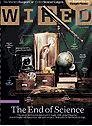
WIRED

If you are in any way involved in writing –and who isn’t?– and you have not thumbed through a copy of Wired, stop reading blogs, and get thee to a book store. The online version of the magazine will not suffice, either.

Why? The very act of turning the page, absorbing the impact of the typography, and juxtaposition of content will teach you something. The contents page looks different every time, the photo-illustrations are quirky, risque, challenging; the sections (like Artifacts from the future) and color really push the boundaries of print. And as for audience engagement, try putting it down after two minutes. I dare you!

Wired also does a few neat things you won’t see in many other publications:

  • Place cryptic words or phrases next to the publication date on the cover that relate to the cover story. July 2006 featured the letters ‘TMI’ because the story was about data. March ’08 was ‘Nothing is sacred.’ For the April ’08 cover story, Evil Genius, it was “original Sin.’ The story was about Apple.
  • Use photo illustrations that are basically articles condensed into illustrated stories and maps –a different way to tell a story.
  • Use a colophon. A what? Somewhere at the back of the book is a column set in all caps titled ‘Colophon.’ It’s one of those obscure words that derive from a much earlier print industry -tablets and manuscripts. It describes odd little details about the making of that issue including the blood sweat and bloody mary’s involved.

I’ve been reading Wired for about ten years now. It’s one of those pubs you know will not go away no matter where digital content is moving into, despite the dire predictions of the ‘Print is toast‘ crowd. Why? Because they pay attention to excruciating details.

Watching Wimbledon … on web radio!

The old truism, that the best pictures are on radio, passed the test last weekend watching Wimbledon.

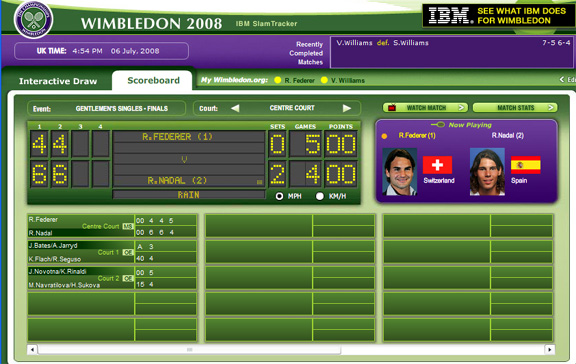
While watching the nail-biting Federer-Nadal men’s final last Sunday on NBC, I couldn’t stand the advertising breaks. So I did what many people do, played a game of ‘media tennis’ –toggling between TV and a laptop, TV and radio. The official web site of Wimbledon had a great digital scoreboard that beat the one on TV.

I am referring to what they call the ‘Slam Tracker‘ (left), a dynamic scoreboard with the interactivity we have come to expect. I could, for instance, click on icons to get details of the Swiss and Spaniard, and switch to scores on a different court in another window.

I then settled for muting the TV and logging on to Radio Wimbledon, that changed the game, so to speak. Especially when the game was stalled due to rain in the 3rd set. Later I discovered the commentary was a few seconds shy of being ‘live,’ but two things made me stay tuned: passion and interactivity.

As with the real game, media tennis has its tie-breaker moments. TV serves up high def pictures, multiple cameras angles, terrific slo-mo replays, and close-ups of royalty in the stands. Radio then slams a return with the commentators tripping over their vocabulary unable to describe the volleys and the 119 mile per-hour aces. It sure gets your adrenalin going.

As Federer succomed to Nadal I wasn’t sure whom to cheer for, the box that made me lean forward, or the box that made me lean back.

In the end I chose a hybrid medium called Web-Radio-TV, and it made this historic finale a rich media experience.

Quotes for the week ending 12 July, 2008

“He brought wit, grace and a great love of country to his work.”

President Bush, on Tony Snow, former White House press secretary who died today.

“But Obama is not just tacking gently toward the center. He’s lurching right when it suits him, and he’s zigging with the kind of reckless abandon that’s guaranteed to cause disillusion, if not whiplash.”

Bob Herbert, syndicated columnist for The New York Times

“Wake up and smell the rice Mr. Ploom! Im tired of Americans who don’t know a thing about the beauty, complexity or richness of Chinese culture.”

Online reader comment to a story about Ambush Marketing at the Olympics, by Businessweek. The story turned into an ugly exchange between readers from Japan and China.

“…it’s not the story about of the burglar who fell asleep on the resident’s couch that matters. Instead, it’s the everyday news affecting everyday life that we hope keep you coming back.”

Jacqueline Shoyeb, Online Editor, Mesa Republic

“As a metaphor, it’s strained. As a narrative –well, it has none.”

Bob Garfield, in Advertising Age, on the ad for HP’s TouchSmart PC, that he calls a large step ahead of the Mac.

“Together, they represent the real stories of the Games.”

Lenovo launching a web site called “Voices of the Olympic Games” featuring 100 athletes, from more than 25 countries.

Ambushing the 2008 Olympics, too irresistible

Beijing, 2008

Beijing, 2008

Someone’s going to pull off an ambush next month in Beijing. It may be a brand ambush, but it could also be a story ambush. There’s going to be a PR controversy over a brand defending the tactic, or someone attacking the ambusher.

I say this because of two trends that have collided:

  • The capacity to blur the lines between mainstream and viral, and
  • The field of diamonds that awaits the publicity seeker because of so much media attention on China

It could happen in a variety of ways, such as the old methods of sneaking in a T-shirt with a logo, a sign with an caustic slogan, or accidental product placement. But there are more sophisticated ways of beating the logo police. The whole idea of ambush marketing is to get attention not inside the Olympic village, but outside it. To you and me.

And that means defying not the logo police but the publishing police. Portable media such as smart phones and cameras can do that all too easily. Naturally the authorities have been cagy.

Rings around social media. And how about video sharing, live streaming, blogging? It’s so easy to stand up in front of an Olympic landmark -even a competitor’s sign –shoot a video and post it in a few clicks. The Official TV sponsor, NBC, may have the rights to all the venues, but rights means nothing to someone who has audience.

Rush to blog. Blog policy is being debated for obvious reasons. NBC has made sure it won’t be usurped by some media upstart, and is embedding its own journalist-blogger, Alan Abrahamson, at the games. Other blogs have cropped up fast, such as the New York TimesRings, and The China Beat written by a group largely comprised of academics. Not media people, mind you! If I remember correct, athletes are still allowed to blog.

At the time of writing, there are 23,800 YouTube videos that come up for the keywords “2008 Olympics.” This includes a BBC clip using a ‘pollution detector‘ that tells a damaging story. In sixty days you can bet that number will be a lot higher, and quite possibly include a few that document tales of ambush.

Earth to Live Earth: where are you now?

Anyone recall what happened on 07.07.07 or SOS? I don’t blame you!

Today is the anniversary of Live Earth the SOS call to everyone that took the form of a seven continent concert. NBC and satellite radio promoted it. So much has happened since then with regard to climate initiatives that the huge global music concert for planet earth seems like a distant dream.

There were ‘Green Guidelines‘ and an album summing up the event. But the event struck me as too much entertainment and less engagement, and I had hoped they would fix that in the months that followed.

Today there seems to be no news. No statements from folks like Leonardo DiCaprio and Al Gore who helped promote the event. Just a pretty (static) web site.

Quotes for the week ending 5th July, 2008

“”We are all Hussein.”

New York Times, reporting on how people are adopting Barack Obama’s middle name to counter those who are using it in a negative way.

“Twitter is the public square. Lots of noise, little signal. Blogs are like a speech. Signal, but little noise.”

Fast Company article on the power of Twitter, highlighting Tweets from Robert Scoble’s Tweetstream.

“Google is the perfect example showing reputation does not correlate with ad spending,”

Robert Fronk, senior VP-senior consultant, reputation strategy, at Harris Interactive.

“In this election the internet is for the Democratic Party what talk radio was for the Republican Party in the last 15 years”

Derek LaVallee, VP-U.S. public affairs practice at Waggener Edstrom, on research showing digital media preference of 18-35 year olds.

“I’m not retiring until every American agrees with me.”

Rush Limbaugh, quoted in the New York Times, in a story on his $400 million contract with ClearChannel.

“Twebinar”

A mashup of a name for a webinar (which itself is a mashup) and conversations talking place via Twitter before, during and after a webinar, attributed to Chris Brogan.

“Police wnt u to fight crime w/txt msgs.”

Headline for a story in USA Today, about Louiville, Florida police opening a text messaging tip line for teens to report crime.

“Your Personal Brand may be doing much more harm than good… to others.”

Mitch Joel, on a cautionary note about how people in an organization embracing social media should not expect others to have the same passion for it.

Associated Press could learn from Britannica

The attribution war between the Associated Press and bloggers may end somewhat amicably, but the problem is not going away.

Businessweek has called it “an early skirmish in what’s likely to become a protracted war over how and where media content is published online.” Who knows, one day they may involved in one.

The “AP way,” as Jeff Jarvis called it, may go down as trying to establish a top-down business approach in a bottom-up world. Or to put it another way, trying to force ‘monetization’ through the funnel of ‘syndication.’

It’s an odd time to try to lock down content and charge for it. I recently tried out Encyclopedia Britannica (and interviewed Tom Panelas) and came to the conclusion that instead of trying to set up snipers on the ramparts of the walled garden, Britannica has basically decided to create a new type of walled garden –leaving the keys to the entrance under the mat, so to speak. If a 240-year company can recognize the value in collaboration not confrontation, a ‘younger’ content repository like AP could surely follow suit.

If they don’t want to take a leaf from the page of Britannica, how about this experiment by David Balter of BzzAgent? He’s simultaneously selling and giving away (free download) a book called Word of Mouth Manual Volume II.

“Crazy like a fox, that Balter,” says Todd Defren, whose blog PR Squared is one of the venues selected to allow those free downloads.

“Protection is no strategy for the future,” says Jarvis.

“Content wants to lose the handcuffs,” says little old me.