Quotes for ther week, ending 12 Sept 2009

“Stories are a terrible way to store information.”

Zach Echola,  a founding member of Wired Journalists, on the role of journalism in providing context. Howard Owens and Ryan Sholin were the other two founders of Wired Journalists, an amazing resource!

“Things fall apart; the center cannot hold. Facebook, the online social grid, could not command loyalty forever.”

Opening line in an article in the NYT on people quitting Facebook.

“we now tweet and friend and tag. But that’s not all—we also listen.”

Colleen Ringer, Comms Manager, blogging about Downtown Phoenix Partnership’s new web site that launched this week. The site has bloggers and several social media options to help users find useful information and build a community.

“Probably not.”

Jim Nail, chief marketing and strategy officer of TNS Cymfony, on whether brands should respond to criticism via social media. The quote was in a  story about a false story about P&G’s Always circulating via social media.

“don’t worry we won’t tell your followers!”

TwittDir, yet another ‘let us help you get famous on Twitter’ type appliications that asks you to add your name in a directory chock full of models, sexed-up people.

“If you were expecting an Apple jetpack or an Apple hovercraft, or even an Apple tablet, you didn’t get that.”

Michael Gartenberg, a technology analyst on Steve Jobs reapparance at Apple’s launch of the iPod Nano.

For attendees at social media conference y’day

Hyperlinks may seem insignificant, but they can be subversive, helpful and enlightening.

At last evening’s video conference I suggested that one way of improving our communication is to embrace this ‘link economy.’ And since social media is the connective tissue, it keeps this economy humming.

It involves some loss of control, which makes it unsettling to some, but it also opens up plenty of new opportunities. I see these as falling into four groups:

  1. Collaboration  – It’s almost impossible to use social media with a control-freak, silo mentality
  2. Crowd Sourcing – We soon learn that ‘they are smarter than I’
  3. Content Curation – While everyone is creating, some of us better start curating
  4. Community Building – Social networks are nothing but communities.

Social Media lets us:

  • Conduct due diligence faster, deeper
  • Look at trends, by mapping out events as they break –swine flu, forest fires, crime rates
  • Bypass bottlenecks — from network outages, censorship, slow feedback
  • Tap into the ‘wisdom’ of the crowds –citizen journalism

Two great Citizen Journalism sites:

One other interesting way to enlarge a story I omited to mention: The Lede from The New York Times. By the way, it happens to be a blog!

On the topic of Citizen Journalism and Civic Journalism:

The purpose of civic journalism is “not to inform the public, but to form the public.”

– Charlotte Grimm, Scripps Howard Foundation

Pay attention to these:

  • Wolfram Alpha –a search engine that will knock your socks off!
  • TwtPoll –If you use Twitter, and want to check the pulse of your followers, try this!
  • TweetDeck – aA desk-top application that will help you manage multiple Twitter accounts
  • iPadio – a simple way to podcast from your iPhone
  • Flickr – much more than a way to share pictures with your inlaws!
  • BlogTalkRadio.com – a simple way to create a podcast using a phone!

Finally:

  • Forget scoops, and consider ‘swoops’
  • Less Content Creation and more Content Curation

Is content still king? Or is there a new crown prince?

This morning I am participating in a web video conference for the US embassy in Sri Lanka on how to think about social media.

My working title for this is ”Think Outside the Blog,’ considering how blogs have become the center of gravity for so much of what we do –what we produce, consume, how we distribute, connect, and participate in the so-called link economy.

I therefore will be digging deeper, and framing it around Cocktail Conversations –how web 2.0 (which has infected our listening and speech faculties) lets us communicate in a very crowded room.

Why is the room crowded? First because everyone is gate crashing the party! It ‘s not just crowded, but noisy because everyone –and not just PR people, journalists and marketers– has a voice. Unfortunately everyone has arrived at the party with a megaphone, rather than an antenna. As such in social media (as in social life!) the best communicators are the best listeners.

But I will also be broaching the topic of whether content is still king. I hear this all the time, at new media hangouts, writing seminars etc. I don’t dispute that cointent is VERY important (the alternative is fluff) but we don’t give enough respect to context. It’s way too easy to come up with, and deliver content. Context takes more work.

Another way to think about this topic is to think about who really has a voice today? In the market economy, those who had the money to run ads and PR campaigns controlled the conversation. In the link economy there are new contenders to the throne.

Quotes for the week, ending 29 Aug 2009

“He took the long view. He never gave up. And though on most issues I very much wished he would give up.”

John McCain, on his friend and Senate adversary, Ted Kennedy who passes away this week.

“IBM is trying to push this debate onto social nets via the most convenient device–the remote you’ve just used to switch channels. “

Fast Company story on the new move to get TV viewers to micro-blog from the couch.

“I would say I’m a different GoDaddy Girl.”

Erin Kalin, a mother and singer who is the latest GoDaddy Girl, who hopes to be a role model for young girls.

“I like to call that person The TMI  Guy.”

A post from CaliberPulse, on how each one of know someone who posts Too Much Information

“a kind of virtual race to get as many people online by the Olympics alongside all the real physical races that will be going on.”

Martha Fox, the British government’s digital champion.

“It’s a balance between the issue and the (one) person …“Pick people who symbolize the issue.”

Kimberly Dozier, on the challenges of being an ’embedded journalist’ in a session (‘Reporting from the frontlines’) at the SPJ Journalism Conference in Indianapolis.

Kill the leave behind for the long tail?

I had a very stimulating conversation with an editor today and we talked about the motivation to take everything that’s ink on paper to an online platform.

So the question I had was, do those who salivate after the long tail value of content (be assured I am a champion of this) really think that the printed product will lose its audience?

After all, as the popular argument goes, why would anyone pick up a magazine or a paper, when they could read the same content on a mobile device or on a laptop? 

My short answer to that: “experience.”

Anyone could duplicate the story, or even enhance it, for an online audience. But it’s no substitute for the print experience. Content that can be folded, torn, highlighted, photo-copied, taped to a wall, or slipped into a folder can never be substituted. Even on a digital reader.

Then there is our appetite for short-form and long-form journalism. Our brains are wired to shuffle between short content and in-depth stories; our eyes are trained to scan headlines, sidebars and  info-graphics; our bodies trigger automatic responses to seeing large bold headlines of shocking news (like this and this).

To those who say, “yes, but newspapers are filled with yesterday’s news,” my response is that sometimes, the story the day after, put together by thoughtful editors, is what we really want. Could we forget the front pages of thistory –on 09/12?

  • When that United Airlines flight splash-landed in the Hudson, were you content having followed the tweets in real time? Or did you crack open the paper the next day to see how the ‘miracle’ unfolded?
  • As of this morning, the wires and other online media updated us on the passing of Ted Kennedy -a story that all ink-on-paper publications missed for obvious reasons. Would you skip the “old news” in tomorrow’s papers, or will you dive into those broad contextual pieces, timelines, photos, eulogies?

As I told my friend, the problem we are facing is people buying into idea (urban legend?) about people’s reading habits , and partly in the fancy notion that the opposite of the (printed) leave-behind is the (digital) long-tail.

I should be the last person to say this, but digital is not a great replacement for all communication. Some times it is a really bad choice; cutting back on newspapers will be a self-fulling prophecy feeding the idea rather than responding to the notion that “no one really reads!”

The ‘news we choose’ won’t land on our doorstep

Long post alert!

As is patently obvious from this blog and my other work, I’m a big supporter of crowdsourcing and citizen journalism, wikis and collaboration.  Not just a cheerleader, but a practitioner. But I’m also a concerned citizen looking beyond the cool factor Digg, and the amazing possibilities of ‘knowledge’ aggregators, and the Twitter stream of consciousness.  I am awed by the new trends in journalism such as spot.us, yet I can’t resist picking up a newspaper.

The big question I ask myself, and am asked by others, is if our addiction to instant gratification, and near-ubiquitous access to content is making us more informed, and … more shallow? Is the blogosphere accelerating a trend where consumers grow up on a diet of context-free data, pinging on the walls of  interconnected echo-chambers? What’s that Eliot quote? “Where is the knowledge we have lost in information?”

Less than two years ago, Pew Research published findings from a study it conducted to see how crowd-sourced news differs from the news that editors of media organizations put together.

It found that:

  • There was a big difference –that “many of the stories users selected did not appear anywhere among the top stories in the mainstream media coverage.”
  • 70% of the stories users selected, came from blogs or Web sites such as YouTube and WebMd.
  • Recommended stories focused more on “news you can use” (such as advice from the WHO health advice etc)

Most concerning was this. It found that “Despite claims that the Web would internationalize consumers’ news diets, coverage across the three user-news sites focused more on domestic events and less on news from abroad than the mainstream media that week.”

When people do make choices of what news to stay on top of, they found that:

  • They seek it form sites that do not focus on ‘news’ per se.
  • Most stories they chose had very little follow up, and appeared only once, never to be repeated
  • They tended to choose news that was more sensational in nature, with a heavy dose of crime and celebrity

But having said that, citizen-based media is not the end of newspapers –and good journalism– as we know it.  A more recent study by Pew (the Project for excellence in Journalism) on the state of the media in 2008  found that citizens are playing a bigger part in news produced by ‘legacy media’ but citizen sites were few. Rather, citizens are being used more as sources than reporters.

What does this all mean? To me it’s not all that discouraging.

  1. Legacy media is just sampling what it means to empower the hoi polloi to fill the news hole; this tricky experiment is ongoing. Citizen sites are providing the kick in the butt for this trend, even through they aren’t kicking too hard.
  2. The news we choose may land in our RSS reader, not on our doorstep, but not in the way we can taste it now. Very soon some smart media organization is going to learn how to package legacy content and citizen content, blend the ‘Dugg’ stories with those reported by solid journalists, and deliver both.
  3. Unless a new type of journalism is taught in schools, the new journalism (content and delivery systems) will be a long time coming. The good news: Digital journalism is being taught in many places. Editors and publishers are taking on issues such as hyperlocal news, free vs fee, the semantic web

Rupert Murdock’s attempt to charge for online content, including content from NewsCorp’s newspapers and TV channels may be a flawed move, but it has woken everyone up.

(Incidentally, that story was also reported by Newser, an  “online news service that adds human intelligence to machine-driven aggregation”)

Ouch!

Quotes for the week, ending 15 August 2009

“We’ve just had a demonstration of democracy.”

Senator Arlen Specter, after a person attending a town hall meeting shouted at him. The man was escorted out of the room, at a Harrisburg Community College.

“The Obama administration has delivered … a message of tough love. We are not sugarcoating the problems. We’re not shying away from them.”

Secretary Hillary Clinton, summing up her trip to Africa

“The Internet disrupts any industry whose core product can be reduced to ones and zeros ..it is the biggest virgin forest out there”

Jose Ferreira, founder and CEO of education startup Knewton

“Doing sustainability is fine, but being sustainable is where we want to wind up.”

Michelle Bernhart, author of “The Rules of the Game” in an upcoming edition of IABC’s Communication World magazine, interviewed by Natasha Nicholson.

“FriendFeed, in my mind, is the new RSS reader.”

Robert Quigley in Old Media New Tricks

“Macaca Day, for those of us who make our living from video on the Internet and elsewhere, is a holy day – the day that marks the birth of YouTube politics, and reminds us that citizens with cellphone cameras and a YouTube account – or at least an election.”

Dan Manatt, at Tech President, on the infamous comment by senator George Allen during the election campaign

“Google Voice “is merely symptomatic of that larger question.”

Ben Scott, public policy director of Free Press, a Washington-based consumer advocacy group in Washington, on the investigation on whether the carrier (AT&T) and handset maker (Apple) had anything to do with banning Google’s voice application from the iPhone.

“This is a decision based upon consumer experiences, child protection and our strategic investment to build up MSN Messenger.”

Geoff Sutton, GM of MSN Europe, on the decision to shut down Microsoft chat rooms in 28 countries.

//

//

//

//

Quotes for the week, ending 08 Aug, 2009

“The narrow prism of terrorism”

John Brennan, President Obama’s new counter-terrorism chief, saying the present administration won’t be looking at allies and other nations this way anymore.

FACT: You do own your brand and brand messaging

FACT: You don’t own relationships customers have with your brand

Beth Harte, at SocialMediaToday.com on Brand Vs Brand Relationships

“Washington Post Magazine ceases its XX Files feature in Sept. Probably cause?…the essays tended to focus on negative experiences with men.”

Tweet by InVocus

“But the pleasure of turning the page! I protested. The feel of something organic, not electronic, in your hands. The crispness…”

Jessica Burnette-Lemon, on looking at the Amazon Kindle

“Scare you away yet?”

Job description for AXIS Inc., for entry-level marketing position that requires knowledge in PR, customer service, sales…

“Successful candidate will have: 1) LinkedIn, MySpace, and/or Facebook account; 2) Twitter account with consistent, frequent updates; 3) Personal blog”

Job description for Social Media Director at ADF

“It’s a big surprise to me that my blog has meant that 250m people have not been able to enter Facebook.”

A blogger names Georgy, on the reason for the denial of service attacks on popular networks Facebook and Twitter.

“Military computers off-limits to tweeting GIs.”

Headline of article about the Marine Corps banning soldiers from using military computer networks to access FAcebook, Myspace and Twitter.

The best news this week, release of Ling and Lee

Back at work after being off the grid for four days, it was great to see the news of the release of Laura Ling and Euna Lee.

The photos from Clinton’s visit struck me as being one of the most ridiculous photo-ops (since George Bush on the deck of an aircraft carrier).
Eight people looking shell shocked on the green rug, the wave mural in the background… Sheer political theater, with bad stage management.

How could this photo save face for a government that held two journalists captive? Everything about it reveals how tense, and cold the situation is. Why bother even taking this photo?

Incidentally the photo comes via the Korean News Agency which ran a story on ‘Trial of American Journalists” reporting their ‘crimes.’ I wonder if the State Department comments on, and the local media questions how KCNA frames the visit:

Clinton expressed words of sincere apology to Kim Jong Il for the hostile acts committed by the two American journalists against the DPRK after illegally intruding into it. Clinton courteously conveyed to Kim Jong Il an earnest request of the U.S. government to leniently pardon them and send them back home from a humanitarian point of view.

Of course, we know this is the stuff of propaganda.

Quotes for the week ending 18 July, 2009

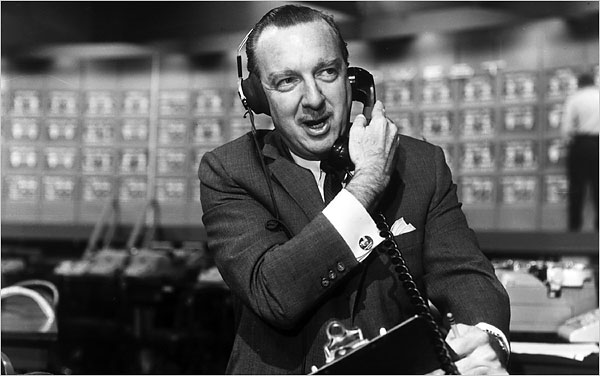
As we say farewell to ‘the most trusted man in America, I wanted to dedicate this week’s Quotes of the Week to Uncle Walter, a role model for me, and for many in journalism, and storytelling.

In seeking truth you have to get both sides of a story.”

“Everything is being compressed into tiny tablets. You take a little pill of news every day – 23 minutes – and that’s supposed to be enough.”

“Television [is] a high-impact medium. It does some things no other force can do-transmitting electronic pictures through the air. Still, as an explored, comprehensive medium, it is not a substitute for print.”

“Objective journalism and an opinion column are about as similar as the Bible and Playboy magazine”

“It wasn’t just that he narrated the spikes in modern history …Mr. Cronkite’s air of authority, lightly worn and unquestioned, was unusual even then.”

Allesandra Stanley, in The New York Times, about Walter Cronkite, who died on Friday.

“And that’s the way it is.”

Great summaries of his life here:

CBS News

Walter Cronkite School of Journalism and Mass Communication