Wikipedia appears to beat media in Chilean miner rescue

By chance I checked Wikipedia on the Chilean  miner rescue operation underway now (9.15 PM Pacific), and was pleasantly surprised to see two things going on:

The first was that Wikipedians are updating the site faster that Google results of news of the rescue operation.

San Jose Mercury News, Yahoo and others come up on search for ‘miner rescue’ with news

that one miner has been rescued.

Wikipedians noted that there have been two miners brought to the surface.

It took about another 10 minutes for the rest of the media reports to show up with this detail.

Meanwhile CBS News is streaming video via Ustream! http://ustre.am/2bWW

The second curious phenomenon will probably be discussed at length in the weeks after this. In what is clearly a sign of the times, where everyone is now a reporter,  the video from the mine captures at least two of the trapped miners photographing (or videoing maybe?) the event that they are part of!

Who’s watching what here? Who’s updating whom here? This is breaking news, and the subjects are reporting the story!

What’s a ‘Great Place To Work?’ Podcast of radio show

Employees are either ticked off or raring to go.  That’s the commonly held wisdom, right?

I wanted to find out and conducted a survey before my radio show, Your Triple Bottom Line.  Some pleasant surprises: A large percentage of responders have positive things to say about the workplace. (The survey is still open for a week, so that number could change.)

However, when asked to describe what a terrible place to work was, one respondent cited “Filth, blind micro-management, too many chiefs.”

Hmmm! Too many chiefs is a common refrain whenever I speak to companies about what’s the biggest stumbling block to a more collaborative workplace.

I conducted this snap survey because we were planning on asking our guest, a much-acclaimed author of the book Fired Up Or Burned Out, about what kind of leadership makes workplaces so dreary or at other times, inspiring. The book (it’s received great reviews on Amazon!) takes you into the ‘power of connection’ at work from the American Revolution to… Starbucks!

Show # 8 – with Michael Stallard

Download a PDF of the book free here.

Cross-posting this from the Show blog, Your3bl.com

What’s your story? Dump the ‘pitch,’ find your story!

I’ve said it before: radio, which seems a lot like ‘old media’ has one leg up over new media because it’s where people come to expect to hear stories. Not sound bytes, not pitches, not bullet points, not all those forms of condensed communication snacks we have come to expect in every other form of media.

Don’t blame it on TV entirely. There are TV programs that refuse to do the truncated story, shun the fast cuts, and slick camera work so as to let the story unfold. We have ingested this packet switching mentality that the Internet brought with it, and forced our stories into the tiniest bits of content. It’s become the default format, and we go along with it.

But guess what? It is not the only format that works.

Exhibit A: I listened to a long segment today on a new trend Daryl Hall started, called Live From Daryl’s House. It’s an internet phenomenon. But if it hadn’t been thoughtfully told as a story by NPR reporter Robert Smith, I would have skipped it.

Exhibit B: Radio again. This time I have to bring in the show I co-host with Derrick Mains as an example of how we make  ‘talk show’ (in most people’s minds it’s where the hosts yak all the time) into a storytelling space. We bring people around the topics of business entrepreneurship, innovation and corporate sustainability, and let their stories unfold.

Everyone’s tired of hearing pitches. Too many people tell you what they do in that distilled, dehumanized format. Stories have a different pace, and in fact, different goals. Yet they break through the clutter in a more powerful way.

What’s your pitch? Could you turn it into a story? Try it. Record it and listen to it. You’ll never want to talk in bullet points again!

Podcasts of first six radio shows!

For those of you who have asked, here are the links to the podcasts of the radio show I co-host on KFNX 1100, every Wednesday.

Show # 6:      8 Sept 2010 – Michael Muyot

Show #5: 1 Sept, 2010 – Park Howell and Donna DiFrancisco

Show #4: 25 August 2010 – Tom Szaky

Show #3:         18 August 2010 – Kathy Miller and Marty Metro

Show #2: 11 August 2010 –  Joe Turturica and Stan Alpert

Show #1: 4 August 2010 – Cindy Laurin and Andrew Nisker

Juggling radio and webinars –a lesson in distraction

I had as a guest in the studio Bart Butler, an IABC member ho wanted to do a  story of my radio show. So it was really flattering to see what came of it –an article in EDIT EXPRESS, the online newsletter for members bt members.

Bart came at  good time. Bad really because this was a week during which I was sandwiching in one of my webinars and the show, among other things. So the point he picked up,(that  radio is non distracting medium) has been on my mind a lot. Here’s why: As we put on our hats as content creators, it could be very annoying to deal with the glue and tape (and that conduits and access points) of media distribution. I find this point being driven home by a book i am not reading, Cognitive Surplus, by Clay Shirky, who talks of the fragmentation of the concept of ‘media’ today. It used to be a word that bundled process, product and  output. But I digress.

Here is his article: Social Media Guru Goes Retro…with Radio

I like to add one thing, Bart: The only reason we seem ‘relaxed’ on radio is that conversations are relaxing. Whether they happen on-air, online or offline. The moment you remove the talk-back button, that’s when sweat breaks out for me!

OK, two things. Please don’t use the word guru!

My new weekly radio show!

I almost forgot to break the story here. I started a radio show last week, focused on business. It’s called Your Triple Bottom Line.

Yes, it’s around the ‘Three P’s’ –People, Planet,Profits. I’m more into the first and the last Ps. (I leave the middle P to my wife, a small business owner, whom you would call a ‘deep green’ person.)

But it’s a great experience, being on radio. I trained at the BBC in London many years back as a producer, and have been a closet radio person all my life. Which is odd, being also into digital media. But I still maintain that radio is the true real-time medium, the first channel that brought communities and conversations together. The Internet simply borrowed the language and the model!

Derrick Mains and I co-host the show. There’s a social media angle here! I host and produce a podcast for GreenNurture, and Derrick has been a co-host of that show. Why radio? Have we got it backwards? There’s no short answer for this, but you will understand if you listen to the kind of guests we bring on every week.

Infographics pack stories – you unzip the meaning

The way I see infographics it’s not just to tell a story. That was the purpose an infographic was originally intended to serve.

I see it performing a different function in a media-saturated world. Fighting the attention economy!

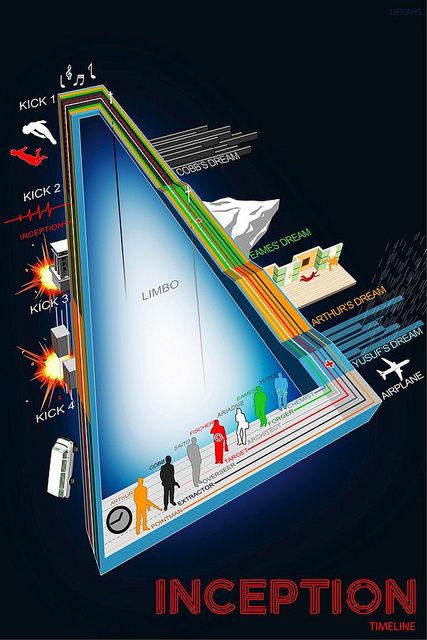
Inception infographic

Take a look at this. It’s not evident first what it’s trying to ‘say’ about the movie.

It’s a way of letting the reader unpack a level of meaning that would be different from the next reader.  It’s perfect for movies and complex narratives, where there is no one universal meaning. Great directors compress ideas and leave it for moviegoers to discover those nuances.

Oddly enough, journalism and advertising works in the opposite direction –even though both like to be also known as genres of storytelling. They like to bring pure clarity, and therefore unpack the details for the audience. (Check this simple, timely one on BP’s spending.) Worked until about five years ago. Today, consumers, newspaper readers (some call them media snackers for good reason!) don’t want that level of explanation.

Maybe you don’t have the capacity to embed an infographic into your commmunictaion, but you could learn the secret of leaving the reader to unzip his or her own meaning.

Could PR industry do some crisis PR in post-BP mess?

Now that the BP oil leak has been stopped —or so we hear today — has anyone considered that it may be time to create some good juju for PR, after what BP has successfully done in maiming the industry?

Many of us PR and non PR types have railed against the dark stain that BP’s oil spill is leaving. I have tremendous respect for those who handle corporate PR whether they are consultants or internal PR folk. It’s a tough job getting the organization to say it as it is, and to stop publishing mindless statements just for the sound-byte effect.

So I was hoping to see a coalition of PR agencies coming together, perhaps under the umbrella of PRSA, and the CIPR (British PR association), to bring in some of the largest booms (thought leaders) and heavy equipment (smart technologies) to stop polluting our pristine beaches (er, reputation).

PRSA’s mantra is “Advancing the Profession and the Professional.” Looks like the industry has been mugged by flaks who are effectively planting land mines along this path. Search for BP at PRSA’s web site and you see articles such as “Can the BP brand survive Tony Hayward?” I was hoping to see some folks come out say why “BP’s PR has been toxic for their business.”

Meanwhile BP continues to write about its wonderful response about how it is “Flying higher to get closer to spill response,” and its sea bird rescues.

And nobody in the PR industry seems to mind.

Live blogging, Wimbledon style

A lot has happened since I played a bit of ‘media tennis’ in 2008, watching Wimbledon . IBM had introduced the ‘Slam Tracker’ and I was toggling between the TV coverage on NBC,  watching the scores update online, and listening to ‘Radio Wimbledon’ streamed over the website.

This year, I find the live blog adds a new ‘camera angle’ so to speak. Check this one, covering the women’s game with prose like this about Tsveti Pironkova, who went on to beat Venus Williams:

“Tsveti is tserving up a tstorm. Strong but above all accurate. Bepa’s not getting a look-in at all and is totally on the back foot as Tsveti is following up her services with deep ground strokes.”

Enter the Red Button: The media is also covering Wimbledon in new ways. Take the case of BBC. For those of us in North America who don’t have the interactive TV experience that the Brits have had (I’m talking pre-internet, analog interactivity of Ceefax etc) there’s something called ‘PLASMA teletext content management solution.’

Today there’s the service known as the Red Button from BBC INteractive (BBCi). It is complemented by the functional red button on the new remote. Viewers watching Wimbledon, could select to watch the game from different courts, or engage in a discussion online.

Then there’s the podcasting and ‘radio’ coverage –a.k.a. Radio Wimbledon. Once again a great blend of behind the scenes information, rather than the volley-by-volley coverage we tend to get. This is how the blogosphere can provide a richer experience, whether you are at or following a conference, or an international event. I’ll end with this bit of writing by one Matt Hill, from the Radio Wimbledon blog:

Me? I sit in a small, windowless room at the end of the day and put the highlights together with a popular song. And I love it. This is for two reasons:

1. I suffer from chronic hayfever. I hate the grass, and the grass hates me.

2. It’s my chance to inflict my preferred music on everyone else.

In the end, this year, I settle for the live radio —that you can listen to here. As one listener’s commented (read on air by the broadcaster) “Who needs NBC, when we can have Radio Wimbledon.”