Filtering social media stories into ‘newspaper’

This is an interesting reverse phenomenon.

We’re used to traditional media being massaged into (‘poured into’ might be the more appropriate term) digital formats to create new distribution feeds.

So I was intrigued by the way a Swiss-based startup, Small Rivers, lets me pull in digital feeds from Twitter and Facebook, and create the look and feel of a newspaper.
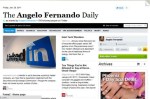
Here is a look at my newspaper for today, 28 January, 2011.

http://paper.li/heyangelo

Now I grant, this smacks of a vanity press affair, but if we think slightly outside of the ‘Daily Me’ the ease of generating an aggregation of  content might be give us  different approach to corporate newsletters. I subscribe to a lot of newsletters, or pull them in via an RSS reader. These custom news sheets, could be open up a new level of variable data print options, too.

Many years ago I managed a Print On Demand for a Marcom portal. It seemed liked the coolest thing at that time, but seriously lacked the kind of customization I was always asking for. That was because it lived inside a print company –tied to an Indigo machine— and not a digital content aggregator. Today, an organization with a team of writers who create content in a handful of social media channels could collaborate on a newspaper, and not even think of themselves as being in the news business. They could be marketers, researchers, videographers and bloggers whose output is turned into a news channel once a week.

No Indigo required!

In related news:

Six months in ‘multi-media radio!’

Can’t believe it’s been six months since I took up the challenge of starting the weekly radio show, Your Triple Bottom Line. It’s truly been a terrific ride!

There’s a lot that happens behind the scenes, lining up the guests, planning topics, keeping the content fresh on the web site –which runs on the WordPress blog platform — and using Twitter to chat with listeners, often while the show is in progress! Sometimes we upload photos, and have even tried video streaming. And then, after the show, I edit down the file (shrinking the commercial breaks, etc) to  a podcast format that I upload to iTunes and Libsyn. With so much multi-media rolled into the show, I find this new radio format invigorating.

It also lines up nicely with my other digital and social media work.

I am truly grateful to all our guests (who agreed to be under the microscope, so to speak), and of course our listeners. Thanks too, to my co-host Derrick Mains who is such a natural on a talk show.

Speaking of whom, listeners, many of you may have been tuning in to the live stream or listening to the podcast via iTunes, seem to add an international flavor to  show that happens to be primarily out of Phoenix Arizona. Listeners seem to come from Australia, Hong Kong, Sri Lanka, Chile, Brazil, UK, Israel and a few other places, apart from the national audience.

How do I know this? I use the URL shortener bit.ly, which has a great feature that tells us about incoming clicks on the live stream link, http://bit.ly/Your3BL.

Next week, we plan to do a survey to get more feedback from listeners. Till then:

A working model of ‘Social Capital’

I’ve been indulging in Wikis a lot this year.

I wrote quite a bit on the topic here and elsewhere, recently. And his Monday I was in charge of the wiki portion of what amounts to the launch of the first open source business development plan in Sustainability, for Arizona. More about this here.

So on Wednesday, when I visited Gangplank to get a better sense of this remarkable working environment I could not help notice the parallel.

If Gangplank is a piece of software, it would most probably be a Wiki!

It’s a a true collaborative space, whose ‘permanent residents’ (independent businesses) don’t pay rent, though they get to use the utilities, the workspace, conference rooms, wifi etc for no charge. Derek Neighbors, co-founder of Gangplank and our guest on the radio show this week, prefers to call this an investment in ‘social capital.’ It reminded me of another semi-financial term used in the book Groundswell –how collaboration earns a person ‘psychic income.’

But to get back to the topic of wikis, if you consider how much time has gone into Wikipedia –approximately 1 million man hours, according to Clay Shirky-– it is a model that works even among largely anonymous people. So of course it world work when you get a room filled with creative people.

Just step into Gangplank, and you’ll see a working model -or a ‘use case’ if you prefer another geeky term!

When you can’t broadcast, why not podcast?

A funny thing happened on the way to the radio station this week.

We had a great guest lined up, but were informed a day before that that time slot –7 PM Arizona time — was being preempted because the station, KFNX, had a prior commitment to carry the University of Arizona basketball game.

Rather than take a hiatus, I decided to pull out my trusty Zoom H4N and record a podcast with my co-host Derrick Mains. It happened to be a fitting week to talk of the launch of a baseline study by his company, GreenNurture and Miller Consultants. (More details here at the show web site.) This podcast also includes a report from Heather Clancy, our second on-the-ground correspondent.

The irony of this is, the radio show grew out of a weekly podcast! So, using social media-based format to broadcast a ‘show’  is more than a fall back. It’s an integral part of what I’m doing in radio in the digital era.

Do HR Managers ‘get’ social media?

“If somebody in your industry becomes responsive to social media,” observed Jay Baer,  “then your silence becomes deafening.”

He was talking of how listening in for customer feedback, and hiring employees who are attuned to these kinds of feedback mechanisms, have huge implications for business. “Everybody in your company is in ‘marketing,’ whether they are in Marketing or not.”

Jay, a social media strategist, much sought-after keynote speaker, and author of an award-winning blog, Convince and Convert, was our first guest on the show.

We paired him off with Patty Van Leer, Exec/ VP. and Chief Strategy Officer of NAS Recruitment Communications.

We decided to do a show to talk about HR practices, and how talent acquisition (and retention, and employee engagement!) has changed and is changing. Employees today live a greater part of their personal and professional lives online. “HR is still process driven, she observed, so resumes are still used because of application tracking systems. “We still live in two worlds,” she admitted, but also recognized that for generations coming out, building a resume isn’t the first thing that employees do. Building an electronic profile is going to be their gateway to introductions with companies.”

Great show, touching on the hot-button issues of branding, customer service, marketing, and workplace behavior.

At the front end of this show, we also launched On The Ground With Abigail Rethore, a new segment, that will become a weekly sustainability report from different parts of the country.

In the last 10 minutes of the show, Derrick Mains officially announced the launch of a Sustainazility grass-roots movement, and the launch of the wiki -at www.Sustainazility.com.

The podcast is now available on iTunes.

Cross posting this from www.your3bl.com

Are magazines this desperate in tablet era?

I had meant to publish this last week. The topic been on my mind as the print vs digital tension grows every day.

Every time I travel I do an unscientific check of the readers on the plane. I always find that newspapers and magazines beat digital platforms. Twice I’ve sat next to someone with a digital device – a Kindle and an iPad — and one of them showed me how the magazine reading experience with the ads, photos and all was awesome. The features, too!

This kerfuffle over GQ’s photo spread seems to suggest something I typically refuse to believe –magazine junkie that I am –that magazines will try anything to stay alive.

The photos that have angered many, are part of a story on Glee, the TV show. Why? They a dangerously seem to promote pedophilia. The Parent’s Television Council (PTC) has come out strongly against the issue.

Are magazines that desperate? Or is being borderline something, anything the only way to stay relevant? This is not the stuff of controversial magazine covers, a common technique since George Lois’ time, and before.

Maybe some magazines are engaging this kind of  risky business as they find their footing in the myriad of digital platforms available. Two clues as to where this is headed:

  • New Niches: See this interview by  Tom Wallace, the Conde Nast editorial director. He talks about using digital to reach audiences that magazines have been unable to reach. Maybe next year this time my in-flight survey will have different results…
  • Rich Platforms: Apple may be offering struggling pubs a lifeline with their  ‘rich-media wrappers for e-books and e-magazines.’ The iPad is obviously a precursor to the new home of –and reading experience –for magazines.

So indeed, magazines need not be so desperate. For now, some of them are just borderline …obnoxious.

Podcast on Green Teams

We had a jam-packed radio show on Green Teams this Wednesday.

If last week was all about the external aspects of greening an organizations -buildings and facilities management– this week was all about how health care organizations build green teams. The best practices, and the learning moments.

  • Colleen Cusick of Johns Hopkins Health System talked about the sub-groups in the team that take leadership in many sectors of a health care system.
  • Joan Plisko talked about the corporate culture that drives behavior, and the need to have everybody on the same page.

Here is a link to the podcast: http://bit.ly/your3BL13

Barrier for social collaboration: integration not motivation

I’m attending a webinar right now on ‘Leveraging Social Software for Increased Employee Engagement and Performance’ with Michael Fausette and Steve Paul.

Interesting slide here, earlier on, based on attendee poll.

The biggest barrier to collaboration appears to be:

NOT lack of collaborative tools

BUT: lack of integration with other systems, and that some in the organization won’t use the tools provided

The product being featured is Spaces, an enterprise platform for collaboration from Moxie.

Perfect timing for a discussion today on our radio show, at www.your3bl.com, where we are taking about Green Teams –Part II of our series. The typical tools teams have always been comfortable with are IM and email, while the more social tools such as Wikis and Twitter or even Sharepoint, pose too steep a learning curve to team members.

I’m going to ask our listeners to take a quick poll during the show to tell us what type of tools they are using today, and what they might consider for their team.

If you care to listen in, here is a link to the live stream: http://bit.ly/Your3BL
The show is at 7.00 pm (Pacific)

  • Ping us at @your3bl
  • Email us at contact@your3bl.com
  • Call us, toll free at 1866.536.1100

A formula for going viral? Picking Everett’s and Brown’s brain

I had a great conversation with Brown Russell, former Chairman of Gum Tech (GUMM:NASDAQ), last evening on our radio show.

Brown was behind (and by this I mean he led) the launch of Zicam –the cold remedy, medicine. I didn’t know this but Zicam was one of the fastest growing new cold treatments in recent history.

The reason I thought he would be a great guest was because of a book I noticed on his desk one day. It was one of those thick books on communication that communicators who have just graduated may have not even heard about: The Diffusion of Innovations by Everett Rogers, first published in 1962. (By the way Rogers published 30 books in 15 languages.)

To put this in perspective this was before the Internet was ‘discovered.’ And some of the concepts Rogers analyzed presaged  viral marketing by what, 40 years, maybe?

How do ideas spread and products take off, I asked? Is the diffusion of innovations across networks (the unwired kind) dependent on a marketing and PR push? Derrick brought us a good point –that demand, could possibly be influenced by planned scarcity (as in Apple’s play); by game mechanics (as in earning rewards), and filling the need that nobody has quite recognized (as in Facebook).

Here’s the podcast, if you’re interested. http://bit.ly/your3bl11

By the way, if you occasionally use terms such as ‘early adopters,’ ‘late majority’ or ‘laggards’ you’ve been borrowing from Roger’s theory!