2011 dominated by people rather than technology

It’s impossible to overstate how tumultuous a year 2011 has been.

Every year we seem to think that we have been shaken, twisted around, rudely awakened. Usually it’s about technology. But usually it’s about some life-changing technology, or a new ways of doing things. Refreshingly, this year there was a large human dimension to it, some of which I covered here on this blog.

It was as if we were looking through a camera and switching between two filters:  Pro-democracy and Anti-terrorism. But we also saw a share of media events, some even about the media!

  • The people’s revolutions in Tunisia, Morocco, Egypt, Russia, Libya…
  • In a surprising move, the US captured and killed of Osama Bin Laden — ten years after he declared war on the US.
  • Then there was Occupy Wall Street, a movement pooh-poohed by many but seemed to catch on, franchise-like, sprouting  arms, posters, and megaphones…
  • The shooting (and amazing recovery) of congresswoman Gabby Giffords dominated the early part of the year. At least here in Arizona.
  • The media scandal in the UK rocking Rupert Murdock’s empire.
  • The Kate and William extravaganza in the media -a.k.a. the royal wedding.
  • The earthquake, tsunami and nuclear disaster in Japan in April.
  • The passing away of Steve Jobs –perhaps slightly exaggerated as an ‘event’ (even on this blog!) But it made us consider how one man could have impacted so many.
  • Aung Su Kyi returned to the political arena, registering to run in upcoming elections

Human Microphones thwart heavy-handed bans

I’ve always been tempted to play with IABC‘s tagline, “Be Heard.” Do we business communicators really want to be the noise makers and talking heads? Or do we rather want to be the ‘inside voice’ of business strategy?

That’s why when I first began paying attention to the ‘Occupy” movement (OWS and its franchises  Occupy Oakland, Occupy Denver, Occupy Phoenix etc) I argued that we shouldn’t be too hasty to think of them as a fringe movement craving  just to be heard. Hard to pigeon hole, it was too easy to dismiss them because they didn’t fit the model of activist movements. I was reminded of  something innovators have reminded us from time to time. Disruptive ideas do not stem from existing templates. Marshall McLuhan put it well when he observed “I don’t know who discovered water, but it wasn’t a fish.”

Watching OWS evolve, it is interesting to see how they are inventing a  new template for being heard. Make that being taken seriously. They may be leaderless, but have found ways to have their own media team, financial system, and trademark bids. And I don’t mean media in the way we tend to think of it -the kind that come with a lens, a ‘like’ button, or segmented followers.

Much of the media we see being used in these movements are crude hand written signs.

When OWS group figured out that since electronic speakers and microphones are banned in public places (or require special permits) they created what’s known as the ‘Human Microphone’ –basically humans, en mass, repeating something a speaker says so that the sentences get carried across vast spaces of crowds. It sounds like a messy echo, but it is richer than the echo-chamber.

They have also begun another remarkable project in amplification: they are printing their own newspaper. Ok, that’s not new media. But it’s old media in a brand new way. (The fact that it is called, provocatively, the ‘Occupy Wall Street Journal’ may be a brilliant stroke of creativity.) But what really interests me is how they could do it with no real editorial hub, no newsroom, heck, no editor! (CORRECTION: See comment from Jen Sacks, below.)

There’s a livestream, of course, and someone who amounts to a news anchor.

How will this change media? Even if you’re not directly working in the media how this movement works with the groundswell will become one of the most lasting tutorials for anyone wanting to be heard.

Graphics, info-graphics and flat-out dubious statistics

I thought I loved info-graphics, until they were run over my marketing people.

Seriously. I used to find the art of info-graphics irresistible long before we they grew like weeds, online. The people who wee good at it were illustrators who worked for newspapers. Some complex heist, or a catastrophic event would be nicely compressed into an info-graphic in a newspaper.

Now there are so many info-graphics, I found this infographc about infographics!

But what exactly is an info-graphic?

It is usually used as a synonym of Data Visualization. But is it? The simple definition of DV is that it tells a story using data points. But it need not be a ‘graphic’ per se. It could be a dynamic time line, such as the Time Line produced by the Guardian, London. They created what seems like a nice graphic of the incidents of rioting in London in August. But it contains a slider that allows the reader to move through the days from 6th August onward, as towns from Tottenham to Ealing to… Liverpool reported incidents.

Here’s what it looks like. Click on image to launch visualization.

Contrast this to an Info-graphic, Big Brothers, about satellites that countries from Mexico to Pakistan to Iran have sent up.

To me the best info-graphic does these five things:

  • It summarizes a large volume of data in a snapshot.
  • It tells a story by helping our eye navigate complexity, and move between icons or illustrations that represent events, people, trends, hierarchies.
  • It is great at providing supplemental information on a page, when the publisher does not want to lose the reader who might turn the page, and jump to something else.
  • It provides a sense of scale, through visual tweaks, to explain something that might be difficult to comprehend, even with traditional data we cram into presentations (tables, lists, quotes, price points…) The orbiting satellites info-graphic above does a great job of this.
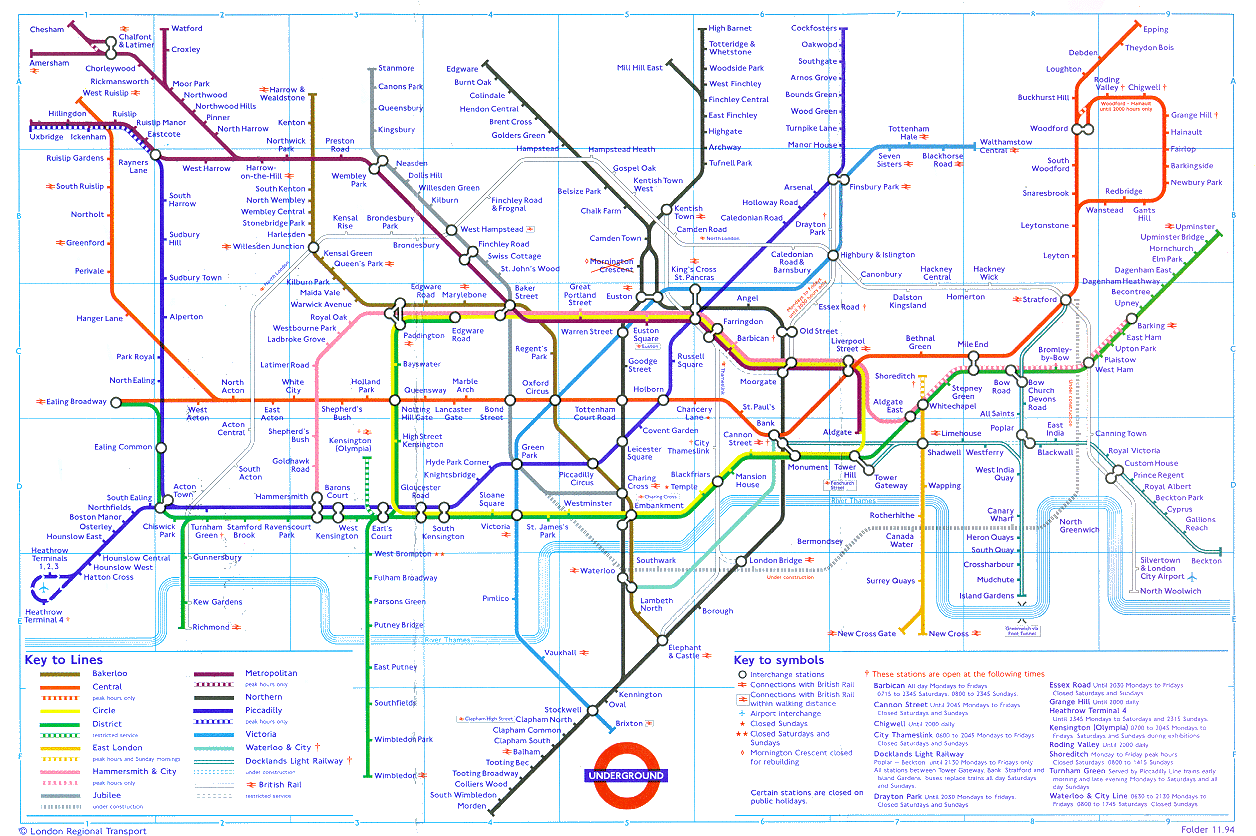
  • It provides direction, and relationships of where that direction might take you. The simplest info-graphic for me is the compass. I do not need to know the ‘degree’ of the direction, as long as I have the four data points. The best known inf-graphic in this category is the London Underground map.
So what then, is an info-graphic? To Alberto Cairo, an info-graphic specialist, and author of Infographia,  who teaches this stuff,
 “Infographics are difficult to define precisely because of their multiple and flexible nature….an information graphic is an aid to thinking and understanding.
He goes on to say that an info-graphic makes patterns arise, helps readers stumble upon trends, and it does this in a very small space. Because an info-graphic is so easy grab attention, especially in a world where few people have tolerance for long-form content (such as this post; sorry folks!) an info-graphic can be completely distorted and not get too mush scrutiny.

I am working on an article on just this topic. So if you have some examples -the good, the bad, the completely distorted– please leave a comment here or send me a tweet.

I will leave you with a great resource by Aaron Weyenberg. His post, “How to distort data” looks at the dangers that lie here.

Be warned. This is not a short form content, but it does have some cool graphics!

Inconvenient truths about citizen journalism

This article was published by LMD magazine this month.

“This is not good anymore… Once the battery charges, I’m going to download it from the camera and stream it to you live. I mean, I don’t believe this is happening. Seriously, I don’t believe this is happening…”

They were the last words of one of the bravest citizen journalists of our time – Libyan Mohammed Nabbous, killed in Benghazi in March (find the story at http://bit.ly/LMD0811)

When we talk about citizen journalism, we think of accidental reporters who, in the face of a catastrophic event, grab a cellphone and capture a story that would otherwise never have been recorded.

Many in the West recall the first heartbreaking reports of the 2004 Asian tsunami, captured by citizens in Sri Lanka. Commuters, not trained reporters, provided the first grainy videos when terrorists bombed subways and buses in London in 2005. Likewise, the first images of the dramatic ‘splash landing’ of an US Air­ways flight into the Hudson River in Manhattan were captured by a citizen journalist. But like those in mainstream media who have put themselves in harm’s way (those like Daniel Pearl of The Wall Street Journal, who was killed in 2002; and Tim Hetherington, who was killed in Misrata, in Libya recently), citizen journalists are following in their footsteps.

Now that large media organi­sations have downsized, citizen journalists are often filling the gaps.

Whether we approve of them or not, they are often the first responders, covering a broad range of events – wars, hurricanes, earthquakes, elections, civil un­rest, famines and terrorism – that seem to be taking place with greater frequency these days.

Media Test Kitchen. There are many questions of course, as this ‘accidental profession’ shows signs of turning more professional (‘Pro’) than amateur (‘Am’). How will established news-media organisations deal with this new phenomenon? Or the more pertinent question is, how will governments adapt to this reality?

First to the Pro-Am relationship. In the early years, the Pros were sceptical. Yet, more recently across the world, as mainstream media organisations began cutting back on staff, this gave rise to newsrooms where Pros could be sought after (or outsourced) like Ams. Steve Outing, Direc­tor of the Digital Media Test Kitchen, once observed that “few news organisations have the manpower to cover everything that their readers are interested in, but by tapping the volunteer (or cheap) resour­ces of the citizenry, a news organisation can potentially provide coverage down to the little league team and church-group level, as well as offer better and more diverse coverage of broader issues by bringing in more voices and perspectives”.

In 2006, probably the turning point of citizen journalism, the BBC announced that it would in fact pay Ams for their contributions that could include video footage taken and saved on cellphones. The BBC’s Direc­tor of Global News Richard Sambrook observ­ed how invaluable citizens’ input had been in reporting the London bombings the previous year: “Within six hours, we received more than 1,000 photographs, 20 pieces of amateur video, 4,000 text messages and 20,000 emails. People were participating in our coverage in a way we had never seen before.” (For a discussion of the struggle between Pros and Ams, listen to the BBC report at http://bbc.in/LMD 0711)

Sambrook called this new phenomenon ‘open-source journalism’, where there was collaboration between a Pro and his or her readers on a story. In other words, the Pros were working alongside the Ams!

Indeed, citizen journalism has pushed the boundaries of traditional journalism. Just like the BBC, many major news organisations have begun tacking on a citizen-powered news stream, and it is becoming more of a hybrid. And the vast number of events taking place in parts of the world that are hard to access has created the perfect conditions for niche-media outlets.

In Libya, a citizen journalist noted the following: ‘Before the revolution, there was only one newspaper that belonged to the Government. But after the revolution, now there are almost five…” He appeared jubilant that even he could play a small part in making that happen.

His profession – when he isn’t a citizen reporter – is…? A dentist!

Just this June, The New York Times opened up a story for citizen participation in making sense of a trove of email records (24,199 in all) from Sarah Palin, released by the Governor’s Office in Juneau, in Alaska: “We’re asking readers to help us identify interesting and newsworthy emails, people and events that we may want to highlight. Interested users can fill out a simple form to describe the nature of the email, and provide a name and email address so we’ll know who should get the credit.”

Likewise, The Washington Post invited readers, saying: “That’s a lot of email for us to review, so we’re looking for some help from Fix readers to analyse, contextualise and research those emails right alongside Post reporters over the days following the release.”

Note the words ‘alongside Post report­ers’. To qualify, people didn’t need to have a degree in journalism… just a computer and an internet connection!

Others have been cooking up different recipes in the test kitchen of citizen participation. Media observers have been calling it ‘non-profit journalism’ and ‘grassroots journalism’.

“Non-profit journalism organisations as well as citizen journalists are producing news that too often is overlooked by traditional media,” observes Jason Stverak, President of the Franklin Center for Govern­ment and Public Integrity, a non-profit journalism organisation.

The distinction between online journalists and those who write in to newspapers and magazines or work in radio or TV are disappearing, and their skill sets are being cross-pollinated. Stverak rightly says that “not all those who write online stories are journalists yet, but the ones who are should get the same access and treatment as those few still employed by newspapers, television and radio”.

For the Ams (who are often videographers, bloggers and podcasters), access and ‘treatment’ are sticky issues. Consider the following. Even when it comes to major events such as the World Economic Forum (where bloggers and YouTubers provide up-to-the-minute and live coverage), press accreditation is reserved for ‘all accredited media’. Three bloggers who called themselves ‘alternative journalists’ sued the New York Police Depart­ment for giving them the cold-shoulder treatment – by denying them press credentials.

In the UK, the Tameside Council (a borough of Manchester) ruled that bloggers could not be permitted to tweet, since they were technically not members of the press corps. The council however permitted the Manchester Evening News and the Tameside Reporter to use Twitter during its meetings. In many instances like this, a person needs to prove that he or she is an ‘accredited representative’ of the press.

Which begs the question: would someone like Nabbous have been considered an accredited member? Probably not!

Jay Rosen, a promoter of the Pro-Am model for many years and a journalism professor at New York University, thinks that the profession has not been making much progress in this area – for the simple reason that the Pros have not been making it easy for citizens.

“The ergonomics of participation in Pro-Am journalism are poorly understood. We don’t have enough experts in it,” he says. In order to engage people in this model of reporting, “they need to see and feel the connection between the small part they are asked to contribute and the big story that will result”.

Then there is the credibility factor. Citizen journalists do not have the built-in reputation of a news organisation, especially if they are working solo. But this has been changing. As the BBC’s Michael Buerk noted while talking to an Egyptian citizen journalist, “it’s not important because of what old-style journalism can’t do, but for what they won’t do”.

There is an upside to all of this, not just for the media but for communities and for democracy. The ‘inconvenient truths’ in a functioning democracy, says Sanjana Hattotuwa, Editor of citizen-journalism outfit Ground Views, is that with citizen participation “you risk the multiplicity of voices and strengthen media literacy”.

And yes, it is messy… but you end up with an informed citizenry, which isn’t a bad payoff. They, the hoi polloi, decide on which media they will believe – and as has been the case in Iran and Egypt until recently, they often do not believe the official narrative coming from the mainstream media.

Professional Amateurs. Some ex-journalists and entrepreneurs have spotted opportunities in this space and begun to create business models, albeit non-profit businesses. One of them, The Uptake (www.theuptake.org), is a ‘citizen-fuelled news organisation’.

“Online tools will not solve community development,” says The UpTake. It stresses the need for a different type of citizen journalist – the Professional Amateur.

It also explains how one person wearing many hats is not the norm in citizen-fuelled news. Shooting the video, editing the story and publishing it online is more than what a Pro-Am ought to be asked to do.

Uptake recommends three core areas a citizen-fuelled organisation needs to focus on: train, organise and crowd-source. More importantly, it looks at citizen journalism not as a reactive means to cover a story as it breaks.

The co-founder of The UpTake Chuck Olsen calls it “committing an act of journalism” – meaning, going out there and finding the story, not reacting to it. “Most acts of citizen journalism are simply documenting something – a London subway cellphone photo, for example. And that’s very important,” he notes.

But as the model matures and takes on a Pro-Am status, Olsen calls for more: “We want to elevate citizen journalism from being reactive to being proactive. Go out and find stories that interest you, and provide some training on how to capture and tell that story.”

Tabloid gets tabloid treatment. Oh, what fun!

Working on an article about the media war that broke out with the phone-tapping scandal in Britain –you know, the one that brought down News Of The World.

No one really questions who reads these crappy papers. (Typical front page story in NotW: “F1 boss has sick orgy with hookers.”) So I am sure there are very few who moan the loss of the ‘red tops’ as there are referred to in the industry.

I found a great project (the mock up is his on left) by Adam Westbrook,  a journalism lecturer who asks “If you edited the final News Of The World, what would your front page be?”

The Time cover below, by the way, is real.


The media are changing. And you?

In 1999 (before we many of us began thinking deeply about the role of the Internet on the media as we know it), USAID foresaw a trend, or rather a need for citizens to be able to “make informed decisions and counter state-controlled media.”

They talked of nurturing ‘alternative media,’ which at that time made many people uncomfortable. Mainstream media journalists, especially, thought that this would be lead to erosion in standards.

USAID may have never dreamt that something called social media would sow up and deliver this ‘alternative’ into our laps. Later, in 2005, Pew Research Center for the People & the Press, which tracks newspaper reading habits, recorded a curious shift. They observed that people were turning away from traditional news outlets, particularly those “with their decorous, just-the-facts aspirations to objectivity.” And what were they gravitating toward? They were turning toward “noisier hybrid formats that aggressively fuse news with opinion or entertainment, or both.”

News infused with opinion? That sounded like heresy!

Not anymore! Dozens of news organizations have begun using a combination of social networking, citizen journalism and traditional reporting to do just that.

I mentioned Internews. It may not be ‘noisy,’ but it is definitely a hybrid format. Internews is an international ‘media development organization’ that empowers local media worldwide. Meaning it not only becomes a distribution channel for global voices, but it gives people the tools to connect, and thereby be heard.

A similar organization, Global Voices, is a nonprofit foundation comprising an international team of volunteer authors, and others who are active in the blogosphere. In fact, one of its divisions, Lingua plays a sort of the amplifier role. Lingua, it says, “amplifies Global Voices stories in languages other than English with the help of volunteer translators.” They translate content into more than 15 languages.

Pew’s recent State of The News Media Report talks of how media consumption in a world of increasing mobile devices  forces news companies to follow some messy rules (of device makers, for instance) to deliver their content. The news ecology is getting uneven, it says.

This is where hybrid, alternative media has taken root. Let’s get used to it!

A longer version of this is published in LMD magazine.

Inconvenient truths about Citizen journalists

Are you rooting for mainstream journalism or the grassroots variety?

How about both? One has the training. The other has the temperament. One has the credibility. The other has access. Mainstream journalism and citizen journalism are shaking hands, and the consequences may be very interesting for the media we consume and our role as potential collaborators.

We typically think of citizen journalists as these accidental reporters –those who in the face of a catastrophic event, grab a cell-phone, and capture a story that would have otherwise never been recorded. We recall the first heartbreaking reports of the 2004 tsunami captured by citizens in Sri Lanka. Commuters, not trained reporters, provided the first grainy videos when terrorist bombed subways and buses in London in 2005. Likewise, the first images of the dramatic ‘splash landing’ of an U.S Airways flight into the Hudson river in Manhattan, New York, were captured by a citizen journalist.

Today, we are witnessing the rise of a new breed of reporters, an ‘accidental profession’ that has begun to turn more professional (‘Pro’) than amateur (‘Am’).

Some ex-journalists and entrepreneurs have spotted opportunities in this space and have begun to create business models, albeit non-profit businesses. One of them, The Uptake (www.theuptake.org),  is a citizen ‘fueled’ news organization. Chuck Olsen, co-founder of The Uptake calls it ‘committing an act of journalism.’ Meaning, going out there and finding the story, not reacting to it.

Mohammed Nabbous, killed in Benghazi, Libya in March 2011, was one of the bravest citizen journos of our time, killed while uploading a story. Check out a video of these last moments at http://bit.ly/LMD0811 In the last part of this video you can sense he is terribly impatient, waiting as a large file uploads from his camera.

“Where is the media?” he asks, rhetorically, with gunfire just outside his door.  It does not strike him that he was “The Media’ –an Am behaving like, and filling the void of, a Pro.

Today many mainstream news organizations have embedded elements of citizen journalism, often training their reporters to use the tools that the Ams take for granted. BBC, for instance is training its reporters to use iPhone apps to file stories. This month, The New York Times opened up a story for citizen participation in making sense of a boatload of email records (24,199) from Sarah Palin. “We’re asking readers to help us identify interesting and newsworthy e-mails, people and events that we may want to highlight.

You could find a broader discussion of this evolving Pro-Am model in an upcoming article.

Let’s send our congressmen to social media boot camp

Interesting statement by the Ministry of Defense on soldiers using social media:

“We are not here to gag people, because we acknowledge the ubiquity and significant benefits that social media offers to people and the MoD.”

The warning comes at a good time, almost a bit late in the game, now that soldiers have been using a host of social media to stay in touch with their families and even the media. Now that not one, but two congressman have been caught with poor social media discretions, it’s about time for a social media boot camp for government!

Back in 2004, the military began cracking down on personal journals maintained by soldiers serving in Iraq.  Some still blog, but are not sure if they will get into trouble, as this NPR story, reveals.

This April, in the wake of Wikileaks, a Pentagon official, Doug Wilson talked about how “technology — and particularly technology at the intersection of national security — has outpaced the policy.”

My reaction was: Still? You would think thee are more policy wonks than tech people in government.

It’s not just the defense folks who have realized that policy has always been lagging as technology zips ahead. States have been facing the same problem. A national survey of social media in government found that

  • Two-thirds of survey respondents lack enterprise policies addressing social media
  • One-third of the states responding have enterprise policy standards,and are in the process of developing these
Furthermore, “relatively few have developed policies or guidelines to provide an enterprise context for managing social media tool use,” and are “completely balked by uncertainty”
Bottom line, they are seriously lagging in policy.
But the government has also stepped up, with its just released International Strategy for Cyber-security. It states that

“The United States supports an Internet with end-to-end interoperability, which allows people worldwide to connect to knowledge, ideas, and one another through technology that meets their needs.”

All this big picture stuff is well and good. Someone needs to put our elected officials in a room give them a 101 course in using digital channels. Their DIY method of using social media is turning out to be one of DYI –Damaging Yourself Irreparably.

Deeper, faster reading with FastFlip, Flipboard, Apture and NewsGlide

I like to follow up on the article ‘Surfing in magazines, while swimming in print” (Communication World magazine, Nov-Dec 2009), with some useful developments in how knowledge that exists in the print world, is being pulled into the digital stream.

What’s really neat is how it could resemble the page-turning (or page flipping) experience. Four applications fascinate me:

PageFlip: Back in 2009, Google partnered with New York Times and Businessweek and others to create PageFlip. Check it here.

NewsGlide – The Chrome app at Huffingpost. It’s not exactly a magazine experience, but it’s like a cross between Flipboard (for the iPad) and Pageflip. Check it out here!

Flipboard: This iPad app is definitely worth checking out! I wrote about it here last year.

Apture. Finally a feature to give let web browser do a deeper dive –a ‘fluid dive’ they call it — when you’re reading online.  Publishers could add Apture to web pages to let users go beyond the content.

Activists know this: Posters are magnets for media coverage

Capturing a sound byte used to be a great way to thread a breaking story. News organisations such as NPR, or BBC for instance use the formula well. Some use it to balance a story, others, to tilt one in favor of a point of view it wishes to hold up.

Audio is also a great way to capture the ambiance of a particular environment. A machine grinding away on factory floor, a call to prayer from a far away minaret, children on a playground…

So why is it that the poster is suddenly making a comeback? It’s one dimensional, after all!

I think of it as a powerful tool not only because of what it says but how it is displayed. In other words, there is more contextual detail that surrounds a poster that adds to the story, even though it is a frozen moment. Two things come into play that make a poster powerful:

  • The image is at once analog (when printed) and digital (when photographed and preserved in a digital stream).
  • The message feeds a story because it tends to be connected to a human who holds it up, or a group of people in which it seems to be rooted

There is a third element – mystery. The unknown or un-clarified details take on greater significance, goading our curiosity, and our need to fill in the gaps of the larger story.

The protests in the past few weeks in Egypt  demonstrate this. From the simple pen sketches, to the large-font messages to the administration:


No face here, but the reference to another country adds a new dimension to political intrigue in the region.

Adding more context, a paper poster is just another element to counterpoint the heavy machinery around it!