Being Obscure, clearly. Why ‘Romnesia’ and ‘Obummer’ distort elections

They are funny, memorable, and provide plenty of water-cooler conversations.

The campaigns know it. They must have gag writers on staff to supplement their communications and marketing people. The unfortunate thing is that they work.

Not the lines, but the distraction. They provide a sidebar to the main event that eventually drowns the real issue.

When Obama, fresh from his speech in New York this week (the annual Alfred E. Smith Memorial dinner, where both Obama and Romney delivered great one-liners, a tradition of that white tie event) fired up a crowd using a coined word ‘Romnesia‘ it supposedly lit up social media. Sure, it gave the president a stick to poke at his challenger, who has been gaining ground.

But in the last few weeks to the election, it is a huge distraction from what Obama and Romney should be doing: telling voters, especially those uneasy about both candidates, what they stand for. It may have pricked the bubble about the self-created entrepreneur, but it also treats an important election as a referendum on who citizens don’t like, as opposed to what they really want. Bumper stickers are all about this. Bumper-sticker campaigning just feeds this mentality that we don’t really need to know  (or read) the candidate’s policies, so long as we keep up with the tweets, and let the one-liner define our choice.

Locally, in Phoenix, we have one of the most intellectually embarrassing senate races, by Jeff Flake and Richard Carmona. Going by their ads, I personally don’t want any of them representing me.

Like both major parties, they spend millions on tarring each other’s reputation instead of telling us why we should pay their salary. Worse, they hide behind shady organizations that pretend to represent us, who pay for these spiteful spats.

Take a guess: who might ‘Americans For Responsible Leadership’ and the ‘Committee for Justice and Fairness’ represent? They are quite opaque –by design. These political action committees (PACs) poison the waters of democracy. Why?

  • They are still stuck in the mass media mindset, imagining that he who shouts the loudest will win our vote.
  • These nattering nabobs of negativism account for 75% of negative advertisements (a tar bucket that’s worth $507,240,744.99 according to the Sunlight Foundation)
  • Their ‘message’ –a mess of pottage, really– is clear. Don’t think, just vote! Their goal is simple, as in E.B. White’s words: “be obscure, clearly”!

To think we as a country spend billions trying to introduce democracy to other parts of the world!

Hungry for zingers? We citizens get what we deserve*

The cynical side of me wanted to skip the presidential debate this Wednesday. But with so much build-up and punditry surrounding this made-for-TV event that pretends to be a way a democracy decides on its leader, I gave in.

Truth be told, I am one of those decidedly ‘undecideds.’ I had decided to not be influenced by this stylized boxing match.

I happen to teach Language Arts, so I wanted to watch it from the perspective of rhetoric. I often I ask young people to pay attention to turns of phrase, juxtaposition, and tone-of-voice. It’s how writers and speakers hold –or lose– an audience. So in this debate I was less concerned with facts and half-truths (we have to expect plenty of the latter, in this setting) and more with how the idea was packaged and delivered.

My three observations:

1. Trickle-Down Twist: Many of you are all familiar with trickle-down economics, a term often associated with president Reagan, but really refers to supply-side economics. I liked how Romney added a twist to it, by introducing the term trickle-down Government.

“The president has a view very similar to the view he had when he ran four years, that a bigger government, spending more, taxing more, regulating more — if you will, trickle-down government — would work.”

Note how he forced Obama into a corner, by starting out the sentence saying his view coupling it with loaded keywords such as big government, regulation, spending

Obama’s come-back?  None. His limp attempt to punch a hole in this branch of macro-economics later, was a painfully professorial argument that was lost in the weeds:

“Now, that’s not my analysis. That’s the analysis of economists who have looked at this. And — and that kind of top — top-down economics, where folks at the top are doing well, so the average person making $3 million is getting a $250,000 tax break, while middle-class families are burdened further, that’s not what I believe is a recipe for economic growth.”

Got that? A 48-word summary of an analysis may have had its place at some dull economic summit, but not here, with a debate divided into tight ‘pods’ by the moderator.

2. Tax Cuts Vs Tax Offset. Obama  tried to clarify his position versus Romney’s as being based on tax cuts.

“And this is where there’s a difference, because Governor Romney’s central economic plan calls for a $5 trillion tax cut — on top of the extension of the Bush tax cuts — that’s another trillion dollars …”

But Romney’s pushed back calling it tax offset, and attacking it thus: “Mr. President, Mr. President, you’re entitled as the president to your own airplane and to your own house, but not to your own facts.” In effect, he was pushing the president into a corner, saying “liar, liar, presidential pants on fire.”

Romney may have been, as numerous fact-checkers very quickly pointed out, tiptoeing with his numbers himself. FactCheck.org called him “a serial exaggerator.”  Romney’s website does state clearly he plans to “Make permanent, across-the-board 20 percent cut in marginal rates” and “Eliminate taxes for taxpayers with AGI below $200,000..”  But who reads campaign websites? It’s too much work; much easier to watch the debate pod!  Romney’s zinger about the airplane +White House +facts was perfect for the Twitterverse.

3. Birdseed For Social Media. Speaking of Twitter, you have to imagine that Romney’s attack on Big Bird was a well planned sidebar. It is a silly piece if information, since PBS accounts for such a minuscule amount of government money (the govt spends $0.223 billion on PBS vs $4 billion subsidizing oil companies). But it adds color to a dull fight between two men in suits on a dark stage.

I believe Big Bird was seeded by those the Romney campaign who knew social media users would love something not-so-boring to tweet about. The yellow bird generated 135,000 tweets per minute while the debate was on! One of the many insta-Twitter accounts that ensued, @FeedTheBird, has tens of thousands of followers.
Will social media, or even the ‘verdict’ of who won, matter in whom the country chooses? My optimistic side believes it will not. But we cannot discount how TV debates have indeed swayed elections. If you are cynical, you will want to believe that we citizens feed this machine that produces a televised horse race. We are ready to scan past the deeper arguments and remember the zingers, and the candidates feed our appetite.

Truth, Lies and iPhones

I had been fascinated about the Mike Daisey story that broke some months back here in the US.

It opened up a can of worms about how truth (or ‘truthiness’ as Stephen Colbert put it) and how we twist and maim words and facts. Politicians do it, as do talk-show hosts, reporters, advertisers, scientists, corporate leaders etc.

As someone who writes for the media, I thought this brouhaha was way too important to dismiss as one man’s folly. Daisey was the everyman in a culture of compromised truths and spin; a culture that sometimes believes the means justifies the end in getting a message across. (Anyone remembers Message Force Multipliers?)  The infamous scientist who lied about climate studies admitted he had has a  “serious lapse” of “professional judgment and ethics.”

The classic statement by Daisey for me was this:

“I’m not going to say that I didn’t take shortcuts in my passion to be heard. But I stand behind my work… It’s not journalism. It’s theatre,”

Is marketing also ‘theater’ then? It could be argued that some aspects of it –product display, packaging etc– is staged, right?  Could some forms of PR (stunts, at least) be also considered theater? Are we sometimes taking Daisey-esque ‘shortcuts’? This is the uncomfortable space many of us operate in.

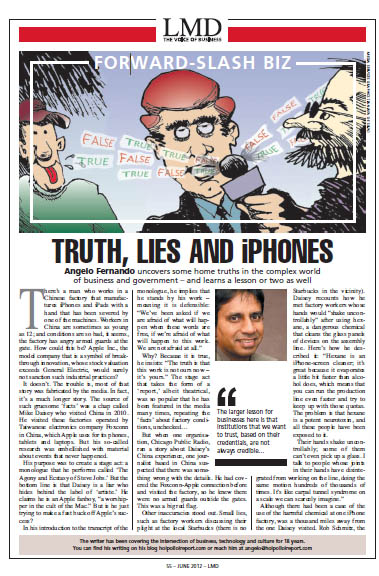
That’s the background to my recent piece in LMD Magazine, titled “Truth, Lies and iPhones.” Read it here.

Or download a PDF of the article here.

(Incidentally ‘truthiness‘ despite its quirkiness, became the Number 1 Word of the Year in 2006.)

Lost in translation – when jokes go sour

With so many channels permitting us to share so much chatter, it’s alarming how people forget that what seems private could be very public. Twitter is “a village common” says David Carr, media and culture columnist for the New York Times. He considers what someone says on this channel as very public. (There is a journalistic debate on whether a tweet is actually public content.)

Humor often has a way of going wrong. If you are planning on posting a zinger remember the Aflack guy. The comedian Gilbert Gottfried, who was the voice of the duck in the Aflack commercials, made a few off color tweets soon after the tsunami in 2011. One of them was: “I just split up with my girlfriend, but like the Japanese say, “They’ll be another one floating by any minute now.” He quickly became the ex-Aflack voice.

Even a comedian ought to think before he tweets.

Speaking of humor, this joke gone wrong, involving the Dalai Lama would crack you up. Nothing offensive, but the punch line, lost in translation, just didn’t connect. Karl Stefanovic, the anchor of the Today show in Australia explains.

Storytelling tips from Lone Ranger

When I teach young people about the  elements of a story, I tend to lean on the trusted models of the Who-What-When-Where-Why-How (or the 5WH) structure. Or the one about having a Beginning, Middle and End. (My version of this, for those writing for the web is to make sure they have a Beginning, a Middle and a Hyperlink.)

So this week I revisited  two stories, separated by several centuries. The Lone Ranger, and Beowulf.  (Yes! There’s a delicious irony of being able to listen to a 1930 radio show of The Lone Ranger via a Kindle app!)

The basics of these stories –one from the radio age, and the other from a different culture and era, entirely – is that they revolve around conflict. It makes good drama. Good vs evil material. But beyond that, it is how carefully  the author, or script writer selects his words.

So here are four things we could take away from Lone Ranger:

1. Grab Your Reader/Listener
Cut short the pre-amble, and get to the point fast.  In Lone Ranger, we are all familiar with how the scene is set: “A fiery horse with the speed of light, a cloud of dust and a hearty “Hi-yo Silver!”  (The previous intro was: “In the early days of the western United States, a masked man and an Indian rode the plains, searching for truth and justice. ….Return with us now”)

The ‘search for the truth’ is built around intrigue (masked man) and the promise of action (search for truth, hoofbeats…)

2. Cut to the ‘Chase’
Move quickly to build up the tension. The stereotypical car chase (or horse chase here) can have other variants such as a puzzle that the reader is yearning to solve, the expectation of a confrontation etc.

3.  Build Great Dialogue.
Though the story is told to us by a narrator, it is rich in dialog. Tonto, his foil, despite the author’s use of some clumsy pidgin English, is full of exchanges.

TONTO: “Crooks try rob bank last night”
RANGER: “Have Bogus Brown and his pal Elk been in town?”
TONTO: Umm. “Them the fellers try to rob bank?”

4. Humanize Your Characters
The Lone Ranger, despite his mask, is still human enough for others to be able to relate to him – Sheriff’s, townspeople, crooks.

Too often our modern ‘stories’ –um, press releases, podcasts etc– are full of inside jargon, and layer upon layer of description. It’s almost as if the boss’ requisition stated that the script be stripped of ‘normal’ words, and the sort of everyday, ordinary exchanges. Instead what creeps in a slick, sloganized phrases, put in the mouths of spokespersons who would never talk like that.

Maybe we should make Fran Striker (college dropout, announcer) the little-known writer behind Lone Ranger, essential reading for those writing for an attention-deficit audience.

Time magazine’s cover sells, enrages

I’m a great fan of and subscriber to Time magazine. I’ve been used to their shift to become more edgy over the past few years –perhaps in order to stay in business. But this caught me off guard.

Last Friday, when it arrived, I left the magazine on the counter, not thinking too much about the mother and child cover. Another mother’s day angle, I surmised. My wife was shocked, and my daughter probably was even more.

I could see the firestorm emerging. But it’s coming from several interesting sides, especially those enraged by the ‘Mom enough’ question, and also the challenging pose of the breastfeeding mom. The “this creeps me out” reaction from mothers was quite common, and I bet Time wanted This kind of reaction, as the buzz was good for newsstand sales.

Time magazine is not just a news outfit. It’s a marketing machine. I’ve noticed that recently it often makes a big point about how a story gets more web traffic than any other story, or has has more letters to the editor etc. I also get it. Covers need to be provocative, and even stimulate a conversation. But in this instance I think Time went too far. Here’s why:

The headline. Reading the article, it seems to have very little to do with adequacy or inadequacy of mothers, and their feeding methods. Connecting that headline to the stand-up feeding pose, seems like it is posing an unspoken question: “Would you be brave enough to do what I am doing? (with my one hand on my hip, too!)”

The eye contact. They probably took a lot of angles of this mother-and-child. (They had great inspiration, apparently)

New York Times forcing us through Facebook funnel

Updated: 21 April 2012

I’m Ok with funnels for decanting liquids in the kitchen or garage. Media funnels are another matter entirely.

That’s essentially what The New York Times is trying to do with us readers: entice us down the narrow neck into Facebook territory. No thank you!

We’ll never know what the conversations were at the Times in the past few weeks, but it certainly didn’t involve us.

The folks there probably looked at the evidence of how media is now flowing through networks, how people are jumping platforms and thought it was time to send us to Zuckland. Call it Funnelization-meets monetization.

Were they scared we may be sucked in elsewhere?

I don’t buy the ‘newspapers are dead’ argument any more than I think books are dead. (I love my Kindle, but I don’t plan on not reading real books anytime soon.) I grant that I do get plenty of my news updates via social media, but that has never stopped me from picking up a newspaper, tuning into a radio show or watching a non time-shifted television show now and then. The sheer serendipity of discovery using ‘old media’ could never be replaced.

In short, I get sucked in by great content.

The Times and Facebook relationship is not new. It began in 2010, with a new design of the front page. (Explanation by NYT here.) I liked the idea of enabling readers to be able to follow threaded comments and connect via social channels. It was a tough call, to make trusted commentary a feature that was by invitation only. But hey, reputation is always earned!

Starting this week, however, content on NTY.com is limited to ten articles a month free. Content will still be available via Facebook.

But that’s not the main problem. The Times requires one to link a Facebook account to the Times story to be authorized to comment.  That tantamount ro appointing Facebook as a sort of gatekeeper. An e-verify system for readers. Why Facebook? Why not LinkedIn, amore professional system? Good question. Andrew Rosenthal, the Times’ editorial page editor explains it thus: It’s coming! For now we’re stuck with Facebook.

Maybe it’s not so bad. After all Facebook is now a major authenticator and on ramp to other online properties. But it’s thumbs down for me. I’m not ready to jump into this funnel yet.

Updated: If you have inadvertently linked your Facebook account to the NYT, here’s where you can find the button to uncheck it.

You?

Why Journalists go for your blog

There are some studies that compare a company’s Twitter profile to a blog.

The 2012 Edelman Trust Barometer study, which I’ve always found to be a fascinating read on where we are in social media practice, had some equally strong indicators as to where traditional and digital media sit on the trust scale.

For instance, trust in company’s web sites are (hold your breath!) up!

So this infographic, which summaries a survey by UK-based Text 100 is a good sidebar to the study. It speaks of engaging journalists using social media.

.

Instagram Vs Pinterest explained

Still trying to find the difference between Foursquare, Instagram and Pinterest?

Social media sounds more complicated than it is. I like it when someone demystifies it. I like it better when someone uses a ‘dumb screen’ instead of gratuitously holding up some tablet (as do too many TV news reporters today, notice?) to make a point. Thanks to Douglas Ray for this.

This might help!

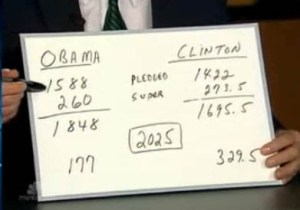
Speaking of white boards, this feels like an homage to the late Tim Russert (of NBC’s Meet the Press) who was a master of the white board when trying to simplify an idea in  a story.

I sometimes wonder if Tim would have ever clutched at an iPad to make his point as he did here, during the last election.

If you’re interested here’s the video of his explanation to Brian Williams.

Trust in media went up. Really?

If you’ve been following the Edelman Trust Barometer over the past few years, you’ve known that this the value of this ingredient has had impossible to predict. The 2012 Trust barometer did, however throw some surprises.

Government is the least trusted institution. What else is new?

Trust in the media actually rose in the past year! (That has to be impressive, considering that two years ago, a Pew Research study found it to be at an all time low, with Americans who were aghast with inaccurate and biased news.). Gains were in India, UK, the US and Italy. Which is counter intuitive, considering how the Murdock scandal tainted much of the British media last year. Not surprisingly, social media, recorded the biggest gains in media trust.

More details here from Edelman Insights