Filtering social media stories into ‘newspaper’

This is an interesting reverse phenomenon.

We’re used to traditional media being massaged into (‘poured into’ might be the more appropriate term) digital formats to create new distribution feeds.

So I was intrigued by the way a Swiss-based startup, Small Rivers, lets me pull in digital feeds from Twitter and Facebook, and create the look and feel of a newspaper.
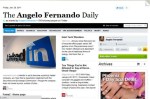
Here is a look at my newspaper for today, 28 January, 2011.

http://paper.li/heyangelo

Now I grant, this smacks of a vanity press affair, but if we think slightly outside of the ‘Daily Me’ the ease of generating an aggregation of  content might be give us  different approach to corporate newsletters. I subscribe to a lot of newsletters, or pull them in via an RSS reader. These custom news sheets, could be open up a new level of variable data print options, too.

Many years ago I managed a Print On Demand for a Marcom portal. It seemed liked the coolest thing at that time, but seriously lacked the kind of customization I was always asking for. That was because it lived inside a print company –tied to an Indigo machine— and not a digital content aggregator. Today, an organization with a team of writers who create content in a handful of social media channels could collaborate on a newspaper, and not even think of themselves as being in the news business. They could be marketers, researchers, videographers and bloggers whose output is turned into a news channel once a week.

No Indigo required!

In related news:

Wikipedia appears to beat media in Chilean miner rescue

By chance I checked Wikipedia on the Chilean  miner rescue operation underway now (9.15 PM Pacific), and was pleasantly surprised to see two things going on:

The first was that Wikipedians are updating the site faster that Google results of news of the rescue operation.

San Jose Mercury News, Yahoo and others come up on search for ‘miner rescue’ with news

that one miner has been rescued.

Wikipedians noted that there have been two miners brought to the surface.

It took about another 10 minutes for the rest of the media reports to show up with this detail.

Meanwhile CBS News is streaming video via Ustream! http://ustre.am/2bWW

The second curious phenomenon will probably be discussed at length in the weeks after this. In what is clearly a sign of the times, where everyone is now a reporter,  the video from the mine captures at least two of the trapped miners photographing (or videoing maybe?) the event that they are part of!

Who’s watching what here? Who’s updating whom here? This is breaking news, and the subjects are reporting the story!

Quotes for the week ending 22 May, 2010

“If we get to that point, the business of e-commerce and m-commerce may get a huge jolt”

Ian Schafer in Advertising Age about the dawn of Facebook currency

“Writing in the voice of another.”

Mike Klein, responding to Steve Crescenzo‘s post at IABC Exchange, on the three kinds of writing communicators need to know.

“Front-load your subject lines.”

Doron Kritetz, on the four subject lines that grab readers

We know some people are suffering because of this blockade, but we have to obey the court order in letter and spirit”

Najibullah Malik, secretary of Pakistan’s ministry of information technology, on why Facebook was banned this week in the country.

“I never started a Facebook page. I apologize to people of Muslim faith and ask that this ‘day’ be called off.”

Seattle cartoonist Molly Norris, who called for the ‘day’ to draw a cartoon of the prophet.

“If an economic boycott is truly what you desire, I will be happy to encourage Arizona utilities to renegotiate your power agreements so Los Angeles no longer receives any power from Arizona-based generation”.

Gary Pierce, Arizona’s Corporation Commissioner in an empty threat to Los Angeles Mayor Antonio Villaraigosa. The spat was over several states and counties calling for a boycott of Arizona over its new immigration law. The law has promoted many cartoons and punch lines.

Do your pictures embed a story?

Last week I had the opportunity of assisting 7th grade students studying photography –Black and White photography. It involved dark-room techniques as well.

Yet, it was not what you might think. The students did not use digital cameras. They were using pin-hole cameras made from … cookie tins!

Analog? Why would this be exciting to a generation we like to typify as digital natives? Why would young people who only know –or so we think –instant gratification give a hoot? Why would a camera with no lens, no aperture setting,  and no buttons appeal to someone who loves iPods and Flip cameras?

I wondered that too. But it turns out that the technique –‘art’– of taking a picture inspires them. They were fascinated with the subject, not the tool aimed at it.

So with a rudimentary, very temperamental camera, they realized that framing the context for that subject was suddenly very valuable. Black and White also forced the picture taker to seriously think about lighting and contrasts . When there is no white-balance adjustment it concentrates the mind! And finally it taught each one of them what they could not learn from the handbook or a how-to YouTube video: patience. Shadows and clouds move, people in the background suddenly dart across, the wind stirs things up …

I like to put it this way. The photographer needs to find his/her ‘story’ within the picture and try to convey it at the moment he/she clicks. In their case, the click involved flipping open the magnet that covered the pin-hole, counting the seconds and replacing the magnet. Tedious? Not for this always-on generation.

And to pull back a bit, I found a great example of how a photographer must have had to frame, study and wait for the moment to get this story. What might otherwise have seemed a very mundane observation of a woman walking on a lonely stretch of road.

What’s a Press Conference?

I like to link to a post I wrote at ValleyPRblog last week that received some good comments. I was curious to know who in the media had attended Sheriff Joe Arpaio’s press conference.

“I always thought a press conference was called when you had something of value to offer to the media. So when I received a text alert yesterday to say that Arpaio won’t run for governor, I was tempted to wonder what other bits of non-news might get the media to come over with cameras and notepads.” Read the rest and the commments here

It opened up a great discussion of what is a press conference. Is it an event? One reader suggested the act of announcing something to a targeted audience –via email — is no different.  Another reader pointed us to a marvelous exchange between Robert Gibbs, White House press secretary and the press corps. Apart from exploring the definition of a press conference, it shows us how a great host can disagree with the audience and still get the feedback that serves everyone, and doesn’t waste their time.

View the video here.

Quotes for the week ending 8th May, 2010

“In the Future, we’ll all have 15 minutes of privacy.”

Scott Monty, head of social media for Ford, on a post about Facebook’s latest move to connect to the rest of the web

“No one is laughing in Arizona. Do your job and secure the border.”

Governor Jan Brewer, in a YouTube video aimed at president Obama, who made a joke about the immigration Bill that Brewer signed into law.

“A lot of great stories are hidden within the public”

Manesh Nesaratnam, Malaysian film director of a movie, Your Grandfather’s Road, which is being crowd-sourced.

“That QR code on the left will even take your smartphone to my Twitter feed. And if you really liked this story, you can re-Tweet too.”

Kit Keaton, whose column in Fast Company, features this Quick Response code.

“A nastygram.”

Shel Holtz, referring to the letter Apple, which sent a nine-year-old girl a cease-and-desist letter after she suggested enhancements to the iPod.

“You gotta give him credit for his media manipulation skills.”

Pat Elliot, commenting on a post I wrote for ValleyPRBlog, about the value Sheriff Joe Arpaio holding a press conference to announce he is NOT running for governor.

We are heartened by news reports that J.S.Tissainayagam appears to have been pardoned…”

CPJ (Committee to Protect Journalists) in a statement on the presidential pardon for journalist J. S. Tissanayagam in Sri Lanka

Quotes for the week ending 17 April, 2010

“I write essentially 7,000 words every week for the blog and for the paper and all that stuff.”

AdAge on the New York Times Reporter, writing fro DealBook, who resigned for ‘accidental plagiarism’

“If you get the chance, grab a video camera (or a smartphone) and head to your nearest Tea Party. Who knows, your footage could dispel some false accusations; citizen-journalists are turning in the most reliable kinds.”

Lachlan Markay,  of Dialog New Media, on the Tea Party infiltrators.

“To all the Twitter lovers out there: this is NOT the first sign of the apocalypse….People will not desert Twitter for this. It’s inevitable — technology services need revenue.”

Josh Bernoff, on Twitter’s business model that might involve advertising

“Her brand is Teflon, ubiquitous and so strong that a book like this is not even going to dent it….The media is not going to give this story a second life.”

Michael Kelley, in Advertising Age, on Kitty Kelly’s latest unauthorized biography on Oprah

“Wait, Who Says My Tweets Belong to Google or the Library of Congress?”

Slate’s Heidi Moore, on the news that Twitter content from as far back as 2006 is being archived in the Library of Congress

“Weave in your personality. Sure it’s business, but you don’t want to be a social media sleeping pill. Avoid dry and boring messages, posts and links.”

Susan Young, at Ragan.com on the ‘Seven Habits of Highly Successful Social Media Communicators’

Quotes for the week ending 6 March 2010

“This may be one of the largest experiments ever conducted on the web.”

Ben Parr, at Mashable, in the introduction of auto-captioning to YouTube videos

“Blogging success is a slow march, not a mad dash.”

Jason Baer, at Convince and Convert, on the 10 key success metrics for a blogging strategy

“The idea that content is king is true, but some people miss out on reading that great content because there is nothing interesting in the headline that represents it.”

Alex Fraiser, in a post about headline techniques for blog posts.

“Every defective part is like a dead body…To figure out what killed it, we need to duplicate the crime.”

John Smith, a member of GM’s Red X team of engineers who study bad auto parts

“So What”, you say? So there are no pilots or even air traffic controllers to guide us, what does this mean? In the Web 2.0 skies, organizations are gliders who must reacting to their current environment.”

Rick Spratley, at the Employee Engagement Network

“We live in an age in which ideas and arguments fly across the globe almost instantly … Assaults on those rights, like “libel tourism,” tell us just how rare, and fragile, they are.”

Editorial in Arizona Republic on foreign nationals suing Americans for libel in foreign and US courts.

When life gives you lemons, don’t taint your lemonade, bro!

Maybe the headline to this post ought to be “Why editors make poor marketers.”

The Virginian-Pilotblew it” as its editor said, apologizing for the error. No small typo, this. They printed an entire story, photos and all, with a wrong headline claiming the Colts beat the Saints! The apologies were profuse:

But then the editor added this:

We did remake the page for those who want to buy a Sports front suitable for framing. Just go to here to order it.”

The comeback from some readers was predictable! One reader wrote:

“Your paper makes a HUGE error and I am supposed to pay you $79 for a corrected framable(yes I am a Saintas fan)version! … The Virginian-Pilot, Toyota and the Chinese drywall manufacturers should go into business together, you all would be very succesful.” Ouch!

To use the editor’s own word — for the poor marketing ploy, not the headline error, “as far as errors go, this was a whopper.”