They did what with my story?

Role playing in \I attended an amazing session yesterday titled “A day in the life of a TV reporter” that may have seemed like it was about news, but was really about PR. Specifically about pitching your story to a TV news team,

Gerard Braud who ran the session is a been-there-done-that kind of guy. It was not the usual how to, with five golden rules, etc. It was an exercise in every sense of the word –one of the most fast paced sessions I’ve ever attended– to put us in the hot seat of the news team.

I guess you never realize the “if it bleeds it leads” imperative in a newsroom until you work in one. Attendees were divided into four news stations, KSUK, KRUD, KNTS and KRAP (no shortage of acronym fun!) given the same stories, and asked to produce three news bulletins -an A.M. newscast, an afternoon, and the big enchilada, the evening news. But it wasn’t just that. We were assigned to roles of egocentric, tired, underpaid, ambitious and reclusive individuals who put it all together. But if they were caricatures, Braud assured us he had worked with precisely these types.

That was the whole point of this. To see how stories, pitched to a news organization made up of dysfunctional (read: human) individuals dealing with the pressures of advertising, sweeps, budget constraints and deadlines ever make it.

The day’s story line-up included murder, corruption, a weather related car wreck, a local government story and a technology piece among others. As we set off to report and package the stories for the bulletin, a story of a blogger (posing as a child to lure a pedophile) was dropped by most teams, never mind the social media hook. (Please don’t tell Shel Holtz that!) The zoo story about a giraffe giving birth, survived. But you knew that, didn’t you? Even though it meant sending a cameraman in two different directions, it was in keeping with the silly convention of a cute story wrapping up a bulletin stacked with very depressing stories..

Just when we began to get the hang of things, Braud threw a curve at all four teams. I won’t spoil it for any other group who might attend this session some day, but just say this. Hard exposive stories are the sexiest -with the exception of the giraffe.

There were some great lessons. Pitching lessons, empathy lessons, and sensitivity to the news cycle. “We tend to treat them news people as special, don’t we?” remarked Braud. “We put them on a pedestal, but don’t recognize they are human, just like us.”

Quotes for the week ending 21 June, 2008

“It’s a push back from the sound-bite culture.”

Lee Rainie, director of the Pew group, on recent findings that 30% of Americans use the web to get more of the story that the media slice up.

“We have a steady, relentless snack-food diet of facts and ‘news briefs’ driven by the mistaken perception that fast is best and better in an RSS alert-enabled world. Unfortunately, with news happenings in constant motion, we never “have time” to “go back” and provide a deeper look for our news consumers.”

Linda Zimmer, on the blog Business Communicators in Second Life.

“A radical suggestion for the Social Media Release: don’t put any Social Media Releases out over the wires.”

Todd Defren, recommending people publish a regular press release on the wires, with a link in it to the Social Media version.

“They’ll get half of it right. We’ll push them to getting all of it right.”

Michael Tippett, co-founder of Now Public, on how bloggers are being trained in Journalism by the Society of Professional Journalists.

“The reality is that they’re tiptoeing in the gray zone between open and traditional media.”

Andrew Keen, commenting on Encyclopedia’s move to expand it’s ‘community of experts.’

“Nope. No fine print here my dear sirs and madams. HONEST. Everything that’s currently free is still free.”

Mike Curtis, on Jing’s blog, about the relationship -and business model– of Screencast and Jing by parent company Techsmith

“it’s a big red flag that the AP is now waving in the blogosphere.”

Neville Hobson, on the Associate Press’ pay-as-you-quote system

Bloggers and journalists embrace professional motion blur

Another major blur is taking place, as we hear more and more about bloggers and journalists walking in each others’ shoes. We are all passing through what I could best describe as a constant Professional Motion Blur: Marketing and Communication, PR and Advertising, Blogging and Media Relations, Digital Printing and Direct Marketing, Search and Marketing, Journalism and Blogging.

This story and this captures what’s happening as bloggers get to learn the rules of journalism, while ironically journalists are learning to play by the ‘rules’ of the blogosphere, and even learn to use Twitter. The Society of Professional Journalists is conducting a series of seminars in Chicago, Greensboro, and Los Angeles.

Are we muddying the professions? Some will say it’s the death of expertise. I just think we cannot afford to operate in our silos anymore. Faced with our multi-media, highly connected, multi-cultural audiences, we have no other option but to embrace the blur.

Tim Russert’s style

The sad news today for journalism –and NBC –of Tim Russert’s death makes us appreciate the kind of journalists we so often take for granted. You could watch Tim, and see his genuine curiosity seep out of his eyes, and you could almost feel he was asking the question you would have if you were in the studio/oval office.

I didn’t realize he had been hosting Meet The Press for so long. That word, the ‘Press,’ has gone through many incarnations, but the type of reporting, analysis and perspective Russert brought to journalism never wavered. He never seemed happy with the glib, half-hearted or spun answer.(see how doesn’t get Clinton and Obama off the hook) which gave him the notion of being “tough.” But I like to think of him as being something else: honest to his audience.

Jon Stewart blurs journalism. So what?

A Pew Research story this week based on research into The Daily Show by Jon Stewart says that he blurs the line between comedy and journalism, but also followed the agenda of the news media, albeit selectively.

However they also note that:

  • The Daily Show performs a function that is close to journalistic in nature — getting people to think critically about the public square.”
  • “its use of news footage to deconstruct the manipulations by public figure … performs a function that is close to journalistic in nature — getting people to think critically about the public square.”

Maybe controversial. May it’s pushing the envelope, but when all other envelopes are being pushed, bent out of shape and torn to shreds, Stewart could be setting the stage –or reflecting a shift– in the new journalism.

Cameras kill participation

The pastor at a church in Pinetop, Arizona made a point that got me rethinking the role of photography. “Like the Pueblos and the Navajos ask,” he said, “come in and join us, don’t observe us…please no photography.”

I’ve been into photography for a long time. At conferences, weddings and children’s school events I switch between participation and observation, making an effort to blend in and be as non intrusive as possible. Maybe I’ve been fooling myself that I could make the switch.

Photo journalists face another part of this join-us-don’t-observe-us dilemma when covering events: should they stop what they came to do and get involved, or stand back and be objective? Through their lens, they see monks getting tear gassed, accident victims traumatized, children fleeing attacks, and natural disasters. Often see journalists among the first responders. Minutes after Nik Ut captured the Pulitzer prize winning photograph of children fleeing a North Vietnam attack on a village, he and another journalist poured water from their canteens on the burned child. He then drove her to hospital.

Where does the word “engagement” stack up in this line of work? Read this story and you will realize it’s not a black and white issue. Marc Halevi of the Eagle-Tribune went to cover a rescue on Plum Island. He first saw the took pictures of a woman on a sand bank of the stormy ocean. “Seconds later as he was looking through his viewfinder, he saw a wave crash against the embankment on which she was standing, knocking down the sand and pulling the woman into the water.” So he did what any photographer would do. He clicked. He also shouted to the rescuers on the scene. “Rather than do it myself,” said Halevi, “I just made this immediate decision that (these people) would be better than I (at rescuing her).”

Participation or Observation?

Citizen Op-Ed writers enlarge Spitzer story

Lorenzo Sierra has a great theory. He may not have hyped it enough, but it’s worth a considering. It’s called the “cyclone of influence.” It has a neat way of explaining, in communication terms, the ever widening circle of influence. It’s very different from the ripple metaphor, he explains. Nor can the cyclone concept be illustrated by your typical PowerPoint icon. It almost requires a 3D perspective spinning and moving in unpredictable paths in real time.

Communication, like some climatic events, are triggered by deliberate or inadvertent human events. The recent Elliot Spitzer cyclone was whipped up in a high pressure area we call infidelity. You could track the scandal on Twitter, as the digital cyclone moved outward, aided by not just gossip publishers, and talk show rants but citizen op-ed writers. People, who were not your typical pundits, were enhancing the story with 140-character Op-eds.

One Michael Parekh wrote: “apparently, Paterson, the likely successor to Spitzer is also a Clinton super-delegate, though apparently not as committed.” Another wrote: Eliot Spitzer is getting Googled today from all over. 10 of the 11 big movers deal with him.

There were those outraged, some funny, and others with insider information like this and this that even journalists covering (enlarging) the event would have appreciated.

Which brings me back to the cyclone concept. Whether the news has the elements (sex scandal, politically incorrect speech, money…) that make it spiral, or is simply hyped by people on a slow news-tweet day, the op-ed factor broadens its footprint. Better get used to it. Especially so if you’re someone who blasts The Media (“Media content has gotten more graphic … “) as Spitzer did.

Journalists approve of social media

Journalists are not as fearful or pessimistic of the new media as some make it seem.  Pew Research study just out finds that journalists do approve of the changes taking place in their business model.

Considering the impact of the internet and social media on their business model, local and national journalists have given new media a vote of approval.

The study was done with 585 national and local reporters, producers and media executives.

Media blind eye to media attacks in Sri Lanka

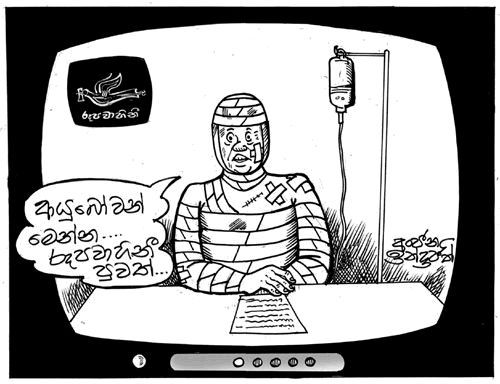
rupavahini.gifWith so much attention to China’s response to Tibetan protesters and the recent repression in Myanmar, there seems to be a blind spot when it comes to the media intimidation story in Sri Lanka. Five workers at the state television station, Rupavahini, have been attacked as the cartoon depicts.

It’s not funny. The methodical attacks follow a situation last December. Separately, journalists have being jailed without trial. Just a handful of organizations like the BBC and Reporters Without Borders are following the story. There are some indications that citizen journalists such as GroundViews will fill the void.

Storytelling formulas at business writing workshop

Aren’t we all storytellers! Business communicators and PR people aren’t the only ones with stories to tell. At a weekly management meeting I often hear a response to a complicated question that goes: “Ok, so here’s the story…” Or take reports. The most interesting executive summaries I have read have a beginning-middle-end format, and one more element –the cliff-hanger to get you to read the rest of the 15-page document. (Conversely, the most boring ones have bullet points and stats. The do the job, but they don’t light a fire.)

And my point is? Yesterday I attended a workshop by the Donald W. Reynolds National Center for Business Journalism. It was on “High intensity business coverage” and dealt with the finer points of finding, crafting and publishing business stories. Terrific speakers, with amazing takeaways for writers, a very good cross section of attendees, including some the storytellers a.k.a. journalists I am familiar with from The Arizona Republic.

In one session, writing coach Dick Weiss talked about the ingredients of an A1 story: Action, narrative, dialog, passion, character, theme. But what stuck in my mind are two other elements he recommended –tension and quirkiness. Weiss has another nugget: “Start where the readers start” because it addresses their values, and the what’s-in-it-for-me question.

Storytelling isn’t a new skill. If you’re a parent you’re probably a master at it. Every night I need to invent a story for my daughter at bedtime and one day she gave me the ideal recipe: “Could you make it a little scary, but give it a happy ending?” From then on, storytelling has been a breeze. Sprinkle tension, bring about a resolution, fade to black… Since yesterday, I’m working on the quirkiness thing.