Negative ads taint McCain’s character

He shouldn’t have gone there, but he did. John McCain stood out as a different breed among the presidential hopefuls on the Republican side, watching as contenders like Rudi Giuliani and Mike Huckabee imploded. He displayed an unusual trait in politics: Presidential.

But the Karl Rovian attack ads unleashed by the McCain campaign are showing a new trait in McCain. Desperate. Heck, you don’t have to believe me. Even Karl Rove thinks they are going too far.

“I regret, and am sometimes offended by some of the negative aspects of this campaign,” he recently remarked in an ad released on YouTube. It’s as if he’s saying “I’m John McCain; I’m not sure what I was thinking when I approved this message.”

I guess being found out (even as far back as January this year) is also regrettable.

McCain’s campaign, seduced by the capacity to launch inexpensive ads via YouTube, will soon find it is backfiring. There’s too little thought put into these pictures + sound bites + title card videos that are caricatures of ads. They taint his political stance by naively allowing the “..and I approve this message” sound clip to be added to the video.

Will negative ads backfire for Obama? Absolutely! But McCain ought to know better, having being the target of such tactics in the previous election.

The SEC badly needs media monitoring

Just from a media monitoring perspective, I wonder who in the Feds, if at all, is monitoring statements and warning signs in the way marketers do.

Take this quote from Alan Greenspan, made in August this year:

“There may be numbers of banks and other financial institutions that, at the edge of defaulting, will end up being bailed out by governments.”

And this, in March, Yoshimi Watanabe, Japan’s financial services minister said this:

“It is essential [for the US] to understand that given Japan’s lesson, public fund injection is unavoidable.” Watanabe called on the US to “fix the hole in the bathtub.”

That same month, Greenspan said this:

“The current financial crisis in the US is likely to be judged as the most wrenching since the end of the second world war.”

And last September, NYU economics professor Nouriel Roubini made a dire warning of a ‘hard landing‘ of the US economy

Was the SEC walking around with noise-canceling headphones?

Just wondering.

Quotes for the week ending 13 Sept, 2008

“Google is the oxygen in this ecosystem”

John Battelle, journalist and author, commenting on the company called Google that started out in this garage on 7 September, 2008.

“I had thought 51 years of rough-and-tumble journalism in Washington made me more enemies than friends, but my recent experience suggests the opposite may be the case.”

Robert Novak, longtime journalist, columnist for the Chicago Sun-Times who was disgnosed with brain cancer.

“In an age when politics is choreographed, voters watch out for the moments when the public-relations facade breaks down and venom pours through the cracks.”

Nick Cohen, The observer, UK

“Colgate University Has an Official Twitterer. World Yawns.”

Headline for article in the Chronicle of Higher Education, about how the university is using micro-blogging.

“The reports of my death are greatly exaggerated.”

Steve Jobs, using the Mark Twain line to open his address at a Mac event.

“It works like predictive texting. You start to type in a word…it suggests what you might mean to say. Like….you start to type in “stre”, and it might suggest “street view” or “utter lack of privacy” or “you only need to sign off 3,793 papers to get your face off our program”

Jodie Andrefsky, with a cynical take on Google’s claim to ‘anonymize’ people’s searches on the new web browser, Chrome.

“Houston, we have a PR problem! I’d offer the McCain campaign some PR advice, but I can’t seem to stop laughing…”

Len Gutman, at ValleyPRBlog, a on Saragh Palin’s PR nightmares.

“Good journalism is essential to democracy. With good journalism, you have good government.”

Calvin Trillin, hournalist, poet and author (A Heckuva Job: More of the Bush Administration in Rhyme), who will speak at ASU on 30 September, 2008

“We become the proverbial, ‘just stopping in for a cup of coffee don’t have time to chat social network user’.”

Mark Meyer, Director of e-commerce and interactive marketing for Emerson Direct, a fellow blogger at SocialMediaToday.com

Cut to the chase with visualization

Despite what your position may be on Shell, you have to admit it invests a lot on visualizing the energy future –“more energy, less carbon dioxide”–it is grappling with, for good or ill. This is the stuff that gets churned out in white papers, and high-brow academic gatherings, but doesn’t often trickle down to the hoi polloi. We know by now that spreadsheets and PPT decks make people’s eyes glaze over..

In Shell’s 2050, post-Kyoto energy scenario, the visualization lets you pick a year from 2015 through 2050, and look at several factors that come into play in a planet that will be home to 9.5 billion in 2050; the ‘picture’ looks grim/complicated, even from within the cheerful graphics. It makes you want to do something whether it is to invest in fuel cells or reduce your carbon footprint.

Visualization is that great lens that puts data in context, and moves us to take action, even if it starts off with clicking a button. It can be as simple as being a dynamic feed. Check WorldoMeters.info. The speed at which you ‘see’ top-soil erosion taking place, and ‘dollars spent on dieting in the USA’ will give you a jolt!

We use similar, but more complex visualization tools to create scenarios like this at the Decision Theater. The most interesting one, WaterSim, lets people simulate a drought and see the effects on agriculture and lifestyle choices. The challenge is to take this complexity that works well in our immersive environment (the ‘drum’) and render it in a webified environment.

Looking around at so many data-rich web sites, I could see why many sites are begging to be rendered with more visualization. Those of us writing or designing data sheets and white papers will have to recognize some hard realities:

  • New platforms. People will use new devices and platforms to interact with our information via small screens, on high-res devices, and those capable of and hungry for animation.
  • Audience habits: Readers will demand to ‘snack’ on information, before they dig deep. Will our web pages and PDF’s cut to the chase? What’s a ‘media snack?” Check this out.
  • Time shifting. Information might be accessed (downloaded, snacked on) via one platform, consumed on another. Will the visual appeal transfer? Quality isn’t the issue, but compatibility. CNN stories watched on a high-def monitor still transfer to grainy formats on YouTube.

Visualization poses many challenges, but they are grood ones, because they force us to distil information, and give it more context.

How to make a ‘green’ message stick

After you spend some time at a conference on sustainable practices and products, (titled ‘Green Summit’) the 5-letter word GREEN becomes wallpaper. How to break through the clutter? Here are two examples of people who go to great lengths to tell their story.

I admire the man, John Schaar, dressed up in scuba-diving gear (outside temp in Phoenix: 107 degrees) to promote what is basically a filtration system that produces drinking water out of the humidity in the room. (It tasted just like any other bottled water product.) The company, Xziex International, was situated in an aisle with a slew of green products, from drinks to cleaning products that are available today. A scuba diver who gives you a great elevator pitch is hard to forget.

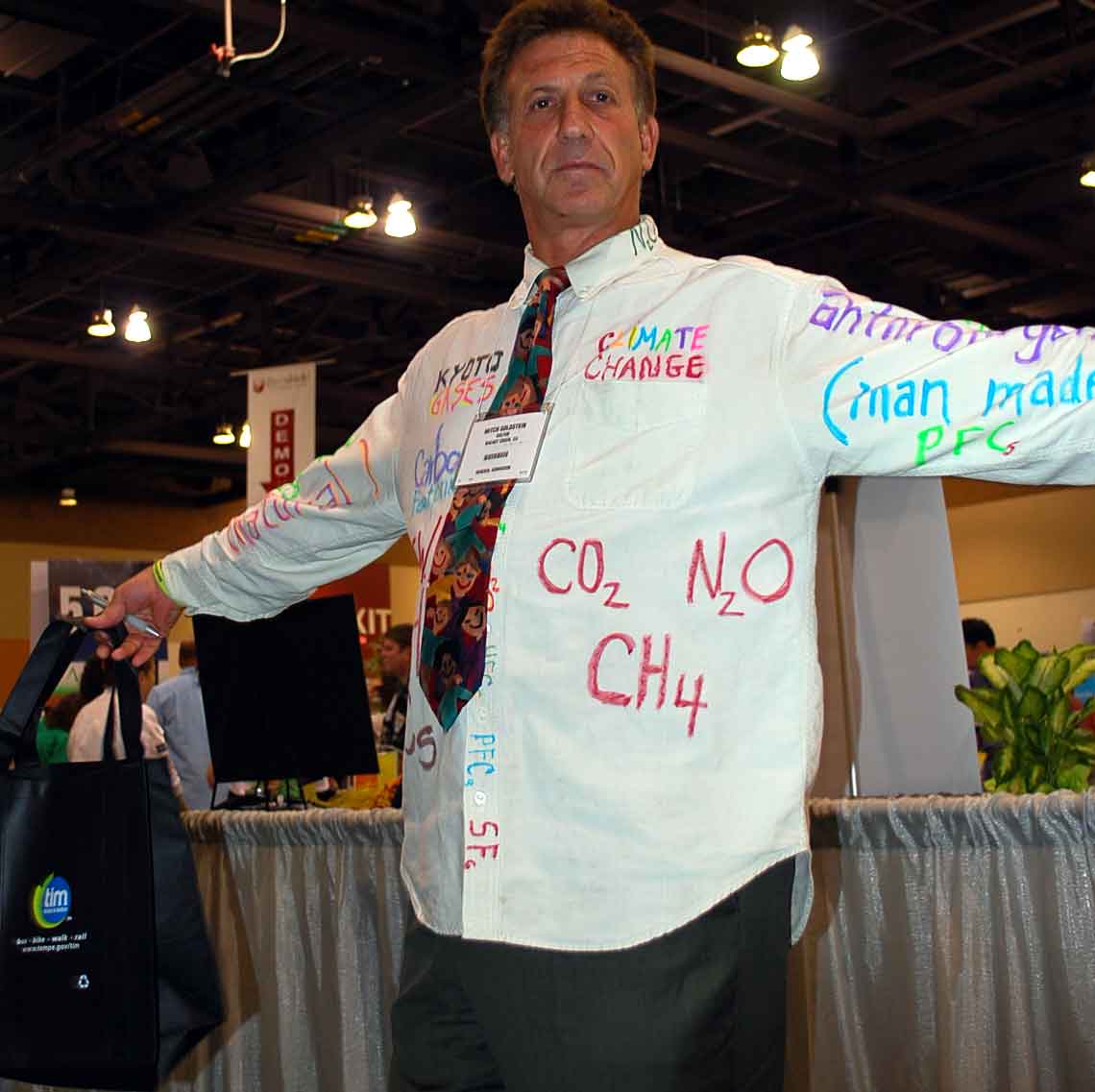
Then, there was this guy Mitch Goldstein, with no product to sell but a message writ large. He’s a teacher from San Francisco, attending the conference to check the pulse, but also to tell his story that I will go into in another post. What I wanted to focus on is how he’s using a white shirt as you would a white board with the bullet points. The elements on his left and right sleeve are the two parts of his message that he says people need to know more about.

Time to rejigger the microsite

Anyone who knows me knows how I make a big deal about microsites. The reason? Web sites are boooring, and way too static to engage me. (I really shouldn’t be saying this because I have a very static elder-statesman web site that I am too lazy to redesign.)

But I am talking of business web sites that are so full of the About-us stuff. Microsites, however break all the old rule of ‘stickiness’ and the default mode of information overload. But it’s about time to rejigger them because of the way our reading, search and navigation habits are going.

I am working with a crack team of designers on several microsites for some completed projects. My point is that I don’t want to simply knit up a project with a microsite, but create a structure for it to be a work in progress, a knowledge hub that is (a) never static like the parent site and (b) malleable and confident enough to have as many external links that are necessary, if it means rewarding visitors with content they may not have come across before in one place.

David Armano makes a few great suggestions on how to do this. His observation of the Lenovo (micro)site, which has been featured here many times, is spot on –that it doesn’t even scream microsite! His basic premise: build microsites that are more bloglike.

Why stop there? Why not bag traditional web site architecture and make web sites more bloglike?

Mojave Experiment: marketing not science

I don’t use Vista, the Microsoft operating system. But I have heard mixed feelings about it: It’s classy, or it’s like adding a piranha to your gold fish bowl. Vista has a huge perception problem; maybe we humans are just fickle; maybe there’s a marketing or PR fix to tell the Vista story better.

Maybe.

But if the Mojave Experiment is part of that attempt, you wonder what kind of mad science teacher is sitting next to the PR wizard in the perception adjustment department.

The set up: 22 Hidden cameras; ordinary people who have heard bad things about Microsoft Vista, and would never ever try it.

The experiment: This happens off camera, so we see no more than a before and after series of short video clips

The outcome: People who thought they were using a “new” operating system called “Mojave” having seen the software box and tried it in the ‘lab’ loved it, loved it, loved it, loved it.

The microsite looks like a fun experiment from a marketing angle. A panel of clickable videos that give you a feeling you are watching the participants as you would from behind the one-sided glass in a focus group.

But it’s easy to see that these are edited clips. We don’t see the whole reaction. This is not a lab experiment but a video shoot in search of footage that could be used for other purposes. I would have liked to see the guinea pigs use the OS, watch them struggle with the set up, and (assuming these are not all IT folk) do things like install print drivers, set up a wireless network, download web apps etc to suggest they/we do in real life.

If the Mojave Experiment is an exercise in attitude adjustment, we need to see less of the (reality) TV and more of the transparency. I like to know:

  • Who are these people in the experiment?
  • What do they say now –outside the lab?
  • Are some of them blogging about it? Could they be quizzed by us?
  • What percent of them are upgrading from Microsoft XP to Vista in their homes?

Finally, what is the outcome? I guess there will be more Mojave experiments. Give me some Mojave results.

Mommy bloggers carve spot in media mix

So Proctor and Gamble is doing a McDonald’s? They are inviting 15 so-called “mommy bloggers” to their corporate office.

One of them is MIndy Roberts, a mother of three. She calls her blog, Wonderbelly, a chronicle of “life and children in the sleepless hours in an effort to capture her young family’s world in real time.” Roberts is also the author of Mommy Confidential.

P&G seem to have done their homework in making their pick. “Metropolotal Mama” Stephanie Sheaffer, is another in the group of invitees. She says she works in the PR industry by day and blogs by night.

The Golden Arches did something like this around this time last year. Creating an advisory panel was a good way to counter the kind of flak they were getting from some quarters —and bloggers. Today Blogger Relations is becoming standard PR practice with lots of advice from the pros.

What does this tell us? It signals that bloggers are quickly becoming part of the media mix, rather than a group that only exists on the edges.

Quotes for the week ending 26 July, 2008

“Randy died this morning of complications from pancreatic cancer.”

Posting on Randy Pausch’s web site, on Friday 25 July announcing the sad news of the American professor of computer science known for his “The Last Lecture,” that became a New York Times best seller.

“I get that many consumers of online-transmitted information don’t like print much anymore…What I don’t get is why those Republic readers who haven’t sworn off computers altogether would simply ignore the logical digital complement to their dirt of print-based information.”

Paul Maryniak, General Manager of The Mesa Republic, inviting print readers to make better use of the Arizona Republic web site.

“To the average flier, this isn’t a case of the boy who cried wolf; It’s a case of the wolf who cried wolf.”

Editorial in Advertising Age about the disingenuous attack by the CEOs of 12 airlines asking their passengers to support them in their fight against oil companies to restrict oil speculation.

After 9/11, Mr. Bush had the chance to summon the country to a great nation-building project focused on breaking our addiction to oil. Instead, he told us to go shopping. After gasoline prices hit $4.11 last week, he had the chance to summon the country to a great nation-building project focused on clean energy. Instead, he told us to go drilling.

Thomas Friedman on on the significance of 9/11 and 4/11

“The gnashing of teeth from the left took on the odd cast of intellectuals congratulating each other for recognizing the satire of the image …”

Ann Marie Kerwin, on the New Yorker cover that sparked an uproar by the Obama campaign last week.

“The Web is not stealing audience away from TV, but rather helping them to build it.”

Mitch Joel, commenting on the fact that 45% of the CBS TV audience, watches their shows online.

“A throng of adoring fans awaits Senator Obama in Paris …And that’s just the American press.”

John McCain commenting on Obama’s visit to Europe and being neglected by the local media.