Spinners – Stress reduction fad or potential STEM tool?

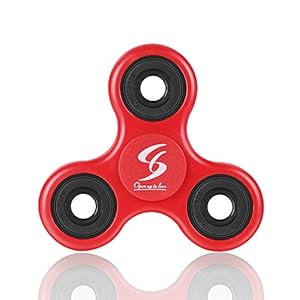
Gadgets fascinate me, especially those that have levers, sensors or even gyros. So the Spinner, a ‘momentum toy’ also known as a ‘fidget toy‘ looks promising.

If not for the fad factor.

Every kid finds it irresistible, no different from how yoyos, or Rubik’s cubes were hard to put away. But the Spinner is also seriously hyped, being claimed to solve many problems. Stress, ADD, and whatever seems to fit. But we better make a distinction between a sensory aid and a gadget that could be used just to show off. Not to mention it becoming a distraction device, rather than solving an ‘attention’ problem.

Having said that, I could envisage how with a few add-ons and variations of the Spinner design, it might be used in a STEM lesson. I’ve seen at least one teacher use the rotations and spin time as variables for math challenges. My colleague and I just discussed how this could become part of a robotics-related lesson, being a mechanical device, after all. No apps required, please!

The field is wide open. Let’s hope we don’t get steamrolled by the fad, and it doesn’t evaporate like…. last Summer’s Pokemon Go.


Build a ‘Steady-hand Game’ for under $3

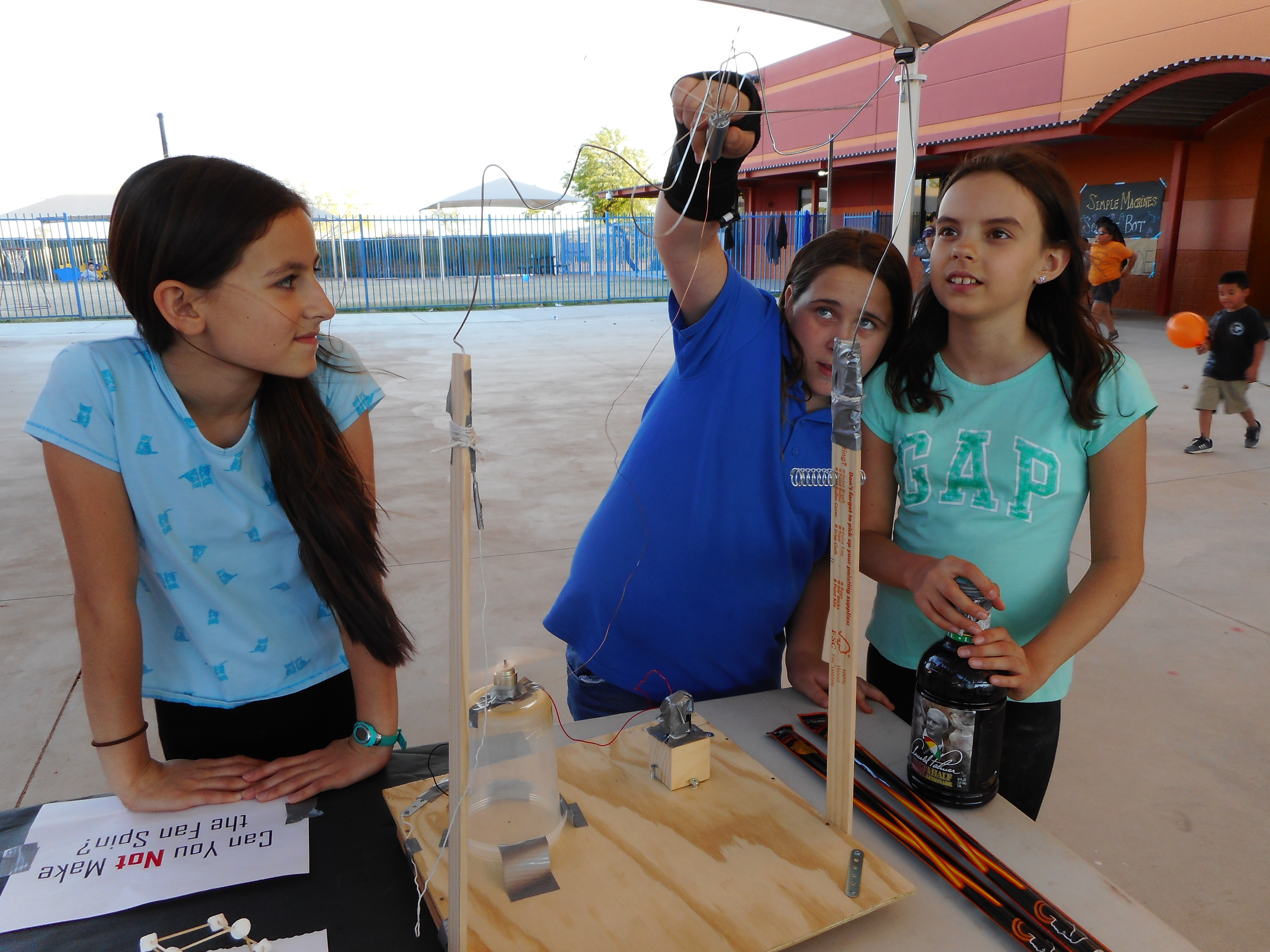
Here’s the device I constructed from mostly scrap material. It’s been called the ‘steady-hand game.’ The goal in this challenge is for the player to not to complete the circuit!

If any part of the metal wand touches the wire, it completes the circuit, which is connected to a rudimentary ‘fan’. Took me about 45 minutes to assemble the contraption.

I admit, the challenge was a tad too difficult. I could have made it easier, but it tends to be more fun if it triggers the fan. Perhaps for a younger group I could have straightened the wire, or bent back the metal ‘wings’.

Material: wood, scrap wire, duct tape, old plastic container, 9-volt battery, copper wire.

  • The Wand: Metal egg beater from the Dollar Store. Bend back some of the loops to create wing-like protrusions.
  • Fan: Made from an old CD, with a piece of Duct tape to cover the center hole. Pierce the tape with the top of the motor. Connect the positive and negative terminals of the motor to the battery
  • The motor. Available at any hobby store, Radio Shack, or online
  • Battery: Ideally a 9-volt battery. D-size battery will also work fine.

Expand the idea! While this is a great way to incorporate it into a unit about electricity and circuits, you could get some students to design an elaborate set up: More complex coils of wire, different size wands, and different circuits that set off off a bell, a light bulb, a buzzer, and a fan, depending on which circuit the wand touches.

‘Electric Avenue’ lights up STEAM Night at Salt River Elementary

This year’s theme gave us plenty space for creativity at our 5th annual STEAM Night celebrating science, technology, engineering, art and math at our school.

The cross-streets of Electric Avenue were filled with parents and children engaged in activities from ‘art bots’ to solar power; from unusual ‘machines’ to circuits. Then there were the bridge builders! The competition this year was to build a bridge with no more than 50 Popsicle sticks. The structure had to carry a load of up to 10 pounds.
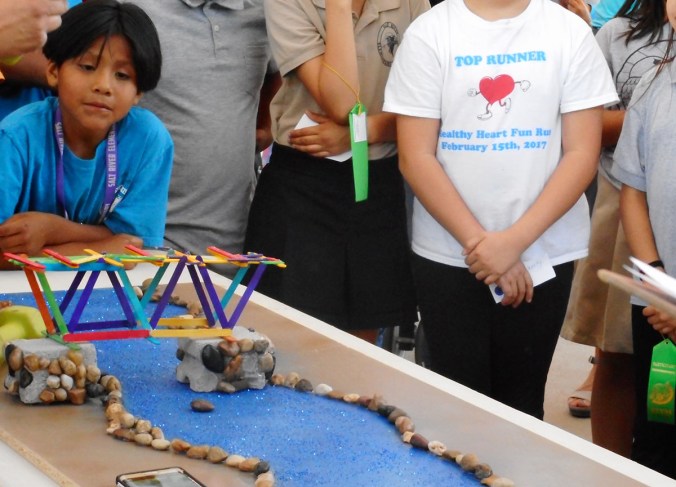
  • Students could not use: Metal, plastic, wood, nails, screws, super glue, staples or string.
  • They could use: Paper, Elmers glue, a glue gun, and 4 clothespins
As you will see design, and not just heavier or more expensive material, is key. A big thank you all the teachers and support staff who participated. Also to three organizations I had invited:

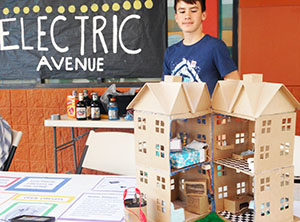
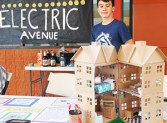
Montessori International School – Brown Road campus. Students and their science teacher, Scott Logan had an interactive table display of batteries (the fruit kind!), motors built with copper wire and a battery. They also brought a student-made ‘Electric House’ designed just for this event. It was a cardboard cutout with working models of home appliances that could be operated via a series of switches.

HeatSync Labs – Mesa, Arizona. Eric Ose brought something that required a hands-on effort of many students to make the device work. It was a cutout of Saturn, and students were given a soldering iron with which they had to connect a string of individual LEDs, to the ring of Saturn.

By the end of the evening, we could light up the ring, taking Electric Avenue to a different level! HeatSync Labs, a Maker Space run by volunteers, is definitely worth a visit. I took my robotics team there a few years back.

Martin Art Center. Martin Wesolowski and his wife displayed a Chaldni Plate. Martin runs a hands-on STEM center in Glendale Arizona. The experiment was about using sound waves to create artistic patterns when particles on the plate (salt, typically) resonate.
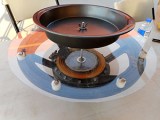
My ‘Specials’ team manned a  ‘MakerSpace’ table on circuits, batteries and motors. I even built something I had wanted to do for a long time – build the so-called ‘Steady-hand Game’. This used to be a staple game of skill in our youth.  The concept being, a wand that you had to move along a twisted wire, without touching it and completing the circuit.

Below is an art project that glowed under a black light, and some of the bridge entries.


My ‘Maker’ nephews’ hydraulic-powered bot built from scrap

This morning my nephews, Nikhil and Shenal, surprised me with a a video of a robotic device they built from scratch.

You’ve probably seen STEM projects that involve making bots or mechanical arms using batteries and sensors. This whatchamacallit does not require electronics. Just cardboard, pins, and syringes.

As a teacher, there are three things I love about this project:

  1. They don’t read off a script!
  2. The commentary is a conversation, building drama (including a mini count down) as the brothers wrestle with the device
  3. Simple explanation of the scientific principles – about levers, the ‘power’, and traction

I like how the claw seems to have a life of its own – good choice of camera angle!

This is what the Maker Space movement encourages, to build, test, fail, redesign, and demonstrate. Their ‘lab’ is their kitchen table!

Olympic-styled Robotics competition coming up in July

Last week I was contacted by ‘FIRST Global‘, an organization launching an Olympic-styled robotics event in Washington, DC, in July 2017. They were keen to see students from Sri Lanka represent their country.

I have been talking to organizations in Sri Lanka about this, and wanted to summarize details of the endeavor.

FIRST Global is the brainchild of serial entrepreneur, Dean Kamen, whose organization holds several robotics competitions for schools across the country. My school participates in it, and I have been the robotics coach since 2012. But this event is different, and stretches its global footprint to reach out to every country on earth, and empower students in engineering and science.

The event: An international competition in Washington, DC
The Goal:  To ignite a passion for Science, Technology, Engineering, and Mathematics (STEM) among the more than two billion youths across the world.
Dates: 14 – 18 July, 2017
 
The Requirement: High-school students (ages 15 – 18) who would build and program a robot from a provided kit (hardware and software)
Team : Could comprise 3 students, plus a coach
What I like most about this event is that it fosters a new international movement among future STEM leaders who will use the ‘competition’ as a springboard for global collaboration not just in robotics but in the emerging fields within science and technology.
The Robot Challenge: The focus this year is on Water. More specifically access to clean water.
For this, the robot table at the competition will be set up with challenges solving the global water crisis.
This could be similar to how the ‘missions’ are set up on the board for the other FLL competitions (2016 was Animal Allies, in 2015 it was Trash Trek etc) in which the robot to accomplish as many missions as possible within two and a half minutes.
For students who might want to contact me, here is one of the videos that explain the hardware that will be available  to design their own bot. If you need more information, please contact me at publicradius at gmail.

A trip to Mars would make NASA great again

Scientists plan to grow wheat seeds in growing substrate called arcillite

There is a lot of discussion on whether the US can afford to be in the space business. After all it costs something in the range of $4 billion to maintain the International Space Station.

It cost $1.7 billion to build a space shuttle back in the day.  The Space station’s building it and running costs have a price tag of $160 billion. But that bill is divided by all tenants – the Big Four (United States, Russia, Canada, Japan) plus 10 other European nations. Some estimates put the US portion at $3 billion a year.

NASA which is now focused heavily on research, is committed to supporting the space station until 2024, which is about six years ahead of when it expects to have a Mars mission ready. NASA has always had a research bent, since its inception as ‘NACA’ which was called a Research Laboratory.

Exploring another planet may seem a luxury, considering that our tax dollars are being used for other urgent matters at hand – healthcare, infrastructure, etc But the ongoing work in planning for a trip to the red planet is in and of itself an endeavor that helps scientists and engineers push the boundaries of science and technology. Take for instance the ‘lab work’ going on in the continuous study of humans in Mars-like habitats on an Island of Hawaii. Or hundreds of experiments being done in space (on the Space Station) on cellular biology, remote sensing, micro-biology, seed growth, and micro-gravity.

The latter two, are some of the dozen science projects from students, who would one day diversify, and spearhead various fields we have not even heard of today. Mission 12, will accept experiments from Grades 5 to 16, for their experiment to be included on a flight to the International Space Station in September this year.

Perhaps it is this scientific thrust, and the work of an emerging cadre of scientists who would make NASA great again!


As seen outside Tucson, Arizona

For those of who think giant cacti are the only things that dominate Arizona, here’s another fantastic landmark.

ufo-sighting-tucson_tn


And no, it’s not a set from Close encounters of the third kind. It’s one of the many giant telescopes on Kitt Peak, 55 miles east of Tucson. And yes, it was snowing up there, at 6,800 feet when we visited.

Kids take to design as Digital Learning Month kicks off

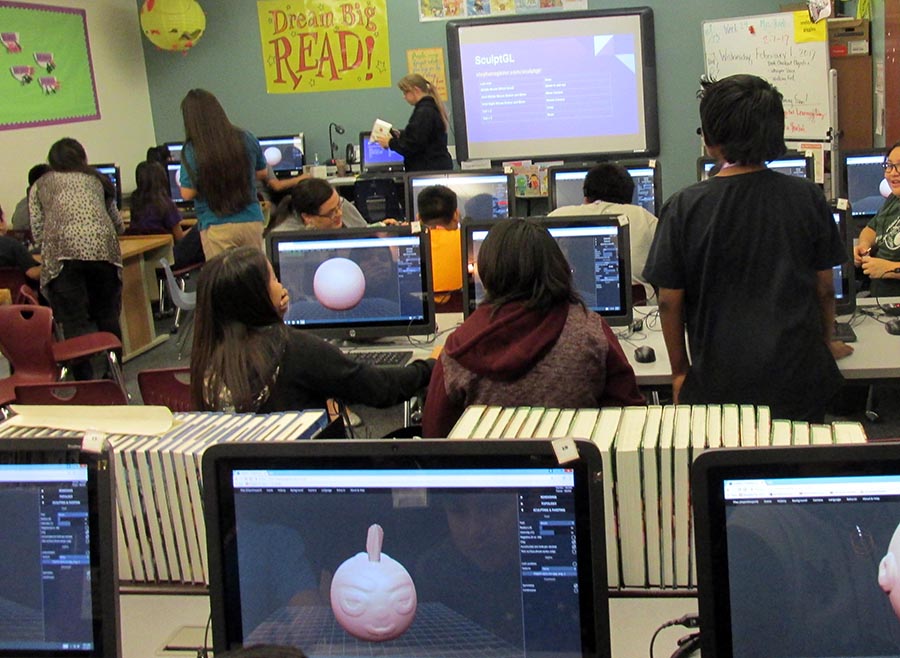
sculptDon’t you wish you could have learned in elementary school what kids have access to now?

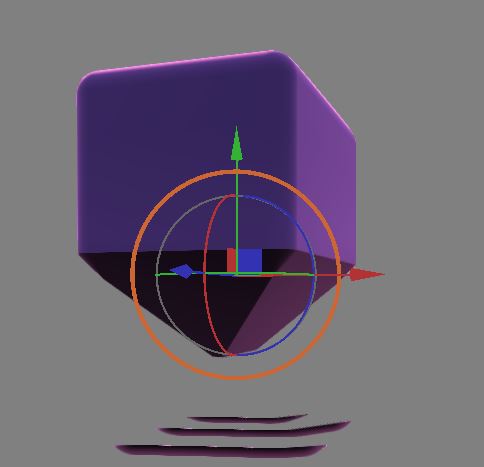
That was one of the comments of a designer from TimeFire VR, speaking of how excited she was to see 6th graders quickly learn how to use SculptGL. It is a powerful open source CAD program for 3D sculpting. (I created this in just 2 minutes, having no experience!)

Of course there is much  more work to be done and TimeFire showed us how we could to get there, with Blender, another open source application. This being Digital Learning Month, we will dlday1have time to get deeper into CAD and 3D sculpting. I’m planning to ask TimeFire to come back for an encore session soon.

I like to thank John Vise for making this happen. Specially to Jessica, Rainy, and Ariana for showing us the exciting software, and future career possibilities.


Do we have space for Makerspaces and tech shops?

Some days I wish I could convert part of my computer lab into a Makerspace. After all I have re-defined it as a Computer and Technology Lab, so it would be appropriate to have other technologies. Like a metal cutter, or workbench to build things – such as making a speaker out of an Altoid tin, or rudimentary printing such as silk-screening.

I thought of this again after getting into a discussion with a teacher visiting our school from New Zealand this week. She spoke of how curriculum there includes woodwork, needlework and many hands-on activities.

She was not been aware of Makerspaces, but mentioned a parallel well-organized movement called Mens’ Sheds – run by retired people so that anyone could take up a new skill.

Makerspaces here are great places for students with rudimentary engineering products in mind, for say a science fair. They are open to anyone and are often free. Some school libraries are carving out makerspaces for 3-D printing.

I’ve visited one in Mesa, Arizona called HeatSync Labs. Love the name!

I’ve still to visit the TechShop in Chandler where you could learn CAD drawing, or how to build a (guess what?) Bluetooth speaker!