NASA ‘flowing’ water on Mars newsflash, messes the plot

I’m sure many wanna-be Martians (and there is a training program for this) are breathing a sigh of relief to know that one does not have to go the Matt Damon route to stay alive on Mars.

Today NASA announced that H2O from hydration salts means that it is flowing –as evidenced by image analysis from the Reconnaissance Orbiter. It also thickens the plot for may *young* scientists to whom we put this question: What would you take on a long trip to the Red Planet.

Mars Day is around the corner at my school. This will certainly be a topic that comes up. Maybe we ought to contact MarsOne. Bas Lansdorp, if you get a chance to see this, I’d love to chat with you about speaking to my students.


Technology in schools. Love it or hate it?

IMG_0302

Touch screens and Robotics. My classroom this yea

In my upcoming July technology column I analyze the pros and the cons of Technology in Education. A few in my network have asked me about my thoughts on this ever-changing topic. (In Oct 2014 I did cover it – “Disrupting Education)

Here’s a summary of what’s to come. As you and I witness the discomforting transition from text books to tablets, from hand-outs to videos-as-homework, from sequential ‘lectures’ to disruptive (noisy) small group activity, it’s easy to fold our hands across our chests and fight it. But there are some compelling arguments on both sides. The Wall Street Journal, and the International Association of Technology in Education almost in the same week ran Pro and Con arguments about Ed-Tech. I get both sides! In my classes I argue against the inane use of social media for the sake of ‘publicity’, but I encourage thought use of digital media with real, and real-time audience participation.

‘Hall and Stevens’ Vs Khan Academy. In my younger days, I had to thumb through Hall and Stevens, the geometry ‘bible.’ Today’s kids are learning geometry from a guy called Salman Khan, founder the free online learning portal for mathematics and science. (Fun sidebar: ‘Hall and Stevens’ is available as an eBook; flip the pages as if it was a real book, here: https://archive.org/details/schoolgeometry00hall

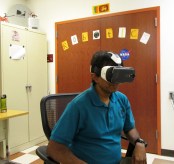
Screen Time vs Think Time. I am a big proponent of virtual and augmented reality, especially if it could bring in ‘distant’ experiences (Civil War, 3D models of engineering, space science etc), but I also aggressively advocate limited screen time. Odd isn’t it? That’s the dilemma we educators and parents face. Augmented Reality

Your son or daughter probably goes to school with a device in her backpack with more processing power than the rocket that took men to the moon, and this child wants to be… an astronaut? You’ve forgotten how to log into your son’s school website to download his missed homework, but… he’s found a way to ‘jailbreak’ your cell phone? There are ‘teaching moments’ in all of these.

Sal Khan speaks of the “fundamentally dehumanizing experience” in education. And he was not talking about teenagers and even pre-teens staring at their phones and not talking to one another. A real, ‘digital citizenship’ crisis, right now! He was referring to children packed in a classroom! Hmm!

Love it or hate it, technology is gate crashing our class rooms, just like ball-point pens or calculators once did. Are you ready for it?

Messy Learning Labs. Just what our screen-obsessed kids need

If you’ve ever complained about classrooms being stuck in the industrial age, here’s a glimpse of a different kind of class. It’s Hi-Tech space with a factory-floor setting. Perfect for digital natives, huh?
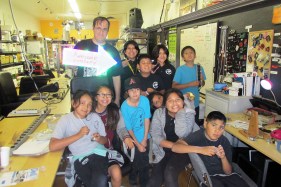
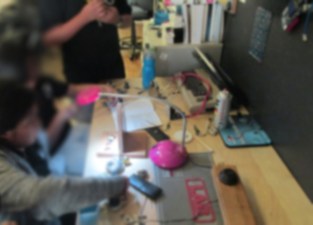
heatsynclabs_tnI took my robotics students here last Tuesday, to a place called HeatSync Labs in Mesa, Arizona. Not the kind of ‘lab’ they had in mind – but in a shocking way! It is what’s known as aMaker Space’ where kids come to ‘learn by doing’. They didn’t want to leave!

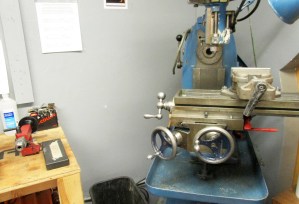
You see, a Maker Space like this is more like a mad scientist’s garage, than a classroom, with a variety of machines, tools and material just begging to be used. If you recall how HP began in a humble garage, you’ll see why a tinkerer’s tool-shed like this is what classrooms ought to be like if we are to motivate the next generation of inventors, astronomers and mad scientists like Bill Hewlett, Dave Packard. Or the next Thomas Edison (who barely went to school, please note).

Having worked with 6-12 year olds for four years now, I know how hungry they are for science. Especially science that comes to them in unexpected packages. OK, so in one corner of the lab there was a 3-D printer, an artifact from our all-too-digital present. But someone had used it to produce intriguing pieces such as this plastic cube (right), with gears!

In 75 minutes my students probably got more about science that any slick PowerPoint presentation. This was about experimenting, making mistakes, and asking ‘what-if’ questions. This was about rummaging through bins, and peering through scopes, working with laser-cut stamps they mounted on blocks of wood. And not a tablet in site!
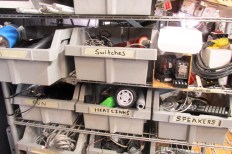
Shelves

Machine


At one point, Eric Ose who works there took me aside and told me, awkwardly, “I am not used to young people here asking permission to do things.” Meaning, this was a space that people came and just tried things out, used material lying around, and worked on their own pace. Of course there are guidelines – especially safety guidelines, as when watching laser cutting, or operating the 3-D printer.

But the real house rules are this: Try something out. Make things. Break things. Revise. Start from scratch. Discover. Build something impossible!

Note: If your students have never been to one I urge you to make it your next field trip. Many cities have these community run spaces. (Map)
HeatSync