For Robotics this year we’re re-imagining ‘Trash’

We just kicked off our new Robotics season in my school –my 5th year as coach!

With 26 students signing up, that’s more than twice the number of applications from last year. It’s a ‘good problem’ to have, to see kids become so excited about doing the hard stuff – the building, programming, doing the requisite research, and finally running those complicated missions.

On first glance, this year’s theme, Trash Trek,‘ is much less abstract than last year’s ‘World Class’ (around global education). Lots of big ideas to get our minds around the three R’s that could become a cliche unless we re-interpret RE-ducing, RE-using and RE-cycling . For instance, how about RE-imagining:

  • How far does the trash that gets into our bins has to travel? Could we calculate this (the ‘M’ in STEM) and display it somewhere? Perhaps in our communities — as some sort of a dashboard? If so, who would build the app? What would that display look like?
  • Who decides on the packaging that gets into the products we buy? How much cost will it save if we RE-fuse to ‘pay’ for this (with our landfills?)
  • Could our trash bins earn us money – a la Recyclebank?

I’m talking to all kinds of people – entrepreneurs, engineers,, designers etc who could come in and inspire my students. If you know someone, please call me, email me or send me a tweet at @heyangelo.

Some examples we might use for inspiration this week.


Technology in schools. Love it or hate it?

IMG_0302

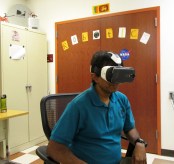
Touch screens and Robotics. My classroom this yea

In my upcoming July technology column I analyze the pros and the cons of Technology in Education. A few in my network have asked me about my thoughts on this ever-changing topic. (In Oct 2014 I did cover it – “Disrupting Education)

Here’s a summary of what’s to come. As you and I witness the discomforting transition from text books to tablets, from hand-outs to videos-as-homework, from sequential ‘lectures’ to disruptive (noisy) small group activity, it’s easy to fold our hands across our chests and fight it. But there are some compelling arguments on both sides. The Wall Street Journal, and the International Association of Technology in Education almost in the same week ran Pro and Con arguments about Ed-Tech. I get both sides! In my classes I argue against the inane use of social media for the sake of ‘publicity’, but I encourage thought use of digital media with real, and real-time audience participation.

‘Hall and Stevens’ Vs Khan Academy. In my younger days, I had to thumb through Hall and Stevens, the geometry ‘bible.’ Today’s kids are learning geometry from a guy called Salman Khan, founder the free online learning portal for mathematics and science. (Fun sidebar: ‘Hall and Stevens’ is available as an eBook; flip the pages as if it was a real book, here: https://archive.org/details/schoolgeometry00hall

Screen Time vs Think Time. I am a big proponent of virtual and augmented reality, especially if it could bring in ‘distant’ experiences (Civil War, 3D models of engineering, space science etc), but I also aggressively advocate limited screen time. Odd isn’t it? That’s the dilemma we educators and parents face. Augmented Reality

Your son or daughter probably goes to school with a device in her backpack with more processing power than the rocket that took men to the moon, and this child wants to be… an astronaut? You’ve forgotten how to log into your son’s school website to download his missed homework, but… he’s found a way to ‘jailbreak’ your cell phone? There are ‘teaching moments’ in all of these.

Sal Khan speaks of the “fundamentally dehumanizing experience” in education. And he was not talking about teenagers and even pre-teens staring at their phones and not talking to one another. A real, ‘digital citizenship’ crisis, right now! He was referring to children packed in a classroom! Hmm!

Love it or hate it, technology is gate crashing our class rooms, just like ball-point pens or calculators once did. Are you ready for it?

My school profiled on US Dept. of Interior website

When Sec. Sally Jewell visited our school last week, little did we know how it would figure in the grander scheme of things. It was much more than a simple ‘air drop’ of a dignitary.

Turned out it was to kick off something bigger – a Listening Tour, of Native youth.

Yesterday we noticed that apart from the previous media coverage of this visit, the folks managing the communication for Secretary Jewell’s department had featured a lot of great shots of her engaging with our students. Two of the students featured are potential podcasters in my class on audio. Three are in robotics.

Here’s the video:

And below are some of my pictures taken at the event – also covered here on this blog.

This, taken in my class. Student Council president and robotics student explains how they approach a mission, program and document their work.

More pictures from my class blog, here

We often complain that government is tone deaf to much of what goes on in our communities.Speaking to Sec. Jewell, I could tell that this was much more than a token visit so as to report to the boss she’s been on the road.

We spoke of science. A lot! I mentioned that in the midst of so many changes in education, government seems to be not doing enough to promote science and technology.I mentioned that the State of the Union this year barely touched on STEM, despite Obama’s otherwise talking the talk on why we need more investment and more STEM teachers in science in schools. She was a good listener.

Visit by US Secretary of Interior to my class

Exciting morning yesterday with the visit of Secretary of Interior, Sally Jewell to our school.

Sec. Jewell was kicking off to the Obama administration’s ‘Listening Tour’ in Arizona, visiting Native American schools and communities. She devoted a good part of her talk to stress the importance of science, in the four STEM areas. “I am the ‘E’ in STEM,” she said.

As part of her tour she stopped by my class to hear about the robotics program.

One of my students in robotics, who happens to be the president of the student council, explained our program and research projects.

Some media coverage, below.


Cronkite News, ASU

KJZZ Story – Interior Secretary Sally Jewell Begins Native Youth Listening

Fun way to ‘warn’ drone enthusiasts

I’m impressed at how the FAA decided to educate would-be drone pilots. They partnered with The Association for Unmanned Vehicle Systems International (AUVSI), to release this video.

It sure doesn’t look like a government agency production.

It’s mainly about the 400-foot rule, but also ‘gently’ warns about invasion of privacy.


Communicating with crew on ‘Mars’ – Text-To-Speech

Those who know me, know I’m a follower of all things in space – from watching the International Space Station fly by, to the latest maneuvers of the latest Mars Rover.

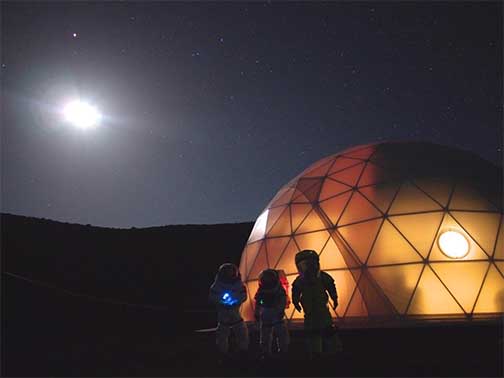
So this week, it was a chance to communicate with Jocelyn Dunn,one of the 6 inhabitants of a Mars simulation mission, going on in Hawaii. The project, is called HI-SEAS (which stands for Hawaii Space Exploration Analog and Simulation).
The reason: I’m putting together Mars Day a now-annual event at my school. I thought my students would get a kick out of talking to the folks who are paving the way for humans on the red planet. Or, to put it another way, they’ve seen a lot about the bot that got there; now it’s time to communicate with Homo sapiens!

Jocelyn and the rest of the HI-SEAS crew began their ‘analog simulation’ last Friday, inside a 1000-square foot geodesic dome.(Another crew member, Zak Wilson is also blogging the stay.)

HI-SEAS Dome

Image, courtesy hi-seas.org

So what is it like to be practically isolated from the rest of the world? Isolated as in no phone calls. Now they do have access to the Internet (!) so I will be asking her these questions in a few days. Yet, to simulate the real thing, the crew’s email is subject to a 20-minute delay.

The fun part is planning for Jocelyn and her crew to answer questions from my students. After a couple of back-and-forth (time delayed) she came up with a good solution: We would send her the questions via email, and they would record their answers on a video, and send it back to us in time for Mars Day!

It will give new meaning to ‘Text-to-Speech’!

Here are links to other crew members

Could robotics’ kids could teach adults some ‘Gracious Professionalism’?

Newsflash: Not all kids are staring at their phones.

Ever walked into a mall and thought the world is going to hell in a hand-basket, watching teenagers ‘socialize?’

I had the opportunity to see another side of kids and technology, at a robotics tournament yesterday. The event is part of the FIRST Lego League events, that challenges young kids to put their minds to robotics. (There are a series of such events going on across the country over the next few weeks.)

Salt River Elementary School, Robotics - Gracious Professionalism

It’s a different lens. You get to peer into the future, watching a bunch of 12-year olds get themselves in and out of a sticky situation, and employ communication skills we wish some grown-ups had. You see them go through all stages: panic, disagreement, leadership and teamwork. When things go awry, they often problem-solve and improvise on the spot. (And there’s not an App in sight!) And best of all, they celebrate each other’s success –even competitors at the next table.

If only Congress would work like this, I thought.

And then it dawned on me. These kids will be the ones on Capitol Hill, someday. Or running our institutions, setting our agendas…

The FIRST Lego League requires that we adults promote what it calls ‘gracious professionalism’ in our teams. (The term was coined by Dr. Woodie Flowers, a professor at MIT), because that is how the grown-up world works. But the reality is, such a brand of professionalism in many facets of business and governance is more the exception than the rule. It’s a winner-takes-all world, we are often reminded.

But here at the FLL level, we teach our students to consider failure as a wonderful learning opportunity, and to not be obsessed by trophies. One of the core values they must exhibit is enlightening:

“What we discover is more important that what we win.”

Then, at the end of the day, the results show up on the large screen. Your heart sinks as you see the wide gap between the team that has mastered every mission, and those that had epic failures as their bot went off track, and wrecked their team’s chance of making it to the State tournament. But they quickly get over that and enjoy the moment.

They’re our gracious professionals in the making. 

And then life threw me a lesson plan

For more than a year, I have been making a transition from corporate communications to education. I have been given an opportunity to be a computer teacher at an elementary school in Scottsdale, Arizona.

It’s an amazing time to be joining a profession that’s getting lots of attention. And scrutiny. From the recent schoolteachers’ walkout in Chicago, to the just out Nations Report Card, among others, the story is not exactly cheerful.

Meanwhile, as knowledge acquisition is moving an 120 miles-per-hour, pedagogy is ambling along.  I can see this through the lens of our two children, as new engagement tools emerge, and curricula change. Analog classrooms are trying to adapt to digital natives. Britannica now has an app for the iPad and other tablets. Classrooms are being ‘flipped.’ We can’t continue to do the same old, same old.

If there’s a simple lesson plan for my career, it’s this: push students to the edges. Focusing on ‘core’ areas, but also widen the aperture. Knowledge of ‘computers’ without context of where they are used, is meaningless. Often it’s the topical things we introduce in class that make planned (not canned) lessons relevant. One study last year found that students who did “science-related activities that are not for schoolwork” performed higher.

TO KICK OFF, I re-positioned the computer class as a Technology and Computer Lab, in which students will engage in subjects from space exploration to search engines.

Being the school’s robotics coach helps. This is a program established by the FIRST Lego League. Students can step out of their comfort zone and take risks, even while engaging their math and design skills.

Each day, the lens zooms in and widens…


Will tablets and smart phones kill conversations?

A few weeks back, I passed a sad tableau of an Asian family: a dad and two sons waiting for Mum outside a Chinese grocery store. All three of them were silently thumbing away on their iPhones. In cars, in waiting rooms, the tablet and the smart phone has become the new baby sitter.

Over the past five years, having reported social media’s many benefits I often have to step back and wonder about what it means to be too much digital.

We have become so used to being ignored while having a conversation with someone with a Blackberry that we sometimes take it for granted.

It’s not just an etiquette problem as some have alerted us to in the past few years. It’s a social problem that will have deeper ramifications –too much ‘media’ perhaps – as we marvel at how connected we are.

It generates caricatures such as this and this.

  • Smart phones don’t automatically make us smarter. (Perfectly captured in that Geico commercial that poses that rhetorical question.)
  • Likewise one more screen in the home won’t make us better informed. While we do see attempts to engage students better using tablets, social media and other digital platforms, parents and educators need to add some caveats. Teaching children media literacy would be a start.

There is a connection between learning to have ‘conversations’ and learning how to learn by deconstructing information presented –a.k.a. discourse analysis. I am planning to connect my Robotics class with a class in Thailand, soon, and have given much thought to the balance of a traditional class with a digital experience where students will talk to each other with and without digital devices. More on this later.

I will leave you with two great pieces :

Enjoy! And do send me your thoughts, comments.

When Robotics is more science than fiction

A few weeks back I took my Robotics team to see one of the coolest robots. It has ‘eyes’ and a brain, and it knows enough to get itself out of trouble, even when its handlers are not in the next room —let’s say 34 million miles away! This was the Mars Rover, at the  Mars Space Facility at Arizona State University.

The purpose of the visit was to get students to start thinking of technology as something much bigger than the gadgets they tend to get exposed to. To many 4th and 5th graders a computer is a box with a screen. A remote control is a piece of plastic with buttons.  And a robot tends to be thought of as an anthropomorphic device that takes orders.

Is our education system to blame?

Perhaps our society has to face up to the bigger challenges facing young people today. Challenges that may not be solved just because these kids become savvy using an iPhone app. Or being able to define the Pythogorean theorem.

Apart form a tour of the Rover, the students got to meet the NASA robotics team who demonstrated the simple-looking but complicated bots they are working on, using PVC pipes, , scrap metal, Styrofoam, and wire. Twenty years from now one of these could be making the big step to solve unsolvable water, energy or safety issues back here on earth. I think my students walked away from there realizing that robotics is more science than science fiction.

They took notes! They asked a lot of questions!

One of them, a budding designer, is making very complex sketches of his ideal robot.  Someday all children will…

I will leave that sentence unfinished –for now.

But as adults, there’s work to be done. Recently President Obama addressed students at the Carnegie Mellon’s National Robotics Engineering Center. He was imploring students to think like the future inventors and  entrepreneurs. This country is sorely lacking them.

“Now, imagine if America was first to develop and mass-produce a new treatment that kills cancer cells but leaves healthy ones untouched …or flexible display soldiers …or a car that drives itself. Imagine how many workers and businesses and consumers would prosper from those breakthroughs.”

Those things aren’t science fiction, he noted. It is the “kind of adventurous, pioneering spirit that we need right now.”

My class of 14 students is relatively small. We do not have the funds of a Carnegie Mellon. But we have big ideas. Wide-open eyes. Some of them are already programming the Lego NXT brick to perform some neat manoeuvres.