Bring out the rockets – It’s S.T.E.A.M. Night!

This will be our 7th annual STEM (or S.T.E.A.M.) event, and it seems like a perfect year to focus on rockets.

Paper, air-propelled rockets, slingshot rockets, and even those that soar nearly 300 feet. Students have already begun designing and building their entries for the competition. Rubber bands create great kinetic energy!

We will have several related S.T.E.A.M. activities:

The Date:  30th April, 2018
Place:       Salt River Elementary
Time:         5 – 7 pm


While some robots handle hernias, others could be invade countries. Are we crossing the line

I’m all for the use of surgical robots, or the emerging field of ‘drone journalism’ for data gathering, and even exoskeletons. But could others go too far?

Two types of robots worth considering this week:

Exhibit A: Robots in the battlefield. The Guardian reported that AI experts have called for a boycott of South Korea’s Advanced Institute of Science and Technology (KAIST). The arms race for autonomous robots as machines of war is real. The US Military with Lockheed Martin has been developing autonomous armored vehicles.

Exhibit B: Then there’s the more benign use of a robot –in a coffee shop! The Da Vinci surgical robot (which I have written about) was used in a ‘demo’ of sorts in Kullman, Alabama, to give people a chance to see its capability in a friendly setting. This robot typically handles gall bladder and hernia procedures. (No fear, it’s not an autonomous bot.) Nice touch, humanizing this strange-looking refrigerator-sized 4-arm robot.

The point being, teaching robotics ought to come with a layer of ethics. It’s not enough to be develop breakthrough robots just because we can. There is such a thing as the 4 Laws of Robotics, as written up by Science Fiction writer, Isaac Asimov. They are:

  1. A robot may not injure a human being or, through inaction, allow a human being to come to harm.
  2. A robot must obey the orders given to it by human beings, except where such orders would conflict with the First Law.
  3. A robot must protect its own existence as long as such protection does not conflict with the First or Second Law.
  4. A robot may not harm humanity, or, by inaction, allow humanity to come to harm.

The fourth law was added later by Asimov. We may have begun crossing the line, and ignoring it.

Interestingly, the UN this week has addressing the pace of robotics, through the Convention on Conventional Weapons (CCW) agreement, and the UN Institute for Disarmament Research. Lots of semantics in the debate, with regard to ‘autonomous’ and ‘automated’ and what constitutes ‘human control’ of these devices.

‘Weapon of Mass Instruction’ – Where did a Library lead you?

This week, April 8-14 is National Library Week. It’s a given: libraries have transformed our lives. Whether it was a sparsely equipped school library, or an uncle’s bookshelf, there’s a chance that a ‘library’ or a book that you randomly picked led you to this career.

So how did a library change your life? 

I am asking this question from as many people as possible, and will post responses here. Do send me your mini stories!


WEAPON OF MASS INSTRUCTION: Created by a photojournalist, this moving library, a ‘tank,’ is a converted 979 Ford Falcon that holds up to 900 books.

PROJECT GUTENBERGR, an Internet archive of 11 million boks and texts, and 4 million audio recordings of writing. You could find and download for free a book published prior to 1923! Gulliver’s Travels? Hamlet? It’s free!


Rock, Paper, Scissors, Writer’s Notebook!

There are some sure-fire things that spark creativity in a classroom. And no it’s not always a computer! I say this despite the fact that my class is a computer lab, so bear with me. I keep magnets of all shapes and sizes handy, as it is easy to start a conversation about science with a lump of metal. I also have a box of weird-looking rocks that look like they belong to a Martian landscape.

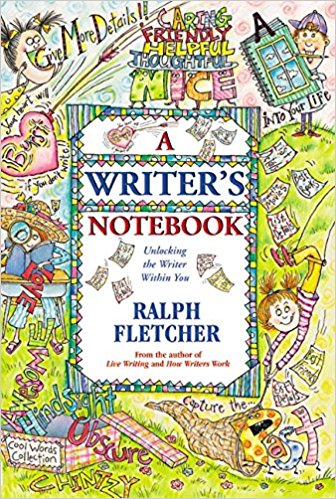
A few weeks back our reading specialist gave me a book called A Writer’s Notebook by Ralph Fletcher. It seems pretty obvious, that every would-be writer should jot down thoughts and ideas he or she stumbles upon. The book encourages students to consider taking ‘notes’ in different ways: “Seed ideas,” “Mind pictures,” “Digging out crystals” and “Snatches of talk” among others.

When I teach writing, no matter what the task at hand is (a letter, a poem, an essay, a speech) I get the student to start with a blank sheet of paper and use it as a ‘brain dump.’ This could exist on the margin of a hand-drawn graphic organizer. Somewhere in that stockpile, there will suddenly appear a key word or phrase that you can take and run with. Fletcher explains that unearthing ideas is akin to excavation:

“Once you locate the rock you use a heavy tool like a crack hammer to carefully break off pieces of stone ….revealing a ‘gem pocket’ filled with sparkling Herkimer diamonds.”

Writing is a lot like that. Anything can spark an idea, but one must painstakingly mine it to let the words tumble out.


Still publishing Newsletters? We do!

I’ve often said I still read newsletters. From the quirky Trader Joes’ black-and-white ‘Fearless Flyer,‘ to those that come in the mail, often unsolicited. A good friend, a realtor, publishes and mails us an information-filled newsletter that is a delight to read each month. And there are many more – we just don’t give them enough credit in an everything’s-on-Facebook kind of era.

What’s your favorite newsletter? Does it still get printed or has it turned digital? I’m curious.

The case for newsletters has been debated ad nauseam. Most tend to get into the print vs email debate. But I don’t think it’s an either/or. It could be both. Sure, the reading habit is on life-support in some places. But we’re not going to pull the plug.

And so in school, some of us continue this tradition as a way to communicate with parents and the community as to what goes on in our classes in Music, Art, Library and Media Center, PE, and Computers & Tech. Here’s our latest Specials Newsletter – the March 2018 issue.

Cliches don’t work after this school shooting. Students will put spin doctors out of business!

I came across an observation made by Michael Shammas, who asked us to consider what we would say if Kim Jong-un disputed international arms control treaties by adapting the cliché, “Nukes don’t kill people; people kill people!”

We would dismiss it as deranged thinking, wouldn’t we?

The events following the massacre at Marjory Stoneman Douglas High School in Parkland, Florida have created a different kind of tipping point. One that shows students’ capacity to hold up these tired clichés and talking points for scrutiny. Such as these lines spoken by a senior at that school:

“They say a good guy with a gun stops a bad guy with a gun: We call BS!”

“They say guns are just tools like knives and are as dangerous as cars: We call BS!”

These students are thoughtful, logical, vocal –the kind of non-polarized citizens a country needs. Imagine what they could accomplish when they get to voting age!

Coding and Digital Learning Day, today

It’s Digital learning day across the country, today. Salt River High School is hosting Code Night, a community event to showcase week-long Hour of Code activities.

Last week, at the elementary school we focused on Digital Learning, beginning with a kick-off event featuring speakers who talked to students about social media, and coding. It’s interesting how much has changed –and how much more scrutiny we give to digital learning –since last year. Parents and educators have to deal with much more than memes, and cyber-bullying. Social media viral stunts for instance.

Coding is somehow more than a passing fad. It’s more about problem-solving than learning a new ‘language.’ Much thanks to Synapse Studios, Mel Adamaitis, Danielle Benally, and Stephanie Schull.


Teenagers need guns like fish need bicycles

It is with tremendous sadness that we process the latest horrific school shooting in Florida. Especially parents and teachers.

If you have a child in school today you would have received a message from the school district ‘assuring’ you of precautions that ensure safety in the school – from cameras that police departments can access, to active-shooter training, and other forms of vigilance.

The number keeps rising. As https://www.npr.org/player/embed/586171960/586171961“>NPR summed it up yesterday, 18 shootings on school property, just 46 days into the 2018. To borrow that line by Australian writer and politician Irina Dunn, who coined the phrase adopted by feminists, a teenager needs a weapon like fish need bicycles.

So many dreams, lives, family histories wiped out because someone –certainly someone who could not qualify as part of a ‘well regulated militia‘ –abused a ‘right to bear arms.’

https://www.npr.org/player/embed/586171960/586171961

Radio days! Podcasts back with a vengeance!

In case you’ve not noticed the podcast landscape had changed. I’m so glad this genre – audio story-telling –has survived in a digital age that at one time seemed to gravitate toward video, slapstick entertainment, and uninformed opinions.

These are highly-researched, well-produced shows – not just opinionated rants. 

Here are a few:

Code Switch – Fascinating takes on race and identity

Rough Translation – A great way to escape the echo-chamber!

The Hidden Brain – Shankar Vedantam’s insight into human behavior

The Tip-Off – Peeling back investigative journalism, by Maeve McClenaghan of London’s Bureau of Investigative Journalism


Some older podcasts still give the newbies a run for their money. Those such as:

  • This American Life – Ira Glass’ extremely topical take on all things social, political, personal
  • Invisiblia – Gripping tales and insights about the forces that shape us.


Spotlight on Social Media Awareness, Coding for Digital Learning Days

Next week, we kick off a week of coding, and also a time to talk about the good, the bad and ugly about social media.

Coding is something that could be exciting for every age group – from simple problem-solving skills, to what-if scenarios. Students will log-into places such as Code.org, Khan Academy, Scratch, and Blockly.  I like how Scratch is positioned as a way to “Create stories, games, and animations.”

Two speakers will kick off the week:

Mel Adamaitis – Synapse Studios
“Why Coding Matters”

Dr. Stephanie Schull – Matter Mission
“The Good, the Bad, and the Ugly of Social Media.”


While we are at it, here are some good resources: