Screens or No screens? Battle lines are being drawn

Which side of the fence are you on when it comes to screens in the lives of your children?

We all have stories to tell. So as I regularly pose this question to my friends and colleagues I like to stay armed with evidence, and more importantly, other parents’ findings. You may want to read the story by Anya Kaemnetz on NPR this month. she quotes may different people. From a sleep researcher parent, to a pediatrician, to an obesity doctor.

  • The obesity doctor has this ‘rule’ in the home: The 5- 2- 1- 0 formula. It’s basically servings of fruits and vegetables a day. No more than hours of screens. 1 hour of physical activity, 0 sugary beverages.
  • The sleep researcher doesn’t allow screens to be used before bed time as t impacts sleep quality and of course sleep time.

Meanwhile the cell phone ban in schools has many advocates, including in France. Would it kill the Ed-Tech supporters? And the one-on-one movement?

What’s your take?

Robotics Team to represent Sri Lanka in Mexico

If you’ve been following my robotics coverage here, I am happy to report on this year’s Team Sri Lanka, who will represent the country at the second Robotics Olympics. The event will be in August, in Mexico City.

I met with the team coaches in Colombo in mid June to find out how they have been progressing. They have been building the robot from the kit they received from First Global, under guidance of a engineer and IT teacher, Shankar. His expertise is in CAD design and he seems excited –though unfazed! — about his students who must build a robust competition-worthy robot.

At the time of writing they are working on a lift mechanism –a so-called ‘cantilever lift’ mechanism — that will allow the bot to move objects to the area that earns them maximum points.

In case you’re wondering, here’s what last years Robotics Team looked like.

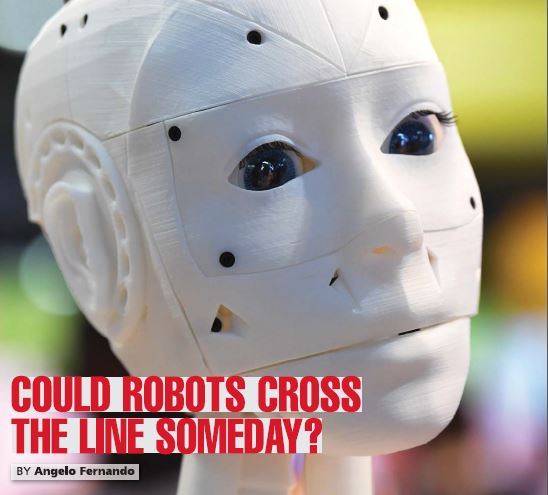
Could robots cross the line?

There are four ‘Laws of robotics’ that are seldom discussed whenever the topic comes up. There were written by the late sci-fi author, Isaac Asimov. More like guide rails, these are practical laws.

With the rapid rise in automation, AI, and robotics from battlefield robots (developed by South Korea, the US, and who knows who else) and surgical bots, these issues are worth discussing. Why leave the issues of automation and robotics to academic and/or politicians?

In this month’s column in LMD, I discuss the pros and cons of robotics. You can read it here.


S.T.E.M, skyscrapers and suicidal Tuk-tuks

One month isn’t enough in Sri Lanka!


Dan Wool’s ‘Cubicle Podcast’

Podcasting just keeps evolving!  Whenever I bring up the topic, either in class or is a media discussion, I find the old definitions are inadequate. The production quality, and the platforms have changed. The content creators have certainly got more comfortable with the format.

So this week I like to showcase a podcast from an old friend, Dan Wool. A solid communications and PR pro (he co-taught a webinar with me in 2010), Dan is now on his way to becoming a doctor!  His podcast focuses on –what else?- health issues. His website, cubicleclinic.com is filled with his take on health and lifestyle issues cubicle dwellers face.

If this topic interests you, please click on this link, or the icon on the right and give it a listen.


Immersive classes, where students learn by doing

The phrase ‘hands-on learning’ often becomes a placeholder for many things. If it does not involve experiencing the subject matter, then it’s still theoretical.

There’s a school in San Diego that doing something really amazing with teaching through experience – or ‘learning by doing’ as some call it. (It is featured in ‘Creative Schools by Ken Robinson.) At High Tech High, subjects are intensely focused on real world challenges. One project, for instance on Urban Ecology is described this way.

Students will discover how humans interact with nature in urban ecosystems. They will understand the terms sustainable and efficient in order to apply them to designing improved modern cities. 

Students end up publishing an  ‘magazine’ on the Urban Ecology, talking on publishing roles.They hold staff meeting with their Editors-in-chief, who are none other than their teachers!

Is this EdTech? Is it a computer class? Can this be used to demonstrate ‘rigor’? Yes to all three! But looking at their class structure, and philosophy, it seems that this kind of pedagogy is very different. In the end it’s not about exams, but about preparing for the real world.

The best tool for Storytelling or Digital Storytelling

The equivalent to the Google classroom is the Adobe classroom. Later this month, Adobe offers a class ‘called Explanimation.’ An awkward word coined to describe animation to explain, or tell a story.

Too often however, Storytelling is linked to software. From iMovie, to Glogster; from Visme and Animoto to Audacity among many others. Humans told stories around campfires before most technologies were invented. So tools like these should not become a crutch.

Storytelling –be it digital or analog– requires being able to describe something succinctly. Long before firing up the software the ‘story’ needs a structure and focus. There’s the tried and tested Beginning, Middle, and End. Or the Introduction, Conflict, and Denouement, if you will.

Students are natural born storytellers, but they often freeze up when it’s time to sketch things out. The best technology for this? Something invented in the same year that Shakespeare was born – the pencil!

Behind the Mic: Communications class explores podcasting

The podium and the microphone –two devices invented 200 years apart –could both be intimidating. My communication class students had prior to this, worked off their stage fright with several impromptu, scripted , and extemporaneous speeches. But juggling the technology here could be demanding on the first try.

For this assignment two groups each worked on a short script – basically Talking Points – for their podcast. I asked them to create a show with a ‘story’ element. They then used Audacity to record it. The results shocked them, too! This group’s work turned out like a PSA with glimpses of Orson Wells’ War of the Worlds. They even downloaded and used a background music track from FreeMusicArchive!

Thank you, Orbital!

Every time we have a STEM event, or SPACE Day, one group I always count on is Orbital ATK, a Chandler, Arizona-based company. Rockets and launches are in the news every month. Just this week, Orbital ATK launched the 139-foot rocket, Antares; the 200th mission to the International Space Station.

For STEM Night at Salt River Elementary, Orbital created an amazing demo using a ‘transformer rail gun‘ – basically accelerating magnets that transfer potential energy to kinetic energy. Plus canister ‘pop rockets’ that explained what Newton’s Third Law is all about. Thank you Javier Molina-Moughamian, Shannon Burke, Monique Dalton, Kelly Wallace, and Kimberly Barraza for being part of our team.