IABC members speak up on the financial crisis

Happy to note, following my post last Friday, that IABC members have been blogging this very subject, making themselves heard. Maybe I missed some of these in by newsreader, but ideas have been coming in.

Fabio Betti Salgado -from Brazil

Chris Grossgart at IABC International

Natasha Nicholson –my editor at Communication World

Shel Holtz – his blog, and also in episode # 388 of For Immediate Release

Wilma Matthews –in Phoenix calls for a teleseminar on the crisis

I just heard from Barbara Gibson, the IABC chair that a webcast and teleseminar will be soon announced, among other initiatives.

Tipping points, “drill baby drill,” and journalism

At the Sustainability Summit today, outside of the lofty discussions around  tipping points (are we there yet?), coalitions (enough tossing bombs at each other), and sustainability was the need for leadership.

As I speculated yesterday, there was an open call for those in the media to drive this train. To up the ante in a different way –explaining to consumers what the policy alternatives mean to them. To bring some clarity. Ah! Media leadership. Not exactly out of the ambit of an industry previously accused of ‘agenda setting.’

A telling quote from the session about the message we need to spread:

“Drill, baby drill” should include “change, baby change!”

Farewell, Randy Pausch

Randy Pausch never met a brick wall he didn’t like. The Carnegie Mellon professor of computer science who inspired his audience -and in this digital age, millions of those who listened to him and watched him and followed his blog — died yesterday.

Pausch came to be known as a fearless fighter against pancreatic cancer. His ‘Last Lecture‘ delivered 10 months ago is now in the public domain. It became a best seller, and is being translated into Chinese. He once said the lecture was never meant for the public.

Pausch however went ‘public’ with his blog about his fight with what he knew was a terminal illness, and was constantly upbeat (“I’ve still got gas in the tank”) about his condition:

“I’m recovering much faster this time from the congestive heart failure (practice makes perfect, I guess). I’m still hideously fatigued, but today I was out of bed most of the day.”

He used it to communicate his ongoing story with his wider audience, commenting on things like a great design of a prescription medicine bottle, the death of Dith Pran (who also succomed to pancreatic cancer) and the media frenzy around his book.

Diane Sawyer is running a special tomorrow (Wednesday) night at 10pm on ABC. People who know what I’m really like will doubtless be throwing tomatoes at the screen ; -)

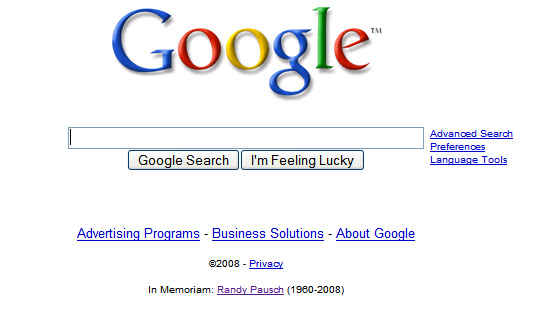
Yesterday, when the sad news came, Google did something it probably has not done for anyone before. It ran a small line under its usually clean search page with In Memoriam: Randy Pausch [1960 -2008], linking to the YouTube video of Last Lecture that’s been viewed over 3.9 million times.

The brick wall reference is from a metaphor he often used about the importance of facing an unsurmountable problem, and what it teaches us.

Great! Students are writing Wikipedia articles

I’m not being cynical. It’s a good sign that students are being encouraged to write feature articles on Wikipedia, instead of being asked to stay away from the wiki format in schools or in some cases ban it wholesale.

What does that bode for our future employees? Not only will they be ready to work in the read-write web, but they will begin to dismiss as irrelevant our read-only intranets and flash-y webs.

Others have tried to incorporate social media in the classroom, or rather the classroom in social media. Professor Jon Beasley-Murray of the University of British Columbia said it best: “the best way to see how it works is to actually take part.”

Quotes of the week ending 8 March, 2008

“Obamicans.” “McCainicrats”

Former White House chief of staff Karl Rove in the Wall Street Journal, about needeing to watch Republicans who back Barack Obama and Democrats who like John McCain, respectively.

“So, I think they have to spin this as best they can, but the reality is still the reality.”

David Axelrod, chief strategist for the Obama campaign, on Clinton’s win in Ohio and Texas this Tuesday.

“We are all living in the middle of a paradigm shift.”

Andrew Leckey, Director of the National Center for Business Journalism, on the role of journalists, at a workshop in Phoenix, Arizona.

“it’s no doubt true that many PR & advertising agencies don’t, in fact, ‘get it’ yet … But it is also true that many clients don’t get it yet, either.

Todd Defren, PR Squared, commenting on the fact that marketers want to put social media into the bucket of metrics and campaigns.

“We can also look forward to flexible screens, holographic projection and LED wallpaper that allows any flat surface to function as a display.”

Bill Thompson, on the technology of teaching.

“In the end advertising isn’t about the click.”

Mike Leo, CEO of Operative, in Businessweek, on the slowdown in Google’s advertising’s pay-per-performance model.

“Haven’t you people learned the art of pretending that you know what you’re doing?”

Cathy Taylor, on why ad agencies (some of whom occasionally blog) are not walking the talk about social media.

“A message is one-way communication and a conversation is not. Rather, a conversation is like verbal tennis where words and ideas bounce back and forth between both parties.”

Andrea Goulet, commenting on the book Now is gone.

Visualization meets communication – my new job

A new phase of my career kicked in this week at ASU. I’ve joined the Decision Theater. A perfect fit for my deep interest in technology and collaborative media.

Excuse the brochure-speak, but if you’ve never stepped into an “immersive environment” on the edge of information technology this is it. The thing that strikes me is how useful it would be to apply this blend of informatics and visualization to other disciplines. Marketers and analysts who value pattern recognition will relate to this high end visualization.

If you’ve dabbled in database mismanagement, you know that spreadsheets and bar charts in spiral-bound books don’t quite set people’s heartbeats racing. Which would you prefer: reading a 90-page document on the ‘water atlas’ or moving a slider to see what happens to the community when reservoir levels dip? Data in 3D, and information presented as alternative scenarios make us want to do something, because we don’t live in one dimensional worlds.

Speaking of which, there was a lot of talk in the last year that the web as we know it is quietly gravitating to a “3D web.” For now it’s a visually interactive web, but the visualization part is making quantum leaps.

Let me know if you would like to see what the future of decision making looks like.

Live Blogging Police Officers – new job title?

New media has made us wear a lot of new hats. It’s also created new job titles such as CBO (Chief Blogging Officer), Manager of Digital Convergence, and Virtual World Bureau Chief (the chap from Reuters, hanging out in Second Life.)

But who’s going to be the one managing (as in snooping on) live blogging at NCAA games? They announced that there will be certain times blogging will be permitted during games. Does that mean there will be a posse armed with wi-fi detectors and binoculars roaming the stands to see who’s thumb typing on a smart phone?

PodCamp Arizona – as good as any paid event

brent_2.jpgKick yourself if you didn’t attend Podcamp Ariona.

As Podamps go, it was an experiment in self organization -taken to an amazing level. The venue –at the University of Advancing Technology— couldn’t have been better picked with classrooms bristling with technology, rather than a sterile hotel ambiance.

The presenters were people many paid events would kill to have on their roster. There was free music, food, and best of all a sense of energy that firmly planted Arizona on the Podcast map. There have been 23 Podcamps across the country before this. One attendee commented that he had attended a few more Podcamps and this by far was the best organized. Kudos to Brent and Michelle Spore for pulling this off.

Many takeaways from this one for me.

1. First, that knowledge is not always to be found in formal education packaging. Nor need it be “monetized” the traditional way. This was an event that was managed by a wiki, if that tells you something about bottom-up organizational power.

3. Third, those who have the best stories have the worst collateral. I say this in a good way, since I’ve seen to many slick PPT presentations, too many brochures in my marketing life that scream marketing, not substance. I attended a session by Marc and Nicole Spagnuolo on “starting from scratch.” Their logo looks like it was designed by a high school student with a Sharpie in the back seat of a car. Really, from scratch! Nicole was happy to admit that they use free survey software, low-cost service providers, print black&white stickers rather than expensive business cards, and barely know how to write a press release. But they are hugely successful!

4. Fourth, podcasters are not afraid to make mistakes, to start over, to admit they got it wrong. Zero egos.

And that’s apart from the lessons of podcasting, and connecting to audiences via a blog, a microphone, a camera…

Defending one’s logo. Pitchforks not required.

ASU‘s other logo, “Sparky,” is in the news. E.J. Montini of the Arizona Republic writes an interesting commentary this Sunday, looking at this as a David and Goliath story.

The story? Sparky’s likeness is being used by a Virginia, Salem high school.

  • ASU’s student newspaper The State Press reported the story last week, quoting a school official as saying “We’re 2,400 miles away from ASU, and we don’t think we’re infringing any laws.”
  • The Virginian Pilot also takes on the issue, calling it “a display of overprotective, greedy and heavy-handed behavior.”

I must admit to a bias here. Being an insider at ASU, I believe framing this as a David and Goliath story is a bit out of proportion here. The university doesn’t see someone misusing a logo or mark as the enemy. Organizations don’t defend a registered mark because they want to crush the little guy.

Last week Dan Ziegler at the Tribune reported on this story differently. He cited Fernando Morales of ASU’s trademark office saying:

“You don’t want to turn people off to ASU by being too heavy-handed,” Morales said. “If a school has invested a lot of money in a basketball floor with Sparky on it, we’re not going to make them rip it up right away. We will be flexible. You can look like an ogre if you do it wrong.”

Flexible? Definitely not a Goliath trait. But that’s not the narrative that grabs readers –or Google juice.

In time organizations realize that a settlement involves a win for both parties. If you recall, Cisco sued Apple over the word “iPhone,” one of Cisco’s registered marks. (They settled in just six weeks.) Likewise Apple settled with Apple Corp, the company that represents the Beatles after a long dispute over the name.

Should ASU stand up for it’s logo? Sure. Could it soften its stance? Certainly. I agree with Montini in one thing: A little savviness wouldn’t hurt.

Facebook profiles: proceed with caution

File this under “what were they thinking.”

People, or even organizations –or someone creating a Facebook profile on behalf of one– uploading stupid pictures of themselves. I am sure many universities see a lot of this, and you have to wonder how these kids expect to enter the job market in a few years when every HR person will conduct some due diligence on social networks. (BTW, good article in WIRED this month on border agents using Google!)

A recent case makes the point. Recruits of the Canadian Border Services in Quebec posted images of themselves, um, imbibing, posting lots of comments unbecoming of any organization, let alone a government agency. An investigation is going on.

Earlier this year an RA at Ohio State University found out that his Facebook pictures could cost him his job and his dorm room.

And we haven’t even touched on the stupid things people upload to YouTube.