When Distance Learning was a mule-drawn wagon!

I have always been interested in Distance Learning, but as I like to tell young people many of our modern business and education models existed before the Internet.

For instance, about 50 years before eBooks made it possible to have the library accessible from home, we had the ‘mobile’ bicycle-drawn lending library.

But this ‘school on wheels’ known as the Jesup Wagon beats that! It was developed by George Washington Carver, a former slave.

A scientist, better known for the innovation we call ‘crop rotation’ and also peanuts, he loaded a wagon with seeds in this His ‘horse-drawn classroom’ and laboratory. His students were former slaves who had become sharecroppers.

The Movable Classroom program began in 1906. The wagon cost $674.

We could all use this to get some perspective, especially when we think we need fancy technology to connect knowledge with students.

The wisdom of Neil DeGrasse Tyson

Astrophysicist Neil DeGrasse Tyson has a knack of breaking down complex ideas into simple concepts. He is the kind of teacher who makes you enjoy learning, without feeling you’re being lectured to!

Some of his statements (and tweets ) are legendary, as are his wide-sweeping statements about science, technology and life. Such as:

“To be genius is to be misunderstood, but to be misunderstood is not necessarily to be genius”In a Popular Magazine feature, August 2015)

“An informed opinion is never based on somebody else’s opinion, lest you empower others to do your thinking for you.”  @neiltyson  Aug 28, 201

But as much as I respect DeGrasse Tyson, I don’t agree with his stance on God and creation. But that’s another topic.

If you want to probe the big questions about science, or even current events seen through the eyes of a scientist, (as this one about the digital revolution) it’s worth tuning into his podcast.

//platform.twitter.com/widgets.js


So we are OK with robots, but scared by clocks!

Paranoia is a marvelous thing. It alters our brain chemistry.

So a boy could get handcuffed for bringing an electronic ‘clock’ to school, when it is perfectly OK to bring in, say, a robot? This turned out to be an embarrassing story for the school, and a wonderful one for NASA and robotics.

Are we sending mixed messages here? We urge kids to think outside the proverbial box aka a classroom, but we like them keep their inventions at home.

I’m not sure how to handle this. I’m in half a mind to have a “Bring your clockwork mechanism to school” day. Many students tell me about the experiments they do –from a simple Rube Goldberg contraption, to a Lego robot. Or should I tell them that guess what, you just might be invited to the White House…

Which is what editorial cartoonist, Steve Benson lampooned in today’s Arizona Republic. It’s hilarious.


Why does Google hide ‘Advanced Search’?

Google does the weirdest things. It’s my favorite Search Engine, but (and perhaps because) it always messes with its algorithm, there are subtle shifts in how we could search.

The only reason I notice this is because I teach a class on Search Engines and Browsers to 4th and 5th grades. And though they use them the time, many are find it hard to tell the difference between a search engine and a browser –as many adults do.

There used to be a feature known as ‘Advanced Search’ – a dashboard on Google’s landing page, and also Yahoo. Now Google has buried it at the bottom of the site, next to ‘Privacy’ and ‘Terms’ – almost a guaranteed spot to be ignored! It is in a menu under Settings.

This dashboard is a very robust tool, letting you filter results by language, and file type etc. I try to break the habit of students type in any phrase or keyword into the search box, and get them to thing through what exactly they are looking for.

  • Is it a set of “Instructions”? O is it a “User Guide”? (For building, say a Solar Oven)
  • Is it the “How tall is the World Trade Center?” Or is it the “Storeys of WTC?”

There are more. The tech terms for these are called Search Operators. But a Dashboard for Advanced Search would simplify things. Over to you, Google!

Ed-Tech grows – and grows up

It might be shocking that while state education budgets shrink, Education Technology or Ed-Tech is on the upswing. Many of them are free, though the full-blown versions are quite affordable. Here are my favorites:

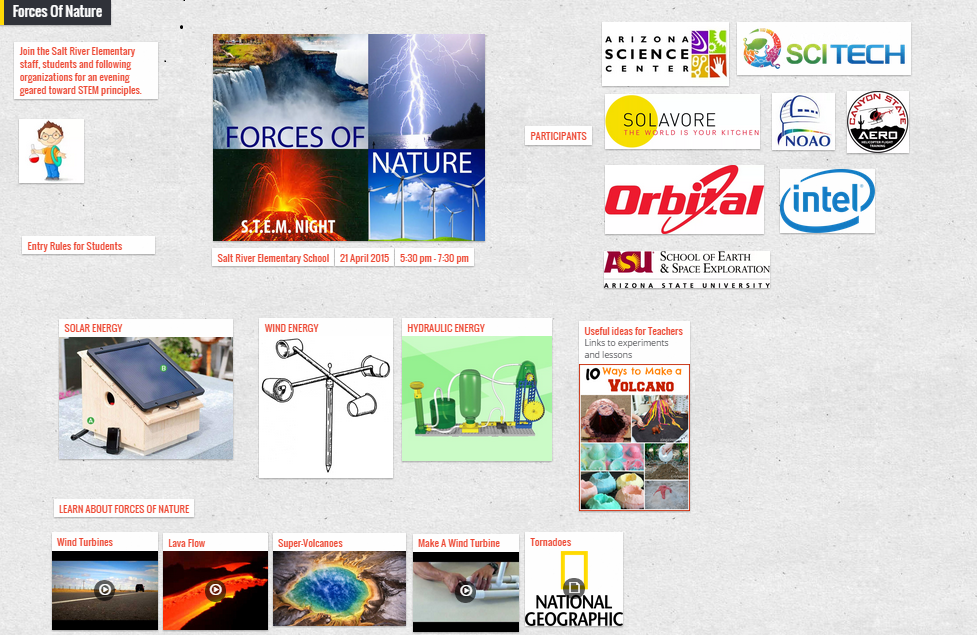
Padlet_SRE_STEM-Night2014Padlet – a collaboration and aggregation tool that feels like a website. What’s even clever isit lets you export that page as an image file, PDF, csv file; you could email it as well. I’ve written about it before here, since I use it as an events page for STEM, robotics, and even to submit a project for a class at a community college.

LinoIT – a canvas, with sticky notes that is a bit like Padlet, but acts like a bulletin board, rather than a website. Perfect for students! For added convenience, you could add a sticky note to your Lino page by emailing it to the page!

Voki – a way to create an avatar that could speak on your behalf, or tell a story!  You could set up a classroom that uses it, or use it to make an announcement! So many uses for this, especially if you want to open up a discussion about animation.

Story Jumper – a simple way to teach students what e-books are like, and more importantly what publishing involves.

PollEverywhere – I love the way it lets you create pop quizzes, to get class responses on the fly. Few schools allow mobile devices in class (mine too) but that’s easily overcome by pushing a link to all computers and have students click on answer choices.

Suddenly Ed-Tech beginning to look like the 2010 all over again, when ‘social’ was the flavor du jour.

(A bit of good news: The global Ed Tech and Smart Classrooms market is expected to grow from $43.27 Billion in 2015 to USD 93.76 Billion in 2020 –an annual growth rate of 16.7%  from 2015 to 2020.)

What would Annie Leonard say to Robotics students

If you’ve never watched “The Story of Stuff” now may be a good time. It’s about the ‘materials economy.’ I have used this as a great way to communicate, using simple language, and a great ‘story’ format. Including, great stick figures!

It deals with how (or why) stuff end up where they do – from toxic waste in a river, to social problems around villages where diamonds are mined. The former, as we have seen in this country, involves graphic images such as this picture below. The latter is a story in TIME magazine last week on Blood Diamonds.

This year the ‘Story of Stuff’ will be a must-see piece for all robotics teams around the world. Annie Leonard stumbled on this and researched this about a decade ago, and it is still relevant. If you have 21 minutes to spare, watch this!

If I could invite Ms. Leonard to speak to my robotics students, I wonder what she would tell them about following the ‘trek’ of ‘stuff that becomes trash.

For Robotics this year we’re re-imagining ‘Trash’

We just kicked off our new Robotics season in my school –my 5th year as coach!

With 26 students signing up, that’s more than twice the number of applications from last year. It’s a ‘good problem’ to have, to see kids become so excited about doing the hard stuff – the building, programming, doing the requisite research, and finally running those complicated missions.

On first glance, this year’s theme, Trash Trek,‘ is much less abstract than last year’s ‘World Class’ (around global education). Lots of big ideas to get our minds around the three R’s that could become a cliche unless we re-interpret RE-ducing, RE-using and RE-cycling . For instance, how about RE-imagining:

  • How far does the trash that gets into our bins has to travel? Could we calculate this (the ‘M’ in STEM) and display it somewhere? Perhaps in our communities — as some sort of a dashboard? If so, who would build the app? What would that display look like?
  • Who decides on the packaging that gets into the products we buy? How much cost will it save if we RE-fuse to ‘pay’ for this (with our landfills?)
  • Could our trash bins earn us money – a la Recyclebank?

I’m talking to all kinds of people – entrepreneurs, engineers,, designers etc who could come in and inspire my students. If you know someone, please call me, email me or send me a tweet at @heyangelo.

Some examples we might use for inspiration this week.


Hi-tech Augmented Reality goes low-tech with ‘Cardboard’

In May this year I previewed Augmented Reality glasses – the Google ‘Cardboard’ variety. So it was a pleasant surprise to see that Palmer Luckey, who came up with the clunky but amazing viewfinder called Oculus, is featured on the cover of the upcoming issue of TIME.

The plan this year is to feature Google Cardboard in a ‘STEM Talk’ in my class. As the TIME feature puts it content will be coming up soon that will enable us to learn in immersive environments. Using special or tricked out cameras that could record in panoramic view, students may soon be able to experience life on the Space Station, or that of otherwise inaccessible nomadic tribes.

Partnerships and competitors will soon bring this AR world into the mainstream. As would some GoPro hacks. I’m betting on Google cardboard, though it’s not as good as Oculus, (I could see schools more amenable to partnering with the Google folk, rather than Facebook, which now owns Oculus Rift).

It goes from this

to this


And it’s coming your way! Perhaps soon in my class!

Pros and Cons for Technology in the Classroom

Your child probably goes to school with a device in her backpack with more processing power than the rocket that took men to the moon, and this child wants to be… an astronaut?

You’ve forgotten how to log into your son’s school website to download his missed homework, but… he’s found a way to ‘jailbreak’ your cell phone?

Yes, teaching and learning is changing!

My July technology column was about tech in the classroom, which somewhat coincided with my talking to teachers in Sri Lanka about technology and STEM. Indeed, there are still those who want limited screens – parents of hi-tech execs, of all people. And those who think otherwise. Which side are you on?

Balloons could add new flavors to the ‘Cloud’ and Digital Democracy

Most of you know how I dislike the word ‘cloud’ as a catchall for anything accessed online. So how about getting used to balloons? As in Google’sProject Loon that has been in the works for some two years, and now is supposed to be set to launch in Sri Lanka.

It’s a crazy, heady idea. Sri Lanka will be the first country to get ‘universal Internet access’ as TechCrunch put it.

I just got back from Sri Lanka, and did an extensive train and road trip with the family. I experienced first hand what connectivity is –and is not. The new, fast highways are obviously connecting more people to more opportunities. The Telcos are providing easy-to-get (via a scratch card) low-cost bandwidth for smart devices. There is growing free Wi-Fi presence in towns as diverse as Galle, Anuradhapura, Kandy and some places in Jaffna; even on a train we took to the hill country! Access does get spotty and sluggish at times, but the appetite for connectivity is growing in leaps and bounds.

And now balloons!

Here’s why I welcome this. Not for the obvious reasons, such as giving everyone including tuk-tuk drivers or election monitors the ability to tweet or upload pictures – which could be useful in and of itself.

Education: First sorely needed bandwidth to homes, schools and offices will change the game. I was at one outstation school, and the science teachers had to use a dongle to get online. ‘Universal access’ for schools would change the dimension of how learning takes place beyond the Google search. Young people could be empowered to create content and not just consume it. It’s about time schools got a better deal when it comes to connectivity. Why haven’t the telcos given schools a better deal? What will they do now?

Political participation. Sri Lanka has demonstrated that despite the dismal examples of governance, that democracy and citizen participation works. ICTA reported recently that “Sri Lanka has shot up to 74th position in the United Nations E-Government Survey of 2014, after climbing 41 places since 2012.” Nalaka Gunewardene goes into rich detail about how Digital Democracy is at work. Beyond elections, this will affect transparency and accountability, when everyone has an uplink, a camera and a voice.

There are obviously several more examples, which some of you might like to add. Please do!