Do we have space for Makerspaces and tech shops?

Some days I wish I could convert part of my computer lab into a Makerspace. After all I have re-defined it as a Computer and Technology Lab, so it would be appropriate to have other technologies. Like a metal cutter, or workbench to build things – such as making a speaker out of an Altoid tin, or rudimentary printing such as silk-screening.

I thought of this again after getting into a discussion with a teacher visiting our school from New Zealand this week. She spoke of how curriculum there includes woodwork, needlework and many hands-on activities.

She was not been aware of Makerspaces, but mentioned a parallel well-organized movement called Mens’ Sheds – run by retired people so that anyone could take up a new skill.

Makerspaces here are great places for students with rudimentary engineering products in mind, for say a science fair. They are open to anyone and are often free. Some school libraries are carving out makerspaces for 3-D printing.

I’ve visited one in Mesa, Arizona called HeatSync Labs. Love the name!

I’ve still to visit the TechShop in Chandler where you could learn CAD drawing, or how to build a (guess what?) Bluetooth speaker!

 

When Microsoft ‘draws’ as good as a Sharpie

When I tell students that Word or PowerPoint is a versatile tool, and not just for typing of creating slides, I never know what to expect. Such as how some of them have mastered the ‘Curve’ tool in the Shapes menu.

Here’s one. Looks like a pen-and-ink sketch, doesn’t it?

goku_student_drawing2


It gets better! Because this is about animating.  The student’s storyboard in PowerPoint  just kept growing!
goku_student_drawing    
goku_student_drawing3

goku_student_drawing4

Farewell to our quintessential Rocket Man, John Glenn

John Glenn was quite a guy. You don’t find many role models like him these days. The ones you could hold up for kids as examples of someone pushing the boundaries of science. He was the first American to orbit the Earth. To me he stood out as someone who put in the grunt work most people miss.

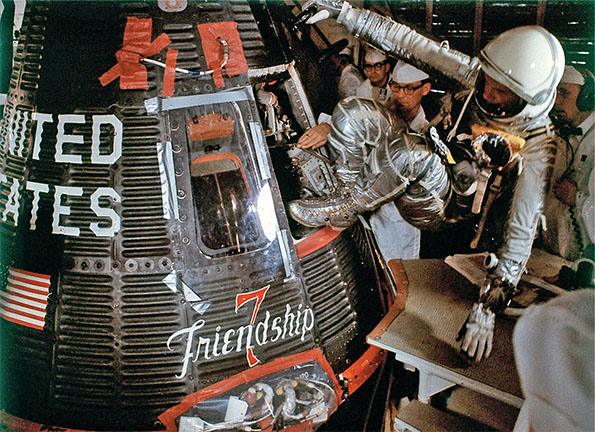
It’s easy to forget that before he climbed aboard ‘Friendship 7′ spacecraft on Feb 20th 1962 for his short (4 hrs, 55 mins, and 23 secs) flight, John Glenn was a fighter pilot.*

The story not often told is that before re-entry, NASA’s Mission Control told Glenn “not to jettison the retro-rocket package after firing” in order to better hold the heat shield in place. In other words, “Wait and see – you are part of the experiment!”

At the Smithsonian’s Air and Space Museum, standing beside Friendship 7, one marvels at the courage it took to climb into this over-sized tin-can in the interest of science, not knowing what might happen when being hurled into an orbit around the Earth at 17,000 mph.

john-glenn

John Glenn passed away today. He was 95.

* He flew missions in World War II, Guam, and Korea, and later served his country as a senator for 25 years. He even got back to space, briefly for a flight on the Space Shuttle.

Robotics team researches Dakota Access Pipeline for FLL project

When our robotics team picked the controversial Dakota Access Pipeline (‘DAPL’) for their research this year, they never imagined a solution to the standoff would come days before they presented it.

It did.

Yet the insight they bring is even more powerful. But how does an oil pipeline relate to this year’s theme, Animal Allies?

Click to Enlarge

A quick thumbnailThe controversy began over a 1,170-mile  underground oil pipeline crossing 4 states (N. Dakota, S. Dakota, Iowa and Illinois). It had been approved by the U.S. Army Corps of Engineers, but as Native American opposition gathered momentum (with activists from several tribes, including a group from the Salt River Pima-Maricopa Indian Reservation) president Obama stepped in, and the pipeline was stopped.

As for the robotics project: It is on the impact of the ‘dirty pipeline’ on animal life. They will present a case for how water and the land are sacred to the Native American people. And how it could adversely impact animal life.

The ‘problem’ may have a political solution. But their project board looks at deeper issues than that, as you could see in their brainstorming session earlier in October.

img_0972


Entertaining ourselves out of Math

What killed our interest in math?

Is it our love for instant gratification? Or was it our ability to outsource our left brain to ‘calculating machines?’

No excuses are good enough. After all, the country that created the first graphing calculator, Japan, ranks 5th place in Math in the ‘PISA’ test (Programme for International Student Assessment), which tests Mathematics, Reading and Science among 15-year-olds in 72 countries. The test is administered every three years. In this latest ranking, the US, unfortunately is nowhere in sight.

pisa-rankings-2016In Math, we are way below Malta, the Czech Republic and Vietnam and some 40 other nations. In Reading, we rank 24th, with countries such as Estonia, and Macao doing better. Singapore tops Math, Reading and Science. What killed math in the US?

I only ask this question because we are in the midst of student evaluation, and I am seeing an increase in student’s interest in programming. Yes, math is hard, but we seem to be entertaining ourselves to death, with ‘watching’ more than doing. Coding, and using mathematical concepts requires students to work through a problem. An ‘algorithm‘ is after all a mathematical construct.
This unhappy news of declining performance comes despite us having excellent hands-on, interactive resources such as Khan Academy. One recommendation is to “teach a lot less but focus at much greater depths,” says the director of education and skills at OECD.

Buried deep in the report are some good indicators of what works in the successful countries. It says, for instance that

students score higher in science when they reported that their science teachers “explain scientific ideas”, “discuss their questions” or “demonstrate an idea” more frequently.

and that raising students’ expectations of working “in a science-related occupation” have greater bearing on the outcomes than material and human resources.

Translated. Investing in new books or fancy devices won’t move the needle unless schools empower (and hire) teachers who could passionately ‘explain’ and ‘discuss’ the subject matter.

Planning for Star Wars class for ‘Hour of Code’ next week

I wish I had had the opportunity to learn JavaScript. But it’s never too late, since I can learn it while teaching some programming next week. You know, ‘He who teaches, learns twice‘ and all that!

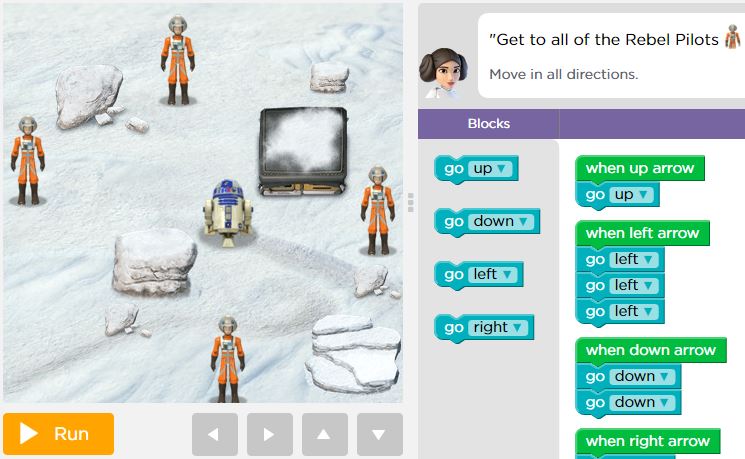
hour-of-code-star-wars

I’m doing this because it is Computer Science Education Week from Dec 5 – 11 with a focus on the ‘Hour of Code‘. (It is also the week when I have to take my ‘Lab’ to the classrooms, while the computer lab is being used for NWEA evaluations.)

The ‘Hour of Code’ folk have added new tutorials featuring, Star Wars. Something my students are focusing on for an Image Manipulation class this week. It helps to have Kathleen Kennedy (seen in the video below), producer of The Force Awakens explain how programming is very much a part of movie production today.

Students will specifically learn to program a game in which BB8 must be sent on missions to recover objects and deliver messages.

In case you are interested, Hour of Code has several social media outlets, including

Twitter https://twitter.com/codeorg
Facebook https://www.facebook.com/Code.org
Instagram https://instagram.com/codeorg
Tumblr https://blog.code.org

Photoshopping the White House

No, this is not another fake news alert. It’s a teaching moment, however.

The subject matter is appropriate. While teaching Photoshop and image manipulation, it’s a perfect time to be teaching students how to become critical consumers of information often seen through imagery. And spot when someone has been tinkering with the truth.

student-4

The class begins with the ‘conspiracy’ around the 2003 Space Shuttle explosion, by looking closely at the Photoshopped images. We also look at doctored images of public figures.

When they get to the computers, their challenge is to add to, or ‘enhance’ fountains on the White House lawn.

Here’s are a couple of examples. student-3

Take a guess. How many fountains are really there on the North lawn?

Please don’t ‘Like’ this post – read it

Look, you are free to not read this. I’m mainly concerned about people clicking on links or forwarding them, while not reading beyond the first two sentences.

If you got this far, Thanks!

I run into issues of young people not ‘seeing’ information in front of them, because their brains have become trained bypass information on a screen and look for images and videos. They are good ‘readers’ as the data shows. They borrow a lot of books, for sure. However they seem inattentive to information, even on beautifully laid out web pages.

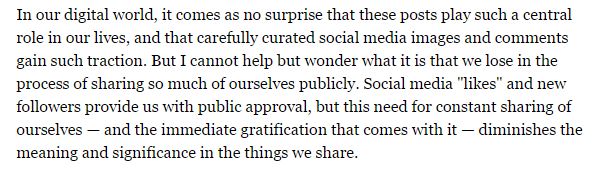
Does it have something to do with our newfound desire to share, reducing our appetite to absorb, and for conversations, as Emerson Csorba says. [“Online sharing and selfies erode the value of our private lives“]

nyt-quote_1


The article for the above quote is here at the New York Times article on Digital Connectedness. Worth a read.

If you got this far, I’m flattered. Thanks!

So how do students read in the digital era? Or rather, how is reading taught today to digital natives? Sadly, in many places, no differently from the pre-digital era. I read a long (warning: long!) article in Education Week, where reporter  says that “practitioners have few guidelines, and many are simply adapting their lessons as they see fit.” Those in literacy studies recommend that we adopt a simultaneous approach, teaching traditional and digital reading skills.

My gut feeling is we assume too much that seeing young people click on topics and pages. It makes us believe that they click, therefore the must be reading. The linear experience is being remodeled by a hyperlinked, non-linear experience even while we watch. Given the powerful desire to share instead of absorb, the non-linear experience may be not as great as advertised.

If you got THIS far, I would like to talk to you! 

(There is, intentionally, no picture in this post. What made you read on?)

Filtering the news for our kids

It gushes out of multiple channels, often without any context.

For young people, especially those under 10 years, what passes for news is almost toxic. Our challenge is to find ways to keep them ‘well informed’ and yet not overwhelmed.

And of course, there’s no wonder app for that. Even the ones that promise to filter the crud (so-called ‘news aggregators‘ like FlowReader, Flipboard etc) are often accomplices when it comes to ‘TMI,’ or To Much Information.

But wait, there was once an filter for this which we have put to pasture. We called it ‘conversations.’ The human 1.0 app that helped us sift through day-to-day details, layering over the minutia with ‘big picture’ ideas, and cross-referencing them with stories.

We re-framed topics too ugly to ponder and yet too important to ignore. Children posed questions, and found answers to them at the dinner table. We didn’t need to fact-check everything on the spot because…. yes, you guessed it: Our conversations were not hijacked by a smart device sitting next to the casserole dish.

So I like to pose the question to you readers: ‘How do you filter the news for your kids? Common Sense Media has a useful guide for different age groups of children.

Whether you’re a teacher of a parent, I like to know. How do you filter the fire hose?