Thank you, Orbital!

Every time we have a STEM event, or SPACE Day, one group I always count on is Orbital ATK, a Chandler, Arizona-based company. Rockets and launches are in the news every month. Just this week, Orbital ATK launched the 139-foot rocket, Antares; the 200th mission to the International Space Station.

For STEM Night at Salt River Elementary, Orbital created an amazing demo using a ‘transformer rail gun‘ – basically accelerating magnets that transfer potential energy to kinetic energy. Plus canister ‘pop rockets’ that explained what Newton’s Third Law is all about. Thank you Javier Molina-Moughamian, Shannon Burke, Monique Dalton, Kelly Wallace, and Kimberly Barraza for being part of our team.

The day rockets flew!

Rockets soared at our school, on April 30th –the same day news broke of China’s plans to test a reusable launch vehicle, the ‘Long March 8.’ STEAM night was quite an experience, six years since we began on this journey.

Ours too were reusable, but they were built by students from Kindergarten upwards. Made of paper, drinking straws, Popsicle sticks, and rubber bands they traveled where no rocket had gone before on the basketball court. (One flew way out of our test range, covering 70 feet!) Most were powered by rubber bands. Some preferred to use wind power – blowing them out of the launch tube! The judges were quite impressed. Said Orbital ATK engineer, Monique Dalton of one model:

While most rockets flew pretty flat and straight, this one showed a curve visible to the naked eye of the sort of trajectory rockets take in space. It was as if this rocket really was on a mission delivering a payload.

This student’s rocket traveled 58 feet, 7 inches.

Meanwhile, SpaceX, is looking for ways to go beyond ‘reusable’ into mass production of rockets, just like GM does cars. Some day one of these kids will be in Mission Control –and I’m going to watch it from my rocking chair!


Note: Check out


Prepping the launchpad – STEAM Night is today!

It’s as if the stars were lined up for this. The launchpads were being prepped in the space industry –and in education.

The race toward ‘Space Tourism’ which has been on for some time, hit a milestone, Sunday. Blue Origin, a company owned by Amazon’s Jeff Bezos, (which I’ve followed for some time now) launched a successful test flight yesterday, using dummy astronauts. Humans will soon follow.

Back here in Arizona, today is STEAM Night at Salt River Elementary School. The highlight of which will be  our ‘3-2-1 Lift-Off’ challenge

Can’t wait to see what kind of rocket entries we receive.

Trying out Sketchpad. Great way to teach layout

I’ve been experimenting with a simple, but powerful design and layout tool called Sketchpad.

It’s like Adobe Spark but with interesting brushes and pens, 800 plus fonts. I like the how easy it is to import images from your computer into the layout. There’s plenty of clip art too. It’s web-based but the offline version is at an unbelievable price of $4.95! For schools, this is a great asset, especially since it integrates with Google Classroom.

Here’s what the working area looks like, as I asked students to create cubes. They were using a connector tools for this, but there are more options. Check it out!


Coding and Digital Learning Day, today

It’s Digital learning day across the country, today. Salt River High School is hosting Code Night, a community event to showcase week-long Hour of Code activities.

Last week, at the elementary school we focused on Digital Learning, beginning with a kick-off event featuring speakers who talked to students about social media, and coding. It’s interesting how much has changed –and how much more scrutiny we give to digital learning –since last year. Parents and educators have to deal with much more than memes, and cyber-bullying. Social media viral stunts for instance.

Coding is somehow more than a passing fad. It’s more about problem-solving than learning a new ‘language.’ Much thanks to Synapse Studios, Mel Adamaitis, Danielle Benally, and Stephanie Schull.


Spotlight on Social Media Awareness, Coding for Digital Learning Days

Next week, we kick off a week of coding, and also a time to talk about the good, the bad and ugly about social media.

Coding is something that could be exciting for every age group – from simple problem-solving skills, to what-if scenarios. Students will log-into places such as Code.org, Khan Academy, Scratch, and Blockly.  I like how Scratch is positioned as a way to “Create stories, games, and animations.”

Two speakers will kick off the week:

Mel Adamaitis – Synapse Studios
“Why Coding Matters”

Dr. Stephanie Schull – Matter Mission
“The Good, the Bad, and the Ugly of Social Media.”


While we are at it, here are some good resources:


Filters needed now, says Isura Silva!

My friend Isura Silva, writes about topics similar to what you find here. One of his recent posts touches on the death of attention, as a result of our proximity to screens. You should read his post to get his slant on it.

The issues we face as parents and teachers is not just screen addiction, but device distraction. Attention spans are in a serious free-fall. I flippantly wrote about this in an article on ‘FOMO’ (for LMD magazine). But it’s a lot more serious than this.

Which brings me back to Isura. He was on a UNICEF panel on Tuesday, discussing child safety online. The panel discussed the study just released, on how adolescents in Sri Lanka use the Internet. To give you a snapshot of it, the press release states that:

“While digital access exposes children to a wealth of benefits and opportunities, it can also unlock a host of risks including the misuse of their private information, access to harmful content, and cyberbullying …whilst children and adolescents are increasingly going online, they are doing so without adult oversight or supervision.”

Next week is Digital Learning Day across the world. Here at my school, I’m bringing in two speakers to address this dire need for digital literacy. Different cultures, different demographics, all feeling the same need.

What 1st Graders can do with Microsoft Word. Who would have thought!

It’s always a surprise when you introduce a tool, and watch where it takes students. First Graders, in this case! (Just a few months ago they were learning how to use the left- and right-mouse buttons.)  Here are two examples of what they did, using the Shapes menu.

Next week, upper grades will work on other tools and effects, as 4th graders did last year. (Watch video)

Making Coding relevant

We’re building up to a week of Coding in a few weeks; this will dovetail with Digital Learning Day. So I’m kicking off the new year with an introduction to the different kinds of ‘codes’ in use, some of which we take for granted: Morse, Braille, even the simple icons we used to call ‘highway code.’ And of course, HTML.

This week I’m focusing on QR Codes, and how we barely notice them. On ID cards, and even at checkouta – the Walmart pay feature, for instance. IKEA too has been testing something similar.

So as we lead up to several  events in Jan and Feb my students will create and test QR Codes – embedding them in a report. Perhaps work on a design for a T-Shirt for Martin Luther King Jr. day next week, and Digital Learning Day in February.

Meanwhile, this use of a code to demonstrate the connection between analog content and digital is very interesting.

‘Hour of Code’ and Digital Natives

During Hour of Codea global event to promote coding skills this week, we strive to ramp up digital literacy.

But what constitutes digital literacy? There are many definitions.

Microsoft looks at it through an ICT lens – where ICT means ‘Information Communication Technology.’ But evidently there is much more it encompasses. How about building ‘digitally inclusive communities’ as is defined by the Institute of Museum and Library Services?

It goes beyond simply learning how to be safe online, or managing one’s Instagram page. It’s about teaching young people, beginning in elementary school, the ‘literacy’ for being successful in civic or economic spaces. It’s a mistake to assume that ‘Digital Natives’ are automatically, or inherently competent in these areas.

I have previously cited Common Sense Media writer, Jessica Laura who makes the point that just as anyone who has grown up speaking English, still takes English classes, those growing up digital, still need to learn about digital literacy.

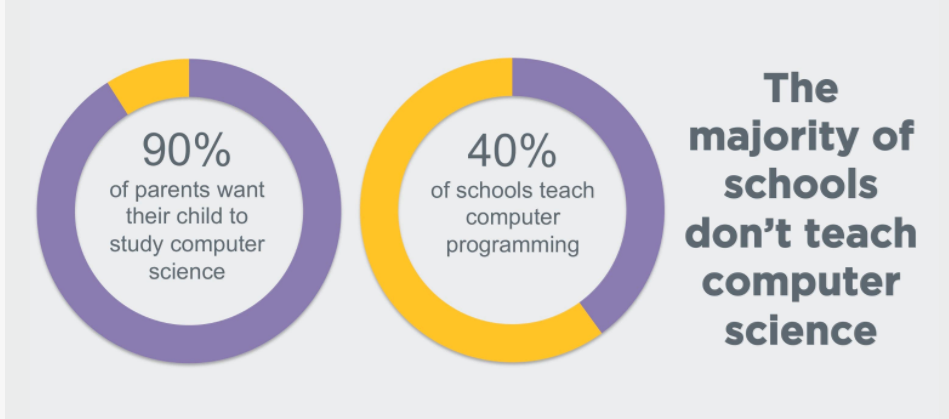
The folks behind Hour of Code often talk about the need for foundation skills related to problem-solving, logic and creativity. Similar to how all students learn about photosynthesis, they ought to also understand how algorithms and coding underpins how their world works – or does not. There are 500,000 current job openings in the US that require computer skills, they say.