Science and Tech Workshop in Sri Lanka

Just got back from a short trip to Sri Lanka, where I conducted two workshops for teachers.The first was in Maharagama on Dec 15th & 16th. The second workshop was in Kandy on Dec 18th.

Here are some stories about the workshops:

Much thanks to my co-presenters:

  • Dr. Paul Funk – Engineer, US Dept. of Agriculture, New Mexico (Via Skype)
  • Ruben Gameros – Autonomous Collective Systems Laboratory, Arizona State University (Via Skype)
  • Scott Logan – Montessori International School, Mesa, Arizona (Via Skype)
  • Lal Medawattegedera – Lecturer, Open University of Sri Lanka
  • Nalaka Gunewardene – Science writer, author, trustee of the Science and Development Network
  • Nazly Ahmed – Web App Dev at Social Seed Media

Also the two Keynote Speakers:

  • Dr. Ajit Madurapperuma – Dir. Of Information Communication Technology, ICTA
  • Dr. Nalin Samarasinha – Astrophysicist at Planetary Science Institute in Tucson, Arizona (Via Skype)

Finally, thanks to the American Center in Sri Lanka who made this possible – especially Joshua Shen.


DSC01238

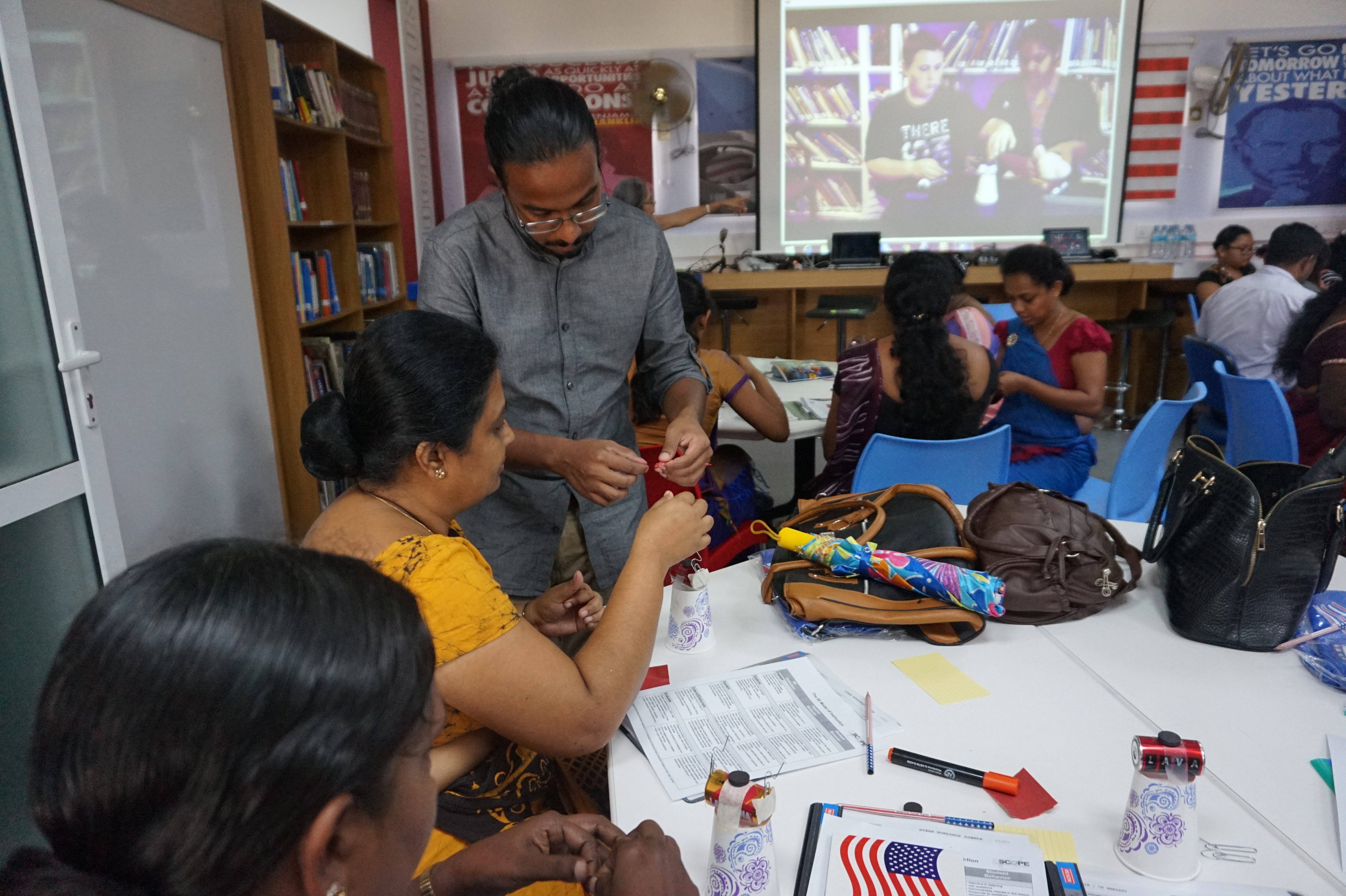
Hands-On Engneering – Spaghetti Tower Challenge


DSC01270

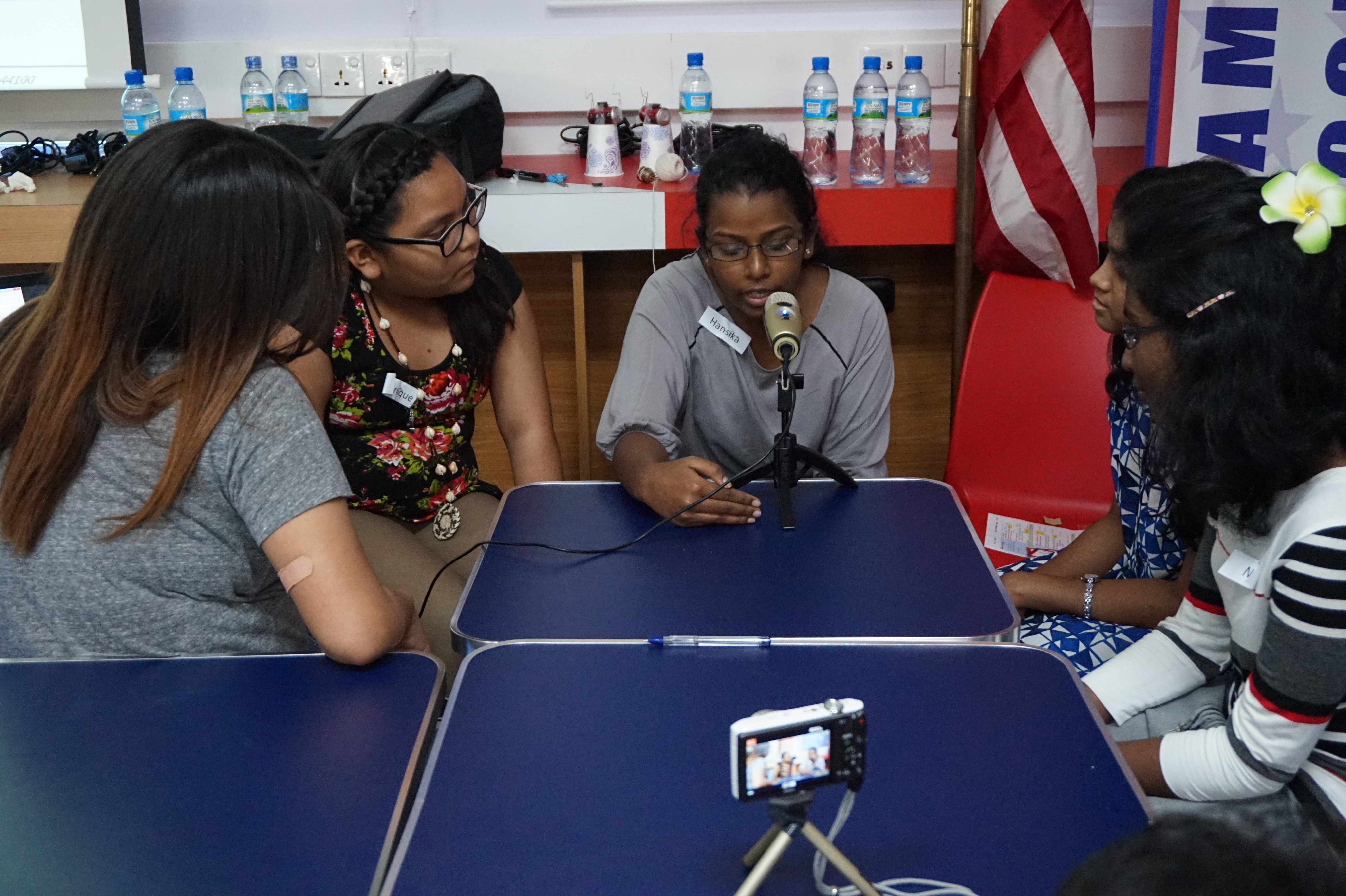
Hands-on session on Audio Recording

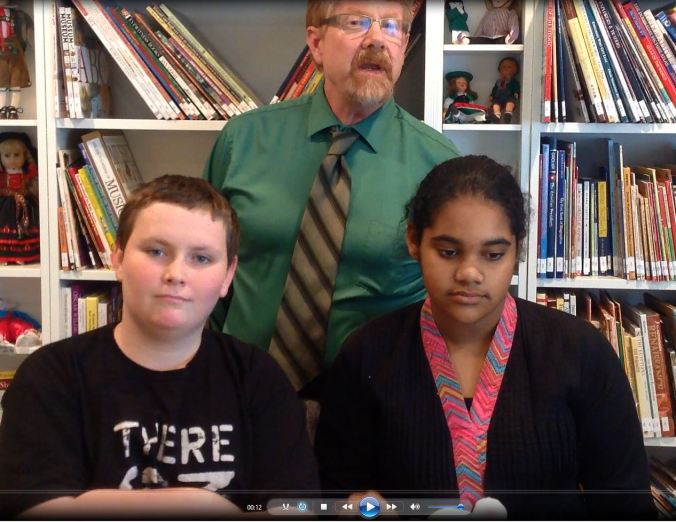
Scot Logan & Students

Hands-on session on Motors and Electro-magnetism

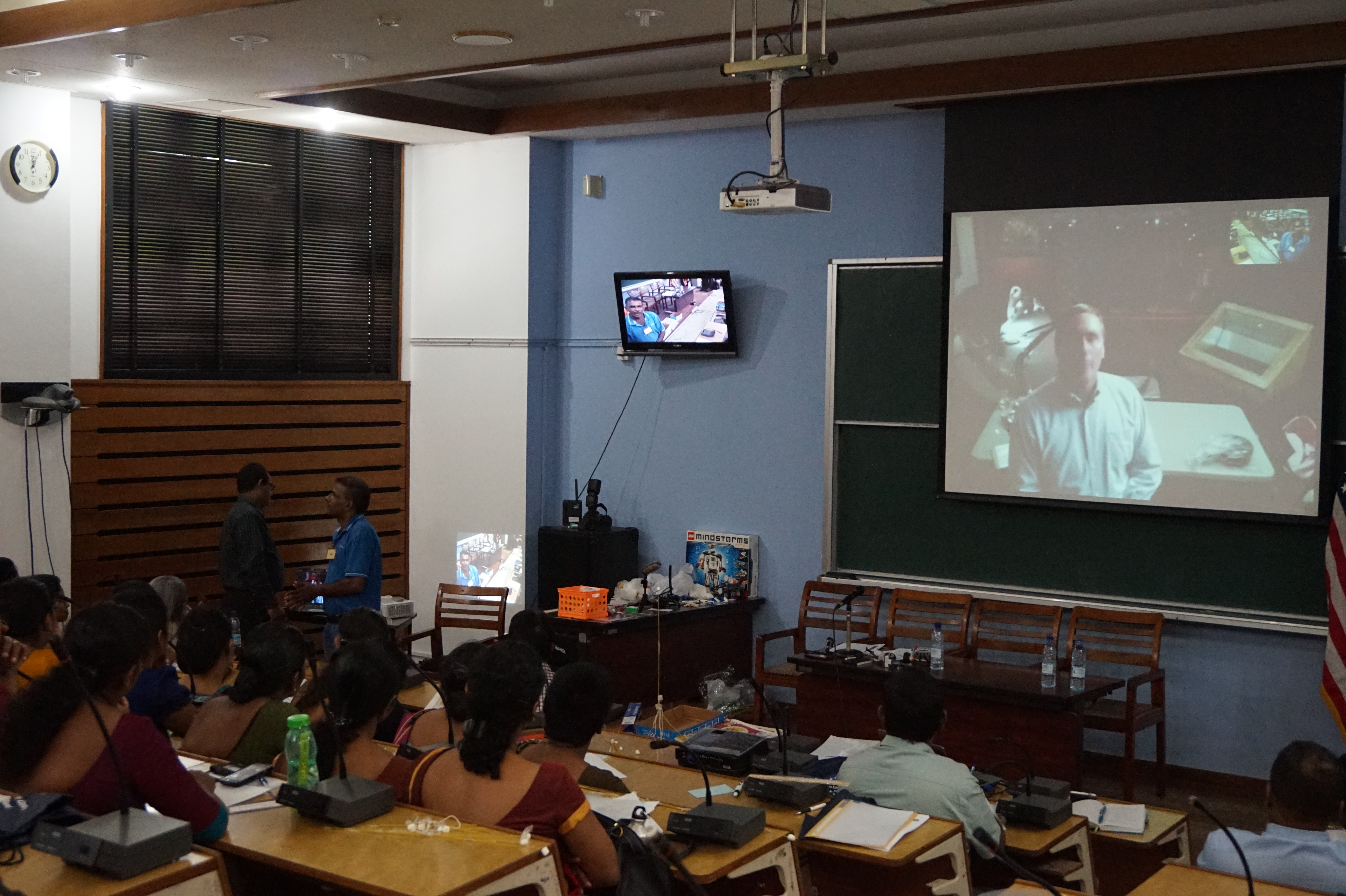
Scott Logan & students at Montessori International School, teach class – via Skype
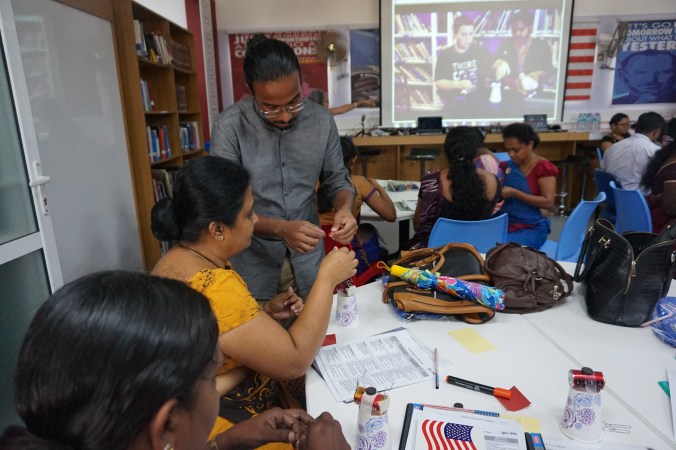
DSC01361

Aaron Fernando facilitates session

DSC01402

Using audio and video for content creation

DSC01415

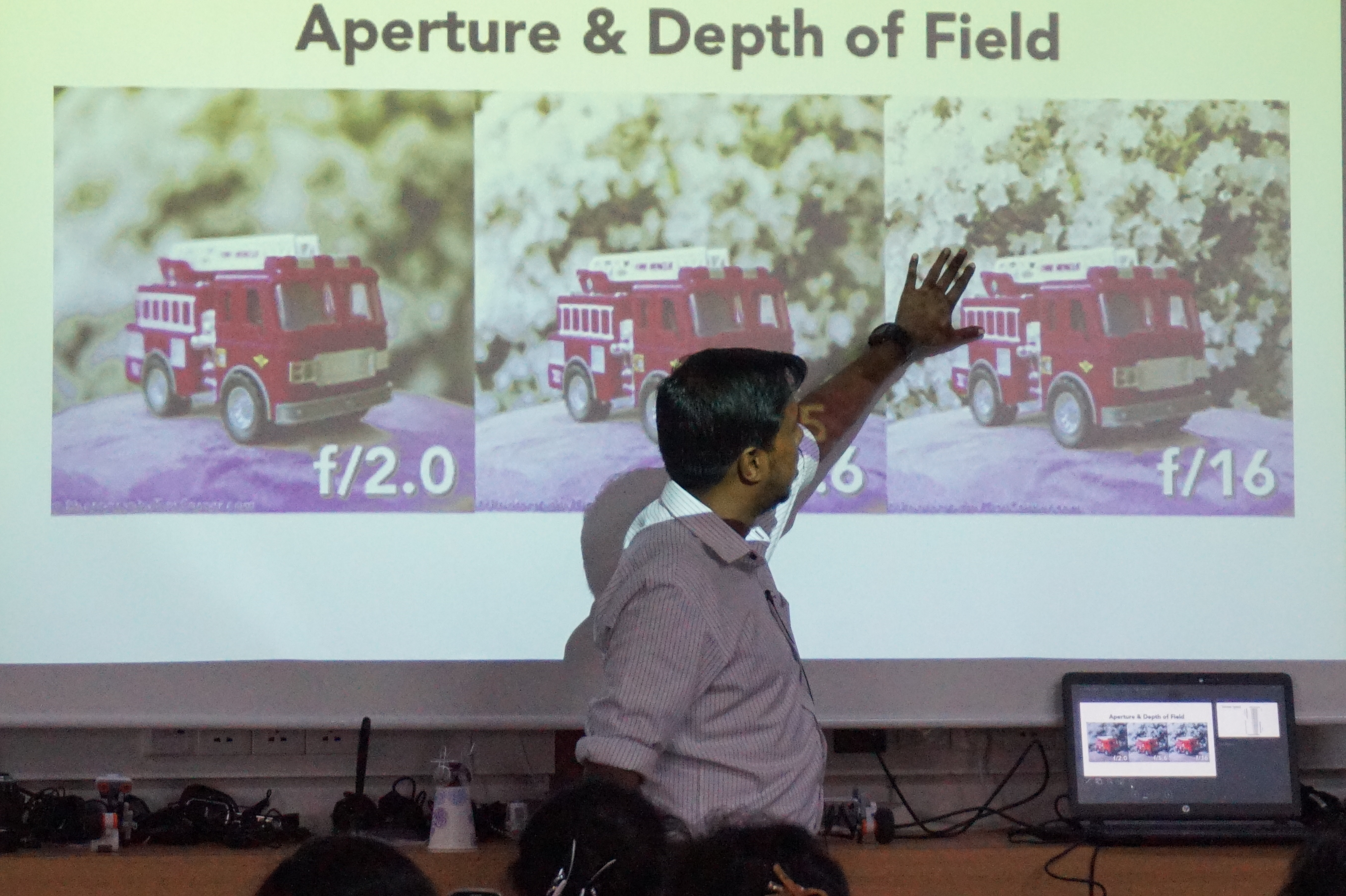
Photography in Science – From SLRs to GoPro

Nazly Ahmed, Social Seed Media explains Depth of Field

DSC01246

Engineering & Problem Solving – Building a Solar Oven

Paul Funk, US DOA

NalakaG

Teaching Science Writing

Nalaka Gunewardene

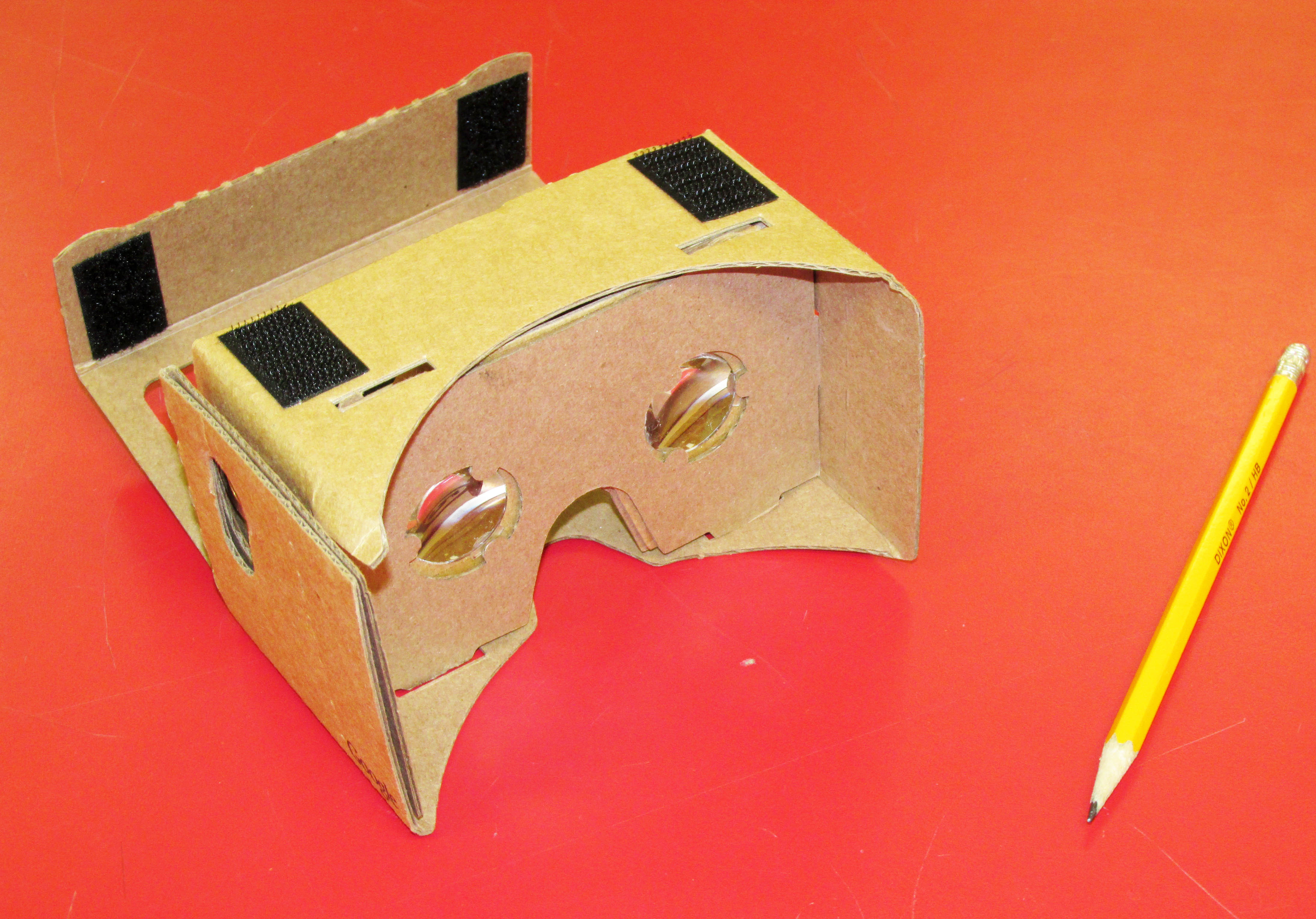
Cardboard 2

Future Ready Classroom – Google Cardboard & Augmented Reality

DSC01419

Future Ready Classroom – Teaching Robotics

Ruben Gameros, ASU, teaches class on robotics – Via Skype
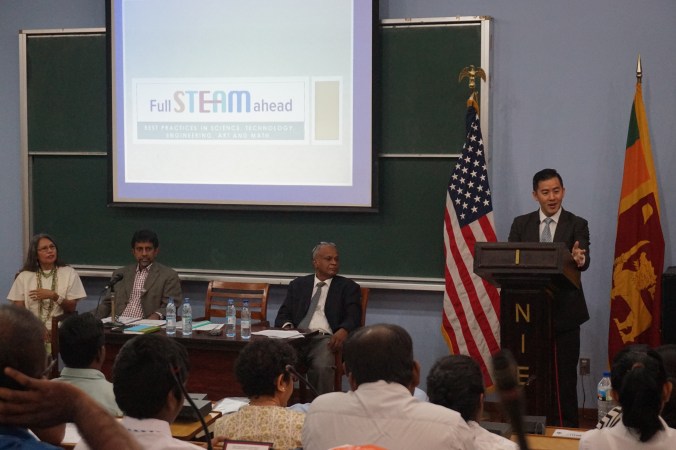
Joshua Shen - STEAM Workshop Introduction

Joshua Shen  Delivers Opening Address

Derrick Mains on Augmented Reality

Could a pair of cardboard goggles become a critical student engagement tool?

Derrick_1I invited Derrick Mains to my computer lab yesterday to explain Augmented Reality, and what doors it might open for us educators, and of course students. I think I am sold!

Many students have heard of AR and VR, and you would be surprised how curious they are about this. Just as they are more interested in photography today because of disruptive devices such as the GoPro, they are more interested in Apps like these because of what it could do “seeing things differently.”

Cardboard_tnAs Derrick explained, this is another way to use Apps in education. Not just to stare at a screen but to ignore the screen (which disappears, the moment you put these goggles on) and engage and explore new worlds. We are not talking about fictitious virtual worlds, but uncharted territories whether it is at the bottom of the Grand Canyon, or to observe an eco-system in a rain forest.
Some of you might remember Derrick Mains from his work in social media. He was one of my co-presenters in a workshop on Digital Citizenship. The reason he’s on camera again, is because he will be in one of the several videos I am producing with my Salt River Pima-Maricopa TV team for another upcoming workshop.

Sri Lankan teaches GoPro to my class (Never mind the time the difference)

Nazly_profileThanks Nazly Ahmed, for taking the time to teach a 35 minute class to my 4th graders this morning. It was 8:45 am Arizona time, and 9:15 Pm in Colombo, Sri Lanka. But what’s a few time zones when it comes to learning from experts?
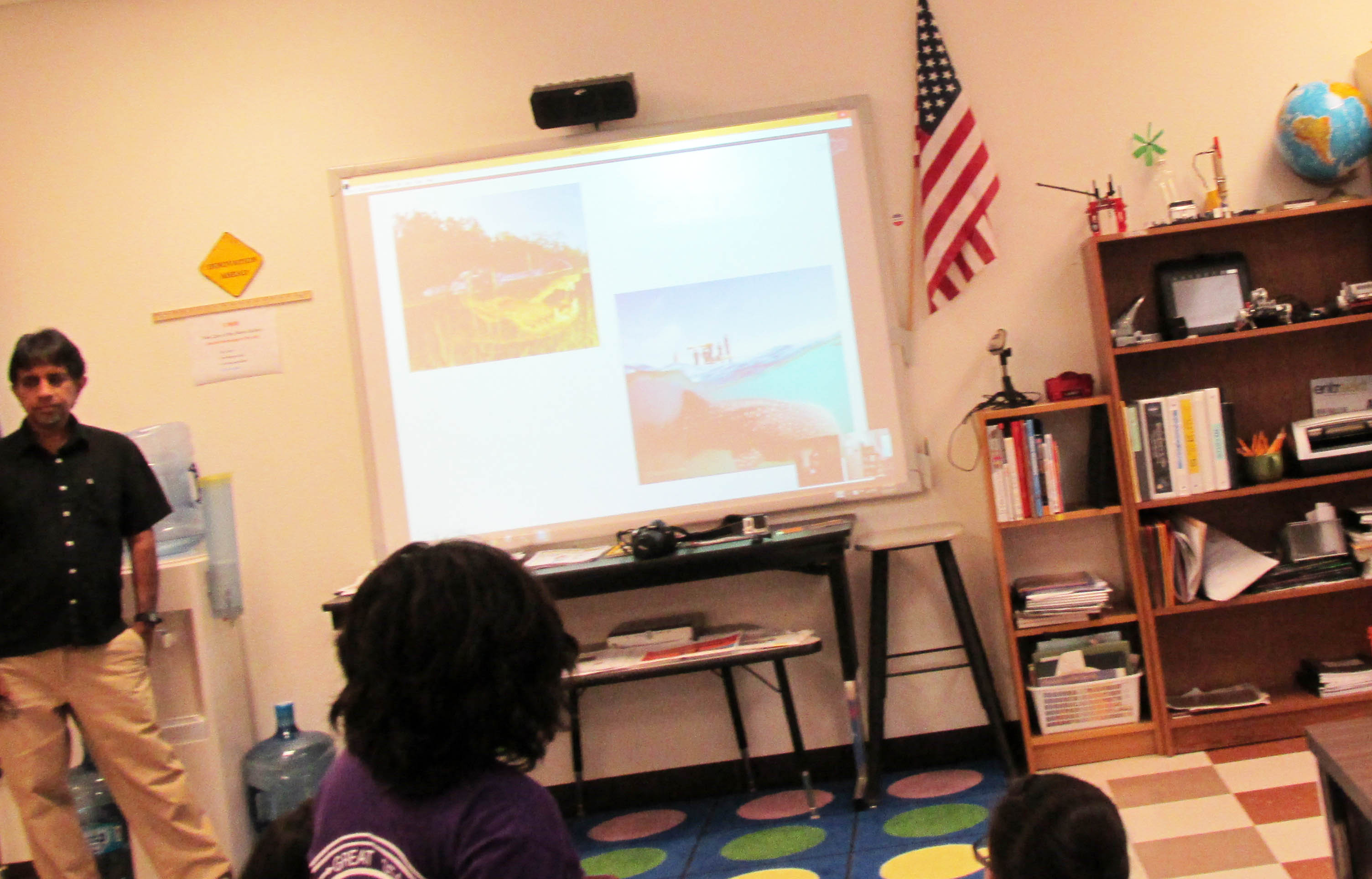
This technology class was a bit of a ‘planned surprise’ for them. Some have even seen a GoPro in action. I happen to have one in class, so before I introduce the hardware, I wanted to bring in a user to talk about it. There were three cameras in class – not counting the one on the PC for our Skype call. Nazly used screen-share from his end, to explain different camera perspectives. Forget drones with cameras. We watched the flight if an eagle mounted with a GoPro!

And students wanted to engage, so the class was (nicely) interrupted by many questions. One student volunteered to document the session on a regular camera. Everyone said they wanted to work with the GoPro, which will be in a forthcoming class.

Now if I could only find an eagle that’s willing to participate in an Ed-tech experiment 🙂 

GoPro class


Learning to avoid cameras – from TV reporters

I love cameras. I hate cameras. Are you like me?

I take a lot of pictures, and often avoid being in them (a photo-catcher’s prerogative!). But sometimes we can’t avoid being in them. (photo-radar, group shots…)

This week, I have to be part of a series of STEM videos that I am putting together. I was looking for ways to not be on camera 90 percent of the time. Ergo, the table-top presentation.

In the TV news business, it’s called Continuity and Cutaways.‘  A well-practiced art we are oblivious to. It works like this:

  1. Anchor introduces story, and station ‘cuts away’ to reporter.
  2. Reporter on camera takes over for a few seconds.
  3. Video cuts away to scene of story – the so-called B-roll footage. The reporters voice (arguably on ‘A-roll’) runs over the video and maintains continuity
  4. Studio cuts back to reporter, who wraps up story in a few seconds.

In total the reporter is on camera for a fraction of the time. Our brains fill in the gaps, and make us believe we were being addressed face-to-face. I hope to really shrink that fraction. Let’s see.

Note: For a good understanding of the cutaway and B-roll, read Steve Johnson’s explanation here.

Photography (and Ed-Tech) lessons from the Blood Moon

DSCN1174

Sometimes the cheapest camera does the trick.

This evening’s Blood Moon, and the lunar eclipse, was a spectacular show in our southern skies.

Not as stunning as these, however, but it could be a great lesson in photography, about how to frame a slow-moving event, and compensate for lighting. The camera was a Nikon Coolpix, which was less expensive than the lens of an older SLR. (It’s become my ‘better’ camera, especially on my recent trip to Sri Lanka, where I shot close-ups of rural life, and in the wilds. Easier to pack to the beach and on mountains hikes.)

Which brings me to the point about technology. How often does the technology get in the way of what you are experiencing or working on in the moment? Just as how we often get trapped in the software just to make a great presentation, a microphone or camera can become a distraction.

In Ed-Tech, which is what I teach, I like the focus to be more on the ‘Ed’ and less on the ‘Tech.’

DSCN1176DSCN1181

When Distance Learning was a mule-drawn wagon!

I have always been interested in Distance Learning, but as I like to tell young people many of our modern business and education models existed before the Internet.

For instance, about 50 years before eBooks made it possible to have the library accessible from home, we had the ‘mobile’ bicycle-drawn lending library.

But this ‘school on wheels’ known as the Jesup Wagon beats that! It was developed by George Washington Carver, a former slave.

A scientist, better known for the innovation we call ‘crop rotation’ and also peanuts, he loaded a wagon with seeds in this His ‘horse-drawn classroom’ and laboratory. His students were former slaves who had become sharecroppers.

The Movable Classroom program began in 1906. The wagon cost $674.

We could all use this to get some perspective, especially when we think we need fancy technology to connect knowledge with students.

So we are OK with robots, but scared by clocks!

Paranoia is a marvelous thing. It alters our brain chemistry.
So a boy could get handcuffed for bringing an electronic ‘clock’ to school, when it is perfectly OK to bring in, say, a robot? This turned out to be an embarrassing story for the school, and a wonderful one for NASA and robotics.

Are we sending mixed messages here? We urge kids to think outside the proverbial box aka a classroom, but we like them keep their inventions at home.

I’m not sure how to handle this. I’m in half a mind to have a “Bring your clockwork mechanism to school” day. Many students tell me about the experiments they do –from a simple Rube Goldberg contraption, to a Lego robot. Or should I tell them that guess what, you just might be invited to the White House…

Which is what editorial cartoonist, Steve Benson lampooned in today’s Arizona Republic. It’s hilarious.


Ed-Tech grows – and grows up

It might be shocking that while state education budgets shrink, Education Technology or Ed-Tech is on the upswing. Many of them are free, though the full-blown versions are quite affordable. Here are my favorites:

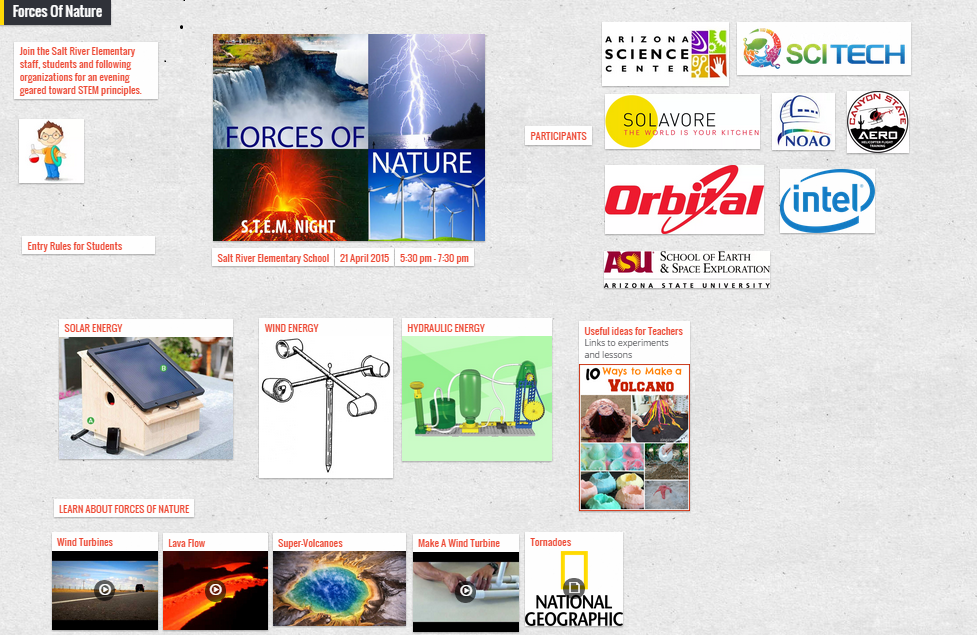
Padlet_SRE_STEM-Night2014Padlet – a collaboration and aggregation tool that feels like a website. What’s even clever isit lets you export that page as an image file, PDF, csv file; you could email it as well. I’ve written about it before here, since I use it as an events page for STEM, robotics, and even to submit a project for a class at a community college.

LinoIT – a canvas, with sticky notes that is a bit like Padlet, but acts like a bulletin board, rather than a website. Perfect for students! For added convenience, you could add a sticky note to your Lino page by emailing it to the page!

Voki – a way to create an avatar that could speak on your behalf, or tell a story!  You could set up a classroom that uses it, or use it to make an announcement! So many uses for this, especially if you want to open up a discussion about animation.

Story Jumper – a simple way to teach students what e-books are like, and more importantly what publishing involves.

PollEverywhere – I love the way it lets you create pop quizzes, to get class responses on the fly. Few schools allow mobile devices in class (mine too) but that’s easily overcome by pushing a link to all computers and have students click on answer choices.

Suddenly Ed-Tech beginning to look like the 2010 all over again, when ‘social’ was the flavor du jour.

(A bit of good news: The global Ed Tech and Smart Classrooms market is expected to grow from $43.27 Billion in 2015 to USD 93.76 Billion in 2020 –an annual growth rate of 16.7%  from 2015 to 2020.)