How handwriting develops the brain in the digital age

If

If you’re interested in education, or chiming in on a controversial discussion of whether handwriting is still relevant (or ‘old fashioned’) in the age of keyboard, here’s some fodder:

Why handwriting is still essential in the digital age – by Perri Klass, MD

The key is to pay attention to “early fine-motor writing skills” even in pre-kindergarten. I’ll spare you the sciency details of this article if you are just scanning this blog. But suffice to cite this from the well documented studies that Dr Class cites:

“After the children were taught to print, patterns of brain activationin response to letters showed increased activation of that reading network.”

It may be satisfying to some that this is not an either-or discovery. There is a role for Manuscript writing, Cursive, and Keyboarding – the need for ‘hybrid writers.’

This is a topic that comes up a lot in my work as a teacher, and I will return to it shortly when I get back to work in my ‘hybrid’ computer lab.

Google Expeditions meets ViewMasters – highly overpriced

It’s pricey, but it’s here. The answer to having Google Expeditions as a Virtual Reality tool for classrooms.

It’s a long, long shot from the basic Google cardboard headset that could potentially work with a smart phone as Google once promised.

The cardboard headsets were part of the lure because they had such a hand-made feel to it. The new kits, sold by Best Buy (the kit uses a Mattel ViewMasters unit) start at $3,999 for just 10 students, making it an over-priced nice-to-have for many schools. Way beyond the budget of many schools.

Virtual field trips are great, but some of us will have to wait until the a disruptor enters the field .Stereoscopy or the ability to have perceptions of depth and mass is being put to use in many areas outside of education. Let’s just hope Google Classroom continues to give us less branded, low-cost ways to experience Google Expeditions. We have already begun looking into VR for some of our STEM sessions, as I have mentioned before.

ISTE Ed-Tech Conference Wrap-up: Part 1

Just got back from the ISTE 2016 conference in Denver, and it’s hard to decide what stood out more: The technology, or the practices.

HARDWARE: Being a tech teacher, indeed the tools were mind-blowing. From the simple Digital Storytelling hacks, and wide range ofgaming technologies, to Makerspace ideas such as conductive material, to Virtual Reality, and Robotics. (More on robotics in a later post.) VR seems to have matured since 2014, and mini robots –like the Sphero, here — were practically running over our feet. OK, I actually took the challenge and drove one of these across the floor. They’re practically unbreakable, too!

SOFTWAREThe software definitely made me do a double take, when it came to programming languages, and ‘kits’ to simplify the learning curve. It’s finally come to this: software doesn’t exist in some abstract dimension, but comes coupled with devices that a student could learn to program – and see the effects in real-time. Google and Microsoft appeared to be fighting for attention. If you had the stamina and enough coffee, you could go through an entire day toggling between a Google classroom and that of Microsoft’s. Both have well defined Education divisions. (The former made 5 education product announcements at the conference.)

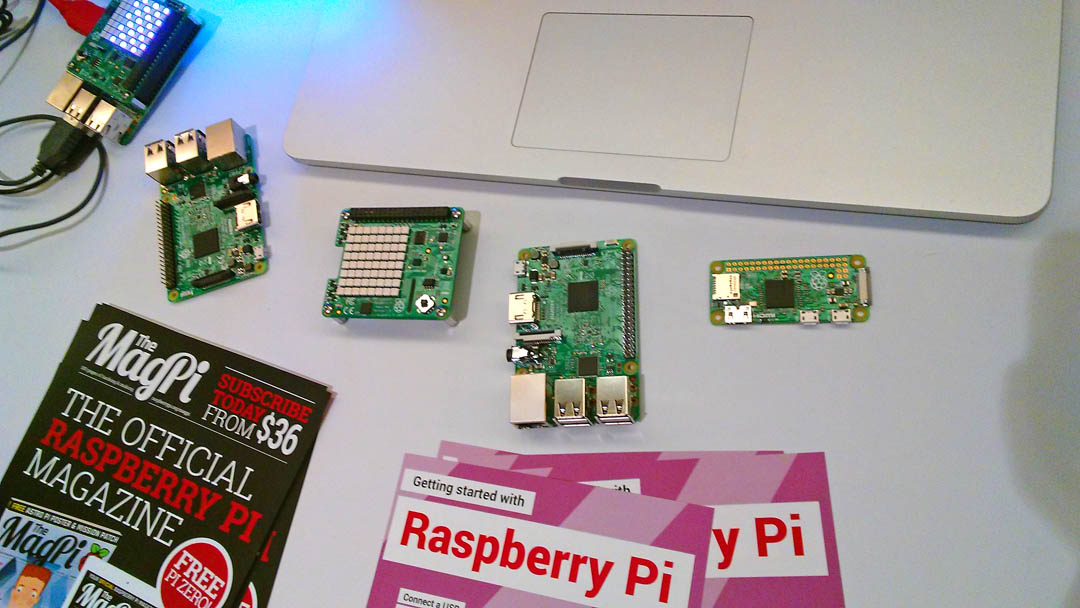
The sessions I liked most, were the Education Playgrounds. These were informal on-on-one or group sessions. I picked several that combined hardware and software. I met with a few Raspberry pi experts, basically teachers who worked with kits that were built around this mini computer.

I was fascinated by the no-frills entry-level kits (starting at the princely sum of $35 an unit!). Why?

RaspberryPi-tn

First because this hardware was not housed in some beautiful laminated case but was transparent enough or a 3rd grader to understand what a computer was all about. I often need to remind students that ‘computing’ is not some mysterious art form.

Second, computer literacy and digital literacy are joined at the hip today, in the same way that Robotics and the Maker movement can be two sides of the same coin. We need to merge our lesson plans, and get our young Digital Citizens to be Makers, engineers, designers, tinkerers, problem solvers and storytellers to recognize they can each take a piece of this action, and run with it.

FINALLY: I attended a few mind-expanding poster sessions, where the presenters were students. I’ve said it before that no teacher conference would be complete until you have met with students who are after all the reason our schools go to great lengths to send us out to these professional development events. It’s inspiring to see the end product of great teaching, and how underpaid teachers in bootstrapped school districts get students to soar. Many takeaways from these sessions.

VoiceThread meets Ted Talks!

I wish I had heard of this earlier – Voicethread‘s answer to TedTalks. Just in time for the ISTE Conference starting Sunday.

https://voicethread.com/app/player/?threadId=7784579

It’s called ThreadTalk. Which is quite a neat play on TedTalk considering how VoiceThread is all about the Thread, more than the voice. They make the point that the quality of the conversation thread is just as important as the presentation.

In other words, it’s not about the fancy slides, but the content.

As the VoiceThread notes, we tend to stop using our voices and replace it with text communication because the Internet was not quote supportive of voice for a long time. It is now, as we know thanks to services such as Google Voice, Viber and other phone apps. But in education, we need to bring back the spoken word and student voices into the mix.

I’m waiting to see what evolves out of ThreadTalk, post ISTE2016.

Attending ISTE 2016? Don’t miss these events

Just a few weeks away from the ISTE 2016 conference in Denver, and it could be daunting keeping up with the information onslaught of sessions, speakers, and trends. The trick is to balance the learning sessions with hands-on activities. Here are two things you shouldn’t miss if you’re attending:

DIGITAL PLAYGROUNDS. ISTE has something called Digital Playgrounds, an area which I plan to frequent a lot, considering how much I was able to take back and implement from the last ITSE conference I attended.There’s a Maker Playground, and a Google For Education session I’m planning to go to, and

POSTER SESSIONS. Sure it’s great to meet one’s peers, and fellow techies. But if you are attending ISTE for the first time don’t miss the poster sessions, where students from many countries will be presenting. In 2014, I learned a lot about robotics from a team in Mexico.

https://www.youtube.com/watch?v=YhqP_tFq7MY

Of course there’s more. Stay tuned via @isteconnects

If you support computer science – speak up!

Care to support a push to promote Computer Science in schools?

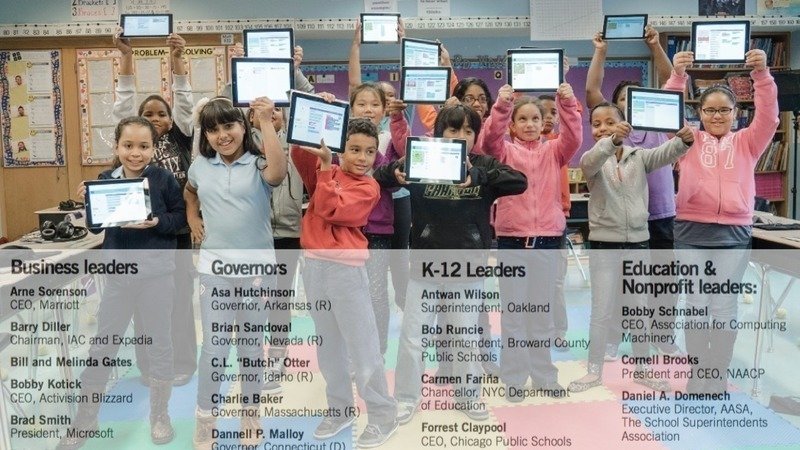
Most schools don’t have it as a foundational class, so leaders from across the US –which includes the Zuckerbergs, Cooks, Schmitdts and Gates’ of this world — have begun a movement to petition our political leaders.

You could find it here at Change.Org.

The petition was started by Code.org founder Hari Partovi., and is also supported by governors and school districts, not just the private sector. Please give it your consideration.

Solar Oven STEM project – Chili Cook-Off!

As temps rise, I’m bringing out my solar oven for an engineering & science class. It will be a ‘maker’ type session that will culminate in a Chili Cook-Off for 5th and 6th grades. Students of each grade have been asked to come up with their own class Chili recipe and put it to the test. Outside judges will decide on the best Chili

To get started, I’m introducing them to topics such as insulation, radiation and the greenhouse effect.

  • Next a session on designing and building a Solar Oven from a Pizza Box.
  • Finally, Ann Patterson from Solavore will be here to teach a class on Solar Cookers and the engineering principles behind it.

If you’re looking for solar oven recipes, here are some. I’m a big Chili Concarne fan. Solavore has some here, too.


Chilli CookOff - CHILLI & STEAM - May 2016

Second eBook experiment. It gets better!

As I mentioned yesterday I’m trying out different publishing tools for eBooks. Here’s the second option, using SimpleBooklet. It is at www.Livebooklet.com. Click on the image to open the book

livebooklet.comFrontPage-Culture

       https://livebooklet.com/angelofernando3


QR Code - Culture Book


The Pros

  1. Simply upload a PDF and the site converts it to an eBook.
  2. You could start with a blank page and add content –including audio and video.
  3. You could change the layout of the book, the way the page flips, and also add a contact card.
  4. Sharing is a big deal here. It generates links and embed code for social channels.You could also email directly from the website to your network.
  5. QR Code generator. Very neat feature lets you generate the QR code –on the right.
  6. You can check Stats on the dashboard (it uses Google Analytics)
  7. My best feature: A unique URL livebooklet.com/yourtitlehere

The Cons:

The embed code was not available for WordPress. You need to upgrade to a paid account to get this.

NOTE: The previous eBook Was created using YouBlisher.com.

Creating an eBook from a PDF – Cool tool!

I am testing a book creation tool called YouBlisher. The goal is to learn how it works so I could teach my students next year how to ‘publish’ in more ways than one! Test it out and let me know what you think.

Click on the icon to view a digital book that lets you flip pages. Then read below the pros and cons:

eBook Experiment - YouBlisher


What’s good about Youblisher:

  1. It’s free, so I don’t have to download any software.
  2. The content has to be created on a local computer, and not on the provider’s website.
  3. You need to convert your document into a PDF to upload it. Which means you create your book as a Microsoft Word doc, or Publisher. Alternatively, you could create a photo book using Photoshop or Powerpoint. As long as you save it as a PDF.
  4. The pages flip like a professional ebook.
  5. YouBlisher gives you a link to embed (which is not what I did here – I just linked an image of the cover, back to the site.) They also give you a Facebook embed code.

What I wish was possible:

  • A way to download the entire ebook, and save it on any device
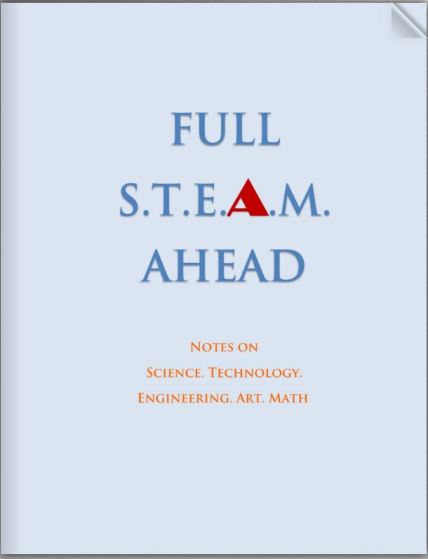
  • A custom URL would be terrific! Right now it’s www.youblisher.com/p/1391665-Full-STEAM-Ahead. But hey!
  • I wish the links within the content worked. There may be a way to fix this…

Note: The content for this eBook was culled from several posts on this blog. It took me just 20 minutes.

Baxter, Sawyer, Tina, SIRI. Is this our future?

Baxter and Sawyer are brothers in arms, so to speak. They are collaborative, follow instructions, and adaptable to their surroundings.

They also happen to be robots. I find it interesting that they have human names, although they are industrial bots. No mistake they are meant for the factory floor, and not cute or friendly robots that are also coming of age elsewhere. Rethink Robotics, which manufactured them says they are “trained not programmed.” It quotes a professor who says his “long range aim is to try to achieve human level artificial intelligence. So the Baxter would be like a person, maybe not a full-fledged adult.”

  • Baxter is a 2-armed bot, and is described as “the safe, flexible, affordable alternative to outsourced labor and fixed automation.”  It weighs 165 pounds.
  • Sawyer is a one-armed fellow, and is called a “collaborative robot designed to execute machine tending, circuit board testing and other precise tasks.” It weighs just 42 pounds

Why I find this interesting is that we have begun to look at robots in humanistic terms, and this paves the way for them to be ‘invited’ into our homes some day soon. If you don’t believe me ask those who love their Roomba, the robotic vacuum cleaner.

How long will it be before we have a Homework robot, and an automated, (two-armed, hopefully) Personal Assistant? Low maintenance, too –no need for company benefits. Some people who use SIRI may say they already have one of those! Chat bots are also in the news now – like the Iranian bot, endearingly known as Tina.

Humanoid devices are also the stuff I have begun writing about elsewhere.