As a new batch of eBooks begin to roll out, the excitement is palpable.
A stark historical record of an event largely forgotten.
It’s that time of the semester, when my 7th graders begin to write and publish their eBooks. The idea of being a ‘published’ author fires them up. They have stories waiting to take flight, and I see my job as a technology teacher paving the runway.
Consider these titles in the works:
‘The Hotel’ — About a boy who gets trapped in a hotel and uncovers its dark secrets.
‘Thalassophobia’ — Yes that obscure fear of the ocean, in a twisted story.
‘Racetrack’ — The diary of a ‘newsie’ in New York City’s past. Sounds like I’ll discover a historical fiction writer.
‘Cinders and Scales’ — A fantasy novel about a girl named Cinder, and the ‘scales’ seem to imply something else.
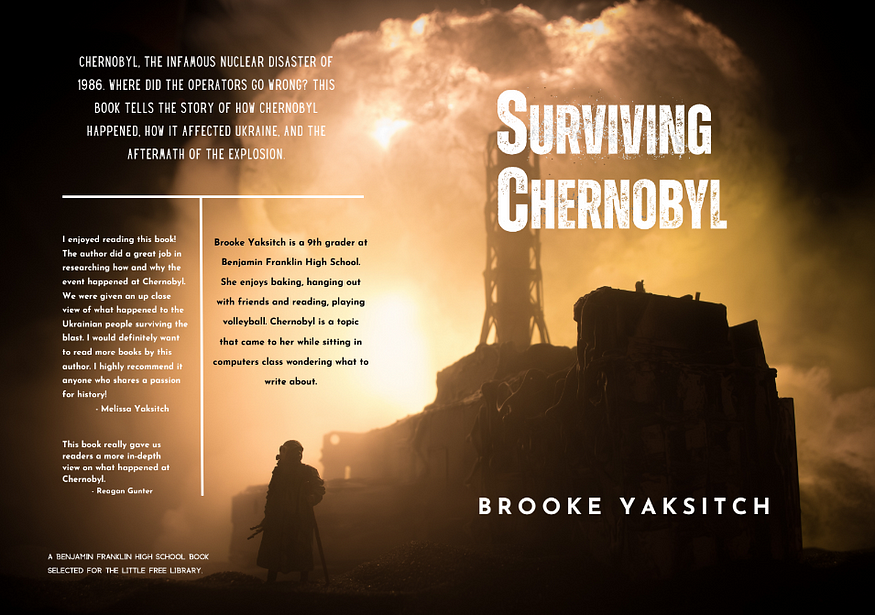
‘Surviving Chernobyl’ — About the radioactive accident in Ukraine in April 1986. The student wrote this book two years ago, and today came in ask me to help her print 10 copies. The above image was the cover we uploaded.
There are more! So don’t let anyone tell you that Gen Z can’t write. They can, if we get them off their phones. Working in a classical school, this I know: Good writers become good consumers of content; Good readers develop good communication skills whether it’s a science report, or a paper about the ghost in Hamlet.
If you’re reading this, you already know the value of cultivating writers and readers. Someday their books will be on the bookshelves of my local library. Until then, they’re on the shelves in my Little Free Library at school.
Answer me this: QR code or printed menus? The smell of newsprint, or a PDF on your phone?
I only ask because I’m conflicted too. I use both. That PDF file on a six-inch screen is annoying to read, but is easily magnified with a two-finger ‘pinch’ of its vector format. A newspaper, however (folded and crumpled and even slightly out of date) still draws me in. I keep old copies of the Wall Street Journal in my magazine rack in my class (Note to Gen Z: Yes, magazine racks were once a thing!) This means reading material is just footsteps away from my students. No need to click, mess with captchas, or try to dodge that paywall.
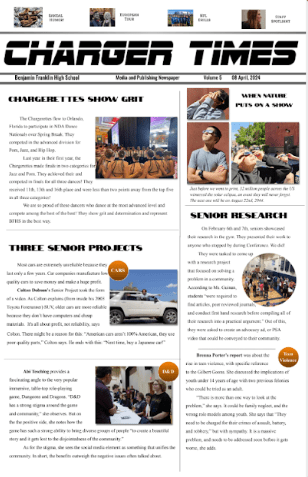
There’s a deeper reason I ask ‘who reads news?’ I want to know who reads beyond the clickbait headline and the first graph? Video clips are the boss of news. At least in my network. Which brings me to the existential question for a teacher: Should we teach writing? If a newspaper falls in the forest of TikToks will anyone look? Meanwhile, here’s what we publish — both in print and as a digital version. Click on the image or this link and you will see what my students put together.
As I buck the trend I give my students my spiel about about story craft. And voice. And that old-school who-what-when-where-why model which never gets old.
Despite what you may hear, we do have a critical mass of readers today who will consume original news — as opposed to screenshots and opinions. (That, I fear, is dwindling faster than the number of pictures of avocado toast that spiked during Covid.) It just depends how they read. At the close of 2023, The New York Times grew to 10.36 million subscribers, 9.7 million of them digital-only. Print subscribers have been dropping!
We are now living in ‘news deserts.’ Just the term News Deserts is disturbing. In February, during News Literacy Week, I ran into some disturbing facts via The Medill School of Journalism about the crisis in journalism. Some highlights:
Since 2005, the U.S. has lost nearly 2,900 newspapers. Of about 6,000 newspapers left standing (600!) most of them are weeklies.
228 counties are now at an elevated risk of becoming news deserts in the next five years.
Let’s start by addressing where do we get our first frame of news? Is it (a) Our network? (b) An app on our phone? (c) That 30-minute TV news segment with a talking head?
For years I have been getting my news via Google News. It always felt slightly unethical since I know Google doesn’t pay news organizations to carry the stories. I don’t want to cry at the funeral of newspapers, while carrying the coffin nails in my pocket. Neither do I want my students to do so, if I can help it. I now pay for an online news subscription to a major newspaper, and have an annual subscription to two magazines.
Perhaps they would one day reach for the dead-tree version in my magazine rack.
Now for the rest of the story. Podcasting is nothing more than a person with a mic and a story well told. But, on a production level, it could get complicated when you add stuff like a ‘DAW’ or a digital audio workstation – a fancy term for a recording and editing software. Or multiple guests.
I love the spontaneity of podcasting, letting guests be themselves, warts and all. Yet I like to edit much; tighten things up, with intros, outros, multiple tracks for voices, and occasional sound effects etc. I use Hindenburg Pro for a bulk of the work, and Anchor.fmto upload the finished product to Apple Podcasts, Spotify and the likes.
The more ‘guests’ you have, the complexity ramps up. There’s overlapping audio when someone occasionally talks over another (a good thing?), bloopers that could be left in –and sometimes should – but at the expense of duration of the podcast. And sound levels to adjust, especially if you have a mic that allows for switching between cardioid (for voices directly in front), and omnidirectional. When I have forgotten to switch modes, the results have been…meh!
Some history here: There was a time, c. 2011, I when Derrick Mains and I hosted a radio show out of Phoenix we called Your3BL (listen here!) which stood for ‘Your Triple Bottom Line.’ It was out of KFNX studios hidden away in a nondescript strip mall. The man behind the glass did all the mixing and sound balancing, so it was pretty easy for us hosts. But Derrick and I liked to shake things up a bit now and then. Sometimes, we recorded the show elsewhere. Like one at Gangplank, a co-working space. There was a time I hosted it on a laptop in a classroom at Clark University in Boston with Derrick in Phoenix. We called in, through a dedicated phone line to the studio. That was one of the ‘live’ events that stretched my capabilities, but the recording taught me a lot about podcast production.
Recently I decided to interview two guests in school, and thought of upping the ante a bit. We recorded it in the gymnasium. That’s asking for trouble, if you know something about the cathedral-acoustics in a gym. Especially, when it’s the first time.
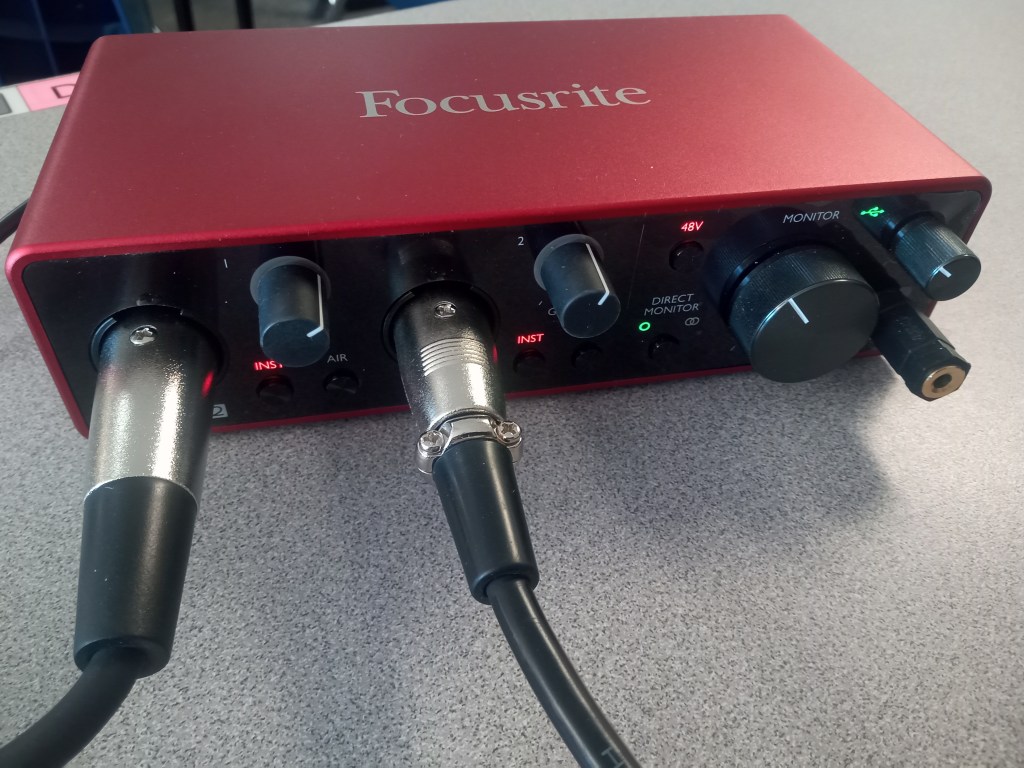
I wanted the acoustics to feel like it was a large space. Then there was the fact that we had two audiences: the ones in front of us, and the ones who would listen to the recording. The student audience in the bleachers came through loud and clear, cheering wildly when our two guests were introduced. But would the recording pick up the exuberance? To compensate, I had a back-up recorder on the desk, my trusty ZoomH4N Pro. I could grab that feed if I needed in editing. There was also a video camera at the back of the gym, hooked to a wireless lavalier mic which I placed next to our guests. This and the desk mic were plugged it in through the Scarlett Focusrite mixer. (That video mic feed came handy in editing, since one of our guests, an awesome pianist, played the theme from Pirates of the Caribbean which overpowered the desk mic. I was able to splice the better audio in later.)
You learn something! Like wishing I had two clip-on mics for the guests. I know, overkill! Or testing sound levels in the vast space before the real thing.
As for our guests, they were freshmen Reina Ley and Landon Madsen. A few weeks before, (Sept 2022), Reina had auditioned on NBC’s The Voice. That same month, Landon, the pianist, had given a stunning performance at our talent show, Franklin’s Got Talent. The podcast were were recording, was a way to celebrate our student’s achievements, as we often do during morning assembly. Moments like this not only memorialize these particular achievements, they reveal something about all our students. The often unspoken talent hurrying through these hallways, toting trombones, football gear, trifolds, and other paraphernalia.
Here’s where the learning gets more interesting. This experiment in podcasting doubled up as an assignment for students in my class on Writing and Publishing in the Digital Age. I got them to help me set up the hardware in the gym. They were the ones manning the video camera, and doing the sound checks. Another was the photojournalist, with a regular camera. After fall break, these students will take this video feed and turn it into a news story, worthy of television. We have practiced with a green screen, so there will be an anchor, a reporter on the scene etc. Who knows where this will go! This, to me is what makes learning more hands-on, and lets them apply the theory of storytelling to real work they could publish (On Medium, the class website, and elsewhere) and see their output. Next month, they will be recording mock political debates in a history class, and produce a newspaper with many of these stories.
They, like me, love the challenge. After all, much of this (and the podcast) takes place in the Computer Lab. I remind my students, ad nauseam, it’s after all a ‘lab’ –where we are supposed to experiment!
Last week, I paused my lesson plan for a moment to address the war. My high school students (in a Writing & Publishing elective) had discussed a recent book,2034: A Novel of the Next World War, by Elliot Ackerman and Admiral James Stavridis. “Does this current crisis with the invasion of Ukraine seem like the next world war?” I asked them. I felt it was bizarre to go on with life, editing videos and writing stories as if this wasn’t happening. War is not always someone else’s problem, I added. In a globally connected world, especially in a world with hyper-connected media, it’s not something just happening ‘over there.’
Which led me to lean on a set of documents from Brown University’s Choices program. It’s got excellent discussion topics, and handouts like this for teaching with the news. I had them read the backgrounder, and analyze political cartoons for labels, symbolism analogy, irony, exaggeration and stereotyping. When you’re writing for the digital world today, you have to take into account the many facets of media — from Tik-Tok, and memes, to cartoons, which have served editorial purposes for as long as newspapers have been around.
Political cartoons have a long legacy. There was Dr. Seuss, whose work included anti-fascist cartoons about Hitler and the rise of Nazism. There were those by Jerry Costello (‘Feeling the pinch’), and those like Punch cartoonist, Fougasse (‘Careless talk costs lives’) who worked for the British ministry of information. Cartoonists, like writers are also journalists of a different caliber. The writer has a rectangle called a column. The cartoonist has a rectangle called a strip. Both must pack meaning into them.
Analyzing history through texts and events requires critical thinking. My colleague who teachers history class described how he was tremendously proud of how his students handled the discussion of the war in Ukraine. I’ll cite his description from a commentary he wrote in a school newsletter last week.
“Something marvelous happened in my classroom last week. Something that I have been waiting for my students to do the entire year. My traditional history class is going over American Imperialism right now, and the subject came up of when Americans should intervene in the affairs of another country. The class was saying what they believed I wanted to hear, namely “Mr. Klicker, this is a horrible thing that is happening, but that doesn’t mean we throw American lives away”. It was good, but their hearts weren’t in it. They were just saying words without any conviction behind them. So I decided to have a little fun. I was going to ‘poke the bear’ and see what I came up with.
“Well by THAT logic, class, I guess you would have stood by and let Hitler and the rest of the Nazis conquer Europe and complete the Holocaust!”
Normally, they just sit their in shock at the fact that I accused of being Nazis, or perhaps they’ll roll their eyes if they’re feeling especially sarcastic. But miraculously, for the first time all year, I heard the words I’ve been waiting to hear:
“Mr. Klicker!” one girl said, rolling both her head and her eyes at me, “You know that’s not true! You always do this and I’m tired of sitting here and taking it! This is way more complicated than that!”
He goes on to say that in a history class, it is far more important that he teaches them to stand up for their beliefs (even when they are attacked) instead of making sure they memorize all of the names and dates. He recognizes that critical thinking is a difficult thing to do — made even more difficult when called to disagree with a person you are supposed to admire and respect. “We have forgotten how to debate,” he says, “to stand up for ourselves and have conviction in our beliefs even when everyone else is telling us to stand down.”
— — — — — — — — — — — — — — — — — — — —
There are plenty of resources for fostering civil discourse in the class room. In times like this, no matter what the subject matter, we have to address the moment in which the lesson is taught. I’ll leave you with two resources. These are guaranteed to start a great discussion in class:
1. People, including children, are singing inside bomb shelters to raise morale. Worth watching this. Why are these images of war so radially different to what might be on cable news, or on social media?
2. A story of an Ukrainian vlogger, Volodymyr Zolkin, who takes it upon himself to call up, randomly, people in Russia, and provide them with a different type of news. Read about it here, in the New Yorker.
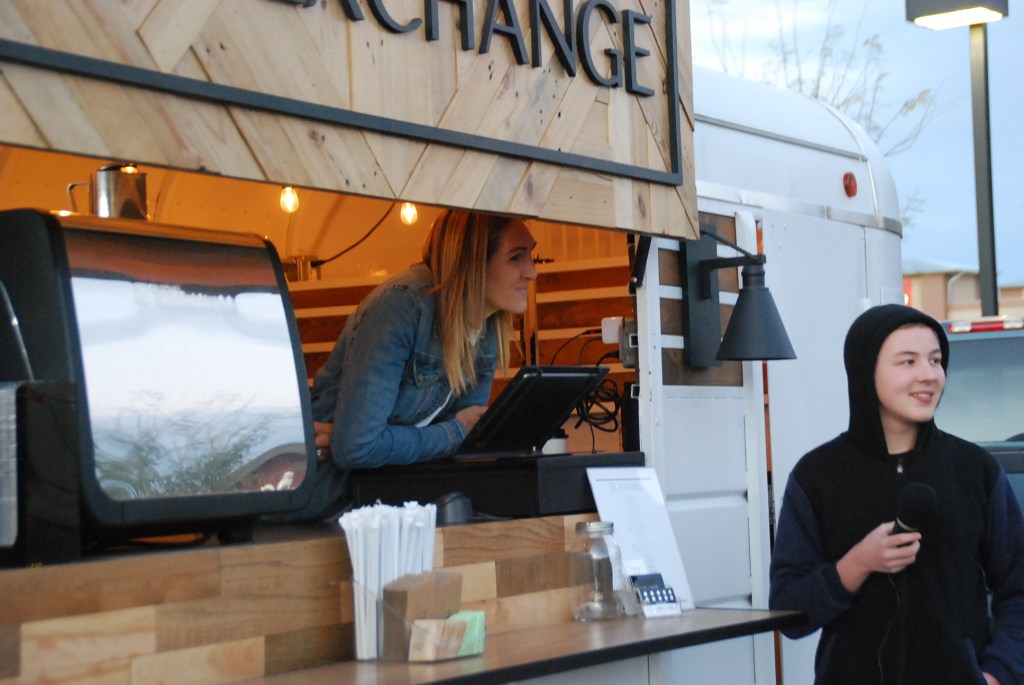
Today, no sooner I got to school, I saw an email to staff about a coffee truck stopping by. A fundraiser for the school’s Cheer team. Not your common or garden food truck (a converted horse trailer) Exchange Coffee is a company with an interesting origin story.
So as my students came to class — my Writing and Publishing class –I nixed the day’s assignment on my lesson plan and asked them if they like to work as an impromptu news team. Grab a camera and some mics I told them. Someone needed to prep for the story, to look up some background information of the owners of Exchange Coffee. Another began to write down possible questions on a small white board while two others tested the audio, and if the clip-on mic units were charged. Clip-on mics aren’t the best for impromptu stories, so one student, adapted our ‘dummy’ mic to the Hotec clip-on, so that it communicated back to the camera. We rushed downstairs. I asked the owners (who also make and serve the coffee) if it was OK to do a story about them.
Once that was cleared, I got the students to shoot some B-roll. A school bus rolling in. A weird half moon was rising as the sun came over the Queen Creek horizon. An engine roared –possibly a train or a noisy aircraft from the nearby Phoenix-Mesa Gateway airport. Sound engineer? Check. Camera person? Check. Reporter? Check.
As we began to roll, Don Meyer, an English teacher unexpectedly wheeled into frame, in full biking gear. Perfect! (I’ve featured Mr. Meyer on a podcast and blog post so I was confident this ‘customer’ would agree to being in the story.) The story was suddenly growing more legs. The ‘reporter’ began describing the scene, and got a interview with the owner/barista.
The audio quality turned out better than we expected. More than that, our reporter sounded like a reporter, despte just having 5 minutes of planning the story. The camera person got her right shots. Fifteen minutes to the bell, we switched off the tech and headed back to class to review the work.
NOW COMES THE LEARNING PART. I will play back the recording, and over the next few days and have the students critique their work. Could they have done anything different? What about lighting? What about camera angles? What if this was an ‘incident’? How would they handle it? Could they have interviewed customers? Could they have got a different camera angle – say from inside the truck?
Publishing in a digital world is tricky business. It’s never static. Stories, like lesson plans are always in flux. The best lessons are learned on the job. We are often poised at the top of the Bloom’s taxonomy pyramid, ‘creating original work,’ investigating, revising, reconstructing knowledge in the moment. Sometimes a coffee truck hijacks the lesson plan. You adapt and run with it.
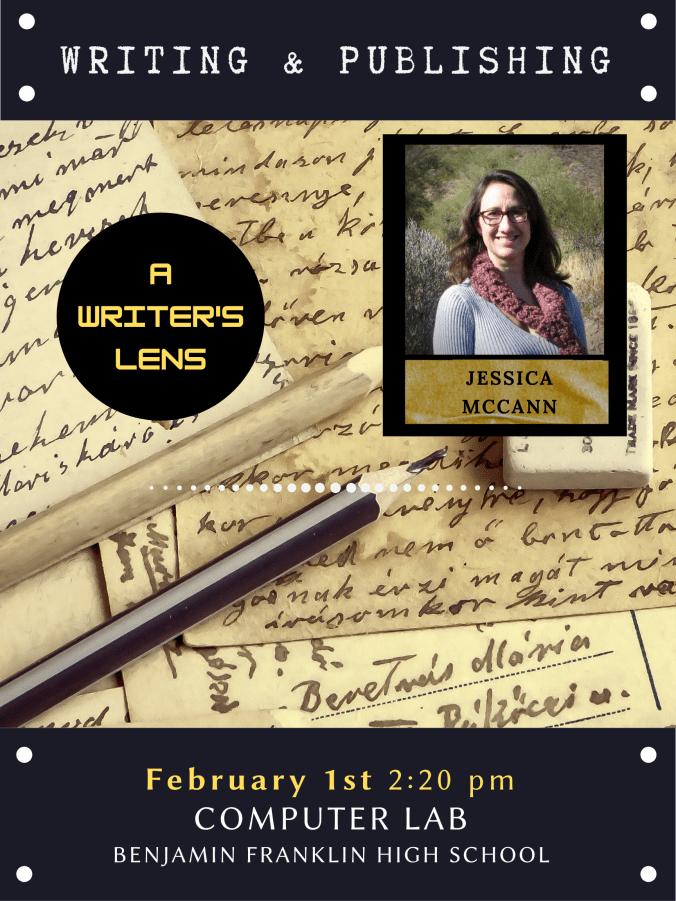
Tomorrow I have invited an author, Jessica McCann, talk to the class about the writing craft, about fiction, and picking out details for a story. Does a video story or podcast have something in common with a novel? We’ll ask!
NEXT WEEK, my students will be working on podcasts. Who knows where this –and what unplanned events – will take my class. Stay tuned. Didn’t I mention – my class starts at 6:30 am? I might need more coffee!
Yesterday I brought back our Technology Speaker series for the new semester.
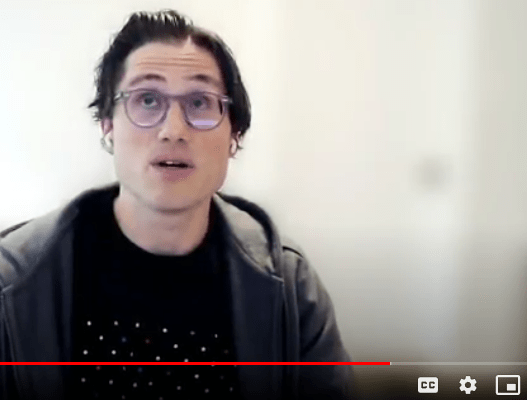
What better way than to start off with a Googler, Patrick Krecker. It was timely as I had just completed teaching units on the roots in the Net. How none of what we access on the Web (or Google) would be possible if not for a man named Tim Berners-Lee.
Patrick Krecker, Google
Web history aside, Mr. Krecker responded students questions. Pointed questions that let him take on some hot-button issues that come up for discussion in my class. Such as What does Google do with our data? Why is there so much hacking these days? What’s ransomware?
Patrick talked about security holes, and the ongoing pursuit hackers and the role of ‘white hats.’ I was glad he personalized what coding in his job involves (He says has written about 200,000 lines of code) given that coding is making its way into many schools now, to get students better prepared for what lies ahead.
As for me, I learned new terms and concepts, too. Things like ‘double spend,’ ‘deprecated software‘ and something known as ‘cross-site scripting‘ which refers to the injection of malicious scripts or code into ‘trusted’ websites.
Patrick has a gift for explaining complex ideas with metaphors. If you like to listen in to his conversation with my students, here’s a link to the video, which is also on my class website.
Listen to the ‘Radio 201’ podcast of this event:
___________________________
Patrick and I used to work at Decision Theater, at ASU about 11 years ago. It’s wonderful to see how far he’s moved along into a field he was always passionate about. Thank you Patrick for this wonderful experience in my class this week.
As Digital Learning Day came around in February I wondered if the distinction between digital and non-digital even exists.
I am old enough to remember when we actually celebrated an annual event called E-Day here in Phoenix, as part of the IABC. In the early 2000s, Business Communication then was pretty much analog, with smatterings of digital. Soon E-Day became passé.
Just seven years ago –a long time in Internet years! -at Salt River Elementary School, STEM had pushed its way through the door. Ed-Tech was a buzzword, as was digital learning. In my computer lab I was introducing students to Mars exploration, Robotics, VR and 3D Printing. With tremendous support from my colleagues at Salt River Elementary, Mrs. Decker, Mrs. Yurek, and Mr. Filhart –from Music, the Library and PE respectively – we created an entire day for this across K-6.
Today, digital learning encompasses almost every facet of what we do, whether it is in libraries or the gym. Online school has made the digital device a necessity, when it once was a nice-to-have. Platforms evolve, from Quizlet to Khan Academy; Grammarly to Google Classroom; Mindstorms to Scratch and so much more. Students now create podcasts with a simple free AnchorFM app on a phone – intros, outros and all. Screencast-O-matic has taken the pain out of video-supported lessons for teachers like me, furiously posting them to Google Classroom.
The VR glasses of yesterday are gathering dust on my shelf at Benjamin Franklin High school as the pace accelerates. Will Digital Learning Day become an archive of education too?
I’ve been curating front pages of the New York Times over the past few months, as a record of how how we are dealing with unfolding events during the pandemic. Some images are so grim that they could have been plucked from a newspaper in another country.
Take this one, for instance. Homeless shelter? Activists? People destroying incriminating evidence? Sadly it’s how people in one of the wealthiest states in the US are keeping warm, after the winter storm crippled its power grid, disrupted its water supply. This is in San Antonio, Texas. Boiling snow for drinking water became the norm.
Then there was this on the same day the winter storm hit – Perseverance of another kind, on a planet 30-plus million miles away. The Mars rover, named Perseverance, landed in the afternoon, Arizona Time. Even the search engine couldn’t resist a bit of exuberance as the page loaded. (that’s a screenshot of my Google search engine results for ‘Mars Rover.’)
COVID has laid bare our split-screen lives. Bitcoin made waves this week, but at the same time economists think the number of unemployed exceeds 10 million in the US. Those hunkering down, and those lifting themselves up are living side by side. The disgruntled and suspicious, and the hopeful move on. Those facing unbearable tragedy, sitting next to those who are building new lives.
Sometimes a lesson plan needs to be revised on the fly. This happened today when one of my students brought in a green screen, so they could do trial runs of their TV news scripts in a Writing & Publishing class. I had planned to use a camera on a tripod and have them simulate a studio setting. I happen to have a 60-inch screen on the opposite wall, so with a bit of tweaking, it could be made to look like a backdrop of a scene for a ‘reporter’ to deliver his/her lines.
And then this happened.
Computer lab at Benjamin Franklin High School
As quickly as it was set up, we dismantled it. But I think it gave students a real world context of what they are actually working on – a story, that is not just an academic exercise but with an audience in mind.
I have to say this is a learning experience for me. [What’s that saying, “He who teaches, learns twice?”] I grew up using what we called a ‘blue screen’ as a chroma-key technique. I practiced this during a training stint in Coventry. My fellow student and I sent up this huge camera that weighed about as much as a microwave, at Coventry cathedral – the bombed out remains from the 1940 German air raids. We then took the ‘film’ to the studio and produced a news show. Now, some 33 years later all it takes is a pop-up screen, and a $300 camera slightly larger than a computer mouse.
This week I’m teaching myself to edit the footage on DaVinci Resolve. It’s not part of the lesson plan, for sure! But who knows. These things are not writ in stone. My elective class that I teach at 6:30 am each week day could evolve. I tell my students this is what a computer and tech lab should be – a place to experiment, to take things apart, and be ready for new ideas that pop-up. It’s one year since COVID made us discover new ways of teaching. It’s a lot of work, but it’s invigorating! Notice how everyone’s wearing a mask. No one’s complaining.
I’ve been teaching writing for the past three years as one component in my Computer class. I teach technical skills –formatting documents, and creating presentations — while always introducing current, big-picture issues in information and communication technologies, or ICT, and social media. You know, privacy, trolls, AI, disinformation…
BUT 202O DELIVERED A SURPRISE PACKAGE, besides a micro-organism that derailed us: An explosion of student writing. Fiction, mainly. The capstone project for the past three years has been an eBook my 7th graders research, write and produce. I noticed a sudden interest in fiction writing by last December, so I invited this semester’s students to consider a Writer’s Club. This week, the club is beginning to take shape. It’s fitting: Benjamin Franklin was a prolific writer, after all!
In parallel with this, in my other class on Writing and Publishing class for high school students, writing seems to come naturally. Which is why they take this elective, after all. But what surprises me is how much of writing they have already begun. Two students are already working on a book. Reading their assignments makes me wonder where these young authors have been hiding all these years. Has COVID been a catalyst for creativity? Somewhere, in some research department, there’s probably a study going on about how lock-downs and screen-time have driven young people to books again; how young adults are discussing issues not covered by memes and Tik-Tok.
AGAINST THIS BACKDROP, I INVITED JESSICA MCCANN, a Phoenix based author and freelance writer to talk to my class on Monday. Jessica writes historical fiction, and her story of how she researches her character, and crafts her story is inspiring. Her examples are what we writers could identify with such as taking on the mundane work (writing about topics such as ‘garbage’), editing work for a different kind of ‘reader’ (corporate documents), and a brush with law literature. The latter is what serendipitously led to her digging into a court case involving slavery in the late nineteenth century, which led her to a character who figures in one of her books.
Speaking of craft, Jessica talked about the need for a writer to capture and convey the sensory experiences of a scene or a character, whether it is interviewing a celebrity or an anonymous figure in history. [Her books are “A Peculiar Savage Beauty” set in the 1030s Dust Bowl, and “A different Kind of Free” set in the pre-Civil War era. Having always leaned toward Sci-Fi, I’ve never read much in the historical fiction genre. I’m sold now!
My students this week are working on a blog post. In a few weeks they will create and produce a podcast, and then a newspaper. Elsewhere, and anecdotally I hear that interest in journalism is on the rise. Does that mean a return to long-form journalism, and greater value placed on writers across all genres? I hope so.








 Hoipolloireport
