Quotes for the week ending 12 April, 2008

“Nobody has the right to say ‘shut up’.”

The Dalai Lama in Japan, saying he supports the Olympics in China, but that protesters have their freedom to speak.

“experience great nights out without the fatigue.”

Description of Burn Alter Ego, a Facebook application from energy drink, Burn (a Coca Cola product) that lets people’s avatars go out and mingle with others, and have an automatic blog post about the encounters.

“Geoffrey Moore’s “late majority” and “laggards” have yet to join the party, but they will.”

Shel Holtz, interviewed by ValleyPRBlog, on the adoption of social media and its impact on PR.

“It’s a dreamer’s ad.”

Barb Rechterman, Exec VP at domain registrar GoDaddy, on the un-risque ad, “Kart” featuring (finally) a message about web sites.

“It is depressing that sound bites have replaced sound judgement, and that character assassination of one’s opponent has become expected political strategy.”

Cal Thomas, Tribune Media Services

“I just wonder why the torch was running away from the people.”

Jerry Fowler, president of the Save Darfur Coalition, on the tactics used to protect the Olympic torch in San Francisco.

“That, ladies and gentleman, is what you call your ‘marketing challenge’.”
Bob Garfield, Advertising Age, about an ad by John McCain that makes us forget the Iraq war, but unhelpfully invokes Vietnam.

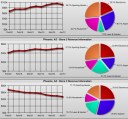
Digital dashboard serves data right

Gone are the PDFs that used to be the static receptacles of data. Now there’s Dashboard. A way to show data as gauges, charts and tables in a more dynamic way

At ASU, we’re moving into this more dynamic format so that a media person, a student or a researcher may be able to get to see the university not as a list of numbers, but by seeing these numbers map out a context.

It’s called ASU Dashboard. Some data like this is public. Other areas require a student/staff/faculty login. The data can be exported to an Excel file, or converted to a PDF.

Visualization and data and using it for decision making has come a long way since PowerPoint. You begin to respect data when you can see business intelligence in a dynamic state. On Corda, the company behind Dashboard, you can track such things as campaign finance by state or zip code, and see up to date results. Or you could see gas prices or unemployment numbers charted out.

How does it work? The application pulls raw data from a variety of public sources, some of which is accurate up to the day.

Fluffing things up, bad for the three R’s

Reputation. Reasoning. Responses. Our writing has a huge influence on them.

I am working on an article about the ‘fluff’ that creeps into resumes, and why the format is in need of an overhaul. I came across this quote in Writer’s Digest: “Unless you’re doing laundry, you’re not allowed to fluff.”

To which I would like to add:

  • Unless you’re calling in to the Rush Limbaugh show, you’re not allowed to use circumlocutory arguments.
  • Unless you’re wordsmithing legal copy for the back of a cholesterol-reducing drug ad, you’re not allowed to write long, entangled sentences which provoke zero emotional response.

Visualizing intangibles, a huge marketing opportunity

We writers tend to think that anything can be explained away with a sentence, a headline, a turn of phrase.

But I am also a huge believer in information graphics and icons. Often a few lines with a Sharpie on the back of a napkin can tell a story much, much better than a few PowerPoint slides. Or an ad. (seen the napkin visual in a Saleforce.com ad?) The downside to this is I have a growing collection of napkins from coffee shops and restaurants.

I picked up a brilliant book that deals with just this –throwing light on complex problems using pictures– called The back of the napkin by Dan Roam. “The best way to see something that isn’t there,” says Roam,” “is to look with your eyes closed.”

Visual thinking is the more intuitive way to understand and crack problems, he says. Couldn’t agree more, being (or in spite of being) a writer. That’s why we still need white boards, Visio, and of course napkins.

On a larger scale I see visualization at work everyday when dealing with intangibles –essentially data– involving complex issues such as epidemiology, environment, performance figures, underground water etc. And the trick is to put visualization at the service of problem-solving and make people “see with their eyes closed.”

Marketers have not tapped into this type of mapping, visualizing and problem-solving. Their ‘maps’ are still connected at the hip to org charts, flow diagrams, spread sheets and supply-chain matrices. The intangibles tend to get lost in the forest of data. When you learn to visualize intangibles, a whole new world opens up.

More un-meetings please!

There are conferences rooms, and there are six comfortable faux-leather lounge chairs in the coffee shop at Borders book store on Mill Avenue. We meet there often to plan projects, or just brainstorm on an upcoming event. Sometimes it’s a visitor, sometimes it’s with a media person. My two highly creative designers seem to thrive in un-meetings –the agenda or core idea staring at us on the back of a napkin.

If you’re in marketing, PR or strat planning, you know there is value in structured meetings and white boards, but too often the format substitutes for the outcome.

Un-meetings, on the other hand, are less intimidating. People check their ‘strategic’ meeting vocabulary at the door and yammer on like real people –like customers. Maybe it’s the coffee shop atmosphere that reminds us that we are customers first and worker-bees second. In coffee shops you hear words like “I swear I got goosebumps when I read that report.” In a conference room, with a supervisor staring down at you, that same thought would go like “I tend to agree on the substance of his argument…” or some nonsense like that.

So here are the five reasons why un-meetings in public places work:

  1. They permit attendees to let their personality, their biases and their passions show through
  2. They let people interact with each other in a non-threatening way
  3. They force people to think like customers –being surrounded by them
  4. They seldom run over the time limit –folks feel they have to get back to “work”
  5. No need for Outlook meeting requests

Quotes for the week ending 22 March, 2008

“Arthur C. Clarke dies at 90.”

News that sci-fi writer and author of 2001: A Space Odyssey, promoter of the communications satellite, died in Colombo, Sri Lanka on Wednesday 19 March, 2008.

I’m as delighted as anyone that Starbucks joined in the “conversation” this week.”

Sarah Wurrey of Custom Scoop’s online magazine Media Bullseye.


“One of the unintended consequences of my dad becoming the presumptive Republican nominee is the increased level of public scrutiny on him and our family.”

Meghan McCain, daughter of John McCain, who blogs at McCainBlogette.com

“Barack Obama is three things you want in a brand … New, different, and attractive.”

Keith Reinhard, chairman emeritus of DDB Worldwide in a Fast Company article on “The Brand called Obama.”

“Financial woes overshadow all other concerns for journalists.”

Headline of a report by Pew Internet, on the positive response many journalists give new media.

“PR stunts can definitely be a great way to make a splash and get some attention — but you’ve really got to know where to draw the line.”

Len Gutman, at ValleyPRBlog, commenting on giant fetuses displayed by ASU students supporting right to life.

“The Internet feels like Dubai.”

Steve Rubel, on why the future of the web is web services not web sites –a combination of big ambitious projects and small initiatives.

Remembering Arthur C. Clarke

We sort of took him for granted in Sri Lanka, his adopted home. At the Otters sports club we frequented, Arthur Clarke was quite a household name.

In 2005, the business magazine (LMD) for which I wrote a technology column, asked me to cover Clarke. I would have liked to have conducted an interview via web cam, if not a Q&A online on a wiki, but the father of the communications satellite made it known that he was past doing interviews. I wrote it anyway, titling the article “From Sarongs to Satellites.

So this week, as the news broke that the sci-fi writer and keen observer of what could be possible had passed on, I wanted to look back and see how I had deciphered the man.

I loved his observation way back before CNN or mobile phones, that satellites would tilt the balance of cultural and political ideas. Anticipating the ‘world is flat theory’ theory by decades, long before networking became an aggressive pass time, Clarke foresaw a hyper-connected global family. He thought the Communications Satellite would be the enabler of what he termed “The United Nations of Earth.”

And the quote I loved most was this: “Swords into plowshares is an obsolete metaphor; we can now turn missiles into blackboards.”

My full article is here.

Quotes for the week ending 15 March, 2008

“This is the wrong image, folks.”

Josh Bernoff, of Forrester, complaining (“People are not bees”) about the gross misuse of the bee image among advocates of social activity

“Each of Spitzer’s words was accompanied by a rush of camera clicks.”

Report on the resignation over a prostitution scandal, of New York governor, Elliot Spitzer.

“Airborne is basically an overpriced, run-of-the-mill vitamin pill that’s been cleverly, but deceptively, marketed.”

David Schardt, Center for Science in the Public Interest on Airborne’s $ 23.5 million settlement with the FTC for false advertising.

“The usual way for a newspaper writer to weasel out of such a request is to say that it is not a “local” issue.”

E. J. Montini, in The Arizona Republic, on a reader asking him to display the nine zeros in $12,000,000,000 (when referencing the amount the US spends on two wars each month) and why he complied.

“Try doing what I do for a living … It’s not that easy.”

Journalist Sarah Lacy, in an all downhill interview with Facebook founder Mark Zuckerberg at South By Southwest convention in Austin, Texas. The audience started heckling her, some started dancing.

“I now see myself as The Curator of Conversations.”

Businessweek writer Bruce Nussbaum, commenting on how his approach to journalism has changed. He was commenting on the Sarah Lacy incident.

Southwest Airline keeps up the conversation

With apologies to T.S. Eliot, March is the cruelest month of the year.

One week before the other Eliot stepped down in the middle of a scandal, and Geraldine Ferraro played an “accidental” race card,” Southwest Airlines put three employees on paid leave and grounded 41 planes. With such an inspired management team, it has never needed to get to this level of damage control. At the Southwest blog, Nuts About Southwest, they have done an admirable job of addressing unflattering issues in the past. They are one of the few companies that allow employees and not just the marketing or PR types to be the voice of the organization. But on this issue, the lawyers seem to have been dragged in and scuttled the bloggers to the back of the plane.

Last week’s post “We take safety seriously” (about a voluntary disclosure by the airline of cracks in 2007) began with “Friends…” but had language that was more lawyered than the usual blog talk from pilots, ground staff and flight crew. This week the blog was a cut-and-paste outlet for its press releases.

Through all this, one thing they are doing a great job of is allowing readers/passengers to leave comments, many of them unflattering. Some readers have challenged the critics, but at least there is a conversation going on.

Strategic Planning – telling “stories” about the future

In the age of GPS, who needs a road map? In the age of short term bumps and market shifts, why even bother with the long view?

Strategic planning is not so much about looking down the road and plotting your next move, but using the long perspective to sharpen the tools we use today to get there. That “road” won’t be the same by the time you arrive at the intersection, but you would know what to make of the resurfaced terrain.

We think about this all the time, here at the Decision Theater. We call it Scenario Planning, which is slightly more complex than strategic planning. Why? Because it involves systems thinking, and gives you (the client) a look at different what-if scenarios that help refine the one plan you eventually settle for.

I recently came across Dennis McDonald’s A short definition of strategic planning that took into consideration social media.

But the best definition of scenario planning I have seen comes from the World Economic Forum, which says thus:

“Scenarios are stories about the future. They are not attempts to predict the future; rather, they aim to sketch the boundaries of the plausible.”

Road maps, both the folded street versions and business kinds, are not always inspiring. Scenarios have inbuilt stories that people could relate to.