Pandemic flu hits blogosphere

I’ve been tracking how the pandemic flu is being covered over the past few months, and notice a spike in interest across many cities, scary media stories, a military-styled exercise. The blogosphere has suddenly become engaged in this.

Blogging a pandemic I. SDHD PanFlu BlogEx, a blog by the Southeastern District Health Department in Pocatello, Idaho is nothing to sneeze at. It is using a blog format to ‘report’ an outbreak within a two-week period using news-like headlines, fact-filled blog posts, videos and and links to external agencies. I like the fact that comments are open to the public. Every carries this disclaimer in red: “This is an exercise. It is not real.”

Unlike most What-If exercises (considered table-top exercises by the Dept. of Homeland Security) a global event like this cannot be contained by governments and medical professionals. There is a huge public component, not to mention a media component. Information will spread fast through whatever channels are available and it is not a stretch to assume that the blogosphere will upstage the traditional media in the same way it did during recent crises, such as the London bombings and the Asian tsunami. People will upload videos from their phones. Paramedics will provide advice via home made videos published on Youtube. Citizen journalists will break stories from far flung places before Newsweek or Catie Couric even get there –if flights to affected areas will even be possible. This format with potential for greater collaboration and dissemination is truly worth exploring.

Blogging a pandemic II: One Michael Coston, a paramedic, maintains a blog called Avian-Flu diary. He’s onto something, being a sort of a paramedic-meets CitJo.

On similar lines, the Kaiser Network is hosting a web conference called “The Health Blogosphere: What It Means for Policy Debates and Journalism” today at 1 p.m. Eastern time.

ASU fired the first shot? I like to think we had a head start on some of these. Our ‘hybrid’ Pandemic Flu exercise at ASU’s Decision Theater in April this year took the table-top model in a new direction, using the collaboration tools of the Theater with rich media inputs, and scenarios.

Networks and social networks push China strategy

I wonder why it took Facebook so long to launch in China. With the summer Olympics almost upon us, all nodes of communication will be pointed at and out of China.

Some highlights:

  • In a few week’s China will be home to 21,600 accredited journalists. Of these, some16,000 will be broadcasters, 5,600 writers and photographers, 200 broadcast groups and 10,000 non-accredited journalists.
  • 1 in 1.3 of those online in China use online video, representing 160 million people.
  • Instant messaging is hugely popular. One company, QQ Labs has 752.3 million registered users.

In other news, “Chinglish” a hybrid language that some say will emerge, is featured in this last month’s Wired.

Groundswell to Obama: “we own your brand!”

Maybe someone should mail the Barack Obama campaign a copy of Groundswell.

I had just interviewed Josh Bernoff last week, and one piece of news began hitting me: a group organizing itself in the groundswell around the name Get FISA Right, and was using the Obama blog to tell the senator he is wrong!

Not that they would, but in case the Obama campaign takes the blog off its servers, the folks also have a Facebook group, with 1,910 members. And yes, there is content on YouTube explaining the bill they are opposing.

Get FISA Right is about Obama’s soft peddling on the issue of giving Telecom companies immunity. He had opposed it but has since revised his position.

As the book puts it, once you engage the groundswell be prepared to listen because you get “answers in high def.”

Quotes for the week ending 5th July, 2008

“”We are all Hussein.”

New York Times, reporting on how people are adopting Barack Obama’s middle name to counter those who are using it in a negative way.

“Twitter is the public square. Lots of noise, little signal. Blogs are like a speech. Signal, but little noise.”

Fast Company article on the power of Twitter, highlighting Tweets from Robert Scoble’s Tweetstream.

“Google is the perfect example showing reputation does not correlate with ad spending,”

Robert Fronk, senior VP-senior consultant, reputation strategy, at Harris Interactive.

“In this election the internet is for the Democratic Party what talk radio was for the Republican Party in the last 15 years”

Derek LaVallee, VP-U.S. public affairs practice at Waggener Edstrom, on research showing digital media preference of 18-35 year olds.

“I’m not retiring until every American agrees with me.”

Rush Limbaugh, quoted in the New York Times, in a story on his $400 million contract with ClearChannel.

“Twebinar”

A mashup of a name for a webinar (which itself is a mashup) and conversations talking place via Twitter before, during and after a webinar, attributed to Chris Brogan.

“Police wnt u to fight crime w/txt msgs.”

Headline for a story in USA Today, about Louiville, Florida police opening a text messaging tip line for teens to report crime.

“Your Personal Brand may be doing much more harm than good… to others.”

Mitch Joel, on a cautionary note about how people in an organization embracing social media should not expect others to have the same passion for it.

What McDonald’s knows and Milford Plaza doesn’t

Do you survey your customers? How many questions in that survey don’t even need to be asked?

I responded to two surveys this week, and some of the questions were so obvious and redundant, I bet the cleaning crew in the office would have been able to answer them. I was a stone’s throw from New York City’s Times Square last week, but when I needed a wi-fi connection to check in with the office, the Milford Plaza was not throwing that in as a value add. Like many hotels, they still make you pay about eleven bucks for it. It’s called “wireless high-speed Internet access available upon request.” Which strikes me as very odd, because (it’s an utility that’s soon going to be free) they’re giving it away for nada a few hundred yards away in McDonald’s.

So when the online ‘customer satisfaction survey’ from Milford promptly arrived a few days later, I knew there would be a wi-fi question. Someone in the org chart rightly paying attention to what customers think about bathroom fittings and the cleanliness of the lobby, had added it in. That someone probably knew what the rating scale would indicate.

So the next time you write a customer survey question keep this in mind.

  • Gut check: Will it tell me something I already know/ignore?
  • Org check: Could the answers change the organization’s attitude toward the customer?
  • Sanity check: Does it make me look pathetic, needing to even ask?
  • Golden Arches check: How would McDonald’s handle it?

Snail mail experiment, cute with a lesson

Three snails, traveling at a blazing speed of 0.03 miles per hour, deliver 14 electronic messages.

Yes, this is snail mail in the digital age. Oh, the irony. We take for granted that we could use the web to deliver snail mail to far corners of the earth that have no internet access. But this experiment delivers web-mail on the back of snails! Meaning, you could log onto the RealSnailProject website, and type in an email to someone, and the web server delivers your email to the snail fitted with a RFID chip. The ‘mail forwarding’ then takes place as the snail moves around and comes into contact with an RFID reader, which picks up your email and send it onward.

For the rest of us who suffer near-death experiences when there’s a Blackberry blackout, there’s a sobering takeaway about this slowed down delivery. It is part of ‘slow art’.

The three snails, in keeping with a MySpace era, have ‘profiles.’ What’s next, a snailcast?

Quotes for the week ending 28 June, 2008

Seth - Meatball Sundae - Godin at the IABC conference, NY, 2008

“We are entering an era of tribes. Every tribe needs a leader.”

Seth Godin, final keynote, at the IABC Conference, New York

“Most intranets look like two tin cans and a piece of string.”

Steve Crescenzo on Corporate Blogging, at the IABC Conference, New York

“I dream of 150,000 members”

Barbara Gibson, Incoming chair of IABC, at the IABC Conference, New York

“Journalists’ sensors are tingling.”

Doug Wotherspoon, on the dangers of ‘greenwashing,’ at the IABC Conference, New York

“We want transparency in business, but wonder why students are baring their whole lives on MySpace.”

John Deveney, on Building Credibility, at the IABC Conference, New York

“You have to be careful in your belief that you can have an influence.”

Carol Sapriel, on Crisis Management, at the IABC Conference, New York

These information panels tell a story

How do you organize information? Once you do that, what kind of story does it tell your audience?

I visited The New York Times‘ building yesterday to check out what’s they call the ‘Movable Type‘ display in the lobby. Couldn’t help noticing the new building since my hotel was just a few blocks from this modern steely landmark. (The stunt a few weeks ago gave me even more reason to visit, although the panels were the real draw.) It takes the old idea of lead-based movable type and interprets it for the digital world where type is on the move, in and out of people’s lives.

The fluorescent panels at the Times building are stunning in their simplicity, considering the complex technology behind them. They are constantly being updated with bits of information coursing through the veins of the news organization -snippets of letters to the editor, comments on blogs, obituaries, headlines, search queries, sports results, politics…

For the past few weeks I have been photographing information panels -the analog, the dynamic, the sombre, and the marketing kind. Below are some of them:

Penn Station, New York

The first is at Penn Station, NY, the second is from the Apple store on 5th Avenue, and the third is a section of the panels at The New York Times. Or take this fourth panel, made of granite. It is one section of the highly charged 246-foot Vietnam Memorial in Washington, DC.

It is not just a list of fallen soldiers. The names are organized according to the day they lost their lives, with a legend next to each name so that a family member, or someone who served at that time could get a broader story.
The design of the wall itself is rich in meaning. It’s impossible to not be moved when you look at each name and read into it your own version of the story. If you look close, you’ll notice the panel reflects the Washington Memorial.

IABC Conference, the classic ‘meat space’

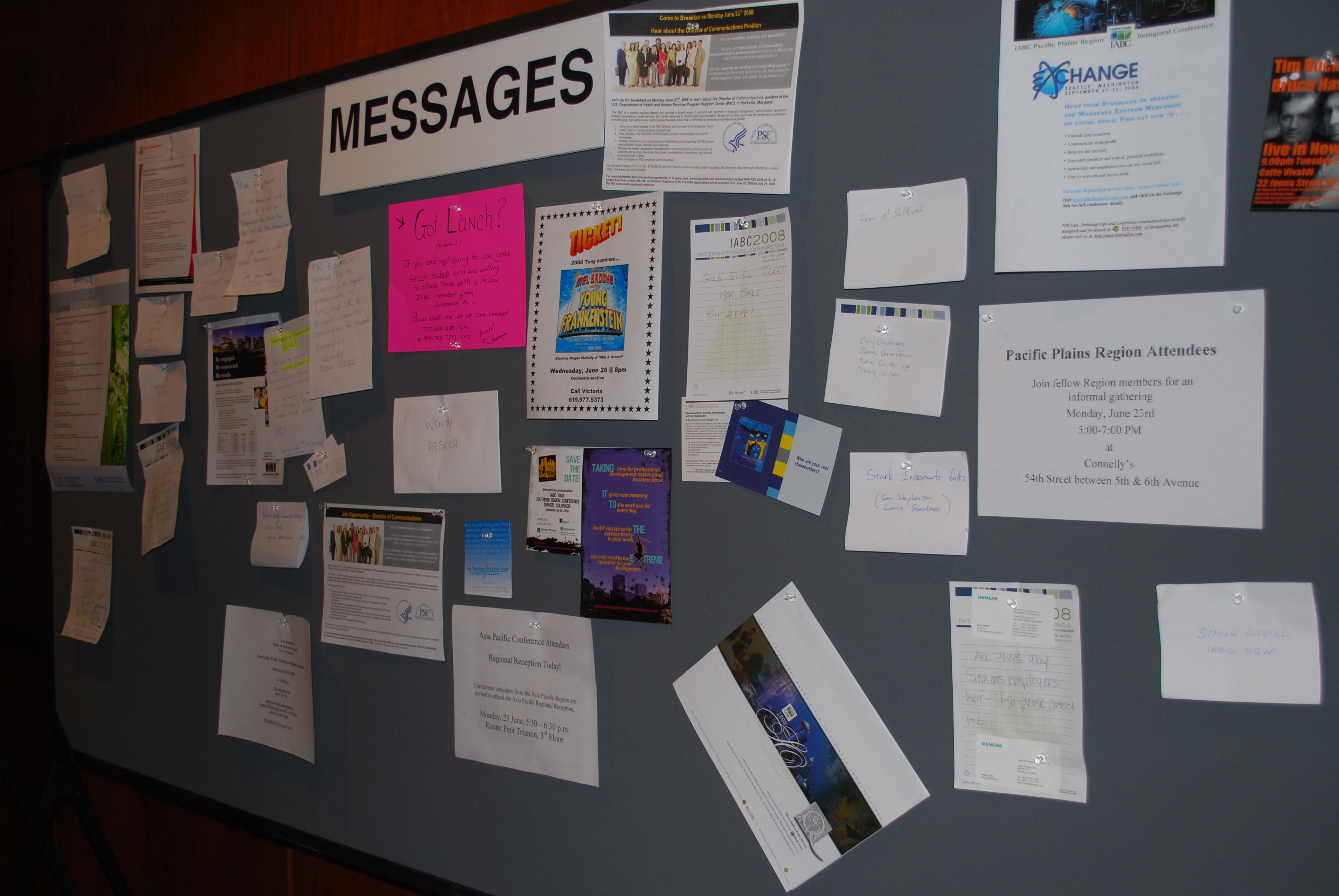
Meeting board outside the networking areaThe term ‘meat space’ may be an awful way of describing why conferences like this –where the focus is on faces, not Blackberries– matter. But it’s true. We have come here to escape the digital world and connect back in analog fashion. IABC tells me that are attendees from nearly 50 countries.

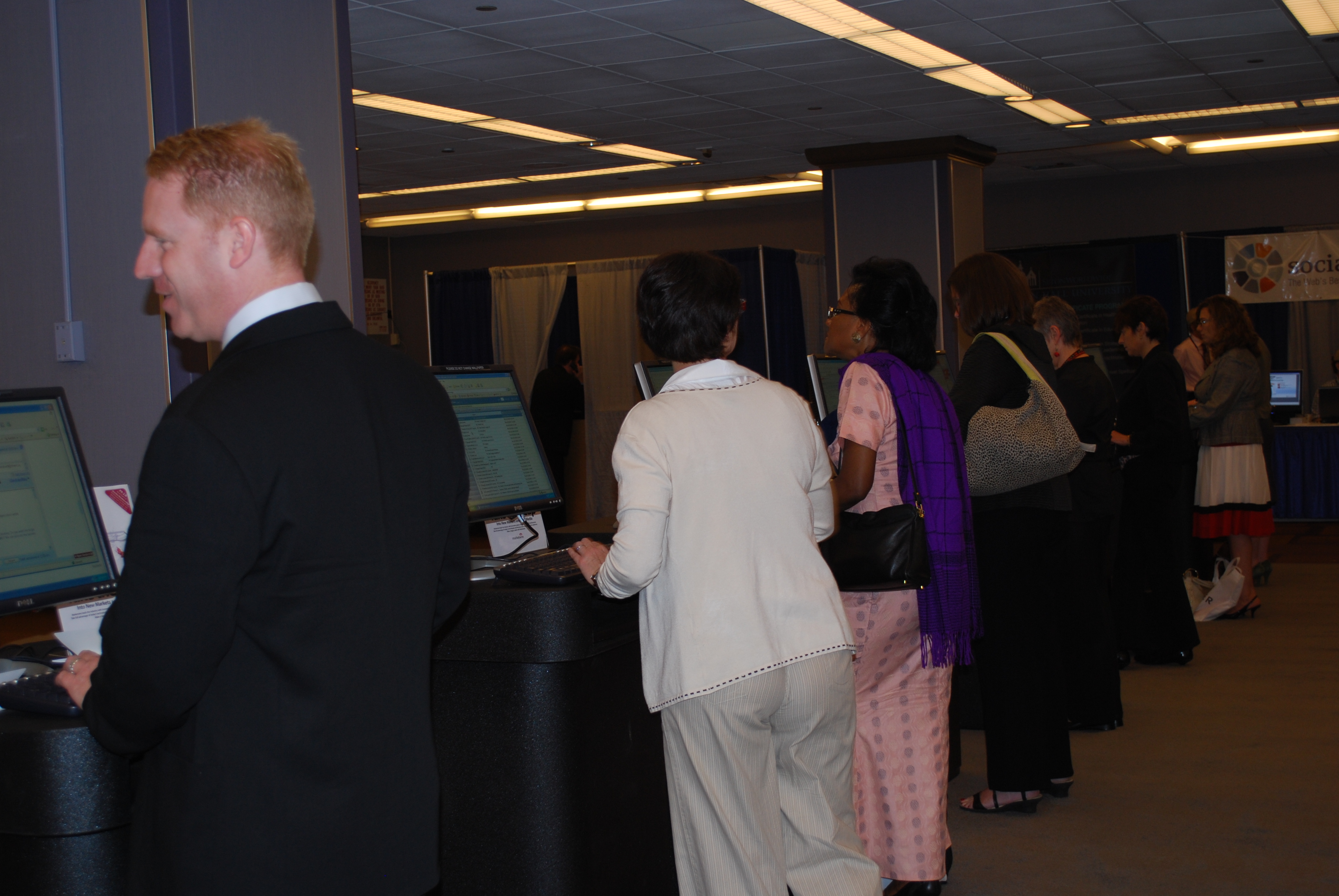
The sheer density of people, back-to-back-to-back sessions, keynotes and dinners force you to realize that sitting at a computer and sucking at an RSS feed does not compare (If you’re reading this via RSS, sorry!) Having said that, there are lines at the computer terminals. Long lines. People multi-tasking, big time. Two other prominent people are blogging the conference: Shel Holtz, and the CEO of Social Media Today, Robin Carey, whom I met for the first time. Delightful team at SMT. They aptly serve the content curation role that Steve Rubel talked about yesterday.

Marriott CEO Blog: “A cool way to tell stories”

Marriott CEO, J.W. Marriott told a shocked audience this morning that he never knew what a blog was when he started, but now finds it a way to listen to others, and communicate better with the thousands of employees and customers around 68 countries.

Marriott spoke at the opening session of the IABC International conference in New York, where he was named the 2008 Excel Award winner. Like a few CEOs today, he stumbled onto blogging thanks to his communications director, but now finds it “a cool way to tell stories.” His advice to other CEOs:

  • Make it personal
  • Stay away from out and out advertising
  • Talk about what you are passionate about

Obviously he was mildly grilled about the value of the blog. Alluding to the ROI of the blog he said it translated ino thousands of dollars in room sales. “I would recommend it to any CEO. It’s worth it,” he said.