Kill the leave behind for the long tail?

I had a very stimulating conversation with an editor today and we talked about the motivation to take everything that’s ink on paper to an online platform.

So the question I had was, do those who salivate after the long tail value of content (be assured I am a champion of this) really think that the printed product will lose its audience?

After all, as the popular argument goes, why would anyone pick up a magazine or a paper, when they could read the same content on a mobile device or on a laptop? 

My short answer to that: “experience.”

Anyone could duplicate the story, or even enhance it, for an online audience. But it’s no substitute for the print experience. Content that can be folded, torn, highlighted, photo-copied, taped to a wall, or slipped into a folder can never be substituted. Even on a digital reader.

Then there is our appetite for short-form and long-form journalism. Our brains are wired to shuffle between short content and in-depth stories; our eyes are trained to scan headlines, sidebars and  info-graphics; our bodies trigger automatic responses to seeing large bold headlines of shocking news (like this and this).

To those who say, “yes, but newspapers are filled with yesterday’s news,” my response is that sometimes, the story the day after, put together by thoughtful editors, is what we really want. Could we forget the front pages of thistory –on 09/12?

  • When that United Airlines flight splash-landed in the Hudson, were you content having followed the tweets in real time? Or did you crack open the paper the next day to see how the ‘miracle’ unfolded?
  • As of this morning, the wires and other online media updated us on the passing of Ted Kennedy -a story that all ink-on-paper publications missed for obvious reasons. Would you skip the “old news” in tomorrow’s papers, or will you dive into those broad contextual pieces, timelines, photos, eulogies?

As I told my friend, the problem we are facing is people buying into idea (urban legend?) about people’s reading habits , and partly in the fancy notion that the opposite of the (printed) leave-behind is the (digital) long-tail.

I should be the last person to say this, but digital is not a great replacement for all communication. Some times it is a really bad choice; cutting back on newspapers will be a self-fulling prophecy feeding the idea rather than responding to the notion that “no one really reads!”

Are you a Specialist or a Generalist? If not what?

When you introduce yourself and what you do, do you use the word ‘generalist’ or ‘specialist’ to describe yourself?

I use neither, because I’ve always had problems with both terms. I am not saying both are wrong, but they have not been an ideal fit. Here is my problem:

A Generalist made me come across as trying to do a bit of this and a bit of that, and not really have in-depth knowledge of both ends. Maybe I was talking to a wrong audience. Maybe I was cut off by the person asking a question –this was before the concept of a 140-character pitch! – and did not have time to qualify with some details.

A Specialist sounded fancy at that time, but did not resonate with me because it made me feel like I was capable of one thing and one thing only. From my agency life I realized that a writer who doesn’t understand design, and a designer who doesn’t appreciate the nuances of language is not a great asset. Today’s specialists are different. I’ve met writers who are deep into interactive media, and web geeks who are podcasters and closet citizen journalist.

So my question  to you is: What label best fits you –Generalist or Specialist? Or do you have a better one?

I am reminded of what Silvia Cambie, author and communicator told me when I interviewed her earlier this month. “The communicator of the future will need to be an integrator able to aggregate info and understand new cultural settings,” she said.

Social media for business conf. brings out heavyweights

Al Maag, Chief communications officer at Avnet opens the Social Media AZ conference with a keynote that has everyone’s head nodding.

He talks of how he brought a technology company to consider using .social media to communicate, by asking the wrong questions, but being persistent in asking the right people. Turns out it was an integral part of Avnet’s brand strategy. His main approach to the C-Suite : He told then, look, “the train has left the station,” and we are going this route, because guess what, the competition is going to be on this train, anyway.

Some highlights of his presentation:

  • The Avnet’s Facebook program began in Europe. It’s Avnet’s way of sharing knowledge and enhancing talent.
  • The Avnet blog was not even claled a blog when they began
  • If you don’t have guts and self-esteem, don’t be in this job. (“I’ve been called Tweeterdumb” and “blog boy”)
  • Lose the battles …win the war
  • Just bring in a consultant. (Shel Holtz plug here)
  • LinkedIn is the new Rolodex, videos are vital, Twitter is not for everyone

AvnetonDemand.com was created with no budget

Al Maag’s blog is primarily to communicate with the media; he talks of things such as Woodstock (guitars) and

The line up of speakers is like a who’s who in new media, PR, interactive.

Mike Corak and Chis Sietsem on crafting a social media plan were good. Some of this is what we know, but it reassures me to see others think this way. Especially that Measurement, that much maligned word, is not just about traffic but measuring (knowing) engagement, sentiment..

Next session Elizabeth Hannan, says welcome to the hot room (a passing reference to the air conditioning here). It’s all about building community.

Quotes for the week, ending 15 August 2009

“We’ve just had a demonstration of democracy.”

Senator Arlen Specter, after a person attending a town hall meeting shouted at him. The man was escorted out of the room, at a Harrisburg Community College.

“The Obama administration has delivered … a message of tough love. We are not sugarcoating the problems. We’re not shying away from them.”

Secretary Hillary Clinton, summing up her trip to Africa

“The Internet disrupts any industry whose core product can be reduced to ones and zeros ..it is the biggest virgin forest out there”

Jose Ferreira, founder and CEO of education startup Knewton

“Doing sustainability is fine, but being sustainable is where we want to wind up.”

Michelle Bernhart, author of “The Rules of the Game” in an upcoming edition of IABC’s Communication World magazine, interviewed by Natasha Nicholson.

“FriendFeed, in my mind, is the new RSS reader.”

Robert Quigley in Old Media New Tricks

“Macaca Day, for those of us who make our living from video on the Internet and elsewhere, is a holy day – the day that marks the birth of YouTube politics, and reminds us that citizens with cellphone cameras and a YouTube account – or at least an election.”

Dan Manatt, at Tech President, on the infamous comment by senator George Allen during the election campaign

“Google Voice “is merely symptomatic of that larger question.”

Ben Scott, public policy director of Free Press, a Washington-based consumer advocacy group in Washington, on the investigation on whether the carrier (AT&T) and handset maker (Apple) had anything to do with banning Google’s voice application from the iPhone.

“This is a decision based upon consumer experiences, child protection and our strategic investment to build up MSN Messenger.”

Geoff Sutton, GM of MSN Europe, on the decision to shut down Microsoft chat rooms in 28 countries.

//

//

//

//

Collaboration is distance agnostic. Of course you knew that!

I get a kick out of seeing how ordinary folk use simple tools of collaboration.

I do a lot of collaborative work here at the Decision Theater. This is often all about web-based tools, putting people in a room full of screens oozing with data, pulling up GIS maps with interactive features…

And then there’s this. Playing For Change. Collaboration on a whole different scale.

Proof that people of different cultures can be knitted together through music, with nothing more than a makeshift ‘recording studio’ powered by golf cart batteries.

You can’t listen to this version of Stand By Me and not be inspired. And it’s not just the words, but the sheer possibility of connecting people irrespective of distance. Enjoy!

Twinterview with Silvia Cambie today

Today will be the 5th Twitter interview in the series I have been conducting over the past few months.

This one will be interesting to IABC members, particularly, since I will be talking to the co-authopr of a just-published book, International Communications Strategy. The book has won a major award.

Silvia Cambié is a cross-cultural communicator and journalist, and advises clients on strategic communication, stakeholder relations and social media.

As the formayt goes, I will conduct the Twinterview via Tweetdeck, and live post the  Q and As here. It begins at 10 am, Pacific.

Let’s get started. Some basic housekeeping matters:

I will be using the tag #hoipolloi to make it easy for followers.

AF: @XCulture Good morning (or evening for you?) Silvia. Thanks for agreeing to this interview.

SC: @heyangelo Good evening from rainy London. You are welcome. Looking fwd to your questions

AF: @XCulture For those who don’t know you on my blog, describe who you are and what you do –you could take 2  tweets #hoipolloi

SC: @heyangelo Cross-cultural communicator , journalist. Used to cover Eastern Europe. Worked for international trade associations. #hoipolloi

SC: @heyangelo Founded London-based Chanda Communications. Advise clients on international comms, social media and the female economy.

AF: @XCulture Journalist, too? We need to pick up on that since we have so many journalism-related issues today I’m v interested in #hoipolloi

SC: @heyangelo Sure, Angelo. Any time #hoipolloi

AF: @XCulture What got you into publishing the book? Was there a  book lurking inside your head? #hoipolloi

SC: @heyangelo #hoipolloi Got the idea in Eastern Eur. I believe cross-cultural comms is essential for real economic progress and peace

AF: @XCulture #hoipolloi You have one awesome co-author. How did you find her? Tell us a bit about who she is

SC: @heyangelo #hoipolloi I met Yang-May through City Women’s Network where I served as a board member. http://bit.ly/Nf1e9

SC: @heyangelo #hoipolloi YM is a blogger and a writer. Born in Malaysia . Is the best co-author ever! So well organised… it’s almost scary.

AF: @XCulture #hoipolloi Let’s talk about the book. With the rise of globalization & offshoring what’s the new comm mindset we need to have?

SC: @heyangelo #hoipolloi Communicators need a new set of skills to be able to interpret complexity and deal with ambiguity

SC: @heyangelo #hoipolloi Communicator of the future will need to be an integrator able to aggregate info and understand new cultural settings

AF: @XCulture #hoipolloi The word ‘control’ has got a bad rap. With orgs so decentralized, and no one in control, is it a recipe for disaster?

SC: @heyangelo #hoipolloi We believe in a new approach to leadership. Integrative Thinking developed by Roger Martin of @rotmanschool

AF: @XCulture #hoipolloi Sounds a lot like integrative decision-making –something we promote -if I may shamellessly plug http://bit.ly/36l3Nv

SC: @heyangelo #hoipolloi Sure go ahead. I love a good plug! Particularly if it supports Integrative Thinking!

SC:  @heyangelo #hoipolloi Replacing control with leadership models able to integrate different cultural elements http://bit.ly/NjdOG

AF: @XCulture #hoipolloi We tend to take digital access to content for granted. What would we be shocked at to find in other countries?

SC: @heyangelo #hoipolloi The story is actually quite different! China is no. 1 in terms of on-line content creation! http://bit.ly/1Q6K6f

AF: @XCulture  #hoipolloi Most people may not have even heard of QQ.  Twice the size of FB? We are cultural frogs in the well, I suppose

AF: @XCulture #hoipolloi To return 2 journalism. You speak of new forms in your book. What are they and why should we pay attention?

SC: @heyangelo #hoipolloi Am great believer in the power of participatory journalism http://bit.ly/UmgLt http://bit.ly/30d1Y7

AF: @XCulture #hoipolloi Great post. FutuRoom? Cafes to chat with journos? Is this in the book? Maybe Spot.Us will be interested

SC: @heyangelo #hoipolloi http://bit.ly/1s2OpQ And We can’t expect people to get their info from the media any longer

AF: @XCulture #hoipolloi I’m going to do something different in this Twinterview, and bring someone else to join the conversation…

AF: @fusionview @xculture #hoipolloi Welcome Yang-May. Glad you were able to join

SC: fusionview @heyangelo #hoipolloi Exciting having YM joining us from the bus! BTW Which bus?

AF: @XCulture #hoipolloi @fusionview Now that I have both authors, I have 2 start by asking u both the story behind your Twitter handles

YM: @heyangelo #hoipolloi Fusion View like fusion food. East & West. I’m from Malaysia, now in London. Name of my blog FusionView.co.uk

SC: @heyangelo #hoipolloi It was actually YM to come up with XCulture as a name for my blog on cross-cultural comms http://bit.ly/yHuPm

AF: @XCulture @xculture #hoipolloi Fusion, cross-culture, collaboration, IABC… I can see a great thread here –great material for the CW blog

AF: @fusionview @xculture #hoipolloi Yang-May, could you talk of a great example (in the book or otherwise) on the interactive use of the web?

SC: @heyangelo @fusionview #hoipolloi Yes, I guess that’s what IABC is all about

AF: @XCulture #hoipolloi Could you tell us an example of cross-cultural use of the interactive web –from the book or elsewhere?

SC: @heyangelo #hoipolloi I love the story of the multicultural YouTube Symphony Orchestra http://bit.ly/DZZuM

AF: @XCulture #hoipolloi So… communications is like an orchestra. Does it need someone to wave the baton, however? Who might he/she be?

SC: @heyangelo #hoipolloi Someone able 2 create a connection that leads 2 sharing. Someone with high cultural sensibility

SC: @heyangelo #hopolloi Yes, it is overstated. Sharing is the name of the new game.

AF: @XCulture #hoipolloi On your blog, you address digital activism in S. America. What’s your take on how the web is empowering people?

SC: @heyangelo #hoipolloi Chile has some great examples re. digital activism. So refreshing! http://bit.ly/4gxgwD

AF: @XCulture #hoipolloi For some it might be unsettling, not refreshing. Could you explain what happened there?

SC: @heyangelo #hoipolloi I also believe that part of the role of comms is 2 unsettle people… get them thinking. Anything but the status quo

AF: @XCulture #hoipolloi Great definition! Be unsettling. Be the catalyst. Be heard 🙂

SC: @heyangelo #hoipolloi I love Be Usettling. We should put it on a T-shirt

SC: @heyangelo #hoipolloi People got 2gether online 2 boycott pharmacies in Santiago accused of collusion. Used FB and Google 2 organise it

AF: @XCulture #hoipolloi Finally, back 2 the book: $40 is  apretty steep price http://bit.ly/r6zgk  Give us 2 reasons 2 beg/borrow/steal /buy it

SC: @heyangelo #hoipolloi Helps communicators 2 function in the Flat World. Has unique case studies gained from broad network of global contacts

AF: @XCulture #hoipolloi Thanks so much for your time, Silvia (and Yang-May if you are online) Good luck on the book. I see it’s won nominated for an award!

SC: @heyangelo #hoipolloi Thanks to you, Angelo. The book has been nominated for the FT Goldman Sachs Business Book of the Year Award.

Quotes for the week, ending 08 Aug, 2009

“The narrow prism of terrorism”

John Brennan, President Obama’s new counter-terrorism chief, saying the present administration won’t be looking at allies and other nations this way anymore.

FACT: You do own your brand and brand messaging

FACT: You don’t own relationships customers have with your brand

Beth Harte, at SocialMediaToday.com on Brand Vs Brand Relationships

“Washington Post Magazine ceases its XX Files feature in Sept. Probably cause?…the essays tended to focus on negative experiences with men.”

Tweet by InVocus

“But the pleasure of turning the page! I protested. The feel of something organic, not electronic, in your hands. The crispness…”

Jessica Burnette-Lemon, on looking at the Amazon Kindle

“Scare you away yet?”

Job description for AXIS Inc., for entry-level marketing position that requires knowledge in PR, customer service, sales…

“Successful candidate will have: 1) LinkedIn, MySpace, and/or Facebook account; 2) Twitter account with consistent, frequent updates; 3) Personal blog”

Job description for Social Media Director at ADF

“It’s a big surprise to me that my blog has meant that 250m people have not been able to enter Facebook.”

A blogger names Georgy, on the reason for the denial of service attacks on popular networks Facebook and Twitter.

“Military computers off-limits to tweeting GIs.”

Headline of article about the Marine Corps banning soldiers from using military computer networks to access FAcebook, Myspace and Twitter.

Quotes for the week, ending 1 August, 2009

“One over-riding rule: do not ask how long your episodes should be. Ask yourself hows short you can make them. People have a limited time to watch/listen to content.”

Evo Terra, co-author of Podcasting for Dummies, when I interviewed him for an upcoming article and, podcast.

“It’s at the point where we almost don’t need to use press releases,”

Martin Murray, senior corporate news representative for the Public Service of New Hampshire, on using Twitter as a way to update customers on an power outage due to an ice storm

“With no correspondents allowed on the ground, the BBC, like almost all major news organisations, is forced to rely on the honesty of citizen journalists to provide details from the protests.”

BBC report on how citizen journalism is on the rise in Iran

Media reports speculated that “Bruno” suffered from the “Twitter effect…”

Reuter report on how movie studios are using Twitter, but how it can sometimes backfire. Tweets about Sacha Baron Cohen’s gay-themed comedy, Bruno, created buzz but also scared people away.

“Lifestyle Lift regrets that earlier third-party Web site content did not always properly reflect and acknowledge patient comments or indicate that the content was provided by Lifestyle Lift,”

Press Release by the the company after New York Attorney General Andrew M. Cuomo came to a settlement with cosmetic surgery firm for published fake consumer reviews on the Net.

“Hey, that’s Apple. They do what they do, and they don’t really care what the rest of us think, as long as they make cool products that we’re willing to pay for.”

Shel Holtz, commenting on the problems of how all reviews on iTunes do not show up the same in all countries. On For Immediate Release, episode 468.

Air New Zealand’s paint job can teach us something

Memo to those producing corporate training videos: Find out what might prevent a captive audience from falling asleep.

I suppose there are a dozen ways to skin this cat when it comes to making inflight announcements. Anyone who’s flown Southwest Airlines knows how a statutory script about flight safety can be given a twist, or a certain delivery to make you pay attention.

And then there’s this clothing optional approach.

Whoever thought a boring safety video would have a chance at serving a marketing function, by going viral. The best part, it’s in sync with the campaign about being up-front, and having nothing to hide.

Thanks to Yang-May Ooi,who featured this on her cross-cultural communication blog, Fusion View.

Losing sleep over keyword ranking?

I recently met Chase Granberry, the founder of Authority Labs. His company is competing in the SEO space — in a business category known as ‘rank monitoring.’

What’s that,” I asked.

It’s all about knowing how your web site ranks relevant to how people use keywords, he said.

“Competitive intelligence” in other words?

It’s also about usability, too, he reminded me. Are people finding what they need on your web site?

Competitive intelligence gathering is not something many of us do on a day-to-day basis. What I found interesting is how this kind of monitoring and optimization could be done by the rest of us –and not just the chaps in IT or a back office in Mumbai.

Granberry told me that his users range from bloggers to agencies PR types, to the web team. Why? Because people are getting more conscious about keywords, and are creating content aware of the way Google, Internet Explorer, Yahoo and Bing are indexing it.  PR and Interactive agencies are using the service to analyze the data and report back to their clients, he says.

“You mean the average PR person can actually understand this stuff?”

I took a peek at some of these reports, expecting to see a lot of geeky stuff. But they were really clean and well coded (up and down arrows to show a change in ranking against the previous day etc).

How do organizations spend on something like this in a downturn, I asked.

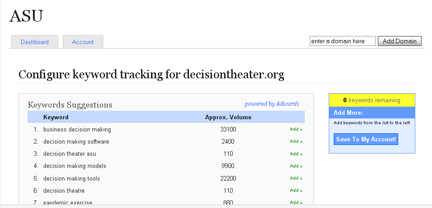
They need to think of search engine optimization as a A_Labs_ASUDTlong-term investment he said. Especially for those who seek ROI in terms of increased traffic and conversions. He mentioned ‘continued insight’ too, and it brought to mind recent cases of how lack of monitoring resulted in PR disasters such as this and this.

We increasingly hear how dangerous it can be when  PR and Comms take its eye off the ball. Competitive intelligence monitoring is like putting matchsticks between your eyelids and staying alert

There’s a free account if you want to give it a try.