Your child probably goes to school with a device in her backpack with more processing power than the rocket that took men to the moon, and this child wants to be… an astronaut?
You’ve forgotten how to log into your son’s school website to download his missed homework, but… he’s found a way to ‘jailbreak’ your cell phone?
Yes, teaching and learning is changing!
My July technology column was about tech in the classroom, which somewhat coincided with my talking to teachers in Sri Lanka about technology and STEM. Indeed, there are still those who want limited screens – parents of hi-tech execs, of all people. And those who think otherwise. Which side are you on?
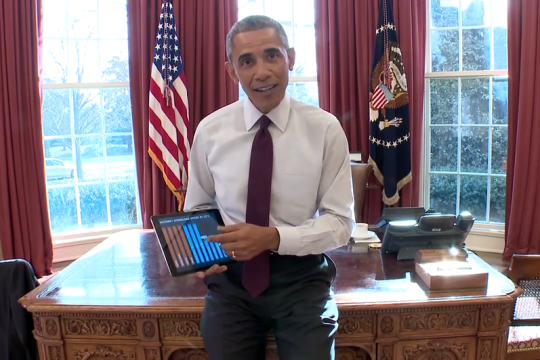
Hasn’t the White House cheering squad got the memo that the number of ‘Followers’ one has on Twitter is not a big deal anymore?
In the early days of micro-blogging, when so many so-called social media experts were bragging about hitting some magic number in Followers, this was excusable – although pathetic.
It is a fun acronym, I know. But it’s just a stand-in for a real person. Caitlyn Dewey put it best, when she said (in a Washington Post column) that “On the modern Internet, impressions of anonymity and ephemerality are, well … usually fake.”
Translated: POTUS is just that – a handle. By handlers.
Hillary Clinton will be in our news feed, whether we like it or not. She is under scrutiny by conservative newspapers such as the Wall Street Journal, and more liberal writers. That’s par for the course, of course, when one announces an application for the top job in the country – an application tendered this early in the race.
I know it’s not quite a race yet. It’s a photo-op here, a downplayed event there, and lots of conspiracy theories running behind her.
Hillary has important credentials. As the then secretary of state, she did a long ‘internship’ in world affairs, but needs to learn the simpler arts, in domestic affairs, for instance. We also want to see her being more accessible, more forthright and transparent. She once presented Russian Foreign Minister Sergey Lavrov an unusual gift – a ‘reset button.’ As the race heats up, she may need to borrow that button, since citizens need to know what the former first lady (FLOTUS, in White House speak) might do for them should she become POTUS.
I don’t know if this is an age thing, but commercial radio and TV ads irritate me. They seem to be eager to drown us in triva –not to mention groan-worthy humor. (have you seen that latest McDonald’s ad about French Fries and chicken something? If not, avoid it like the plague!)
Why is it that a British baby that’s 4th or fifth in line for a ‘crown’ that nobody quite cares about fills our channels? Or why the obsession with the other royal family over on this side of the pond? I’m not talking about the Clintons, but the Kardashians. So many important local and global events are unfolding, but we get non-stop coverage of trivia.
Here’s a glimpse of what went unreported last week.
John Kerry walked beside a Buddhist priest – when he visited Sri Lanka last week. A move that may have been a shot across the bow to China. Now there’s a geo-political story connected with that other big trans-pacific partnership. No baby names are involved, so NBC and CBS strike it off their news list.
NASA tested a 10-engine aircraft capable of vertical take-off, that could change idea of unmanned vehicles. Interesting, since Amazon seems to think the ‘delivery drones’ are actually becoming more possible.
Speaking of books, there’s the Arthur C. Clarke Science Fiction award in the UK, to a young writer, Emily St. John Mandel. It’s been described a novel about the ‘hyper-globalized’ future. Perhaps John Kerry, and Jeff Bezos are reading it right now, while ignoring the Clintons-in-waiting, and the princess of Cambridge, or whatever she is called.
For my Photoshop class last week I tried to bring home to my 6th graders the importance of scrutinizing the media they consume – whether it is a billboard, a news photo in a newspaper, an album cover, celebrity photos, a food label etc.
This is the exercise: Could you put a teacher’s face on the cover of TIME? This recent cover is of one of the twin astronauts, Scott Kelly, (whose brother, Mark is married to former Arizona congresswoman, Gabby Giffords) will be part of a one-year NASA study which I am following.
The local connection and space angle makes it a fascinating topic that will stay relevant until this time next year. The teacher in question is very supportive of this.
Every time I pick up one of his books I am amazed at what he envisioned. My favorite book, a heavy tome, titled “Greetings, carbon-based bipeds!” is chock-full of his essays. Take this statement:
“The breaching of the barrier between brain and machine is perhaps one of the greatest breakthroughs in the history of human thought.” (Page 218)
Notwithstanding my interest in robotics, I don’t agree entirely with him when he says “To put it bluntly and brutally, the machine is going to take over.” He probably envisioned when we humans would outsource our memory to the ‘machine’ we unthinkingly call the Cloud. Or when it would be quite OK to hold a conversation with Siri.
Arthur C. Clarke was blunt, and obstinate, but he was also very humble. He insisted that he did not “discover” the geostationary orbit. Why? Because he says, “Its theoretical existence was perfectly obvious to anyone…” (Page 443)
Today we have satellites conducting all manner of business, from espionage, to knitting together a much fragmented world.
Aren’t we glad he pointed out the latter possibility to us?
1983 photo of Steven Spielberg, Harrison Ford, and Arthur C Clarke. Linked to via http://nalakagunawardene.com. Photo owned by Arthur Clarke Estate
Worth reproducing here a comment he made in 1974, cited in Wikipedia.Speaking of how a young person’s life would be impacted by a computer, he said:
“He will have, in his own house, not a computer as big as this, [points to nearby computer], but at least, a console through which he can talk, through his local computer and get all the information he needs, for his everyday life, like his bank statements, hisc reservations, all the information you need in the course of living in our complex modern society, this will be in a compact form in his own house … and he will take it as much for granted as we take the telephone.”
Listen to the last question about man’s “social life”.
He didn’t foresee some of the addictions that would come with the ‘compact’ screen he anticipated.
I love the fact that the audio format has been on the upswing, even despite the explosion of screen-based communication options. Depending on who you ask, they will tell you video didn’t assassinate the radio star for various reasons. Such as
Podcasts is immensely portable, and does is perfect for multi-tasking
Podcasts capture the ‘authentic’ voice of the person or the moment being represented – no fake ‘DJ voice’ required
Podcasts have in their DNA something akin to long-form journalism – deep dives into content, rather than skimming a topic
Podcasts lend themselves to drama, even while being authentic. The nearest thing to the documentary.
Exactly 10 years ago this week, Steve Jobs took to the stage –a technique he would go on to perfect — tolaunch the iPod Shuffle.
That was Jan 11th, 2005.
I often do ‘anniversary’ events in my class, to get young people to think about where we are now, in relation to where we and the technologies we take for granted were once at. After all, this is a Computer and Technology Lab, and I don’t want to get into the trap of always featuring today’s shiny new object, or the hottest new parlor trick in digital media. We often need context, and it tends to fly by when we refresh our feeds, doesn’t it?
Back to Jobs. His presentation trick was to use insanely simple devices. Well rehearsed, and well timed but simple. Which made him very different from his tech contemporaries, who revel in Silicon Valley argot. (Yes, I listen to ‘This Week in Tech, to catch up with the other kind of tech-talk!)
Listen to how he works up the crowd, and keeps them hanging on for that characteristic”One more thing.” Fast forward to 1:35, and see what I mean.
He uses words like ‘noodled’ (He “noodled on it” not “researched it”)
He uses unexpected pauses, and slows down and speeds up suddenly
He uses home-spun images – comparing the iPod Shuffle to a pack of gum, and contrasting it with four quarters
Notice how he also stays away from big words, using words like “easy”, “simple,” “thing,” etc. (And yet, peppering his presentation with keywords!)
Even if there was no YouTube, I bet we would still listen to it.
Audio is a powerful medium. Overlooked, but extremely powerful.
While video gets all the attention, audio programs –basically podcasts — have been steadily growing recently. This week, I began the new semester by upping the ante for 5th and 6th grade students, showing them how to become producers of content. To start off, I got them to think of themselves as owning their own radio show. A news show, a sports show, or a show about events in the community.
How do they plan and create content? What are the elements of a good show? Good information? A nice pace? A strong personality? Music? Sound Effects?
I plan to use some of my prior radio experience to get students to create their ‘shows.’
The software we will be using is Audacity, which is really powerful software. All computers in the Computer and Technology Lab are now loaded with Audacity, and we just got started understanding how tracks and buttons work, and how to export an editable audio file, to work on it as we move along.
I’m sure you’re wondering: how could digital natives get so excited about ‘old media’? You would be surprised!
‘Salt River Radio’ is the tip of the spear of something bigger I have in mind. I am also looking for input from anyone with radio experience, who would like to be a part of this project, either as a guest instructor, or otherwise.
 You’ve forgotten how to log into your son’s school website to download his missed homework, but… he’s found a way to ‘jailbreak’ your cell phone?
 So it befuddles me why
  Hillary Clinton will be in our news feed, whether we like it or not. She is under scrutiny by conservative newspapers such as the Wall Street Journal, and more liberal writers. That’s par for the course, of course, when one announces an application for the top job in the country – an application tendered this early in the race.
 Here’s a glimpse of what went unreported last week.
 This is the exercise: Could you put a teacher’s face on the cover of TIME? This recent cover is of one of the twin astronauts, Scott Kelly, (whose brother, Mark is married to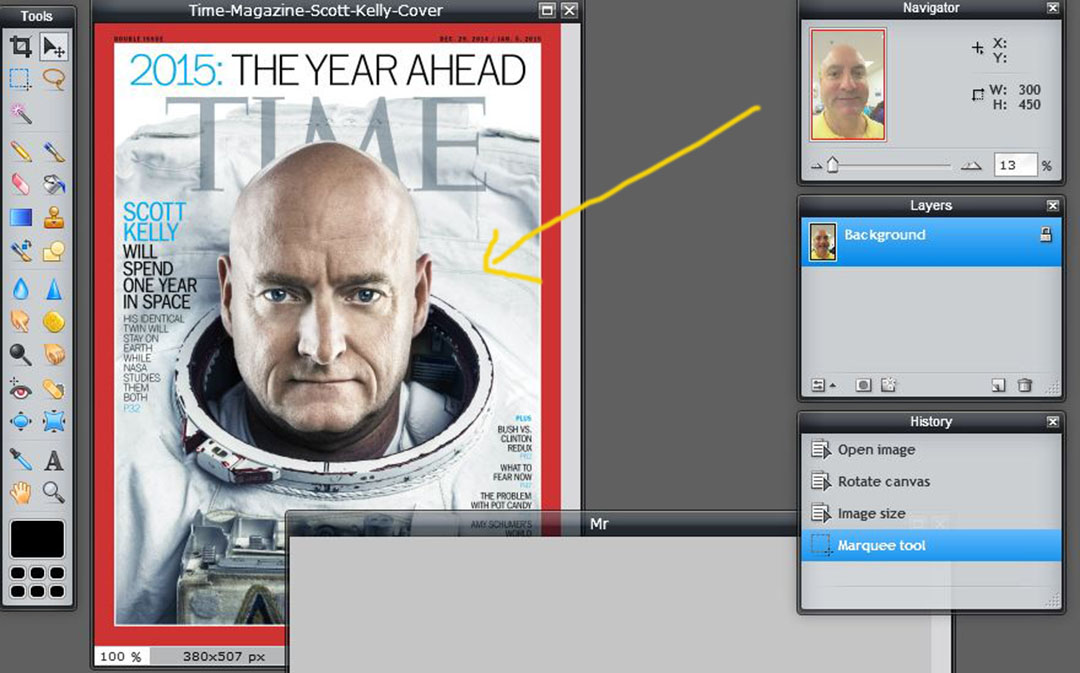
 It’s been 7 years since


 My recent favorites are
 Hoipolloireport