‘Customers Not Cargo’ act thanks to United Airlines

You’ve heard of ‘cattle class‘ – the seating area most of us are herded into?

After last week’s horrible incident in which a doctor was dragged, bloodied and asked to get off a United Airlines flight, congresswoman Jan Schakowsky plans to introduce legislation “that would end the practice of involuntarily ‘bumping’ passengers from oversold aircrafts once and for all.” Likewise in the senate, Chris Van Hollen is introducing a similar ‘Customers Not Cargo’ bill.

The gist of it is that an airline which oversells a flight for business reasons has to come up with a business solution (not a law-enforcement one) to make sure the flight is emptied of the excess passengers who paid for that spot, anyway.

Now I’m not sure we need to have laws to ensure businesses treat customers with respect. But if you’re like me having been adequately bruised, and given the cattle prod, you’d agree they had this coming. Especially the folks who wax about the ‘friendly skies.’ (The Leo Burnett-inspired slogan dates back to 1965, and was brought back in 2013.)

Note the ad on the right. About embarking at Chicago. As the 1960s headline promised, the airline would later ‘catch’ Dr. Dao not far from the gate at Chicago O’Hare. The body copy goes further to suggest being friendly is catching. Hmmm)

Bonus Reading: Read the business evolved between United’s and Continental Airlines merger Wired Magazine

Surprising things happen when Digital Natives get their hands on old-school cameras

Here’s a batch of pictures taken by my students yesterday. Cameras may seem ‘old school’ but there’s always an interest in the basics of aperture, lighting, and perspective. In my Ed-Tech class, 5th and 6th graders can’t seem to have enough of this, as the results show.

An accidental homage to Silicon Valley?


Digital City?

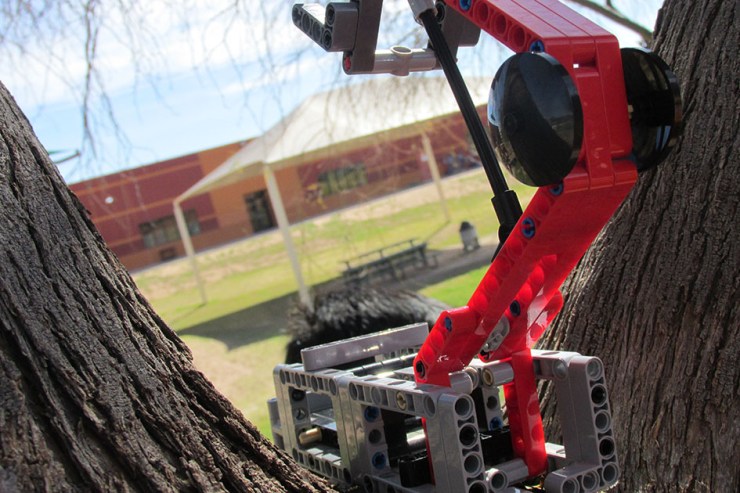
Two very different perspectives of a robotic arm

There are much more! Who knows what ideas they will come back with after Spring Break?

Typos in educashen tweets mask bigger issues

I’m sure Dan Quayle, the vice president who got famous for (mis)spelling ‘potatoe must feel vindicated, now that the new US Education secretary had a tweet sent out to correct a typo in a previous tweet. Unfortunately the apology contained this gem:

“Post updated – our deepest apologizes for the earlier typo.”

Now I’m not going to join the bandwagon and frame it as the end times in education. We all make mistakes. Even one like this, as her staff did. Mistakes happen when we blurt things out without much thought.

However, there are some lessons here worth repeating about using a social media handle to go public:

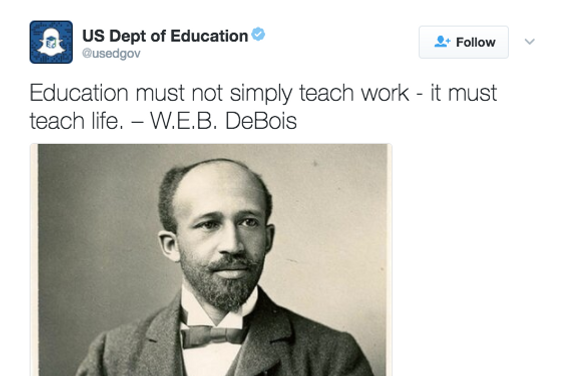
What is the purpose? Micro-blogging, or trying to communicate in 140 characters requires a different discipline (from say shouting, or firing off a press release). One needs to craft the message to the channel and its audience. What was the point of the Education secretary’s Twitter handle being used to publish a quote from the essayist and author? Just to show that the department is clued up on sociology and civil rights? Come on! Does the Dalai Lama need to quote Gandhi to prove himself?

Whose ‘voice’ is it? A department or an organization comprises many divisions. But the top dog sets the tone of voice. A random quote is quite an anemic way to communicate, since it basically reflects no one. Is the channel a news feed, or for insight into the workings of the organization? Is it a place to link to important assets, or ideas? It can’t be all things to all people. Define your brand voice!

Who is doing it for you? Sure someone else may manage the communication, but you oversee it. Or, as some companies like Dell do it, set up multiple Twitter accounts for different constituents. This was something we discussed in 2009 and 2010.

Perhaps government agencies shood should go back to Twitter skhool school. Or at laest least take communication 101.

Shouldn’t we ignore the tweets of the second social media president?

You may have forgotten this. In April 2013, a hacker broke into the Twitter account of the  Associated Press and sent out a tweet about “explosions at the White House.”

Reuters noted then that the Twitter ‘report’ caused the S&P 500 index to fall, wiping out  $136.5 billion of its value.

We didn’t call it fake news then – just a bad prank. It demonstrated the power of ‘news’ that the world was beginning to consume in 140 characters or fewer.

Today, the ‘hacks’ and pranks seem to come from both outside (fake news perpetrators) and within establishments. They’re still using short-form journalism, which is easily spread by headline-hungry readers.

Trump tweets (a busy search term, for sure) have become worthy of analysis at the highest levels, and not just in the media. As Mother Jones writer Kevin Drum notes, these tweets “…are not for you. They are not for the press. They are not for Congress. They are for his fans.”

Meaning, I suppose, ignore them.

One group not ignoring them, and busily documenting them, must be journalism students. They must be relishing the fact that somewhere in this is ‘Twitter torture’ is a real-time study leading to a Masters dissertation. There have been similar dissertations on the rhetorical analysis of campaign tweets. But what began on 20th January is a treasure chest.

Photoshopping the White House

No, this is not another fake news alert. It’s a teaching moment, however.

The subject matter is appropriate. While teaching Photoshop and image manipulation, it’s a perfect time to be teaching students how to become critical consumers of information often seen through imagery. And spot when someone has been tinkering with the truth.

student-4

The class begins with the ‘conspiracy’ around the 2003 Space Shuttle explosion, by looking closely at the Photoshopped images. We also look at doctored images of public figures.

When they get to the computers, their challenge is to add to, or ‘enhance’ fountains on the White House lawn.

Here’s are a couple of examples. student-3

Take a guess. How many fountains are really there on the North lawn?

Good riddance to election noise pollution!

When the party next door becomes too noisy, people sometimes call the cops. But there was very little we could do about the ‘Party’ noise machines we’ve been enduring for the past year or more.

Finally we can reclaim some peace, as the two-party cacophony comes to an end today. (I know what you’re thinking: Yeah right!)


If it was true that Trump’s Twitter account had been wrestled away from him, it won’t be long when he gets back on the air. But at least the media might have other matters to report on. Here’s what I’m dying not to hear about:

  • The word ‘surrogates‘ and any reference to people who echo the party line.
  • Pundits. Those folks to ‘weigh in’ on every gesture or turn of phrase.
  • The phrase ‘social media lit up with…” as a preamble to a political story with no substance.
  • Sloppy, Madison Avenue-like phrases such as ‘Draining the Swamp’ and slogans such as ‘Feeling the Bern.’

Not that vacuous campaign slogans are anything new. In 1944, Thomas Dewey’s slogan was (get ready for this) “Dewey or Die.” And there was the 1980’s slogan “Let’s Make America Great Again” which was recycled (or was it ‘plagiarized’?) this season.

Young web ‘designers’ in 5th and 6th Grade


website2
It’s exciting to be able to teach kids what it means to ‘design’ a web site, and see what they come up with.

I’m not talking about the coding part of the site, but the navigation, layout and content. So much has changed since I worked  on web sites and web content ten years ago. Especially with site builders at Wix and Weebly, or even GoDaddy.

So before website3I introduce students to online site builders, I let them play with design components, using PowerPoint. Yes, PowerPoint!

It’s a quick way to build navigation tabs, work on color and fonts, and eventually embed hyperlinks and video.

Here is some of the work of 6th grade, building a site for Space Day, the school event we just concluded.

Likewise the 5th grade is working on a website for Freedom Tower, a project they began in September. website4

Later they would be using Photoshop for image manipulation, and create and edit shapes and buttons etc. Much later, when we move into audio recordings, and podcasts, I may have them return to their web sites and add voice files using Audacity.

But for now they experiment with bevels, shadows, and other effects that enable navigation.

UPDATED:

spaceday2Design is not just for 5th and 6th Grade. To address the Arizona CCRS Standard, S1.C4.PO 1: “Use digital creativity tools to create original works” I let 2nd grade students work with shapes, colors and also contrast and perspective.

Here is one student’s poster for the same event, using Microsoft Word.


What do we tell our children (about dirty politics)?

Did you feel like you needed to take a shower after watching  the recent debates? Or do you feel like you don’t want to mention the word ‘election’ at the dinner table for fear of dredging up unsavory topics?

‘Adults behaving badly’ might sum up what we have been witnessing these past few months.

I’ve tried to explain to young people who ask, that:

  • This is not how most grown-ups behave – you know, hurling around ugly epithets; using vulgarities, slurs…
  • Political campaigns are unfortunate war games people play, hence ‘battleground’ states, attack strategies.
  • In the 4-year gaps between the these ugly wars, try to not do as they do.
  • The phrase ‘anyone can become president’ is something we are no longer proud of.
  • Though Gallup holds that 75% of Americans identify with a Christian religion (Pew Research says 70.6%) there is nothing very Christian about this process

Aren’t you waiting for this spectacle to be over?

Your ‘rights’ aren’t much under Twitter’s Terms of Service

I’m amused at what Twitter packs under ‘Your Rights;’ in its Terms of Service.

“By submitting, posting or displaying Content on or through the Services, you grant us a worldwide, non-exclusive, royalty-free license (with the right to sublicense) to use, copy, reproduce, process, adapt, modify, publish, transmit, display and distribute such Content in any and all media or distribution methods (now known or later developed).”

In other words, it says, soon after it says “You retain your rights to any Content you submit, post or display…” etc, it lets you know that you have no control over what it does with any content you tweeted, whether it be pictures, ideas of comments.

But hey, when one uses a free communication platform, one doesn’t get it for free. As we remind young people, you pay for the ‘free’ service in one way or another.

Let’s just rename Terms of Service, ”Cost of Service.”