So many Super Bowl ads, so little attention to go around. I’ve always been saying these ads are a total waste of time. Do you really care if the Clysedales didn’t appear in a spot? (Apparently we do. They polled that question -and created a Wikipedia entry for them. Really!)
So, speaking of polling, I have to say that the $130 million Census campaign –never mind the cost of making the Bowl ad– is worth a second look. Especially with the cost of running the ad being in the neighborhood of $2.5 million.
“We’re advertising again,” the Census chaps say, observing what we all know that the Bowl is “rare, in that viewers are just as tuned in to see the commercials as the program itself.”
And yes, there’s the media-relations effect: Run the ad, get editorial comment. The famous carrot that says viewers will rush online once they watch the ad, because it that’s how TV –practically on life-support, tethered to the Net –works today.
But after they dispense with the popular wisdom about buzz and multiplier effects (perhaps after so many meetings with its agency, DDB) they note in true Census-boys style that “If just one percent of the folks watching the Super Bowl had their minds changed to mail back a census form they would have otherwise ignored, it helps save the taxpayers between $25-30 million in expensive follow up costs to collect these forms later.”
???
Translation: Watch ads, adjust your attitude toward being asked personal questions, save the country a boatload of cash, help us pay our agency.
I get that, Department of Census. No need to repeat this point about 3 times in your blog and press releases.
Yes, I mentioned a blog. This is where this campaign gets interesting because the obscenely expensive ad is supported with richer slices of content, some of which is embedded in social media channels. I like the fact that the Director of the Census is blogging, that there’s a Road Tour Blog and lots of space devoted to answering the questions people ask that make of break a census. The Flash site may be a tad too addy, but it documents stories, a la Story Corps, of ordinary people.  The YouTube channel has plenty of video outtakes. The Flickr site has snapshots of an America few of us see every day. This one on left is supposedly at a Lutheran Church in Richmond, California. Thai dancers! The 5,000 fans on Facebook must mean something. and there’s Twitter just in case you miss all other channels.
So with all of this content so well thought out, is the cost of a Super Bowl ad really worth it? I liked the ad, but the greatest ad is not worth being tossed into a space filled with products and services that only seem to lust for eyeballs and water-cooler talk.
There are plenty of other ways to get buzzy, even if that was the objective. As Erik Qualman observes, why not use Facebook and Twitter to GET people to answer those darned 10 simple census questions, and not be entangled in “a $340 million boondoggle“? Because that not feasible, why not use social media to incentivize people to fill out their forms. If the media-as-a-repeater argument is important, why not let 300 million people start something that the media will talk about. (Rather than feed this controversy.)
Why not start with those 2,035 followers on Twitter!
As the character in the ad says at the end (somewhat perplexed) “Absolutely!”
 “People always clap for the wrong things.”
 “It’s too early to tell if this round of Facebook changes will create a backlash, but at the time of this writing there were almost 3700 mostly negative comments on the company’s blog post detailing the new homepage design.”
 Armed with a much-recommended ZoomH4N (that tends to look a friendly as a Taser, and upset a few TSA folk in airports), I’ve started on a series of podcasts for
  Once again I’m working on a story about how journalism is getting bolder in its experimentation with new media. Not just looking for new ways to distribute content, but for creative ways to provide us with richer context around stories.
 “Was he a talk-show host masquerading as a politician? Or a politician masquerading as a talk-show host?”
 It had nothing to do with these two familiar faces. Most of the 400 + attendees at the
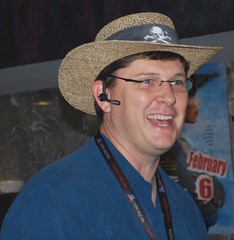
  In between working the floors wearing that funny hat, I sat in on some great sessions. The panel on Building Brand Evangelists with Social Media, moderated by Kevin Gawthrope (@gawthrok), was very enlightening.
 SMAZ also turns out to be a great way to connect with the people we only meet virtually here in the Phoenix area (I met many of our readers from
  It’s at the MADCAP Theater.
 Hoipolloireport