Podcast on E-waste and LEDs

I bet, among all the problems you think we are dealing with,  ‘e-waste’ is not on your radar.

It often sounds a lot like the the industrial effluent problem that we keep hearing about.  But e-waste is a lot more than that, and has a bearing on economic and security issues as well. Some startling stats: Between 2005 and 2006, the total volume of waste hitting municipal landfills increased by 1.2 percent. Ewaste however increased by 8.6%!

On last evening’s radio show, we had to interesting guests.

Jeffery Rassas, began YouChange.com to do something about this. But there’s an interesting business model behind it, where both people and planet benefit.

Our second guest was Daniel Henderson, Founder and CEO, Relumination. His company retrofits lighting features in organizations, small and large. But it’s more than the light bulb that we talked about.

Enjoy the podcast!

Download the podcast here.

Or listen to it here.

Is ‘logistics’ campaign by UPS a bit too soft?

I’ve been following the We [Heart] Logistics campaign for UPS since it launched last month.

On the face of it, the tagline seemed a bit too mushy for my liking, considering that logistics in its true sense is a lot more than getting a shipment from point A to point B. (Granted that’s perhaps the brief, to soften the mathematical features of it all!).

Not many people knew that logistics has been the heart of what UPS had been doing for years. There’s a sizable part of a chapter on this in The World Is Flat, where Tom Friedman talks of ‘insourcing’ –how UPS manages hubs for companies such as Toshiba. Computer service hubs, mind you, not shipment distribution hubs. All this is tied to sophisticated logistical feats of its supply chain –that most of us see as just trucks.

So as I began monitoring the news of the interception of package bombs from Yemen on an UPS plane, I realized that UPS is missing a huge opportunity here. Very little related to its ‘logistics’ shows up in the feeds on social media. or Google, Yahoo and Bing which are nourished by social channels.

I wondered what’s taking Ogilvy & Mather Worldwide so long to update the campaign to tell us, for instance how UPS intercepts bad shipments, how the technology and human intelligence works in synchrony. Enough of people dancing in the streets with heart-shaped icons. Tell me UPS, why logistics is more than bar codes, and why our shipments will be safe. Why business is better off because of your vast network of 96,000 vehicles, 268 planes and bicycles.

http://www.youtube.com/watch?v=s79MWIcITuc

Are magazines this desperate in tablet era?

I had meant to publish this last week. The topic been on my mind as the print vs digital tension grows every day.

Every time I travel I do an unscientific check of the readers on the plane. I always find that newspapers and magazines beat digital platforms. Twice I’ve sat next to someone with a digital device – a Kindle and an iPad — and one of them showed me how the magazine reading experience with the ads, photos and all was awesome. The features, too!

This kerfuffle over GQ’s photo spread seems to suggest something I typically refuse to believe –magazine junkie that I am –that magazines will try anything to stay alive.

The photos that have angered many, are part of a story on Glee, the TV show. Why? They a dangerously seem to promote pedophilia. The Parent’s Television Council (PTC) has come out strongly against the issue.

Are magazines that desperate? Or is being borderline something, anything the only way to stay relevant? This is not the stuff of controversial magazine covers, a common technique since George Lois’ time, and before.

Maybe some magazines are engaging this kind of  risky business as they find their footing in the myriad of digital platforms available. Two clues as to where this is headed:

  • New Niches: See this interview by  Tom Wallace, the Conde Nast editorial director. He talks about using digital to reach audiences that magazines have been unable to reach. Maybe next year this time my in-flight survey will have different results…
  • Rich Platforms: Apple may be offering struggling pubs a lifeline with their  ‘rich-media wrappers for e-books and e-magazines.’ The iPad is obviously a precursor to the new home of –and reading experience –for magazines.

So indeed, magazines need not be so desperate. For now, some of them are just borderline …obnoxious.

Social media driving you to distraction?

The jury is still out whether social media is making us more distracted or not. I’ve met many people who claim that the best way to ‘work’ (and it’s within quotes for a reason) is to turn off the wi-fi and stop mult-tasking.

Like that’s easy!

But forget external communication for a moment. Could socially interactive apps make us more productive when we collaborate? I could give you five reasons why (and a few good books to read on the subject). But for now, here’s a presentation my colleagues at GreenNurture just posted to SlideShare.

I would use it for any ice-breaker, or at the start of a discussion in an organization!

Is Social Media Distracting Your Employees?

Podcast on Green Teams

We had a jam-packed radio show on Green Teams this Wednesday.

If last week was all about the external aspects of greening an organizations -buildings and facilities management– this week was all about how health care organizations build green teams. The best practices, and the learning moments.

  • Colleen Cusick of Johns Hopkins Health System talked about the sub-groups in the team that take leadership in many sectors of a health care system.
  • Joan Plisko talked about the corporate culture that drives behavior, and the need to have everybody on the same page.

Here is a link to the podcast: http://bit.ly/your3BL13

Barrier for social collaboration: integration not motivation

I’m attending a webinar right now on ‘Leveraging Social Software for Increased Employee Engagement and Performance’ with Michael Fausette and Steve Paul.

Interesting slide here, earlier on, based on attendee poll.

The biggest barrier to collaboration appears to be:

NOT lack of collaborative tools

BUT: lack of integration with other systems, and that some in the organization won’t use the tools provided

The product being featured is Spaces, an enterprise platform for collaboration from Moxie.

Perfect timing for a discussion today on our radio show, at www.your3bl.com, where we are taking about Green Teams –Part II of our series. The typical tools teams have always been comfortable with are IM and email, while the more social tools such as Wikis and Twitter or even Sharepoint, pose too steep a learning curve to team members.

I’m going to ask our listeners to take a quick poll during the show to tell us what type of tools they are using today, and what they might consider for their team.

If you care to listen in, here is a link to the live stream: http://bit.ly/Your3BL
The show is at 7.00 pm (Pacific)

  • Ping us at @your3bl
  • Email us at contact@your3bl.com
  • Call us, toll free at 1866.536.1100

When attack ads have a sense of humor, brands aren’t laughing

The moment you see this website you want to have a good gaffaw.

It’s a cross between The Onion, and the fake BP Global PR Twitter handle.

But it highlights the seriousness of social media monitoring, and why you can’t be asleep at the wheel.

On Monday NPR ran a story about Ben Quayle, and how his ‘dirty’* Google juice was pushing down search results to the positive things his campaign wanted to emphasize. Problems like that won’t get buried easily.

Jon Kaufman of Zog Media was quoted as saying this industry is dependent on who controls the message.

Really? Control, or Manage?

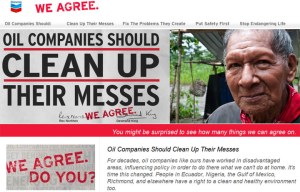
Recall how BP faced a logo attack as well. How do you stop that? Or take a look at this Press Release. It’s Chevron’s statement on….

Just kidding!

Try controlling that!

Your audience will forget your bullet points –just stick to one

I’ve been wrestling with how much information is just enough when presenting, and how much is too much. Over-communicating, like over-sharing, is a present-day malady, influenced by our penchant to provide too much details even to our close networks.

In business presentations and training sessions, some speakers have this tendency to add so many sidebars to the main thing that you often catch them saying “now where was I before I went off on that tangent..?”

Bullet points are one solution when one is prone to over-communicate. Short sentences. Rich metaphors. But even bullet points could be overdone. I have caught myself veering off the ledge hitting the bullet point icon too hard, when I should have hit the delete key instead.

So instead of saying this

  • I end up saying
  • things like this
  • hoping the idea
  • will stand out!
  • Wrong!

So here’s a revolutionary idea. When you have five  things to say, don’t, let four drop to the cutting floor. No one will miss them, I promise.

As in this simple video for Jet Blue, you could communicate one idea well.

Entrepreneurship isn’t a formula: 3 lessons from The Social Network

As I was visiting the Cambridge area in Boston, ten days ago, where’s The Social Network was set, a Harvard grad friend who hadn’t still seen it mentioned that the movie was sold out that evening: Harvard students had apparently bought up all the tickets!

It made me reflect on what such a traditional setting, steeped in centuries-old tradition and architecture, had played in bringing about the huge shift in social networking as we know it today.

The simplistic answer is in David Kirkpatrick’s book and in the movie version: Mark Zuckerberg, he suggests was sticking his finger at the authorities who had been stalling on a version of a college network comprising faces of students and their contact information.

Less than a month after Mark Zuckerberg launched the early version of his Facebook (then he called it The Facebook), Harvard authorities were still scrambling. They had had their no-frills ‘facebook’ online since 1996, but it was nothing more than a contact list. Kevin S. Davis, then Dir. of Residential Computing  noted that they were working on their new faceboook.

“We’ve been in touch with the Undergraduate Council, and this is a very high priority for the College. We have every intention of completing the facebook by the end of the spring semester.”

But the world was not going to wait a few months for the perfect online social application.

Zuckerberg quickly learned –or perhaps was smart enough to decode human behavior — that people were ready to make a big leap into social sharing. Digital generations had prepared the ground for an experience of social trust, notwithstanding so many privacy issues.

In The Social Network (Mark’s story set within a boring board investigation that’s probably highly dramatized) the people in charge at Harvard, including those in IT, are ticked off. This guy doesn’t conform! He’s hacking tradition!

Isn’t this very familiar? Every organization welcomes a new hire by some sort of on-boarding employee experience, just to ensure  some conformity. There are traditions to uphold. Mission statements to memorize. Then you are asked to go forth and be creative –within the boundaries, of course! Entrepreneurs don’t work that way, it appears.

I was immediately struck by how Zuckerberg’s story is a parable for entrepreneurship. On our radio show, we talk to a lot of these kinds of people; the common thread seems to be the fact that they have dared step out of the boundary that others drew for them.

Having said that, these are the three lessons I derived from the movie about Facebook.

1. Cultivate a huge appetite for empathizing with  what people need. We set up a lot of feedback mechanisms that deliver great insights into what people want to tell us But what about something they don’t articulate? In one moment in the movie, when Mark’s friend asks him if he knows if a girl is ‘available’ or not, he retorts something to the effect of ‘people don’t go about with a sign saying they are single.’ he then rushes back to his laptop and codes Facebook to include that feature, and pretty much says it is now ready for launch!

2. Be comfortable with making mistakes. There is no perfect solution. Mark tells his friend that  nothing is ever complete. In real life he was reported to have said (of Facemash, his web site that let students rate others on their ‘hotness’), “I understood that some parts were still a little sketchy.” It’s easy to scoff at this. He probably knew that there would be many iterations before his idea really took off, but (unlike the Harvard authorities) he was not waiting for all the chips to fall into place. His mistake got him into big trouble, but paved the way for a better idea!

3. Intellectual capital beats money. There is a video of an interview about the shoe-string startup, where Zuckerberg reveals that he had run the site for just $85 a month, renting computers for the first three months. In the movie, and in interviews with the student paper he shows disinterest in the money he would make through advertising. His co-founder, Eduardo Saverin has said this: “Intellectual capital, and not just monetary capital, will spawn the next great product or idea.”

The book makes another point, almost in passing. The Facebook was launched at a crucial moment in the life of students at Harvard: they were registering for classes that week, and Zuckerberg knew that many signed up for classes based on knowing who else was in that class. The Facebook provided that insight, just as today’s version of social networks provide those key insights that make them so valuable.

The authorities had the data. The entrepreneur had the insight. That’s what made his creation priceless.

Crowd-sourcing is fine, until you bump into control freaks


I ran into a great post on Crowd-sourcing,by Sid Roy, at an ad agency blog, PO Box. I was very impressed because this is the kind of topic that agency types who –at least the traditional ones — used to be very suspicious of: outsiders invading their turf.

The gist of the post is that is that co-creation, collaboration and open sourcing are here. And that marketing models that worked fabulously well in a world of scarcity would be ‘severely challenged to work in a world of abundance.’

Challenged is an understatement, isn’t it, Sid?

(You probably wanted to say ‘crushed!’)

I pointed out that while it’s taken awhile for crowd sourcing to catch on (Surowiecki’s book on The Wisdom of The Crowds, notwithstanding). There might be three reasons for this:

1. The ‘NIH’ syndrome. The team or department is often threatened by ideas that are ‘Not Invented Here’

2. Intellectual Property lawyers. Very recently Boeing and Apple rejected ideas from outsiders because they have been advised to not solicit or welcome ideas form people who might later sue them if the idea (or some flavour of it) is used.

3. Crowd-sourcing is somewhat anarchic. It’s not easy to manage the crowd in the traditional sense, since they don’t have roles, titles, proper compensation structures etc.

I can see why an ad/marcom agency might be reluctant to solicit and execute a campaign that came from a ‘bazaar’

Or why a school might not want to publish a text book based on knowledge sourced via Wiki platform

Those who control the distribution, creative and knowledge portals, and wear these hats aren’t ready to let the crowds run the show.

Full Disclosure: I used to work for Phoenix Ogilvy and Mather, publishers of the blog