Tablets, digital media coming to a school near you

I have been covering the intersection of technology and education recently, and have interviewed some amazing people at the forefront of the changing classroom.

One of them was Hans Aagard, senior technologist at Purdue University, Indiana. I was intrigued by that university’s approach –plunging in with a social networking application called Hot Seat. It is being used not just on campus, but in the classroom, while the lecture is in progress.

But yes, we are running into mixed signals.

  • While some teachers get their students to create content for topics that have been poorly covered or badly written in Wikipedia, many schools ban on students using Wikipedia.
  • A 2010 survey found that 62.7 percent of US undergraduates surveyed say they owned an Internet-capable handheld device, but many universities have signs posted outside lecture halls about turning off cell phones and electronic devices.
  • Faculty worry that too many screens in class could be distracting to the student and to others, while some high schools have made tablets and laptops integral to the learning experience.

More on this soon. My article was just published in a Sept-Oct issue of Communication World magazine.

So it was a pleasant surprise to see the subject “What Will School Look Like in 10 Years?” taken up in the New York Times  last week. I was particularly interested in the comment by David Silvernail, dir. at the Center for Education Policy, Applied Research and Education. He would rather schools invest in small amounts of technology …to teach students process skills, not just plunking shiny objects in their backpack and expecting them to automatically become smarter. Is he swimming upstream?

I have to admit I have mixed feelings on this.

I teach a robotics class in elementary school. For the past few classes I have been driving  home the importance of research. Finding solutions to problems they never knew existed.  I send them off to encyclopedias, dictionaries and other print material -on purpose. I could easily get them to log on to computers and search –there are more than 20 PCs in the room! But that would be too easy. I don’t want to hold up a think-outside-the-box mantra for problem solving and stick them in front of a… box!

Time to teach ‘media literacy’ to kids

I have two rules in the about TV for my daughter. (1) No watching TV from Monday through Thursday. (2) No turning to watch commercials when someone else is watching a program.

I’ve imposed rule #2 in spite of –perhaps because of– the fact that I once worked in advertising. I appreciate the fact that it is the commercial material that pays for the content in the media. But since Media Buying and its cousin Media Planning  is quite a science, with a wicked –often desperate — streak parents need to be vigilant. It is not accidental that advertisers deliberately place family unfriendly message in family programs. Few know that such a thing as product placement (and such things as ‘adver-games‘) exist to “regain the attention of consumers who can avoid advertising (by) using digital video recorders” etc.

I cannot begin to count how many parents have told me how they have had to do something about preventing their pre-teen son or daughter seeing trailers of movies that have a rating of PG-17 or higher. Because my wife and I are in education, we are constantly asked about how to deal with the problem. But while we rail against TV, let’s not forget the Internet could also be an equally bad influence when children use it unsupervised.

My first response is usually a question: “Do you have a TV in the bedroom?” If the answer is yes, then there is no rule on earth (no filter good enough) that could reduce the impact of the problem. A recent study in Britain found that nearly 8 out of 10 children watch TV by themselves for two hours a day.

My second question is related to  how many hours of TV or internet. The typical answer is “Oh, about 2 hours a day…” Two hours of passive entertainment may seem benign, but it is really two hours of training a young brain to accept information with no critical perspective, no time to reflect on what is presented. Worse, it trains young children to not use alternative sources of information, entertainment, relaxation.(Libraries, trees, sleep!).

But in the end, rules and timers will not be enough. What we need to do is teach our children some basic Media Literacy. Not in some academic way about theories of Marshall McLuhan or Neil Postman (Amusing ourselves to death). What’s needed is a way for parents to be able to tell their children that much of what they see and hear on television was designed to not make them think; that game shows and reality shows are far removed from reality –life simulated on studio sets. And that the emotions displayed in very realistic programs are planned, edited, and the people have been screened and coached.

Sadly, in the British study cited above, 66% of parents didn’t even know the characters or story lines of the shows their kids are watching. Experts who say TV for kids is not so bad recommend ‘co-viewing,’ but in that study 20 percent of parents who co-view approximately “sit in silence with their children.” Other studies have linked television watching to behavioral health problems.

Indeed Media Literacy  is hard, especially when it is easy to turn on the videos in the back seat of the SUV and keep the kids quiet and have an undisturbed chat on your bluetooth. 

Take a cue from the American Academy of Pediatrics which says media education for children could counter the negative effectsof watching violent TV.  Pediatricians have linked food marketing and obesity –an increase of 12 percent with one hour, increasing by 4 to 5 percent for each additional hour.  (May 2011 report).

A rudimentary lesson on media literacy would be a good start for children 4 and up. But it needs to be updated every six months. Later on, when the children grown up and you are fighting the deeper problems of over-sharing on social media, and sexting, you will be thankful you did!

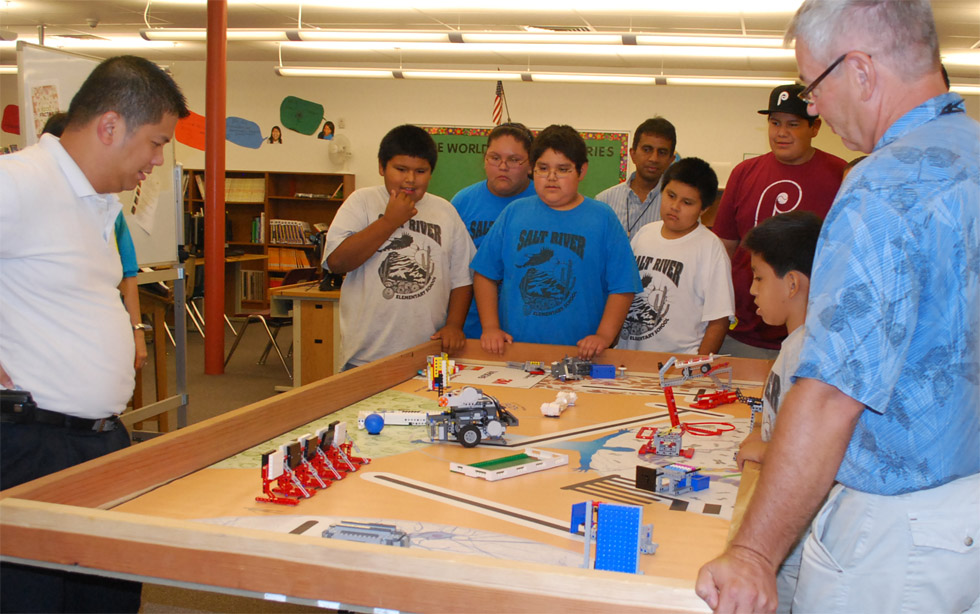
Robotics Club kicks off at Salt River Elementary

A few months ago I never thought I’d be taking on the mantle of coach of a Robotics club.

Well, that day has come!

Today, we kicked off the first meeting of the Robotics Club at Salt River Elementary School. I’m honored to be working with Dr. Bill Johnson, who could probably build one of these amazing bots (to call it a toy is an insult!) in the dark, with one arm tied behind his back.

For all those who despair about kids today being more taken up by computer games than reading and writing, I have news for you.

Salt River Elementary School, Team TitansLast year’s school team, ‘The Titans,’ (students between the ages of 9 and 11) researched the basic conditions and consequence of diabetes, then proceeded to build a robot using mathematical calculations to send it off on a ‘mission’ to solve the problem. They were so good at it and their mission was so well thought out, that they went on to represent the school at the world championships in St. Louis, Missouri.

Care to know more about this? Check out this story.  ASU also featured it here.

Today, we showed parents what humans could do to robots. I talked of the several robots we have taken for granted. Yes, you may have heard of HAL and Roomba.

But not many people have heard of Jason (doing oceanographic studies) DaVinci (performing robotic heart surgery, left), Predator (the drone, of course), Hobo (the fearless robots that disarms explosives),  Dante II (the 990 pound, eight-legged robot built to monitor volcanoes), Kurt (the sewer inspector in Germany).

But more importantly than what humans do to robots is what robots do to humans -the interdisciplinary field of robotics helps us step outside our boundaries, and rethink what seemed impossible.

Here’s one of the smart robots that Dr. Johnson has created. It responds to sound and touch. But, as he notes, that’s only scratching the surface of what these kids are capable of doing.


Dear Eric Schmidt: If I may be so impolite, our track record isn’t great, either.

Interesting to see the debate ensure, now that Google has stepped into the debate on falling education standards.

Google chairman, Eric Schmidt lectured the Brits saying “If I may be so impolite, your track record isn’t great,” noting that education in Britain was holding back the country’s chances of success in the digital media economy. His abrasive comments were made at the Edinburgh International Television Festival:

“The UK is home of so many media-related inventions. You invented photography. You invented TV. You invented computers in both concept and practice… Yet today, none of the world’s leading exponents in these fields are from the UK.”

Ouch!

But here’s the problem, Mr. Schmidt. While it might be shocking to not teach CS to students at a young age, isn’t it terribly frightening that we’re not doing enough to teach/inspire students how to read? This includes how to spend more time in a library and not in front of screens, how to look deeper and wider about a subject on ‘platforms ‘ that don’t have hyperlinks and cool info-graphics. The problem is not in the UK, but in the US!

This may sound odd coming from me, because I do promote digital literacy, integration social media into knowledge sharing etc. But I work with kids, too. I can see where we are headed. Down the cliff! I have heard people brag about how their Johnny is sooo good at computer games, and loves Angry Birds, but these same parents don’t even own a library card in the home.

It is not just low-income children who can’t/don’t read. After investing some $6 billion in such ambitions programs in the US, the nation that is producing tablets and eReaders, and the coolest reading apps, has essentially flatlined in reading scores.

Time to lecture to the home team, don’t you think, Mr. Schmidt?

Inconvenient truths about citizen journalism

This article was published by LMD magazine this month.

“This is not good anymore… Once the battery charges, I’m going to download it from the camera and stream it to you live. I mean, I don’t believe this is happening. Seriously, I don’t believe this is happening…”

They were the last words of one of the bravest citizen journalists of our time – Libyan Mohammed Nabbous, killed in Benghazi in March (find the story at http://bit.ly/LMD0811)

When we talk about citizen journalism, we think of accidental reporters who, in the face of a catastrophic event, grab a cellphone and capture a story that would otherwise never have been recorded.

Many in the West recall the first heartbreaking reports of the 2004 Asian tsunami, captured by citizens in Sri Lanka. Commuters, not trained reporters, provided the first grainy videos when terrorists bombed subways and buses in London in 2005. Likewise, the first images of the dramatic ‘splash landing’ of an US Air­ways flight into the Hudson River in Manhattan were captured by a citizen journalist. But like those in mainstream media who have put themselves in harm’s way (those like Daniel Pearl of The Wall Street Journal, who was killed in 2002; and Tim Hetherington, who was killed in Misrata, in Libya recently), citizen journalists are following in their footsteps.

Now that large media organi­sations have downsized, citizen journalists are often filling the gaps.

Whether we approve of them or not, they are often the first responders, covering a broad range of events – wars, hurricanes, earthquakes, elections, civil un­rest, famines and terrorism – that seem to be taking place with greater frequency these days.

Media Test Kitchen. There are many questions of course, as this ‘accidental profession’ shows signs of turning more professional (‘Pro’) than amateur (‘Am’). How will established news-media organisations deal with this new phenomenon? Or the more pertinent question is, how will governments adapt to this reality?

First to the Pro-Am relationship. In the early years, the Pros were sceptical. Yet, more recently across the world, as mainstream media organisations began cutting back on staff, this gave rise to newsrooms where Pros could be sought after (or outsourced) like Ams. Steve Outing, Direc­tor of the Digital Media Test Kitchen, once observed that “few news organisations have the manpower to cover everything that their readers are interested in, but by tapping the volunteer (or cheap) resour­ces of the citizenry, a news organisation can potentially provide coverage down to the little league team and church-group level, as well as offer better and more diverse coverage of broader issues by bringing in more voices and perspectives”.

In 2006, probably the turning point of citizen journalism, the BBC announced that it would in fact pay Ams for their contributions that could include video footage taken and saved on cellphones. The BBC’s Direc­tor of Global News Richard Sambrook observ­ed how invaluable citizens’ input had been in reporting the London bombings the previous year: “Within six hours, we received more than 1,000 photographs, 20 pieces of amateur video, 4,000 text messages and 20,000 emails. People were participating in our coverage in a way we had never seen before.” (For a discussion of the struggle between Pros and Ams, listen to the BBC report at http://bbc.in/LMD 0711)

Sambrook called this new phenomenon ‘open-source journalism’, where there was collaboration between a Pro and his or her readers on a story. In other words, the Pros were working alongside the Ams!

Indeed, citizen journalism has pushed the boundaries of traditional journalism. Just like the BBC, many major news organisations have begun tacking on a citizen-powered news stream, and it is becoming more of a hybrid. And the vast number of events taking place in parts of the world that are hard to access has created the perfect conditions for niche-media outlets.

In Libya, a citizen journalist noted the following: ‘Before the revolution, there was only one newspaper that belonged to the Government. But after the revolution, now there are almost five…” He appeared jubilant that even he could play a small part in making that happen.

His profession – when he isn’t a citizen reporter – is…? A dentist!

Just this June, The New York Times opened up a story for citizen participation in making sense of a trove of email records (24,199 in all) from Sarah Palin, released by the Governor’s Office in Juneau, in Alaska: “We’re asking readers to help us identify interesting and newsworthy emails, people and events that we may want to highlight. Interested users can fill out a simple form to describe the nature of the email, and provide a name and email address so we’ll know who should get the credit.”

Likewise, The Washington Post invited readers, saying: “That’s a lot of email for us to review, so we’re looking for some help from Fix readers to analyse, contextualise and research those emails right alongside Post reporters over the days following the release.”

Note the words ‘alongside Post report­ers’. To qualify, people didn’t need to have a degree in journalism… just a computer and an internet connection!

Others have been cooking up different recipes in the test kitchen of citizen participation. Media observers have been calling it ‘non-profit journalism’ and ‘grassroots journalism’.

“Non-profit journalism organisations as well as citizen journalists are producing news that too often is overlooked by traditional media,” observes Jason Stverak, President of the Franklin Center for Govern­ment and Public Integrity, a non-profit journalism organisation.

The distinction between online journalists and those who write in to newspapers and magazines or work in radio or TV are disappearing, and their skill sets are being cross-pollinated. Stverak rightly says that “not all those who write online stories are journalists yet, but the ones who are should get the same access and treatment as those few still employed by newspapers, television and radio”.

For the Ams (who are often videographers, bloggers and podcasters), access and ‘treatment’ are sticky issues. Consider the following. Even when it comes to major events such as the World Economic Forum (where bloggers and YouTubers provide up-to-the-minute and live coverage), press accreditation is reserved for ‘all accredited media’. Three bloggers who called themselves ‘alternative journalists’ sued the New York Police Depart­ment for giving them the cold-shoulder treatment – by denying them press credentials.

In the UK, the Tameside Council (a borough of Manchester) ruled that bloggers could not be permitted to tweet, since they were technically not members of the press corps. The council however permitted the Manchester Evening News and the Tameside Reporter to use Twitter during its meetings. In many instances like this, a person needs to prove that he or she is an ‘accredited representative’ of the press.

Which begs the question: would someone like Nabbous have been considered an accredited member? Probably not!

Jay Rosen, a promoter of the Pro-Am model for many years and a journalism professor at New York University, thinks that the profession has not been making much progress in this area – for the simple reason that the Pros have not been making it easy for citizens.

“The ergonomics of participation in Pro-Am journalism are poorly understood. We don’t have enough experts in it,” he says. In order to engage people in this model of reporting, “they need to see and feel the connection between the small part they are asked to contribute and the big story that will result”.

Then there is the credibility factor. Citizen journalists do not have the built-in reputation of a news organisation, especially if they are working solo. But this has been changing. As the BBC’s Michael Buerk noted while talking to an Egyptian citizen journalist, “it’s not important because of what old-style journalism can’t do, but for what they won’t do”.

There is an upside to all of this, not just for the media but for communities and for democracy. The ‘inconvenient truths’ in a functioning democracy, says Sanjana Hattotuwa, Editor of citizen-journalism outfit Ground Views, is that with citizen participation “you risk the multiplicity of voices and strengthen media literacy”.

And yes, it is messy… but you end up with an informed citizenry, which isn’t a bad payoff. They, the hoi polloi, decide on which media they will believe – and as has been the case in Iran and Egypt until recently, they often do not believe the official narrative coming from the mainstream media.

Professional Amateurs. Some ex-journalists and entrepreneurs have spotted opportunities in this space and begun to create business models, albeit non-profit businesses. One of them, The Uptake (www.theuptake.org), is a ‘citizen-fuelled news organisation’.

“Online tools will not solve community development,” says The UpTake. It stresses the need for a different type of citizen journalist – the Professional Amateur.

It also explains how one person wearing many hats is not the norm in citizen-fuelled news. Shooting the video, editing the story and publishing it online is more than what a Pro-Am ought to be asked to do.

Uptake recommends three core areas a citizen-fuelled organisation needs to focus on: train, organise and crowd-source. More importantly, it looks at citizen journalism not as a reactive means to cover a story as it breaks.

The co-founder of The UpTake Chuck Olsen calls it “committing an act of journalism” – meaning, going out there and finding the story, not reacting to it. “Most acts of citizen journalism are simply documenting something – a London subway cellphone photo, for example. And that’s very important,” he notes.

But as the model matures and takes on a Pro-Am status, Olsen calls for more: “We want to elevate citizen journalism from being reactive to being proactive. Go out and find stories that interest you, and provide some training on how to capture and tell that story.”

Augmented Reality could ‘erase’ instead of overlay

As I frequently cover Augmented Reality, I am especially enthused how it could be used not just in marketing, but in education and, outside of schools, in knowledge sharing.

The Korean Reunification Project is an inspiring example of how we could stretch the boundaries, literally, of AR. While the technology of adding new layers of content to ‘augment’ the real life experience is marvelous, this one is all about erasing, not adding.

Erasing, as in erasing (‘and heal’) the scars left on a country that was divided.

The project removes the elements that were part of the Demilitarized Zone (DMZ) “returning it to its natural state before Korea was divided.”

It was developed by new media artist Mark Skwarek, who says his erasAR project is capable of erasing physical objects from the face of the earth!

Tabloid gets tabloid treatment. Oh, what fun!

Working on an article about the media war that broke out with the phone-tapping scandal in Britain –you know, the one that brought down News Of The World.

No one really questions who reads these crappy papers. (Typical front page story in NotW: “F1 boss has sick orgy with hookers.”) So I am sure there are very few who moan the loss of the ‘red tops’ as there are referred to in the industry.

I found a great project (the mock up is his on left) by Adam Westbrook,  a journalism lecturer who asks “If you edited the final News Of The World, what would your front page be?”

The Time cover below, by the way, is real.


Remembering Jeret Peterson

The sad news today from Park City, Utah brings memories of some work I did with a  client in Park City last year.

I was working with former Olympian, Sean Smith who, in a few days before he left for Vancouver, learned the ins and outs of sending in video podcasts from his phone. Online and off, he brought me up to speed about the different categories, and whom to watch. He would upload the videos and I would post them within minutes to the blog, for my client.


Jeret “Speedy” Peterson was a name that kept popping up as Sean was confident that the ‘Hurricane’ would certainly earn Jeret a medal. It did.

Below is a short clip of Sean’s excitement about the Speedy.

My thoughts and prayers are with the Peterson family. Your son was truly a legend!

San Francisco’s ‘Language of the birds’

I recently, serendipitously, came across an inspiring sculpture in San Francisco, called the ‘language of the birds.’ It had been commissioned by the San Francisco Arts Commission, and is located very close to a landmark bookstore, City Lights. Created by two artists, Brian Goggin with Dorka Keehn, they describe it as:

“a flock of twenty-three sculpted illuminated books, which appear to have just taken flight from the plaza like pigeons scared up by a passer by.”

Words on the pavement appear to have dropped off the books!

In a city named after St. Francis of Assisi, I couldn’t help but notice the thematic homage to someone who was said to have been be fond of (and communicated with) birds.