An old video by Commoncraft. But it de-mystifies the whole complexity of how voters and electoral systems work in choosing a president.
Author: Angelo Fernando
Coir brushes, smart phones – How a small rural community found a market
The human connection, and the grassroots involvement is a preamble to this story which was published this month in LMD Magazine.
A few months ago I interviewed a program manager at a major grass roots organization in Sri Lanka. Isura Silva’s story is fascinating. It’s about a pilot project involving smart phones in a very small village in Kurunegala, about 45 miles from Colombo.

The project, by Sarvodaya Fusion, put 21 Google Nexus phones in the hands of the entrepreneurs, because -despite a very high penetration of mobile phones in Sri Lanka –that village wanted education, and the ability to digitize the information they were generating.
The ‘information’ in this case was details about the coir brushes that they were making on very (very!) small scale. Tweaking the laws of demand and supply effects are not enough for a product to achieve scale. If no one knows you have an awesome product, no one wants to buy, and you could remain a small business forever.
Soon the producers were photographing their coir products and uploading it to a Facebook page, using the smart phones. Within a short time, a major marketing and distribution company, Hayleys Exports (which exports textiles, tea, construction material and coir products) had seen the product and began a conversation. They agreed to buy one million items a month.
Was it the power of a smart phone, or the power of conversations they enabled?
 Smart phones are opening up a dialogue with those involved in much more than e-commerce.
In another town, Fusion holds blogging classes, and in another, they show young adults how to use a phone to teach themselves English.
Outside Sri Lanka this model is being tested by grassroots organizations using mobile technologies. UNESCO and Nokia held a Mobile Learning Week in Paris in 2011. Stanford and USAID has a program known as mobile 4 education 4 development.
While all this is going on, Silva is busy trying to find the next big thing for his organization,and how it could further mobilize the grassroots. He accidentally stumbled on Twitter, and has some ideas on that, but that’s a different story.
Truth, Lies and iPhones
I had been fascinated about the Mike Daisey story that broke some months back here in the US.
It opened up a can of worms about how truth (or ‘truthiness’ as Stephen Colbert put it) and how we twist and maim words and facts. Politicians do it, as do talk-show hosts, reporters, advertisers, scientists, corporate leaders etc.
As someone who writes for the media, I thought this brouhaha was way too important to dismiss as one man’s folly. Daisey was the everyman in a culture of compromised truths and spin; a culture that sometimes believes the means justifies the end in getting a message across. (Anyone remembers Message Force Multipliers?) The infamous scientist who lied about climate studies admitted he had has a “serious lapse” of “professional judgment and ethics.”
The classic statement by Daisey for me was this:
“I’m not going to say that I didn’t take shortcuts in my passion to be heard. But I stand behind my work… It’s not journalism. It’s theatre,”
Is marketing also ‘theater’ then? It could be argued that some aspects of it –product display, packaging etc– is staged, right? Could some forms of PR (stunts, at least) be also considered theater? Are we sometimes taking Daisey-esque ‘shortcuts’? This is the uncomfortable space many of us operate in.
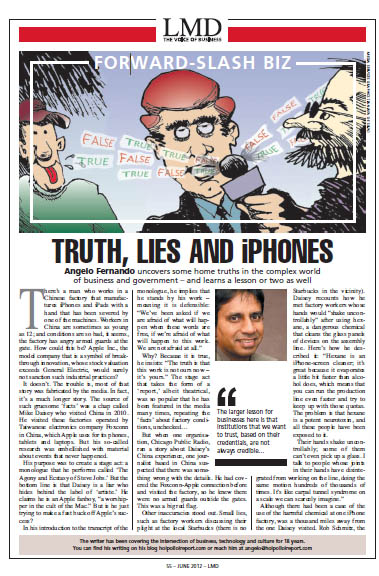 That’s the background to my recent piece in LMD Magazine, titled “Truth, Lies and iPhones.” Read it here.
Or download a PDF of the article here.
(Incidentally ‘truthiness‘ despite its quirkiness, became the Number 1 Word of the Year in 2006.)
Social Media and innovation surge in Sri Lanka
(This post is being updated)
 Today in Colombo the tech and business community attended Social Media Day, a Mashable-coordinated event, worldwide in which 511 cities participated
Two days ago, they held another parallel event known as Refresh Colombo.
One of the organizers noted that the hash-tag #SMDayCMB, which had begun trending regionally (as a ‘tailored trend’) validated the fact that there was a highly engaged community now. Speaking of the community, it’s got the right volatile mix for innovation. One newspaper reported, it was a confluence of “hackers, bloggers, coders, geeks and geek lovers, journalists, techies, entrepreneurs and venture capitalists.” Note: the absence of one group here – politicians. In post-war Sri Lanka, steering clear of politics appears to be a well-honed skill.
One of the highlights was a video-link up with Jehan Ratnatunga in California. Jehan is the person behind the comic YouTube skits. Fittingly (for this social media savvy audience) he explained how he landed a job with YouTube because of his hobby.
Watch this presentation by two of the smartest young entrepreneurs who understand not just technology, but how grass-root change and politics works at a fundamental level.
Watch the whole thing (it’s 25 minutes) because the best discussion is toward the end.
More coverage of event
- Read the report by Hiyal Biyagamage at Ceylon Today
- Read blog post by Ami Amarasinghe, who heads digital media at O&M, Sri Lanka
- Read: a blog post about the event, by Chamindra Hettitantirige
Augmented reality at point of purchase. Will it change the way brands ‘talk’ to customers?
When I first covered this thing called Augmented Reality’ people gave me a few blank stares. After all, in 2010, smart phones penetration in the US was 25 % of all mobile users, and was just picking up speed.
Today, smart phones account for 50.4 of mobile phones. The comfort level people show with using apps, and engaging with tools such as QR Codes and Augmented Reality is making those who work in Marcom rethink what they do.
- Should they stop writing ‘copy’ and start writing story ideas that work in these personal, mobile spaces?
- Is it time to retire headlines and tag lines, and think of ‘swipe lines’ — inspired by the fast growing habits of new touch interfaces
- Should we stop thinking of ‘chunks’ of brand-laden text, and start thinking instead of scenarios for different moments during the point of purchase?
Take a look at this communication between the label of a bottle of ketchup and someone in the grocery story diving into content that hide behind the label. The content is no longer on the label, but somewhere in the cloud. With a small touch that information (a recipe, ingredients, a promotion etc) could be transmitted to the shopper’s smart phone.
It’s getting better! See how a Dutch magazine, Veronica, uses the same idea to make print come alive.
It blows my mind to think of the possibilities for print advertisers who could turn the reading experience into a point of (online) purchase.
Context is king. Book’s web site has lesson for us
 I was looking up author, David Carr, after using a quote from him in my previous post. His is a fascinating story captured in his book, The Night of the Gun.
Since every book today has a companion web site, I nearly skipped it, assuming it was another content dump with blurbs and links. I was wrong! It’s a trove of context, not content.
- One of the tabs opens a page laid out in a grid of 60-squares. Click on each square and it takes you deeper into Carr’s story by way of candid interviews, photos, scanned documents etc.
- Another tab has a timeline, which takes you on an online experience you couldn’t even come close to in the pages of a book.
The publisher, Simon and Schuster, notes that it created a database of content because Carr ended up with a large stack of material, recording his thoughts and interviews using many formats – video, audio, notes etc.
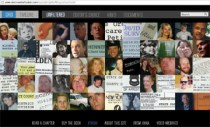
With help from the New York Times‘ digital guy, (a ‘User Interface Specialist!) they built a site as a multi-media backdrop, or more precisely, a back-story, to his memoir.
While it makes for a novel way to market a book, we could learn some important lessons in how to surround any other form of communication with rich, contextual information.
In the end The Night of the Gun is more than a book -a living story that cannot be contained within templates, hard covers or style sheets.
Lost in translation – when jokes go sour
With so many channels permitting us to share so much chatter, it’s alarming how people forget that what seems private could be very public. Twitter is “a village common” says David Carr, media and culture columnist for the New York Times. He considers what someone says on this channel as very public. (There is a journalistic debate on whether a tweet is actually public content.)
Humor often has a way of going wrong. If you are planning on posting a zinger remember the Aflack guy. The comedian Gilbert Gottfried, who was the voice of the duck in the Aflack commercials, made a few off color tweets soon after the tsunami in 2011. One of them was: “I just split up with my girlfriend, but like the Japanese say, “They’ll be another one floating by any minute now.” He quickly became the ex-Aflack voice.
Even a comedian ought to think before he tweets.
Speaking of humor, this joke gone wrong, involving the Dalai Lama would crack you up. Nothing offensive, but the punch line, lost in translation, just didn’t connect. Karl Stefanovic, the anchor of the Today show in Australia explains.
Curating Content With Glogster
 I’ve been experimenting with Glogster recently, and plan to use this in my teaching.
It’s like a more multi-media version of Pinterest. The interface still needs more work, but I could see how it could definitely become a tool in the any presentation, or classroom.
Searching for context, more than keyword dumpster diving
It’s frustrating to hear people say “I researched that” when they simply mean “I looked it up on Google.”
 I believe we have diluted the word ‘research’ by equating it to a one-click action. I’m not trying to say that every topic under the sun needs a deep dive. I’m not suggesting that we turn fact-finding into some geeky task. I’m suggesting that we ought to train our brains to think that knowing something is contextual. There is no pat answer.
Google must know this. It stepped up to the late with the release of what it calls the ‘knowledge graph.’ (I am not a big fan of the term. It has a hint of Zuckerberg;s ‘social graph,’ doesn’t it?) Nevertheless, if you haven’t noticed the contextual info showing up on Google, take a look.
If you’re into the deep dive thing, Google does have a few tricks it tends to hide from the general public. But there are more. Try these:
Google Scholar – http://scholar.google.com
It provides pages from books, PDFs, scholarly literature, peer-reviewed journals, material found via Google books, and even court opinions. Duke University encourages students to use it!
Patent Search – http://www.google.com/patents?hl=en
Lexis Nexis – http://www.lexisnexis.com
This is not a free service, but it combines information from legal, academic, and corporate knowledge databases.
Storytelling tips from Lone Ranger
When I teach young people about the elements of a story, I tend to lean on the trusted models of the Who-What-When-Where-Why-How (or the 5WH) structure. Or the one about having a Beginning, Middle and End. (My version of this, for those writing for the web is to make sure they have a Beginning, a Middle and a Hyperlink.)
 So this week I revisited two stories, separated by several centuries. The Lone Ranger, and Beowulf. (Yes! There’s a delicious irony of being able to listen to a 1930 radio show of The Lone Ranger via a Kindle app!)
The basics of these stories –one from the radio age, and the other from a different culture and era, entirely – is that they revolve around conflict. It makes good drama. Good vs evil material. But beyond that, it is how carefully the author, or script writer selects his words.
So here are four things we could take away from Lone Ranger:
1. Grab Your Reader/Listener
Cut short the pre-amble, and get to the point fast. In Lone Ranger, we are all familiar with how the scene is set: “A fiery horse with the speed of light, a cloud of dust and a hearty “Hi-yo Silver!” (The previous intro was: “In the early days of the western United States, a masked man and an Indian rode the plains, searching for truth and justice. ….Return with us now”)
The ‘search for the truth’ is built around intrigue (masked man) and the promise of action (search for truth, hoofbeats…)
2. Cut to the ‘Chase’
Move quickly to build up the tension. The stereotypical car chase (or horse chase here) can have other variants such as a puzzle that the reader is yearning to solve, the expectation of a confrontation etc.
3. Build Great Dialogue.
Though the story is told to us by a narrator, it is rich in dialog. Tonto, his foil, despite the author’s use of some clumsy pidgin English, is full of exchanges.
TONTO: “Crooks try rob bank last night”
RANGER: “Have Bogus Brown and his pal Elk been in town?”
TONTO: Umm. “Them the fellers try to rob bank?”
4. Humanize Your Characters
The Lone Ranger, despite his mask, is still human enough for others to be able to relate to him – Sheriff’s, townspeople, crooks.
Too often our modern ‘stories’ –um, press releases, podcasts etc– are full of inside jargon, and layer upon layer of description. It’s almost as if the boss’ requisition stated that the script be stripped of ‘normal’ words, and the sort of everyday, ordinary exchanges. Instead what creeps in a slick, sloganized phrases, put in the mouths of spokespersons who would never talk like that.
Maybe we should make Fran Striker (college dropout, announcer) the little-known writer behind Lone Ranger, essential reading for those writing for an attention-deficit audience.
 Hoipolloireport