Collective Surveillance – or crowd-sourcing an investigation

As we get to know different parts of the puzzle about the Boston Marathon bombers, one thing has become clear. The biggest leads came from cameras that were in the hands of private citizens.

To this end, read this by someone who predicted citizens’ potential:

If the day comes when millions of people go about their lives while wearing sensor-equipped wearable computers, the population could become a collective surveillant: Big everybody.

That was Howard Rheingold, in Smart Mobs: The Next Social Revolution.

How will citizen participation take shape when everyone is a reporter, a photo-journalist? It’s easy to be cynical, but I have talked to many people about this, in my book, Chat Republic, and have to admit that you win some, you lose some: freedom / security.

Crowd-sourcing, whether it is investigating health issues or knowledge is always a good thing.
Chat Republic – Galley Proofs today!

The metaphors for describing what one goes through when writing a book are inadequate.

Suffice to say it’s been a breathtaking learning process.

Chat Republic (Cover)_APR252013

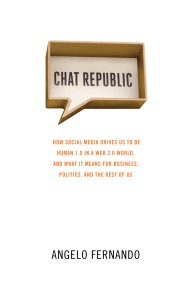
But it’s finally coming down to the moment of truth. Here’s what the cover looks like. I wanted it to be minimalistic, but communicate in an instant what it’s about.

Chat Republic, though a crowded place, is also about a call for more space – space between the noise, space between the rapid, vapid statements we send out and are inundated by.

Some see this is as a ‘country’ –a map– populated by loud mouths. I see it as this giant speech bubble, we could all be sucked into (if we don’t make some sensible choices).

Let me know what you think of the cover!

“Sending a message,” in a post-Bansky era

In my book, Chat Republic,  I feature a few examples of how ‘street talk’ has been effective, even sans the Internet.

“Banksymus Maximus”

This old, classic tactic from guerilla artist Bansky could take us into a whole new discussion of how to create buzz, often without words.

Here’s the set-up: In 2005, Bansky managed to place a fake “rock painting” in the British Museum. As you could see, it shows a caveman as a different kind of hunter and gatherer. The rock was stuck onto a wall in a ‘Roman Britain’ section.

Just plain ‘art-jacking’ or is Bansky an ingenious, much-ignored communicator? In a world empowering us to ‘speak out of turn’ do tactics like this feel relevant? Or are they too edgy for you?

Before you come to a conclusion, take a look at the modern version of this phenomenon, known as Culture Jacking.

I would love to hear your comments.

Vote For iReporter, Gerard Braud

I’ve met Gerard Braud, when I sat in a workshop he conducted some years back. He’s a reporter’s reporter, who knows the ins and outs of working ina  newsroom.

Gerard has been nominated for a CNN iReport award, and I highly recommend him. If you feel inclined, watch this video of his short, succing iReport on Hurricane Isaac. Then, please take a few seconds to cast a vote for him.

Hurricane Isaac iReport – Gerard Braud

When storytellers ‘hyperlink’ they still pull you back. Do you?

I had to explain what a hyperlink is to my class last week.

It’s odd to see, through the eyes of a new audience, how the words we take so much for granted, are really a tad arcane. Yet we continue to use words and phrases such as URLs (no-one cares what it stands for), Cloud, hyperlink.

But just to explain hyperlink by focusing on the word link, made me look of how stories used to be constructed in a pre-Internet era, with built-in hyper-links. The storyteller used his craft to send the listener to a place and then craftily pull him back, thereby enriching the story. The whole back-and-forth link-out/link-back process is how we intuitively learn to write. To keep an audience engaged. (for this experiment I am not using any hyperlinks in this post.)

Take Hamlet, for instance. When he speaks to the ghost of his father:

Yea, from the table of my memory

I’ll wipe away all trivial fond records,

All saws of books, all forms, all pressures past,

That youth and observation copied there;

Shakespeare piles on metaphors of books, records, copying etc, to take the audience –an outbound link– to a place that provides some background to Hamlet’s state of confused state of mind, his ‘distracted globe.’

Now, nearly 400 years later, even as we experiment with ‘media snacking,’ we are increasingly aware that we don’t advance knowledge by reading headlines and summaries.

But while an actor could pull us back, we who abuse the hyperlink (just to show we know more about a topic), inadvertently encourage readers to drift off into some abyss.

Hamlet was, by his own admission,  ‘distracted,’ but he made sure we are not!

What could digital storytellers use to pull an audience back, to enlarge the story?

Citizens’ voices matter

A few years ago I conducted a series of webinar-style workshops for the U.S. State Department, for content creators, educators, marketers and those in traditional and new media. The workshops were called  “Passport to Digital Citizenship.”

I was convinced that citizen’s voices would be valuable, and –despite technological barriers and people who would try to keep them quiet– they could be heard.

So today, as my book is about to launch, I am thrilled to see this report by CNN on the importance of citizen-driven media.

Journalism has been forever changed — I’d argue for the better — thanks to the fact that people can interact with media organizations and share their opinions, personal stories, and photos and videos of news as it happens. This year’s nominated iReports are prime examples of how participatory storytelling can positively affect the way we cover and understand the news. 

(“36 stories that prove citizen journalism matters.” By Katie Hawkins-Gaar, CNN | Wed April 3, 2013 )

When we talk of  ‘participatory journalism’ we mean that ‘CitJos’ work alongside traditional media. They are not here as a replacement model, but to complement the changing media industry. Of the 100,000 citizen stories submitted to CNNiReport.com in 2012, they used 10,789 –having vetted them first.

I just interviewed the creator of a leading citizen journalist outfit in South Asia, and he stressed the importance of community guidelines, and careful design.

Citizen journalism, and the power of citizen voices is a big section in my book, Chat Republic.

Always on, always live

We use the word ‘always-on’ so flippantly these days, we often have no idea what it means.

We use it to suggest being tethered (“my phone is always with me”), or that we are contactable through many devices and points of contact (“find me at these various places…”).

Being Always-On means other things to organizations. They are on people’s radar, will be talked about, tweeted, linked to, photographed etc. Every interaction is an ‘on’ switch that’s permanently green.

To that point about photography, you may have come across the silly move by United to offload a passenger travelling from Newark to Istanbul, for taking photos of the digital panel on the seat in front of him. Read the story here.

Indeed, United had a passenger policy about cameras. (Just the mention of United and ‘policy’ immediately brought to my mind another kerfuffle involving guitars!). But how they exercised that policy and communicated it was just unfortunate.

I’ve travelled with a camera and taken numerous pictures inflight, as I am sure you have. Some of those pictures have been used on this blog. As a writer I use photos to record an idea or an object that I would refer to later, even if I don’t publish it. With so many billions of camera-equipped phones in circulation, it’s lame to even have a no-photograph policy –except in security-related situations.

The whole point is, we inhabit this always-on space on the ground, in the air, under the ocean and even in our work environments. (Heck, I have two installed cameras in my room, plus an SLR that I whip out ever so often; my students know that they may be on camera anytime!)

With that in mind, you may want to listen to one of my favorite podcasters, CC Chapman and his take on the United fiasco: The Always On Society.

Note: CC Chapman is one of the podcasters I interviewed for my upcoming book, Chat Republic. The book will be out in May 2013.

Update on my book: “Chat Republic”

It’s official, and I’m now ready to announce the title of my book, which is in its final stages.

It’s called Chat Republic.

Angelo Fernando, Chat RepublicI’ve been covering the intersection of technology and business; technology and culture for more than 18 years. More recently, I’ve focused on digital media and our social media-centric lives, and I wanted to put my ideas into perspective.

Chat Republic is more than a fictional country. It’s about the spaces you inhabit.  Those online and offline communities you move in and out of: conference rooms, Google Circles, IM lists, Facebook, online forums. I think of it as a ‘country’ whose fluid borders take the shape of a giant, invisible speech bubble.

The conversations and opinions pouring in and out of our republic, in real-time, are what make our communities more civil, more vibrant. Our chats are certainly not friction-free! But absent these conversations we would be one dimensional citizens, won’t we?

As of today, I am planning to launch the book in two time zones, in June.

Some specs:

  • 25 Chapters – Divided into 3 sections
  • Case Studies from the U.S. and Asia
  • Interviews with non-profits, tech companies, activists, chief execs, editors, citizen journalists, PR consultants, podcasters, government officials

More information here at ChatRepublic.net