An evening of “Crosstalk” reveals how people and text interact

No, this is not about Facebook, and how we seemingly interact with text that sometimes seems like a bunch of posturing and talking at cross purposes!

This is about a performance I went to last Saturday at ASU, brought by the School of Arts, Media and Engineering.

crosstalkThe key ‘performance — a semi-choreographed interaction of two women –was to demonstrate how conversations (and text) can ‘make’ people, and their reality. Meaning, how language doesn’t just represent us, but shapes who we are, even while we use it. Here’s how they describe it. The art form:

interrogates these questions (using) 3D infra-red motion tracking, voice acquisition, speech recognition, multi-screen video projection and multi-channel surround sound to create an immersive multimedia environment.

As the dancers move and speak, speech recognition software reveals sentences (and sentence fragments) on two screens at right angles to each other. Then these texts begin to intersect, and create some interesting visual ‘performances’ – dropping off, angling, growing, and interacting with the other person’s texts.

The event was the work of visual artist, Simon Biggs, and composer, Garth Paine, both of whom dabble in the algorithms that work behind the scenes.

Why I found this fascinating was that it is in an oblique way related to my work in Chat Republic, and how our conversations determine our realities. We are, whether we like it or not, immersed in a digital landscape, and what we say to each other lives in a textual sense out there.

One does not have to be steeped in social media to be part of this Web 2.0 world, where much of what we do is cross-referenced by algorithms –when we sign on to purchase something, do a Google search, or leave a comment –that build profiles of us, and builds identities of us.

Just check what Facebook appears to be doing, sneakily boosting your ‘Likes’ when you message someone.

“Absolute Value” confronts traditional marketing theories

We’ve all been influenced by customer reviews, right?

Whether it’s a low-ticket item (ordering food online) or not we use the “knowledge” gleaned from other users as a habit before we make up our minds.

Is this  new? Not exactly, because in the pre-Internet era, we bumped into this information in a haphazard way — chance conversations  during our commute, by trading opinions over our fence etc.

But it’s less haphazard now. It’s ingrained in our purchasing behavior.

In the just about to be released book, Absolute Value, by Itamar Simonson and Emanuel Rosen,  we see how this stream of information is what marketers must now lose sleep over.

I just received an advanced digital version of the book from Rosen, and I have to say it is a compelling idea –the idea of how “nearly perfect information” could disrupt the pillars of marketing we know of as segmentation, positioning, promotion etc. And if course the whole basis of branding and brand value would be in question, if their thesis is true.

The New York Times described it as a book that deals with the power of online reviews, based on Dr. Itamar’s decades-long research at Stanford, prior to this.

Here’s how they summarize how the power of information from ‘other people’ tilt the balance.

Customers’ purchase decisions are typically affected by a combination of three things: Their prior preferences, beliefs, and experiences (which we refer to as P), information from marketers (M), and input from other people and from information services (O). …

…If the impact of O on a purchase decision about a food processor goes up, the influence of M or P, or both, goes down.

For those whose business is all about the M — the marketing push and the brand strategy, you better start paying attention to how the hoi polloi, those “other people” might matter, after all.

Polar Vortex gets media massage – delicious left-wing/right wing debate

Breaking News. Limbaugh’s argument freezes on contact! 

I have to admit the term Polar Vortex at first sounded a bit of verbosity aimed at making a big story out of a weather phenomenon.

But I did look it up, and find that for once, it is not one of those media marquees trotted out by a TV station’s graphics department.

But it turned out to be a delicious controversy, when good old Rush Limbaugh stuck his tongue out at the equivalent of a frigid lamp-post.  I first picked up the detail in the Discussion Pages of Wikipedia. One Charles Edwin, a Wikipedia editor (biting his tongue, no doubt) left this terse note in the Talk Pages:

“a lot about the media frenzy. Rush Limbaugh, like others, say they remember cold winters and walking to school in massive snow, uphill, both ways. 🙂 Rush Limbaugh is a student of global weather and expects there may be a three-day gap in the cold for Superbowl Sunday.”

Limbaugh called the term something invented by the left-wing media. Predictably so, since Limbaugh makes everything sound like a conspiracy, since that is the jet fuel which powers his craft. Here’s what he said on Monday.

“Now, in their attempt, the left, the media, everybody, to come up with a way to make this sound like it’s something new and completely unprecedented, they’ve come up with this phrase called the “polar vortex.”

To which weatherman Al Roker, threw a nice counterpunch, by revealing and reading from a 1959 college text-book that had the term Polar Vortex defined.

Sometimes these silly spats teach us something, especially about speaking out of turn –with poor facts.

Now if you’re wondering why I would be interested in this the Vortex debate it’s this. I just got back to school today, and as is normal, interrupted my lesson plan to get my fifth- and sixth-grade students to do a project on the Polar Vortex. 

As I used to tell people when discussing social media and the oft-contested topic called the ‘wisdom of the crowds,’ poking around the talk pages can take you to down some interesting paths.

WordPress “Annual Report,” a boon to writers

Interesting how WordPress.com delivers stats about one’s blog.

To many, numbers mean a lot. I’m more after the intangible benefits of writing for small groups, so I was able to glean some useful data beyond the highlights. For instance it tells you what parts of the world traffic originates, search terms etc. This is not exactly new, since the dashboard does collect this data.

However, on an annual basis, the Report would be good to compare going forward.

Here’s an excerpt:

The concert hall at the Sydney Opera House holds 2,700 people. This blog was viewed about 8,300 times in 2013. If it were a concert at Sydney Opera House, it would take about 3 sold-out performances for that many people to see it.

As a writer, I constantly look at the ingredients of the story, often by way of feedback from readers. Some remember the exact headlines of a piece written 10 years ago. A few have amazed me by recalling key argument made in a column. Combine this with WordPress stats (an older posts from 2009 seems to get consistently high visits, and now I know why), given the fact that many of my magazine columns begin as blog posts, and it’s valuable data.

Thanks, WordPress!

Is Facebook a faux community?

Over the Christmas break I’ve had a lot of time to think through some of the social behaviors we accept, and quietly incorporate. Sometimes these are things we once scorned, and never thought possible in our lifetime.

Things like doing a Google search while driving; posting pictures the very second we experience an event (basically experiencing an important moment in our life through a screen, first); checking the status of things that once didn’t matter to us before (“What’s the temperature in DC today?”; What does Times Square on 31st night look like on Facebook –since the TV networks do such a sloppy job of it now).

You get the picture…

My wife and I have also contracted a curious digital illness, FAS. Call it the Facebook Avoidance Syndrome. We don’t check in on a daily basis because it means inviting a lot of useless information into our lives, and worse, making what someone posts the main topic of discussion, rather than real issues near us, and around us. I must admit, these are interesting sidebars, but do we really want to be informed how deep the snow is, or the ingredients of one’s holiday cookies? Is this community?

  • Yesterday our neighbor stopped my wife and wanted to tell us they were moving. “I didn’t want to leave a note on your door to tell you this, he admitted.”
  • Friends dropped in a few days ago to check how I was going. No status updates were required in this old-fashioned practice.
  • While we’ve been more-or-less off the FB grid, the phone has been off the hook

I felt the need to post a short message on Facebook the other day to say this: Going forward in 2014, I would further reduce my Facebook activity. I said I won’t be breathlessly posting the food I consume or the anniversaries I celebrate.

What “activity?” you ask 🙂 I hardly add content to the Zuckerberg machine. I don’t subscribe to birthday apps, and the likes. But the point was that, if folks needed to reach me, or keep me informed of things, I didn’t want them to assume I knew, just because it was on Facebook.

Many hard-core Facebookers –and I know plenty, have interviewed many– can’t imagine life without it. Some have begun to feel like this is the only way to stay in touch with community. Granted, we have all used Facebook or LinkedIn to discover people from our past, analog communities. They feel as if there is no other way to trade empathy.

I beg to disagree. If all you had is a hammer, everything begins to look like a nail.

One of my friends asked me “What this means in a Chat Republic?”

I EXPECTED THIS.  My book dealt a lot about online and virtual communities, so I knew this question would come. I’m sure some of you are shocked I would even take this attitude. If you are, all I could say is re-read the  book’s introduction – “Why don’t we chat?” (If you don’t want to get the book, or borrow it from the library, I’d be happy to send you the chapter.)

Another asked me, why make a public announcement of this? Public announcement? I thought most people assumed our posts were just between friends. Maybe some realize that Facebook goads us into self-publicity, even while giving us the sense that we are engaging in private conversations. Indeed, Facebook’s public-private divide is confusing.

Digital Social networks were intended for communities. Humans weren’t built for the networks. Simply sharing whatever crosses our path –or our camera view finder– does not enrich our community involvement. Over-sharing is indeed a disease. It’s sometimes nice to be in the presence of a community where no one is taking pictures and setting others up for a Facebook post. (Sigh!: It’s an adjustment for me. There are places I go to now, where I don’t carry my SLR, and never, ever use my camera phone.)

It’s nice to avoid faux communities, and be in the presence of real communities.

Note:

1. There’s an interesting Carnegie Mellon University study if you are interested, about this very confusion, and how the many changes in Facebook’s privacy policy first reduced how much personal info people shared, and then how it began to rise. 

2. You may actually not see a link to this on Facebook. I don’t intend to post it there. The link between this blog and FB have been disconnected. This blog is obviously a public medium. 

Mars Crew’s ‘Twelve Days of Christmas’

The things you can do on ‘Mars’ now includes 3D printing, and video editing.

I’m talking about a simulated Mars Mission – the crew I have been in touch with for a project.

Sure they live on rations, since this is an 8-month stay in an isolated dome. But Zak Wilson even printed a star for their Christmas tree. Impressive with the video editing, too!

In case you are interested, this NASA-sponsored mission, known as the HI-SEAS Mission, is an 8-month research project to “determine what is required to keep a space flight crew happy and healthy during an extended mission to Mars.”

Related to this, is a very real NASA experiment to study the effects of someone living in space for one year, while comparing him to his identical twin, back on earth. This involves astronauts, Mark and Scott Kelley. The story broke this week in TIME magazine.

Communicating without words – Goldieblox smashes Princess stereotype

Last week someone sent me a link to a video for GoldieBlox, a toy company, that features toys for kids (and parents) jaded by the Princess theme that has taken over the toy industry in this country for that past few years.

I had never heard of the company before, and it was a serendipitous discovery, because of what I have been working on with my students –a Rube Goldberg idea. More about this in a moment.

While most girl’s toys have been Disney-fied, Goldieblox’s products are engineering-inspired. One of their blog posts (titled “An Apology To My Future Daughter”) gives you the reason d’être:

“I apologize that I’m going to have to lie to you. I’m afraid there is a 99.99% chance you won’t grow up to be a princess. I’m afraid I would rather you become an engineer…”

So back to the video, an advertisement, nonetheless, which communicates sans words why science and engineering could be fun for kids, Levers, pulleys, wheels, ramps..all made from everyday objects to create something fantastic. The storyline is about kids who are bored with Princess-saturated television, and go on to create a contraption that uses everyday objects in the home to… turn off the boring fare on TV! If Disney’s princess-fantasy machine has numbed parents’ toy choices, Goldieblox’s ‘Princess Machines’ tries to reverse the trend.

No voice-overs required.

However, another communication issue flared up. Not about toys or machines, but about copyright. In November Beastie Boy’s filed a lawsuit against the use of its song (parodied), “Girls.” That’s a whole other communication issue worth unpacking since it is involves ‘fair use’.

My guess is that the band would drop the charge, once it realizes the bigger picture –beyond a viral ad -of empowering girls.

It won’t help, once the rest of the media begin to see story angles such as “Why Beastie Boys Isn’t pro Girls.”

Could robotics’ kids could teach adults some ‘Gracious Professionalism’?

Newsflash: Not all kids are staring at their phones.

Ever walked into a mall and thought the world is going to hell in a hand-basket, watching teenagers ‘socialize?’

I had the opportunity to see another side of kids and technology, at a robotics tournament yesterday. The event is part of the FIRST Lego League events, that challenges young kids to put their minds to robotics. (There are a series of such events going on across the country over the next few weeks.)

Salt River Elementary School, Robotics - Gracious Professionalism

It’s a different lens. You get to peer into the future, watching a bunch of 12-year olds get themselves in and out of a sticky situation, and employ communication skills we wish some grown-ups had. You see them go through all stages: panic, disagreement, leadership and teamwork. When things go awry, they often problem-solve and improvise on the spot. (And there’s not an App in sight!) And best of all, they celebrate each other’s success –even competitors at the next table.

If only Congress would work like this, I thought.

And then it dawned on me. These kids will be the ones on Capitol Hill, someday. Or running our institutions, setting our agendas…

The FIRST Lego League requires that we adults promote what it calls ‘gracious professionalism’ in our teams. (The term was coined by Dr. Woodie Flowers, a professor at MIT), because that is how the grown-up world works. But the reality is, such a brand of professionalism in many facets of business and governance is more the exception than the rule. It’s a winner-takes-all world, we are often reminded.

But here at the FLL level, we teach our students to consider failure as a wonderful learning opportunity, and to not be obsessed by trophies. One of the core values they must exhibit is enlightening:

“What we discover is more important that what we win.”

Then, at the end of the day, the results show up on the large screen. Your heart sinks as you see the wide gap between the team that has mastered every mission, and those that had epic failures as their bot went off track, and wrecked their team’s chance of making it to the State tournament. But they quickly get over that and enjoy the moment.

They’re our gracious professionals in the making. 

“Are We Talking Too Much?” – Theme of Tempe launch of book

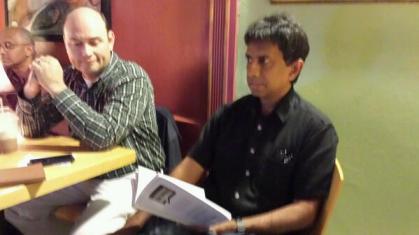
Thank you everyone who attended the second launch event for my book, Chat Republic.

The topics around the book are many, but we seemed to center on the big question as to whether social media has made us too…chatty. How real are the conversations we have, when few appear to be paying attention?

Thank you to may eminent panel who weighed in on the topic.

  • Gary Campbell, editor of ASU’s web site
  • Prabha Kumarakulasinghe – Microchip
  • Don Wilde – Intel

.Some of the topics that came up: 

  • Gold bar espresso, Tempe - Chat RepublicFace Time, Real Time. What is happening to face-time, with people busily checking their phones for possible interactions with the ‘other’? (If you haven’t seen “I forgot my phone, watch this: a statement of our times.)
  • Do we really need smart phones? Or wouldn’t ‘dumb-‘ (um, feature-) phones be adequate most of the time?
  • Transparency Vs Over-sharing. Is our ability to know so much a blessing? Yes, we want to know minutiae about public officials, but many are pulling back because of surveillance. Gary cited the example of how smart phones could help people do dumb/smart things, as in the case of the NFL Player, Brian Holloway, who tracked down the kids who trashed his home. (This story is still being played out, by the way)
  • Smart devices in the class. I enjoyed this one, for obvious reasons. There were several teachers (one principal) in the room, who face this challenge: Are mobile devices in students’ pockets going to help or hurt them?

A big thank you to Dennis and Karen Miller, owners of Gold Bar Espresso, for letting me use their wonderful coffeehouse for this event. These are the spaces –-the Kaffeehaus culture –where deep conversations have taken place for centuries!

Chat Apps could ignite true engagement

We know that Chat Apps are driving a lot of mobile service providers to rethink their once-lucrative profit center. But these apps are also disrupting traditional social networks, because providers know how important it is to keep the user engaged within the channel.

Consider our fragmented mobile experience. We toggle between Email, Facebook, Twitter (or Hootsuite), and SMS. They each have their distinctive experience. Status updates and informative mails are not the same thing; content sharing on a social network, with the ability to garner a small ‘mob’ around a cause or a pet peeve is not the same as firing off a text message to 20 people. International texts are expensive so we may tweet a message instead…

I’ve been intrigued by these so-called ‘conversations’ online, especially since many of them are not always in real-time. They are really partial dialogues, with one word (or one button) responses that are a proxy for people joining in.

That why we need to keep an eye on where Chat Apps are headed. They are simple –as in distraction free– formats that could garner true engagement.

At a recent event, I was asked where I though our social media lifestyles would be headed. My pat answer was that we might see a lot of social media fatigue. The media overload we are all facing might mean vast numbers of us will be quitting those social media channels that just don’t fit our personality. But that’s not to say that we will retreat to our caves, and get back to notebooks and pencils, or phone calls. We will seek out those experiences that help us stay connected. And that’s where I see Chat Apps gaining ground.

THE NEXT WhatsApp or Viber (the free phone app combines the chat feature– free even with people in other countries) could threaten Facebook and Twitter. It could combine elements of email and micro-blogging, so that we may never need to go to the other platforms to see what our friends are saying, and to chime in.

Multiple language chats. I fielded this question to a panel of international students at Scottsdale Community College last week:

  • How many of them spoke more than one language. All hands were up
  • How many spoke three languages. Eighty percent of the hands remained up
  • More than three? About fifty percent

What would happen if we could chat with people in different countries, in different languages, using the same app? Already WeChat, which is apparently a lot like Line, an app not known to many in the West, lets one do this.

Maybe ChatApps are where we may find the genie of true engagement. I admit I may be somewhat biased, because of the title of my recent book.

What do you think? Does social media fatigue drive you to give up on certain channels?