Hyperventilating about tablets in the classroom

You’ve probably read plenty of stories how tablets are shifting the tectonic plates in teaching. And ‘personalized learning.’

I hang around many all-things-digital folk, making rallying for ‘tablets in the classroom! tablets in the classroom!” I also talk to those anxious as desktops give way to touch screens in the class. My daughter’s class now does a math class on Dell tablets. My school has two touch-screen computer hubs.

And though I run a (tablet-free, for now) computer lab, I was a tad irritated by a statement by a fellow computer lab instructor quoted in a TIME article as saying “We don’t care about handwriting.” This was in response to a parent’s concern about screens in a classroom in California.

Not sure who the royal plural ‘we’ referred to, but Matthew Gudenis certainly doesn’t speak for me, or my school’s position. (Read The Paperless Classroom is Coming” in TIME this week.)

Gudenis should’ve read this wonderful piece by Susan Vechon, “Why Learning To Write by Hand Matters,” (in Education Week) who admits she stumbled on the connection between handwriting and the higher-level thinking after many years of teaching.

I’m not dissing tablets, per se. I would be the first to admit that classrooms need to use more of the technologies that young people encounter once they clamber back on the bus after school. But that does not mean dismissing the value of books and pencils, notebooks and research. If we are not careful how we present them, the tabletized learning environment could unwittingly turn students into consumers of knowledge, not producers of ideas and opinions. Touch screens can turn readers into content snackers. We need to create spaces where students could do some thinking and talking, apart from clicking and scrolling.

Twelve to fifteen years from now, these will be our human resources, our intellectual capital. They will be the ones generating your reports, formulating cogent arguments that impact communities, writing persuasive letters, covering the local news.

To say we don’t care about handwriting because kids today know to type, is like saying we don’t need to care about spelling and grammar, because we have auto-correct and spell-check. So let’s stop hyperventilating about tablets, and get excited about what we can do with them.


Update: Just came across this Discussion of Screen Time


Plagiarism claims another victim. When will they ever learn?

There is a fine line between adapting some else’s point of view, and adopting it as your own.

The reality of this cut-and-paste culture of information-sharing, is that many people, especially students, think they could pretend to be original in short 140-character bursts, or longer prose.

I was somewhat shocked to hear that a senator from Montana, John. E. Walsh, was stripped of his Masters’ degree this month, when the college found out he had plagiarized parts of his MA thesis. The paper, titled, “The Case for Democracy as a Long-Term National Strategy,” seems to take off on the so-called ‘Bush Doctrine.”

Going by the New York Times‘ analysis, the senator must have been incredibly lazy, or just plain dumb to have resorted to this kind of plagiarism, even using someone else’s ‘conclusions.’

Which brings to my (blatantly unplagiarized) conclusions:

  • If you’re running for office, or already in office, check your paperwork. Even if your work pre-dated search engines
  • Footnote. Footnote. Footnote. It’s not rocket science to add end-notes, and page notes
  • Finally, if you can’t find something original to say…. (you know the rest)

Sidebar:

UPenn Library has a primer on plagiarism, for those unsure. – at Penn Libraries


Texting Vs Talking – Another View

My son was home for a few days, and his cell phone died.

The world didn’t evaporate into a mushroom cloud. You see, not being connected doesn’t faze him. “My friends all know that I don’t respond to texts immediately,” he replied when I asked him if it found  that not having a phone for a week caused him any problems. It made me wonder if Milennials have reached the turning point of incessant texting.

Just a few years ago, this was what we were hearing about 18 – 24 year olds.
  • 43% of 18-24 year-olds say that texting is just as meaningful as an actual conversation with someone over the phone (2010 eMarketer report)
  • More Millennials (than members of any other generation) use their phone for texting. (Pew Research)

What if people stopped staring at their phones and actually spoke to you? Would that creep you out?

What if people stopped sending you links to stupid cat (or anti-whatever) videos, and actually called you to chat?

Phone calls are cool, once again

Are phone calls back in business?

After all the texting, WhatsApping and refusing to pick up the phone (because you wanted the caller to not waste your time, when a SMS would suffice), it appears that people are returning to real conversations.

Or am I just being optimistic?

Here’s a shocker: In 2013, Skype carried an estimated 214 billion minutes of international “on-net” calls (that’s defined as calls made from one Skype app to another).

That’s in spite of the rise of Viber and Line, and even Google Hangouts which do the same job, or better. There’s also an emerging standard known as VoLTE, that’s supposedly about to deliver ‘infallible voice service’ that’s different from the VOIP standard. It’s too technical to go into this here. But the big picture is that soon, when voice calls become cheaper, and more high def, it’s going to make us want to return to those conversations.

For my Mum’s 90th birthday, last week, I was able to speak to her, and get some half-decent face-time with cousins, thanks to Skype. To me Skype is the trusty service, in the same way that land-lines were some 20 years ago, never mind the poor quality of the line. I still use these ‘over-the-top (OTT) applications, but whenever I yearn for close encounters, there’s nothing like a phone call!

Disrupting Education. Sorry, There’s No App For That!

It’s easy to get sucked into the belief (or is it group-think?) that apps are the only way to disrupt an existing business model, or that true engagement is all about stubby fingers on a screen.

I tend to take the contrarian point of view that tablets are not the thing that will change everything. We romanticize these pieces of glass too much. Waaay too much.

I come at this from two angles. First as someone who runs a computer lab, where the touch-screens will soon over-run the grey boxes. Second hearing first-hand what very young kids barely out of diapers, can do. At the Montessori school my wife runs, pre-schoolers show leaps of knowledge, grasping complex ideas in science, geography, and math, with no tablet in sight.

Against this backdrop I took a deep dive into the Khan Academy, and even got some of my 5th grade students to follow its curriculum. Online, mind you. The opinion I came away with is neither black nor white. It’s not about the screens. It’s not about the technology. It’s a lot more simple –and subtle–than that.

If you have fallen in love with tablets, you may skip this link below:-)


If you want to read about it, it’s in this month’s LMD Magazine, for which I write a monthly technology/business column.

“Disrupting Education. Why Schools Love It.”

“Time Bombs of the Mind” – A journalist’s take on science, technology, and a media-saturated world

The first thing that strikes you when you meet Nalaka Gunawardena is how grounded he is. Someone introduced him as a citizen journalist, but he’s larger than that, with his antennae in many places, covering science, and pop culture, information technology and social media.

Meeting this new generation of media-savvy writers (he’s a blogger and journalist) who are comfortable in both mainstream and new media, makes me optimistic that in a media-saturated environment where one-liners and tweets pass off as news, there is serious journalism underfoot. Nalaka covers such topics as climate change, space science, and road safety, among other areas.

Nalaka’s just published book is, Wanted: Time Bombs of the Mind


Full disclosure: I met Nalaka last year in Sri Lanka –we were on a panel discussion related to my book, Chat Republic.

Lessons from Richard Attenborough

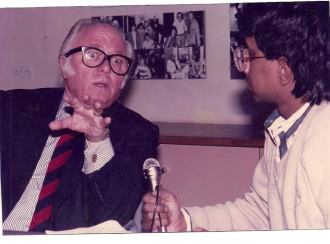
AttenboroughIt was a grey, nondescript September afternoon in London, when we sat down with recording ‘machines’, and microphones, all agog for our victim to walk in.

The victim was Richard Attenborough, someone well known to our class of foreign students at the BBC (whose motto, most appropriately, was/is “Nations shall speak unto Nation“). It was just seven years since Gandhi had been released.

We had practiced the ins and outs of radio production, from managing the heavy tape machine (about as heavy as a small microwave), to splicing, mixing sound effects etc. None of this would have mattered if we didn’t get our interview right. We would have just five minutes of face time.

Mr. Attenborough – I doubt we addressed him as ‘Sir’ Richard– was  extremely gracious, and disarming. This was not what our trainers had prepped us for: the evasive spokespeople, the rude celebrities, and those who intimidate you etc.

What I recall most were two things. Mr. Attenborough patiently listened to my question (about the making of the Gandhi), at times tilting his head to figure out my accent.  Speaking of which, there were no shortage of versions of English and thick accents in that room at the Capital Radio studios, London that day. Before and after me were budding radio hosts from the Seychelles, Malta, Lesotho, and Fiji.

The other thing was how he punctuated each idea with his sweeping arm movements, barely grazing, but totally ignoring the microphone. This is what interviews are supposed to be structured around – conversations, not hardware.He made that easy for us.

Long after the spool tapes gave way to tiny, and barely digital recording devices, it’s still the conversations that matter.

The “Windows in our Palms” and Digital Practice

There is no shortage of studies about the value or misuse of smart phones. It’s hard to find an adult who does not carry one. (For the record I know three people, and they are doing just fine!)

As a technology teacher in an elementary school, I must take into account the downside of too much tech, and too little ‘think time’ whether my students are involved in writing, weighing in during a discussion, or sometimes, even listening to instructions, undistracted by the screens to which we give them access.

These Digital Natives may rarely find a space that is free of technology, or an object or space urging them to turn to technology. For this reason I kicked off my classes with a unit on Digital Citizenship.

Technology is a tricky beast. Should we ban phones and roll out the cart of tablets? Should we discourage social media, but ask them to become familiar with ‘journaling’ a.k.a. blogging, one of the earliest forms of social media? Hmm!

Here are two pieces worth reading and watching:

“Why I quit Twitter” – Patton Oswalt, TIME Magazine 
Not just a discussion of Twitter, but a wonderful, commentary on how people are “peeping at windows in their palms.”

“Kids with cell phones. How young is too young?
A short video by CBS News about the pros and cons of cell phones for young children, and the need to model good practices, and teach ‘digital hygiene’.