Kids take to design as Digital Learning Month kicks off

sculptDon’t you wish you could have learned in elementary school what kids have access to now?

That was one of the comments of a designer from TimeFire VR, speaking of how excited she was to see 6th graders quickly learn how to use SculptGL. It is a powerful open source CAD program for 3D sculpting. (I created this in just 2 minutes, having no experience!)

Of course there is much  more work to be done and TimeFire showed us how we could to get there, with Blender, another open source application. This being Digital Learning Month, we will dlday1have time to get deeper into CAD and 3D sculpting. I’m planning to ask TimeFire to come back for an encore session soon.
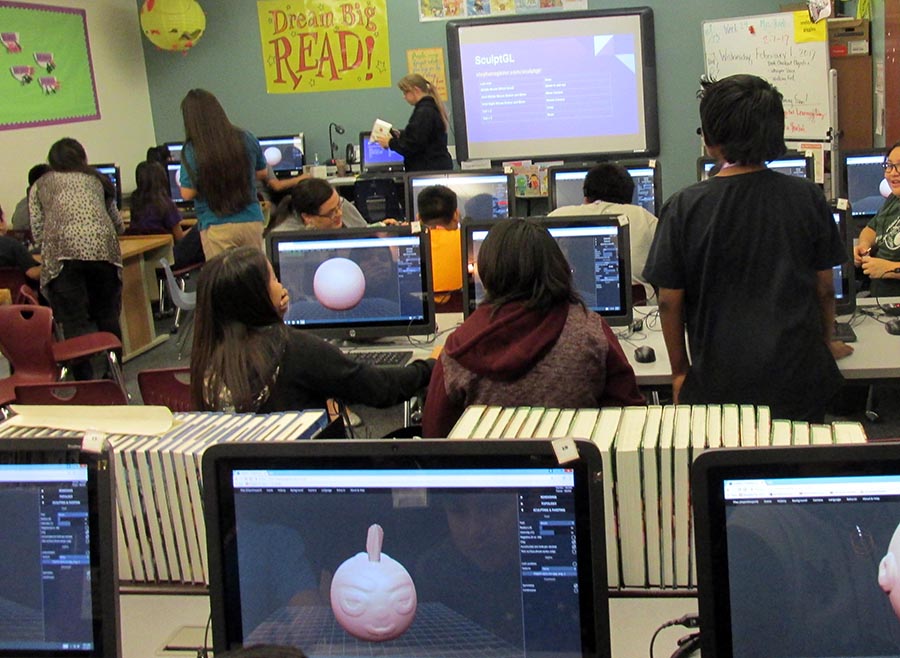
I like to thank John Vise for making this happen. Specially to Jessica, Rainy, and Ariana for showing us the exciting software, and future career possibilities.


Yes, we can be tracked! What students learned at Digital Learning Month kickoff event

Thank you, Fred von Graf for conducting a highly interactive session for our 5th grade students last afternoon. It was the kickoff to our Digital Learning Month in February.

dlday-tnTo a packed room of students and teachers, Fred asked them what social media platforms they use, and provided some cautionary stories of how to protect themselves from hackers, trolls and anyone with rudimentary search skills. He spoke of the dangerous side of oversharing, using same gamer handles and aliases across multiple platforms.

What I liked most about Fred’s presentation was that he avoided the geeky terms (no mention of Phishing or spoofing or doxxing), while explaining quite simply, how someone could find out sensitive and private information about you.

“Some people think of social media as a popularity contest,” said one student, commenting on a case of a someone grabbing information off people and posting it to his YouTube channel. Some spoke about how tagging children could reveal too much information about the family. Teachers shared their safe practices, such as not providing the location of when a picture was taken, or doing it after one leaves the location.

Overall, the room was brimming with insightful thoughts and suggestions, sparked by Fred’s topic, and style of presentation. He summed up, by bringing up oversharing, about seeking ‘Likes’ and the ‘addiction’ that could results from these self-gratifying practices. “You want that attention, and it becomes so easy to say ‘my privacy isn’t that important, let me put this out there’ ,” he said.

VR, 3D modeling, and social media to kick off Digital Learning Month

Digital Learning Day is on Feb 23rd, but this year we are kicking off a whole month of digital learning at Salt River Elementary.

Tomorrow, our students will learn from designers and programmers what being digital means.

3D Sculpting & VR. Students will learn from designers and animators at TimeFire VR Inc what 3D mesh sculpting and painting on 3-D models involve. An exciting hands-on sessions using Blender, and SculptGL. They will also experience what these virtual worlds look like through VR goggles.

Do’s and Don’ts of Social Media. Students will learn from Web3Mavens how to ‘Think like a programmer’ and navigate the world embedded with –or rather overlaid by — social media, particularly Facebook, Snapchat, Instagram, Wikipedia and YouTube.

And there’s much more in store during February!

Shouldn’t we ignore the tweets of the second social media president?

You may have forgotten this. In April 2013, a hacker broke into the Twitter account of the  Associated Press and sent out a tweet about “explosions at the White House.”

Reuters noted then that the Twitter ‘report’ caused the S&P 500 index to fall, wiping out  $136.5 billion of its value.

We didn’t call it fake news then – just a bad prank. It demonstrated the power of ‘news’ that the world was beginning to consume in 140 characters or fewer.

Today, the ‘hacks’ and pranks seem to come from both outside (fake news perpetrators) and within establishments. They’re still using short-form journalism, which is easily spread by headline-hungry readers.

Trump tweets (a busy search term, for sure) have become worthy of analysis at the highest levels, and not just in the media. As Mother Jones writer Kevin Drum notes, these tweets “…are not for you. They are not for the press. They are not for Congress. They are for his fans.”

Meaning, I suppose, ignore them.

One group not ignoring them, and busily documenting them, must be journalism students. They must be relishing the fact that somewhere in this is ‘Twitter torture’ is a real-time study leading to a Masters dissertation. There have been similar dissertations on the rhetorical analysis of campaign tweets. But what began on 20th January is a treasure chest.

Adding new layers to Digital Learning Day 2017

Once again I’m planning some activities around the upcoming Digital Learning Day.

dlday2017Having participated since 2013, the plan is to add more than just lessons and best practices.
I’ve invited some tech practitioners, and we may even consider a community event that addresses topics that parents lose sleep over: over sharing, cyber-bullying, and the correlation between screens and grades.

Plus, I am considering an essay competition on a social media topic, and getting some students to create their own podcasts.

Digital Learning Day is on Feb. 23rd.

Here is what we did for 2016 Digital Learning Day

Long before fake news, we had half-truths

You’ve heard the adage, “a lie can travel halfway around the world before the truth can get its boots on.” 

In the absence of fact-checking, we cultivated scepticism. It’s easy to blame our epidemic of fake news on the Russian trolls, and geo-politics. But truth is, half-truths and conspiracy theories circulated before social media arrived on the scene. Some even embedded themselves into the pages of history. Here are two:

Have you heard the one about Black Confederates? It’s a ‘story’ of how 80,000 black soldiers supposedly fought for the Confederacy. This is, as the Civil War website calls it, shoddy facts that’s were “repeated, amplified, and twisted” to become credible to some, just because the story fit their agenda.

Or the story of American planes dropping napalm in South Vietnam? It surrounds the Pulitzer prize-winning photograph, taken by Associated Press photographer, Nick Ut on June 8, 1972. That too, we are informed by Joseph Campbell, was a myth. The photo was accurate. The story was not.

Which brings me to how do we teach fact checking to young people ?

Until a few years ago some made Wikipedia the culprit. But even before that there were stories circulated via email, that travelled through an unverified friend-of-a-friendsnetwork. They contained dubious facts no one bothered to fact check. Fast forward to now, and we like to blame the trolls.

How easy it is to blame someone else when the onus ought to be on us.

Wired, Tired, and killing our creativity

As we get back to school, I can’t help noticing how tired students seem to be. One doesn’t need to look around to know the reason why: We are probably over-wired!

There are new details coming out each month on how over-connectedness, rather than stimulating creativity, is killing it. When anyone asks me what my follow-up to my book about social media, Chat Republic (2013) might be, I flippantly say it will be called Anti-social Media.

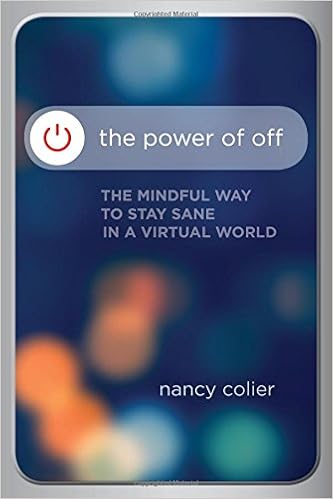
There is plenty of research and literature on the topic. Two books I am planning to read are “The Power of Off. By Nancy Colier. And Reclaiming Conversation by Sherry Turkle.

It sounds a bit like my favorite works on the subject, which I have commented on before:

Do we have space for Makerspaces and tech shops?

Some days I wish I could convert part of my computer lab into a Makerspace. After all I have re-defined it as a Computer and Technology Lab, so it would be appropriate to have other technologies. Like a metal cutter, or workbench to build things – such as making a speaker out of an Altoid tin, or rudimentary printing such as silk-screening.

I thought of this again after getting into a discussion with a teacher visiting our school from New Zealand this week. She spoke of how curriculum there includes woodwork, needlework and many hands-on activities.

She was not been aware of Makerspaces, but mentioned a parallel well-organized movement called Mens’ Sheds – run by retired people so that anyone could take up a new skill.

Makerspaces here are great places for students with rudimentary engineering products in mind, for say a science fair. They are open to anyone and are often free. Some school libraries are carving out makerspaces for 3-D printing.

I’ve visited one in Mesa, Arizona called HeatSync Labs. Love the name!

I’ve still to visit the TechShop in Chandler where you could learn CAD drawing, or how to build a (guess what?) Bluetooth speaker!


When Microsoft ‘draws’ as good as a Sharpie

When I tell students that Word or PowerPoint is a versatile tool, and not just for typing of creating slides, I never know what to expect. Such as how some of them have mastered the ‘Curve’ tool in the Shapes menu.

Here’s one. Looks like a pen-and-ink sketch, doesn’t it?

goku_student_drawing2


It gets better! Because this is about animating.  The student’s storyboard in PowerPoint  just kept growing!
goku_student_drawing    
goku_student_drawing3

goku_student_drawing4

All the *fake* news that fit to share

At least ‘The Onion’ doesn’t pretend to be real news. Just well-written ‘stories’ that parody news. But it gets harder to spot the truly fake from the plausible, somewhat fake. For instance could you spot which one of these is an Onion story, and which is made up?

  • The Secretary Of Treasury Announces Plan To Remove Gross Penny From Circulation.
  • An Ipsos Public Affairs study (for Buzzfeed) showed that fake headlines fool American adults 75% of the time.
  • Pope Francis asked Catholics to not vote for Clinton.

OK, so the story about the penny was a classic Onion piece. The Ipsos Study was real. The Pew study was just made up for your entertainment, though the story about the Pope did get circulated on social media, thought it had been debunked.

If you like to test how news savvy you are (or not) take this sample of  questions, by Marketwatch.